YE3W.1 · Activity Page
Exodus 12:1-14
Leviticus 23:5
Numbers 9:1-5
Matthew 26:2, 17-30
Mark 12:26
Mark 14:1-2
Luke 22:7, 11-23
John 13:1-30
1 Corinthians 11:20-34
PHARAOH - the ruler of Egypt
PASSOVER - the night when God told Israel to put blood on their doorposts to prevent the death angel from killing their firstborn; we observe it today as a memorial of Jesus’ death
PLAGUE - a severe problem or disease
FIRSTBORN - the oldest son
KNEADING TROUGH - container to make bread in
John’s family drove out to the lake for a picnic. Mom spread a cloth on the picnic table. She had a big plate of fried chicken, fresh tomatoes, potato salad, watermelon, and chocolate cake! Everyone sat down to enjoy the delicious meal, but soon John started stomping his feet. There was a big ant hill under the table. Ants were climbing up the table leg. They were climbing up John’s legs. Then Mom began fanning the flies away from the food. She had to cover the cake to keep the flies away. And, as Dad picked up his can of soda, he saw a yellow-jacket sitting on top of the can. There were bugs everywhere! This was just awful.
These insects ruined their picnic. But this is not the first time people were bothered with insects. Many years ago the Egyptians were bothered with far more bugs and critters. But that was only part of the Egyptians’ problem. They were mean to God’s people and wouldn’t obey Him. God didn’t like this and He had a way of dealing with the problem.
Long ago, God’s people lived in Egypt. They were called the children of Israel, or Israelites. They were in a terrible situation. As slaves in Egypt, they were forced to work very hard. Pharaoh and the Egyptians were very cruel to them. Things got so bad that the children of Israel called out to God— and God heard their prayers.
He decided to help them by sending Moses to lead them out of Egypt. God told Moses to do everything He commanded. God sent Moses and his brother, Aaron, to Pharaoh to tell him to let the Israelites go. But, God said that He would harden Pharaoh’s heart. Even when God used Moses to work wonders and signs, Pharaoh would not listen to him. God promised that He would bring them out with mighty acts of judgment, and that all of Egypt would know that He was the Lord.
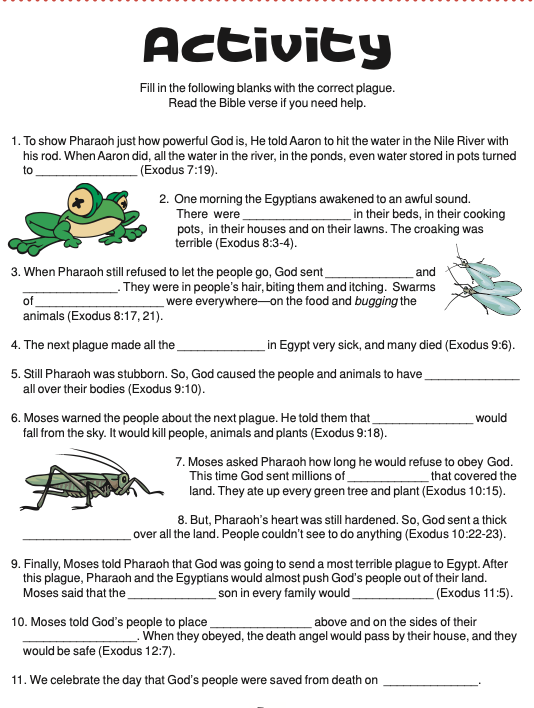
That’s exactly what happened. Moses and Aaron told Pharaoh to let God’s people go, but Pharaoh refused. God began sending plagues against Egypt. The first was a plague of blood. All the water turned to blood—water in the Nile River, in ponds, canals, streams, even wooden buckets and stone jars! There was no water for animals or people to drink. But, still Pharaoh’s heart remained hard. He wouldn’t let God’s people go.
Then God sent another plague—frogs! They came up from the Nile River and were everywhere. Imagine frogs in your bed or frogs hopping in the food your mom is preparing. They were in all the houses, even in Pharaoh’s palace. Frogs were everywhere in Egypt! But, once the frogs were gone, Pharaoh refused to let God’s people go.
God sent more plagues, one at a time. Gnats and flies were on everyone and everything, buzzing and biting. Livestock began dying. Boils tortured their bodies, hail beat their crops down, locusts ate what vegetation was left. Finally there was great darkness over the land. None of these things convinced Pharaoh to allow the Israelites to leave.
Finally, God sent one last plague—the death of the firstborn. God told Moses to tell Pharaoh, “Israel is my firstborn son. . . you refused to let him go; so I will kill your firstborn son.” This plague was on every family that didn’t follow God’s directions.
God told His people to kill a lamb and sprinkle the blood on the sides and tops of their doorposts. The people inside were to eat the lamb and they were to be ready to travel. Once the death angel came through Egypt, the Egyptians would make the Israelites leave.
On Passover night, the death angel came through Egypt. Where there was no blood on the doorpost, the firstborn son and animal died. But, the death angel passed over the houses where there was blood—as God had commanded.
This is important in Israel’s history. But what does it have to do with you? You are one of God’s children. Because everyone sins, you have also sinned. You have done things wrong in your life. And, the Bible tells us that the price for breaking God’s law is death (Romans 6:23). But, God has given you a way out, just as He gave the children of Israel a way to escape the death angel. The way out for each of us is Jesus Christ!
The Passover shows us that God loves us so much that He gave His firstborn Son, Jesus, to die for our sins. He is called the Passover Lamb. When we accept Jesus as our Savior, we accept that He paid the price for the things we have done wrong. We must also try very hard not to sin any more.
You may have wondered why adults are so serious at Passover. It is because they are thinking about what Christ did for each of us. It is a very serious thing. We also thank God for the Passover. The Passover, the sacrifice of Jesus Christ, makes it possible for us to be His children. And we all very much want to be the children of God.
Dear Heavenly Father,
Thank you for Jesus Christ, our Passover Lamb. We know that He makes it possible for us to be your children. Help us learn how to truly act like your children.
In Jesus’ name I pray.
Amen.
Sunday - Exodus 12:1-14
Monday - Numbers 9:1-5
Tuesday - Matthew 26:2, 17-30
Wednesday - Mark 14:1-2, 12:26
Thursday - Luke 22:7, 11-23
Friday - John 13:1-30
Saturday - 1 Corinthians 11:20-34
Exodus 12:14-20
Exodus 12:15
Exodus 12:34-39
Exodus 13:6-10
Exodus 23:14-15
Leviticus 23:4-8
Numbers 28:17-25
John 6:35, 48-51
1 Corinthians 5:2-13
YEAST - ingredient that helps bread products to rise, to be puffed up
LEAVEN - ingredient that helps bread products to rise, to be puffed up
WICKED - doing things against God’s laws SINCERITY - meaning what you say, and saying what you mean
SYMBOL - something that stands for or represents something else
One spring day, Jason came running into the house after school. He was really hungry. Mom was in the kitchen. “Mom,” he said, “what’s for dinner?” “We’re having tacos, Spanish rice, a salad, and brownies. “But I wanted pizza tonight,” Jason exclaimed. “Jason, have you forgotten that these are the Days of Unleavened Bread?” Mom said. “Oh, that’s right,” said Jason. “That means I can’t have pizza, hamburgers, or sandwiches in my lunch for a whole week.” “You’re right, Jason,” Mom said. “God wants us to do this every year as a reminder.” “What kind of reminder?” Jason asked. Read your Sabbath School lesson and you’ll discover the answers.
Have you heard the old saying, “You are what you eat”? In a sense, that’s true. You have learned in school that nutrients such as proteins, carbohydrates, fats, vitamins, and minerals are needed for a healthy body to grow and repair cells. Some people eat things that are not good for them and are not fit to eat. These should be avoided. Your parents try to make sure that you eat the right things. Remember, God is our Heavenly Father. Why did He command us to eat unleavened bread? Why is it good for us to do this?
In our lesson on the Passover, God’s people were commanded to place the blood of a lamb on the their doorways. When the death angel went through the land, he passed over the houses where there was blood on the doorway. After that, Pharaoh told Moses and all of the Israelites to leave Egypt.
The people packed what they could carry. They left in such a hurry there was not time for their bread to rise. But they were on their way to freedom.
On the first night of the Days of Unleavened Bread, a huge crowd of Israelites left Egypt, “with a high hand.” It is this “Exodus” we remember when we keep the Night to Be Much Observed. God led His people in a cloud by day and a pillar of fire by night—a symbol of how God saved us from sin.
This is a really important event in the history of God’s people. Exodus 12:14-15 tells us, “You shall celebrate this event each year (this is a permanent law) to remind you of this fatal night. The celebration shall last seven days. For that entire period you are to eat only bread made without yeast” (The Living Bible). God felt this time was so important He wants us to celebrate the event every year, and to eat unleavened bread when we do.
We know that the Apostle Paul celebrated the Days of Unleavened Bread long after Christ had been crucified. We also know that God wants us to celebrate them today. It’s that important. But, why is this event so important to God?
We learned that the lamb killed on Passover was a symbol of Jesus Christ. You know how very important it is to God’s children that Jesus came to be the Passover Lamb. There is another symbol that stands for Jesus Christ during the Days of Unleavened Bread. Christ said in John 6:51, “I am the living bread that came down from heaven.”
Leaven in the Bible is a symbol for sin. Since Jesus Christ was completely without sin, He was symbolically unleavened. The Apostle Paul tells that we, too, should cleanse our lives of the leaven of sin and evil. Instead we should celebrate the feast with unleavened bread of sincerity and truth.
For seven days during the Days of Unleavened Bread, leaven is a symbol for sin—for the wicked- ness God does not want in His children. Jesus came to die because of the sin in each of us. So we want to get rid of the sin in each of our lives. Symbolically, we do this by getting rid of all the leaven in our houses. Then we eat unleavened bread as a reminder to choose God’s way.
We often face choices between right and wrong. Obeying God is always best. Since pizza crust is made with leaven, would you be willing to eat No Pizza for a Week? God blesses those who choose to do what is right. The symbol of unleavened bread helps to remind us that Jesus is our Passover Lamb, and that we must avoid sin.
So, why did God command us to eat unleavened bread? God wants us to be what we eat— symbolically—without sin. Getting rid of leavened bread for seven days is a really good reminder to avoid sin in our lives all year long. It reminds us to take in the things of God in every choice that we make. Jesus is our Friend. He wants us to be healthy physically and spiritually. But that means we must make the right choices—we have to choose to live the way God wants us to. Then we can be His children in the Kingdom.
Dear Heavenly Father,
Thank you for saving your people from Egypt. Thank you for saving us today, too. We appreciate your giving the Days of Unleavened Bread to us as a reminder of the kind of lives we should live. Help us to make the right choices every day.
In Jesus’ name I pray.
Amen.
Sunday - Exodus 12:15-20
Monday - Exodus 13:6-10
Tuesday - Exodus 23:14-15
Wednesday - Leviticus 23:4-8
Thursday - Numbers 28:17-25
Friday - John 6:35, 48-51
Saturday - 1 Corinthians 5:2-13
Leviticus 23:9-22
Leviticus 23:15-16
Numbers 28:26-31
John 3:8
John 7:37-39
Acts 2:1-47
1 Corinthians 15:20-28
Galatians 5:22-23
FIRSTFRUITS - the first harvested grain; symbol for Jesus and Christians who will be resurrected at His return
CEREMONY - a formal act or observance, like a wedding ceremony
America’s first Thanksgiving day was celebrated by Pilgrims who came to this country looking for freedom to worship God. In the fall, when their crops had been harvested, they held a feast. Thanksgiving is a harvest feast celebrated because God blessed the Pilgrims with a good crop. God also has harvest festivals He wants us to celebrate.
During the Days of Unleavened Bread, a very important event happened in Israel. After the Sabbath was over, the very first stalk of grain was cut. This stalk of grain was waved in a ceremony before God as the Wave Sheaf offering. God required this to happen before the Israelites could harvest and eat any of the spring crop. This ceremony was very symbolic, as you will see in this lesson.
Once the first sheaf was offered, seven weeks of harvest began. After seven weeks of harvest, the people had another Holy Day—the Feast of Weeks. This feast has several different names which express different meanings. It is called the Feast of Weeks because the people harvested the first crop of the year for seven weeks. Another name for this feast is Pentecost—that’s what we usually call it. Pentecost means 50, as in your memory verse. It is also called the Feast of Firstfruits because it came when the first crop of the year was harvested in the spring.
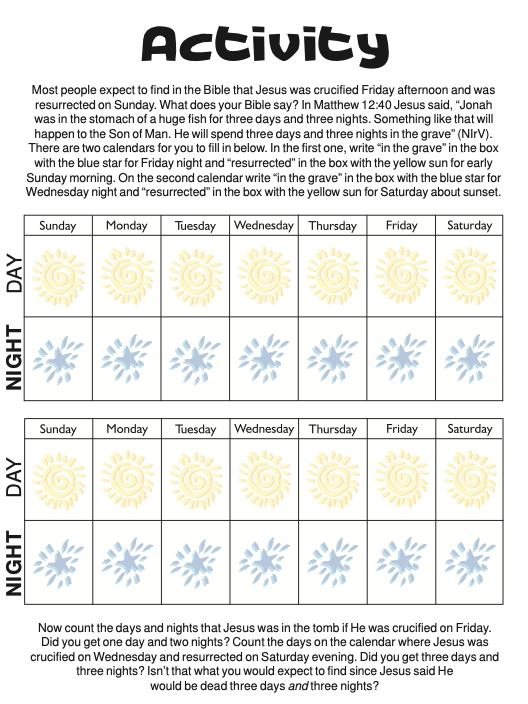
Jesus Christ was crucified on the Passover day—a Wednesday. He was raised from the dead three days later during the Days of Unleavened Bread. The Wave Sheaf was required by God to be offered on the first day of the week. It was the very first stalk of grain cut. It had to be offered to God before the harvest could begin. This was a symbol of what Jesus was born to do for us.
So after Jesus was resurrected from the dead, He presented Himself to God, His Father, as the Wave Sheaf offering. This happened on the first day of the week—the Sunday during the Days of Unleavened Bread. The “Wave Sheaf” is another symbol for Jesus Christ.
Jesus was the very “Firstfruit” to be harvested and offered up to God. He was the very first per- son to be resurrected from the dead and become a spirit being with eternal life. This makes the name “Feast of Firstfruits” very important to us. God’s children will also be resurrected someday if we continue to love, obey, and serve God.
Seven weeks after Christ’s resurrection, another interesting thing happened. People were gathered to celebrate Pentecost in Jerusalem. Suddenly there was a sound like the roaring of a mighty wind. Then, what looked like flames or tongues of fire settled on their heads. On the Day of Pentecost, the Holy Spirit came with great power. Everyone was filled with the Holy Spirit.
Because of this event, many people believed on Christ and 3000 people were baptized that very day. Do you think all of these people were just old people? How old do you think the youngest person was? The church grew enormously in just one day. How would you like to see 3000 people baptized in your church in one day? Wouldn’t that be a wonderful event? That would really be something to celebrate! And Pentecost is a day to celebrate!
What does Pentecost have to do with you today? First it helps us to see how powerful God’s Spirit is and how it can change lives. It shows us that God will resurrect His people to be the “firstfruits” when Christ returns. The resurrection is like a great harvest of God’s people. This is a time when God will make us His very own sons and daughters. You and I have to make sure that we are ready to be harvested. To be ready, you must have God’s Spirit living in you.
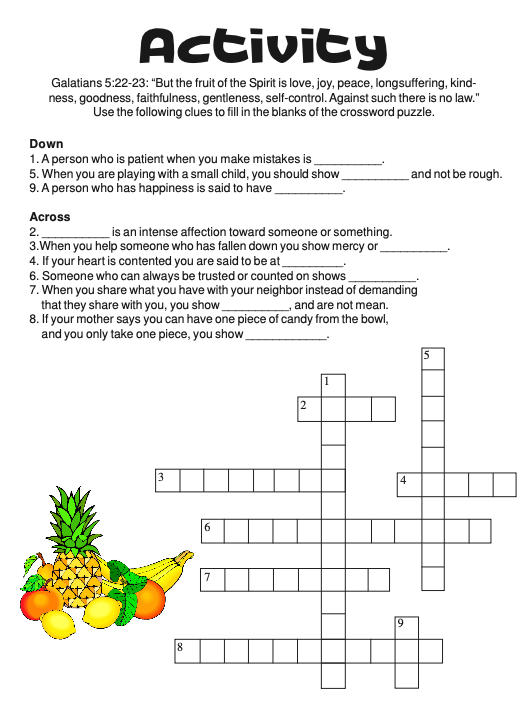
When God’s Spirit lives in us it produces fruits in our lives. Galatians 5:22-23 lists these fruits as: love, joy, peace, patience, kindness, goodness, faithfulness, gentleness and self-control. Those are all good characteristics to have in your life. One way we can get ready to be a firstfruit at Christ’s return is to show the fruits of God’s Holy Spirit in our lives today. These fruits will help you be a better person. They will help you grow so that you will be ready for God’s harvest.
On the Last Great Day of the Feast, Jesus described the Holy Spirit as living water. The Holy Spirit came with great power on Pentecost. Plants grow best when they have plenty of water. Your Christian life is like a plant—it needs to be watered with God’s Spirit. Then the Holy Spirit will help you grow into the person God wants you to be. The Holy Spirit works to remind you to do what is right. When you choose to do wrong, you may not hear the Holy Spirit as well the next time.
It is for your good that you make the right choices. The Holy Spirit is there to help you. Don’t you want to be in the harvest of firstfruits? See how many of the fruits of the Spirit you can put in your life. This will be pleasing to God.
Dear Heavenly Father,
Thank you for the symbols that you give to help us understand your plan. Thank you for your Son, who was our Wave Sheaf offering. Thank you for Pentecost and for giving your Holy Spirit. Help us learn to live as you would have us to.
In Jesus’ name I pray.
Amen.
Sunday - Leviticus 23:9-22
Monday - Acts 2:1-13
Tuesday - Numbers 28:26-31
Wednesday - John 3:8
Thursday - Acts 2:14-36
Friday - Acts 2:37-47
Saturday - 1 Corinthians 15:20-28
Exodus 19:16-24
Exodus 20:18-21
Leviticus 23:23-25
Numbers 10:1-5
Numbers 29:1-5
Psalm 81:2-3
Ezekiel 33:1-6
1 Corinthians 15:50-58
1 Thes. 4:13-18
1 Thessalonians 4:16
Revelation 11:15-29
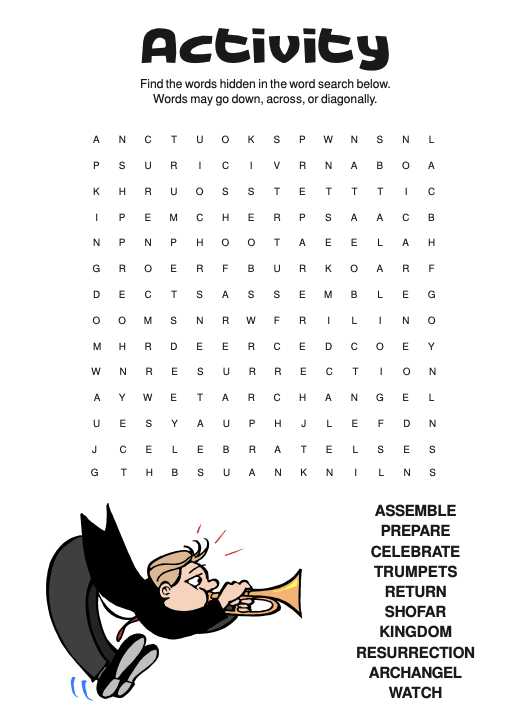
ASSEMBLE - to gather together, in this case, to worship God.
PREPARE - to get ready
CELEBRATE - in this case, to joyfully keep the Holy Day as a Sabbath of rest.
SUMMON - a call to appear
When the children of Israel came out of Egypt, there were at least 600,000 men plus women and children. That’s a lot of people! They didn’t have modern conveniences like cell phones to communicate with each other. Think about it. How would they notify that many people about an assembly, to break camp, or when to begin marching toward the Promised Land? Since the trumpet blast could be heard over a large area, it was the answer to this problem. Leaders used the trumpet to let people know what they were supposed to do. There was one trumpet call for them to assemble, and another call to set out on the day’s march which was different for each of the tribes of Israel. There was still another call to set up camp.
“Now the Lord said to Moses, ‘Make two trumpets of beaten silver to be used for summoning the people to assemble and for signaling the breaking of camp. When both trumpets are blown, the people will know that they are to gather at the entrance of the Tabernacle. But if only one is blown, then only the chiefs of the tribes of Israel shall come to you. Different trumpet blasts will be necessary to distinguish between the summons to assemble and the signal to break camp and move onward” (Numbers 10:1-6 TLB).
Does it sound strange that the trumpet was also used a long time ago to let people know what was going on? The trumpet is still used today, especially in the military. You may be familiar with some trumpet calls. You have heard the trumpet sound for “Charge!” There’s another for sadness and respect at funerals. It is called “Taps.” Then there’s “Reveille.” It is played early in the morning to awaken soldiers and sailors from sleep. The bedtime tune is “Day is Done.”
You have something similar at school. Instead of trumpets to announce changes or things about to happen, you hear a bell—the recess bell, the bell for dismissal, the lunch bell, etc. They all sound the same, but you know they are different because of the time of the day they ring. Occasionally other bells sound at school. There are fire alarms or maybe a tornado alert siren, depending on where you live. When they sound, you already know what it is, even if you don’t hear it every day. You also know that you’ve got to move quickly, following directions so that you will be safe from danger.
Just as you are used to bells, the Israelites were used to trumpets. In fact, God named one of His Holy Days the “Feast of Trumpets.” Your memory verse this week says that Christ will return when a trumpet sounds. It will be with an incredible sound—the trumpet blast of God! It’s won’t be a sound that you have ever heard. But, we will recognize what it is, just as you recognize the fire bell.
Schools have fire drills and other safety drills so students can be as prepared as possible if a real fire does occur. Students learn what to do when they hear the fire alarm.
God’s people are blessed with the Feast of Trumpets. It reminds us to be ready because Christ is coming. Jesus told His disciples, “There- fore keep watch, because you do not know on what day your Lord will come” (Matthew 24:42). Just as we don’t know when a fire will start, we don’t know when Jesus will come back. And, just as your teachers expect you to do certain things when you hear the tornado siren, Jesus Christ expects His people—and that includes you—to be obeying Him when He comes back.
Christ’s return will be very different from a disaster like a fire or tornado. After Christ returns, little children won’t be stolen from their parents. You’ll be able to walk home from school by your- self without fear. Christ will end violence in schools, homes, and cities. You’ll be able to play outside by yourself after dark without your parents worrying about your safety. There won’t be any more stealing or lying. You’ll be able to leave your house unlocked all the time. There won’t be any more babies killed just before they’re born. After Christ returns, all things that are wrong and bad in this world will come to an end. The world that Christ will bring will be a wonderful, crime-free place.
Don’t you want to live in a safe world with peace and joy? For you to be a part of that, you have to make the right choices and you must be doing the right things when Christ returns. You must believe on Jesus Christ as your Savior. And you must try to obey and please Him every day. We can’t wait to do these things, we must always be ready. Remember, we don’t know when Christ will return. Celebrating the Feast of Trumpets on the first day of the seventh month is the right thing to do and a good reminder to be ready for Christ’s return.
Dear Heavenly Father,
Thank you for the Feast of Trumpets which reminds us of the return of your Son, Jesus Christ. Thank you for the kind of world that you have planned for us when Christ returns. Please help me learn to live the kind of life that I should. I very much want to be a part of your Kingdom.
In Jesus’ name I pray.
Amen.
Sunday - Leviticus 23:23-25
Monday - Exodus 19:16-24, 20:18-21
Tuesday - Numbers 29:1-5
Wednesday - Ezekiel 33:1-6
Thursday - 1 Corinthians 15:50-58
Friday - 1 Thessalonians 4:16-18
Saturday - Revelation 11:15-29
Leviticus 16:1-34
Leviticus 23:26-32
Leviticus 23:27-28
Romans 5:6-11
Hebrews 9:1-7
Hebrews 9:11-28
Hebrews 10:1-6
Revelation 19:11-16
HIGH PRIEST - The highest ranking priest in the Temple service and the only one who could go into the Holy of Holies
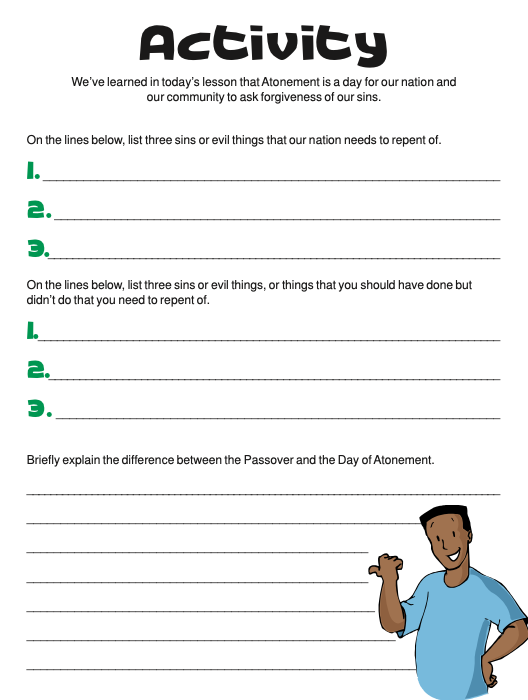
ATONEMENT - covering our sins
Have you ever been in a play at school? Everyone has a part to act out and lines to learn. They know where to stand on the stage and what to do. The stage has a curtain that is pulled between acts. People watch the play as it tells a story. The story has a lesson for people to understand.
Every year, on the Day of Atonement, a ceremony or play was acted out by the High Priest in the Temple. This play told a story. The High Priest had certain things God said he must do. He was not free to do what he wanted. He had to do every- thing just as God said it should be done.
The Temple had different rooms. There was a golden altar for incense. A wooden chest called the Ark of the Covenant held the gold jar of manna, Aaron’s wooden staff that budded, and the Ten Commandments. This was covered by a curtain like the stage at your school. You couldn’t see behind the curtain when it was drawn.
The priests could come into the Temple daily and do their work for God. But only once a year could anyone go behind that curtain. And then, only the High Priest was allowed. This was very serious. If anyone went behind this curtain when they were not supposed to, they would die. Behind this curtain was the Most Holy Room. God was there.
God told Moses, “Speak to your brother Aaron. Tell him not to come into the Most Holy Room just anytime he wants to. Tell him not to come behind the curtain that is in front of the cover of the ark. The cover is the place where sin is paid for. If he comes behind the curtain, he will die. That is because I appear in the cloud over the cover” (Leviticus 16:2). God is so powerful that physical human beings can’t come into His presence.
God instructed Moses to bathe on the Day of Atonement and put on a white linen robe before he could go behind this curtain. This ceremony was so special, so sacred, that Aaron, the High Priest, had to do everything exactly as God commanded.
As part of this ceremony, the High Priest was to take two male goats and a ram. The ram was to pay for the Priest’s sin and the sin of his whole family. Then he cast lots to see which goat would be for the sins of the people. He took the blood of that goat behind the curtain and made an atonement for the people.
On the Passover, a lamb was slain to symbolize Jesus dying for our sins. On the Day of Atonement, God said a goat must be used to make an atonement for the sins of Israel. But, He said there were to be two goats. What happened to the other goat? This goat was to remain alive. Aaron was to lay both hands on its head. While he did that, God required the High Priest to tell Him all of the sins and evil things and the times the people of Israel disobeyed. Aaron laying his hands on the head of the goat was a symbol. He was symbolically putting all of the sins of Israel on this goat’s head. This goat was to be sent into the wilderness by a fit man. This goat had another symbol. He symbol- ized carrying all of the sins of Israel away.
How is the Day of Atonement different from the Passover? Both ceremonies required an animal’s blood to be shed for our sins. Jesus gave His life on the Passover so that you personally might be forgiven of your sins. This forgiveness includes all the evil things you have done, and all the things that you should have done, but didn’t do. If you were the only person who ever sinned, Jesus would have had to die for your sins.
You are not the only one who needs to be forgiven of your sins. Our whole nation has sinned and needs to be forgiven. This ceremony was for everyone to be forgiven of their sins, all the evil things they had done, and all the things that they should have done. This is so serious that God commands us to fast on the Day of Atonement. We keep the Day of Atonement every year to remind us that our nation has sinned and needs to be forgiven. On this day we are to ask forgiveness for our sins and the sins of our nation.
We all like to eat. And going without food isn’t much fun. But it’s not much fun to God when we sin. He gave His Son to die for our sins. Seeing His Son die was much harder than going without food for 24 hours. Think very seriously about that.
Talk with your parents about how you should afflict yourself this year. Discuss with them whether you should do a total fast for 24 hours. If you and your parents decide that you are ready to fast this Atonement, try very hard to think about Jesus Christ taking our punishment, never once com- plaining. Think how proud God will be of you at the end of the day. And think how good you will feel for having afflicted yourself.
At the end of the Day of Atonement, when you ask the blessing on your food, thank God that you have been forgiven of your sins. How wonderful it is to know you have been made right with God! You know that you can go before Him with gladness inside!
Dear Heavenly Father,
Thank you for the atonement that your Son, Jesus Christ made for us. Thank you for accepting Him as He died for me. Help us to learn to follow you ever more closely, choosing your way and making wise decisions. We thank you and praise you for your mercy to us.
It’s in the name of your Son, Jesus Christ, that I pray.
Amen.
Sunday - Leviticus 16:1-19
Monday - Leviticus 23:27-32
Tuesday - Romans 5:6-11
Wednesday - Hebrews 9:1-7
Thursday - Hebrews 9:11-28
Friday - Hebrews 10:1-6
Saturday - Revelation 19:11-16
Leviticus 23:33-44
Leviticus 23:42-43
Numbers 29:12-25
Deuteronomy 14:22-29
Deuteronomy 16:13-17
Zechariah 14:16-19
2 Corinthians 5:1-4
Hebrews 11:8-16
Hebrews 11:38-40
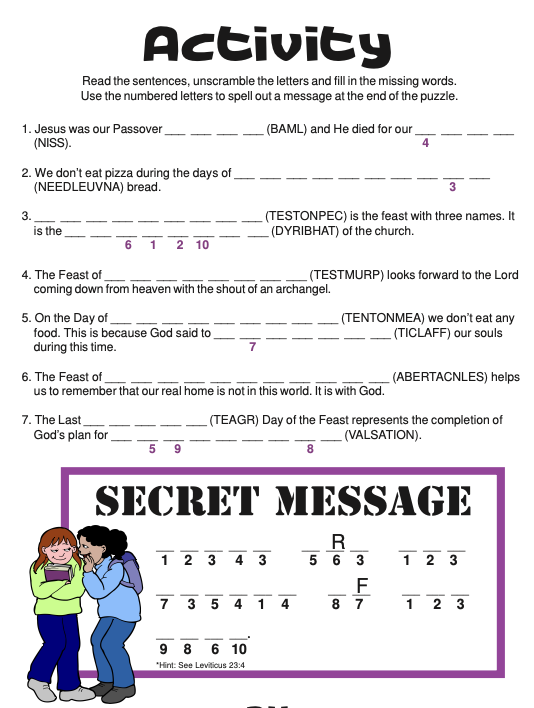
TEMPORARY - not permanent
GENERATION - a group of individuals who are born and live at the same time; the term is usually about 30 years
MEMORABLE - something that is easy to remember
What do you want for your next birthday? Do you want your mom to bake your favorite cake and invite your friends over to celebrate your birthday? What kind of cake would you want? Do you really think that you could blow out all ten, 11, or 12 candles with one big breath?
Birthdays are special celebrations. Since this party is to celebrate your birthday, what kinds of decorations would you want? How about a huge bouquet of balloons that says “Happy Birthday”? Do you have a special party favor that you want your friends to receive so they will remember your birthday? What would it be? Kids like action. So what really neat games do you want to play to make your birthday truly memorable?
Your birthday is a big deal to you. It’s the day you become one year older. It’s a time to celebrate. God knew that people need times to celebrate. So five days after the children of Israel kept the Day of Atonement in the wilderness, God gave them something to really celebrate. It was the Feast of Tabernacles! They were to celebrate not just one day, but seven days! This Feast was also a harvest festival. It was to be a joyous celebration. On the first day Israel was to have a worship service to honor God. And no work, except for the preparation of food, could be done on that day.
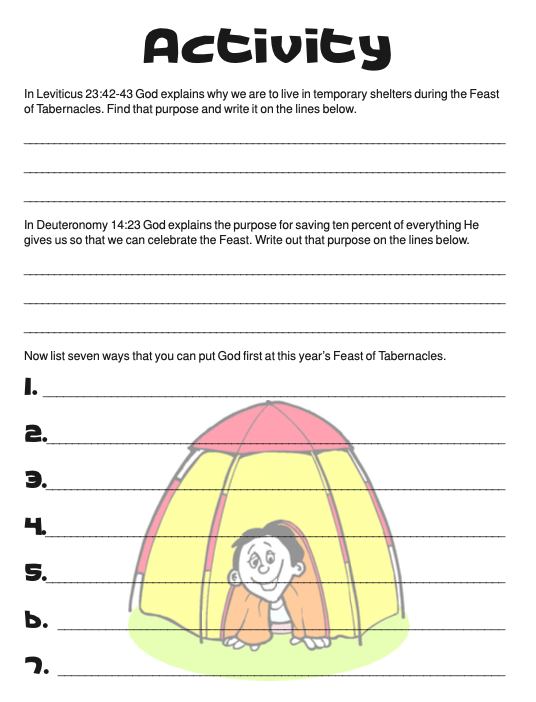
This celebration also has several names. We all know it is called the Feast of Tabernacles. But it is also called the Feast of Booths and the Feast of Shelters. Why “Tabernacles,” “Booths,” and “Shelters”? Well, these all mean basically the same thing. They are temporary places in which to live. “During those seven days, all of you who are native Israelites are to live in these shelters. The purpose of this is to remind the people of Israel, generation after generation, that I rescued you from Egypt, and caused you to live in shelters. I am Jehovah Your God” (Leviticus 23:42-43 TLB). All year we live in comfortable homes with our familiar things around us. But for seven days God wants us to move out of our permanent homes and live someplace else. Why?
Because He wants us to celebrate that, way back then, God rescued Israel from Egypt! He not only wants you to celebrate, He wants you to do it with God’s people. This will cost money and God knew that. So He even provided a way for you and your family to have enough money to celebrate the Feast. In Deuteronomy 14:22-26, God tells us to save ten percent of all He gives us so we can celebrate the Feast. You may want to call it the festival tithe. This is a different tithe from the one we are to give to God. You are to set aside ten percent of all that God gives you so you can celebrate at the Feast. This tithe can be used to cover your expenses for a trip to the Feast, a temporary home, food to eat, and fun things to do.
If you set aside one dime out of every dollar you receive for allowance or for jobs you do, you will have some money to do some really neat things at the Feast. You may be able to buy your parents a gift, or take a friend to 31 Flavors and buy him or her a double-dip ice cream cone. Buying gifts, treating friends, going to Mazzio’s or Pizza Hut are all fun ways to celebrate. But is there more to the Feast of Tabernacles than that? “The purpose of this tithe is to teach you always to put God first in your life” (Deuteronomy 14:23b TLB).
God wants you to go to the Feast and celebrate, and He wants you to put Him first. How do you do that? One way is to get up early and attend every YEA class. These are really neat classes with lots of fun and action. You’ll have your very own YEA book to read your lesson and learn your memory verse before class. There are games to play, lessons to learn, songs to sing, and prayers to say. You will learn how to obey and serve God better. You will learn some neat ways to help people. Maybe you can even be in a play or sing with the children’s choir on Youth Day. These are fun ways to celebrate and put God first in your life.
God also wants you to attend the worship service each day. He wants you to sing and praise Him with songs. He wants you to listen quietly to the sermon. The minister will help you learn more ways that you can put God first in your life.
The family picnic and the fun show are really cool events to attend. Look for ways you can put God first in your life while you are there. Can you help a person in a wheelchair, or take care of a baby while a mother goes through the line to get her hamburger? Can you help set up chairs or help clean up? When you give of your time to help others, this is putting God first in your life.
What can you do in your temporary house to put God first in your life? Mom needs time to celebrate as well. Can you do such things as clean the table, make your bed, set the table, and clean your room? Your mom will be happy and enjoy the Feast even more. These things can help her to put God first in her life at the Feast. Then the whole family can celebrate big—the way God wants us to. This celebration is much better than birthdays!
Dear Heavenly Father,
Thank you for showing us that the Feast of Tabernacles is a time to celebrate big. Thank you for showing me that the purpose of this is to teach me to put you first in my life.
In Jesus’ name we pray.
Amen.
Sunday - Leviticus 23:33-44
Monday - Numbers 29:12-25
Tuesday - Deuteronomy 14:22-29
Wednesday - Deuteronomy 16:13-17
Thursday - Zechariah 14:16-19
Friday - Hebrews 11:8-16, 38-40
Saturday - 2 Corinthians 5:1-4
Leviticus 23:35-39
Numbers 29:35-40
Nehemiah 8:18
Ezekiel 37:1-28
John 6:44
John 7:37
John 7:37-39
John 14:2
1 Corinthians 2:9
1 Thes 4:12-18
Revelation 20: 5-12
Revelation 21:1-17
TERRORIST - someone who uses violence or threats for political purposes
MOLESTER - a person who makes indecent sexual advances
FOUNDATION - the base on which something is built
From the very beginning, God had days He wanted us to know about. As the children of Israel wandered in the wilderness, God told them about days to celebrate. This book gives a lesson on each of these holy days so you can understand what God told Israel to do. More important, God wants you to know what He expects you to do. You’ve learned why these days are important to remember and celebrate. These days are so wonderful that God does not want us to ever forget them.
In the last lesson, we learned about the Feast of Tabernacles. It shows us that our bodies and everything in this world are temporary. They weren’t made to last forever. They wear out. God has something so much better for us than the bodies we live in. The body God has for you won’t get sick or hurt. In the world that He has waiting for you, houses won’t burn down. Things won’t rot and decay. They will last because they will be eternal! “No eye has seen, no ear has heard, no mind has conceived what God has prepared for those who love him” (1 Corinthians 2:9). God is telling us that He has something so wonderful waiting for us that our minds can’t begin to imagine it.
God commands us to celebrate the Feast of Tabernacles for seven days. Yet we stay at the Feast for eight days. Why? It’s because there is yet another Feast to celebrate. God said, “On the eighth day, come together for a special service. Bring an offering that is made to me with fire. That special service is the closing service. Do not do any regular work on that day” (Leviticus 23:36 NIrV). Your memory verse says this is the greatest day of the Feast! Since it is the greatest, don’t you think that we should really celebrate big? But why?
This day symbolizes something so great and wonderful. God has a beautiful description of what He has in store for us. “Then I saw a new heaven and a new earth, for the first heaven and the first earth has passed away, and there was no longer any sea. I saw the Holy City, the new Jerusalem, coming down out of heaven from God, prepared as a bride beautifully dressed for her husband. And I heard a loud voice from the throne saying, ‘Now the dwelling of God is with men, and He will live with them. They will be His people, and God Himself will be with them and be their God. He will wipe every tear from their eyes. There will be no more death or mourning or crying or pain, for the old order of things has passed away.’ He who was seated on the throne said, ‘I am making everything new!’” (Revelation 21:1-5a).
Imagine a beautiful place where everything is sparkling clean, brand new, and perfect. There won’t be any evil—no wars, no terrorists, no drug dealers, no child molesters, no divorce, no pain or crying. God will wipe away every tear from your eyes. What a wonderful place to be!
But will the new Jerusalem look like your home town? The new Jerusalem will be laid out like a square with the brilliance of jewels. Look at the foundation of your house. It is probably just concrete or wood beams. But the foundation of the new Jerusalem will be made of jewels. It will have three gates in each of the four walls—a total of twelve gates in all. Those gates will have the twelve tribes of Israel written on them.
“The great street of the city was of pure gold, like transparent glass. The city does not need the sun or the moon to shine on it, for the glory of God gives it light, and the Lamb is its lamp.” Do you remember who the Lamb is? It is Jesus Christ! But there’s one other thing that will make this city so wonderful. God Himself will also be there. This will be such a place of great happiness that no one will want to miss out on being there.
What must we do so that we can live in the new Jerusalem with Jesus Christ and God the Father? Believe that Jesus Christ is our Savior—that He died so that we can have forgiveness. We have to be really sorry for our sins and be determined, with God’s help, to never do them again. When we are old enough we must be baptized to show God that we are serious about these things. Then we have to live as Jesus would have us live.
Keeping the holy days, the Sabbath and God’s commandments are not what gets us into the new Jerusalem. But these things show God that we love Him. Doing these things make your life better because sin always has bad consequences.
“Nothing impure will ever enter it, nor will anyone who does what is shameful or deceitful, but only those whose names are written in the Lamb’s book of life.” When you see how wonderful God’s plan is for you, isn’t it worth doing what it takes to be a part of the new Jerusalem? It’s so wonderful that God said that it is the greatest Feast of all!
Dear Heavenly Father,
Thank you for the promise of eternal life. Please be with us always guiding us and teaching us your way. Help us to continually grow closer to you.
In Jesus’ name I pray.
Amen.
Sunday - Leviticus 23:36-39
Monday - Numbers 29:35-40
Tuesday - Nehemiah 8:18
Wednesday - John 7:37-39, 6:44
Thursday - Revelation 20: 5-12
Friday - 1 Thessalonians 4:12-18
Saturday - Ezekiel 37:1-28
Exodus 20:3
Exodus 23:13
Numbers 33:50-56
Deuteronomy 4:2
Joshua 23:7
1 Kings 11:1-11
Jeremiah 7:18-21
Ezekiel 8:13-18
Matthew 12:40
Acts 12:4
Revelation 17:1-18
Revelation 18:1-14
Revelation 22:18
FORSOOK - to leave entirely or renounce
TRANSLATION - a book or a writing that has been changed from one language to another
Have you ever looked in a box or drawer expecting to find a certain thing, but it wasn’t there? If you peel an orange, you expect sections of an orange inside. You expect to eat it and enjoy the juicy flavor. But what if the orange was empty—nothing but air inside. Would you try to believe that you saw orange slices there? Of course not! When you look at a book, the picture on the cover usually shows something the book is about. But that is not always true. You’ve heard the saying, “You can’t judge a book by its cover.” Does that say you don’t always see what you expect to find?
For many, many years people have been told that Jesus was resurrected on Easter Sunday morning. They go to church that morning expecting that this is pleasing to God. They may even get up very early and go to a sunrise service as a special celebration of this event. They do these things because they think the Bible says Jesus was resurrected on Easter Sunday morning. Because they think the Bible says it, most people expect to find it there. But when we look inside the Bible, is that what we find? Is Easter even mentioned in your Bible? If so, how many times is it mentioned in your Bible? Do we find that Jesus was resurrected on Easter Sunday morning, and a command to celebrate that day? Let’s take the peel off the orange, so to speak, and see what we find.
You know what a concordance is, don’t you? It’s a book that lists every word in the Bible with the book, chapter, and verse where it is found. Let’s look in one to see how many times Easter is mentioned in the Bible, and what it says. Let’s see if we find what people expect to find about Easter.
Do you know what we find? We find the word Easter mentioned only once in the Bible. In Acts 12:4 it says, “And when he had apprehended him, he put him in prison, and delivered him to four quaternions of soldiers to keep him; intending after Easter to bring him forth to the people.”
There are several interesting things about the only verse in the Bible that mentions Easter. The first thing is that the King James Version of the Bible is the only translation that uses the word Easter. Even then, this is the only place where Easter is mentioned. And it doesn’t say a word about Jesus being resurrected on Easter. It says nothing about God commanding Easter to be celebrated as a religious holiday.
But there is another thing that’s even more interesting. The men who put Easter in the Bible used the wrong word. When these men translated this word from Greek to English they should have put in the word Passover, not Easter.
Through the years many people have worshiped gods other than the true God. In the spring, about the time of the Passover, a feast was celebrated to a goddess who had many names. In English she is called Easter. Before the sun came up on Sunday morning, the people would meet outside and face the rising sun to praise Easter, their goddess. This celebration included hiding colored eggs in the grass and finding them. This happened many years before Jesus was even born, so it could not have celebrated Jesus’ resurrection. Well then, did this please God?
No! “They forsook the LORD, the God of their fathers, who had brought them out of Egypt. They followed and worshiped various gods of the peoples around them. They provoked the LORD to anger because they forsook him and served Baal and the Ashtoreths.”
Who were the Ashtoreths? Astarte was one of the goddesses—a goddess of the evening star. Astarte is another name for Easter. In Exodus 20:3 we read, “Do not put other gods in place of me.” God is so pure, so good, so righteous. We must not confuse Him with other gods or goddesses.
God wants us to pay attention to this severe warning: “I am warning everyone who hears the words of the prophecy of this book. If you add anything to them, God will add to you the plagues told about in this book. If you take any words away from this book of prophecy, God will take away from you your share in the tree of life. He will also take away your place in the Holy City. This book tells about these things” (Revelation 22:18). God says this is serious business. He gave us days in the Bible to celebrate—Passover, the Days of Unleavened Bread, Pentecost, Trumpets, Atonement, the Feast of Tabernacles, and the Last Great Day. When we look in the concordance, we find these days are in the Bible. When we look them up in the Bible we find that God commands us to celebrate them. We see what we expect to see. God wants us to celebrate these days to worship Him and not add any other religious days to them. It’s very important that we read the Bible and see and do what it says.
Dear Heavenly Father,
Thank you for showing me in the Bible what you expect me to do. Help me to be a good example to my friends who keep Easter.
It’s in Jesus’ name I pray.
Amen.
Sunday - 1 Kings 11:1-11
Monday - Ezekiel 8:13-18
Tuesday - Jeremiah 7:18-21
Wednesday - Exodus 23:13; Joshua 23:7
Thursday - Numbers 33:50-56
Friday - Revelation 17:1-18
Saturday - Revelation 18:1-14
Leviticus 18:3-5
Deuteronomy 8:11
Deuteronomy 12:29-32
Deuteronomy 18:10-12
2 Kings 17:15-18
Matthew 22:31-32
Acts 20:32-35
2 Corinthians 4:1-4
Ephesians 6:11
Ephesians 6:11-17
Philippians 4:8
1 John 3:1-5
EXTINGUISH - to put out a fire or cause to stop burning
DETESTABLE - abominable, hateful
ADOPTING - to choose or take to use as one’s own
Long ago, Halloween started as a celebration of cold, darkness, and death—as pagan worship to another god. People celebrated this day thinking that the spirits of dead people returned to their homes on this evening. They made huge bonfires, burned animals, crops, and sometimes people. Sacrifices were offered to make other gods happy.
Halloween hasn’t changed from being evil. Although people don’t burn other people in a bonfire any more, they do play pranks, tricks, and cruel jokes on each other. These are not godly things to do. Some people dress up as evil, detestable creatures. Even pretending to be an evil person or creature is wrong.
Since God created us, He is the One who decides how we are to worship Him. Our worship of God must please Him. We can’t decide that a celebration like Halloween is a good way to worship God. “You must not worship the Lord your God in their way, because in worshiping their gods, they do all kinds of detestable things that the Lord hates” (Deuteronomy 12:2, 31-32 NIV).
“Here are things you must not do. Don’t sacrifice your children in the fire to other gods. Don’t practice any kind of evil magic at all. Don’t use magic to try to explain the meaning of warnings in the sky or of any other signs. Don’t take part in worshiping evil powers. Don’t put a spell on any- one. Don’t get messages from those who have died. Don’t talk to the spirits of the dead. Don’t get advice from the dead. The LORD your God hates it when anyone does those things. . .” (Deuteronomy 18:10-12). Some people try to make contact with the spirit world or a dead person. God says these things are wrong and He hates them. We certainly don’t want to do anything God hates.
During this celebration, people wore costumes of animal skins and heads. Gradually, the Catholic Church adopted Halloween as the night before All Saints’ Day. This is the day they celebrate to all of the good people (saints) who have died. Adopting a pagan day to celebrate all the good people who have died may sound good on the surface. But this was a day to worship a false god. Remember the Second Commandment says, “You shall have no other gods before me.”
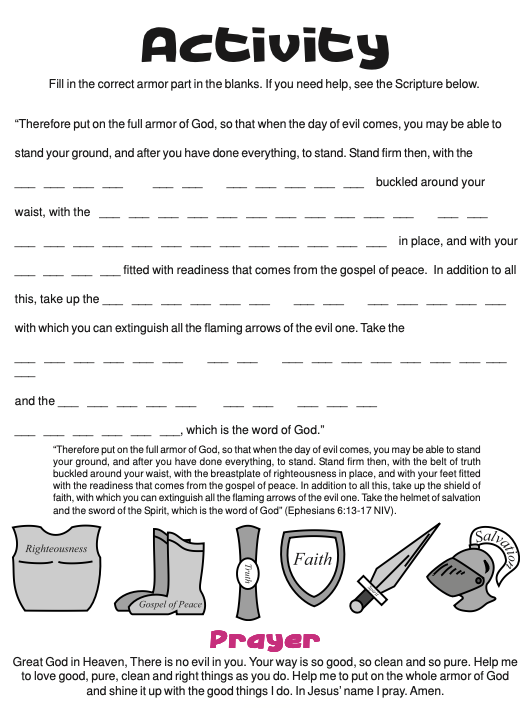
Dressing up in costumes may seem like fun. God wants us to dress up, and even gives us all the things we should put on. But He doesn’t want you putting on a Halloween costume. The costume you put on must be the right one. God wants us to wear it all the time. It is the armor of God.
We are His soldiers and He has an armor He wants every Christian to put on for protection from evil. “Put on the full armor of God, so that when the day of evil comes, you may be able to stand your ground, and after you have done everything, to stand. Stand firm then, with the belt of truth buckled around your waist, with the breastplate of righteousness in place, and with your feet fitted with the readiness that comes from the gospel of peace. In addition to all this, take up the shield of faith, with which you can extinguish all the flaming arrows of the evil one. Take the helmet of salvation and the sword of the Spirit, which is the word of God” (Ephesians 6:13-17 NIV). Let’s look at each piece of the armor that God wants you to put on:
1) The belt of truth—you must always tell the truth. It may be hard, but it is the right thing to do. God’s Word is truth.
2) The next piece is the breastplate of righteousness. God’s commandments are righteous. They are for your good. And they should be in your heart to protect you from evil. The breastplate is a suit of armor that protects your heart.
3) Even your feet need to be protected so they can take you safely in God’s path.
4) A shield is to protect all of your vital organs, which are necessary for life. The shield of faith, or believing in Christ, is necessary for you to have eternal life.
5) A helmet is absolutely necessary in battle. When you accept Jesus Christ as your Savior, He will give you the helmet of salvation.
6) As a soldier in battle, we all need to be equipped with the tools to protect ourselves. God has given us the tools to be well equipped.
7) The sword of the Spirit. The Bible is our sword. Knowing the Scriptures gives us a powerful tool to defend ourselves against Satan. Remember what Christ did when He was tempted. Every time He was tempted, He quoted a Scripture.
It’s as important to be careful about what you put in your mind as what you put in your mouth. These are the things the Bible tells that we should think about: “Whatever is true, whatever is noble, whatever, is right, whatever is pure, whatever is lovely, whatever is admirable—if anything is excellent or praiseworthy—think about such things” (Philippians 4:8). God did not tell us to think about death, darkness and evil things. That is what Halloween is all about, isn’t it?
When Halloween comes again you may see some attractive costumes. But remember, you are already dressed in the armor of God and Christ. You don’t want to think about dark, detestable things. You want to think about good and pure things. You just don’t have any room to dress up like anything else. Put on your godly costume— your shining armor!
Great God in Heaven,
There is no evil in you. Your way is so good, so clean and so pure. Help me to love good, pure, clean and right things as you do. Help me to put on the whole armor of God and shine it up with the good things I do.
In Jesus’ name I pray.
Amen.
Sunday - Deuteronomy 12:29-32
Monday - Leviticus 18:3-5
Tuesday - 2 Kings 17:15-18
Wednesday - Acts 20:32-35
Thursday - 1 John 3:1-5
Friday - Matthew 22:31-32
Saturday - 2 Corinthians 4:1-4
Deuteronomy 12:30-32
Isaiah 40:18-21
Jeremiah 10:1-6
Jeremiah 10:3-4
Matthew 1:18-21
Matthew 2:1-11
Luke 2:1-32
John 1:1-14
Romans 3:23-25
1 Timothy 1:6
2 Timothy 4:4
EGGNOG - a thick drink made of cream, eggs, and usually brandy or whiskey
PAGAN - a person who worships a false god
LINK - one ring or piece of which a chain is made
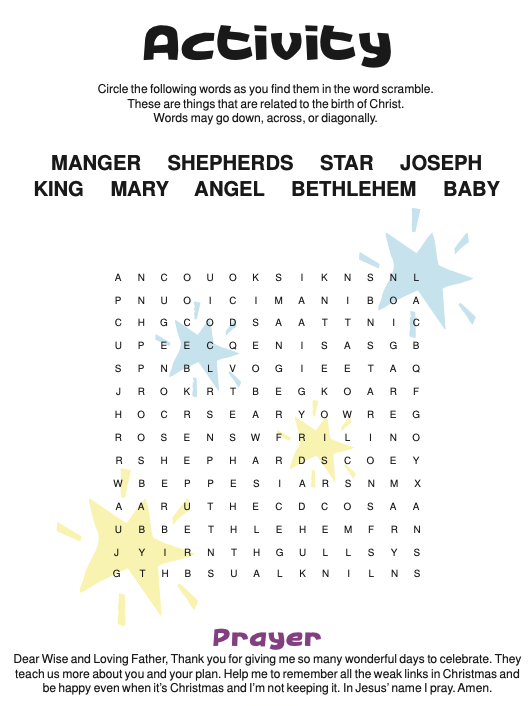
A chain is no stronger than its weakest link. Some people keep Christmas, thinking God wants them to. They think Jesus was born on Christmas day. These are some links in the chain of reasons why people think they should celebrate Christmas: Jesus’ birth, Santa Claus, Bethlehem, Christmas trees with lights, presents, carols, reindeer, eggnog, sleigh bells, manger, snow, stockings hung by the fireplace, wise men, December 25th. If you snipped out each link that has nothing to do with Jesus or God, what would happen to your chain?
Before we snip weak links in our chain, let’s look in a concordance and see how many of these words are actually in the Bible. Remember, every word that is in the Bible is listed in your concordance. Well, we don’t find Santa Claus, Christmas trees with lights, carols, reindeer, eggnog, sleigh bells, or December 25th. If a chain is only as strong as its weakest link, how strong is the chain to support celebrating Christmas?
Jesus was born in Bethlehem. Mary put Him in a manger. Angels appeared to shepherds in the field and announced Jesus’ birth. Wise men brought gifts. Did these things happen on December 25th—Christmas day? Shepherds were in the fields watching their flocks at night. But it would have been too cold for them to have been out there late in December. So Jesus couldn’t have been born then.
Many years before Christ was born, December 25th was celebrated in much the same way as people do today. This was not a celebration to honor Jesus’ birth for He had not even been born. It was to celebrate the sun god named Sol Invictus. In this celebration, people even decorated trees. “They cut a tree out of the forest, and a craftsman shapes it with his chisel. They adorn it with silver and gold; they fasten it with hammer and nails so it will not totter.”
Did this please God, and is it what He wants us to do? The Bible says, “Do not learn the ways of the nations, or be terrified by signs in the sky, though the nations are terrified by them (Jeremiah 10:2b-4, The New Adventure Bible).
Christmas trees, beautiful lights, stockings hung by the fireplace all seem like so much fun. What’s wrong with using these things to worship God? The Bible says we shouldn’t. “Don’t ask questions about their gods. Don’t say, ‘How do these nations serve their gods? We’ll do it in the same way.’ You must not worship the LORD your God in their way, because in worshiping their gods, they do all kinds of detestable things that the LORD hates” (Deuteronomy 12:31 NIV).
Can’t we worship God as He says and just add a few of these things to it because they’re so pretty and seem like so much fun? Again, the Bible says, “Be sure you do everything I’m commanding you to do. Don’t add anything to my commands. And don’t take anything away from them” (Deuteronomy 12:30-32 NIrV Kid’s Devotional Bible).
Have you noticed that many weak links make up the chain called Christmas? The things people do to celebrate Christmas don’t teach us about God and His plan. They confuse us. God’s plan is so wonderful. It includes the birth of Christ because it is very important. We have no Savior if Jesus was not born as a baby. So we should be very thankful that Jesus was born to Mary. But He wasn’t born on December 25th, and was probably born about the time of the Feast of Tabernacles.
Even though a Christmas tree and lights can be very beautiful, they don’t teach us God’s plan. Lights were used by pagans even before Christ was born. Christmas comes when the sun shines the fewest hours in a day. People knew they needed the sun to grow crops and to keep warm. They lit lights and candles to encourage the sun to come back. They didn’t know that was useless. Lighting candles or many lights shining has nothing to do with how many hours in a day the sun shines. You’ve learned in school that it has to do with the rotation of the earth. But people do the same thing today even though they have forgotten where the custom came from.
God doesn’t say it’s wrong to keep Christmas because He doesn’t want you to have fun. He says it because it is not good for you. He’s given us some wonderful Holy Days to celebrate! They show us who the true God is. Each one tells what Christ has done or is doing for us. All have so much mean- ing. There’s not a weak link in any of them. Jesus shows His supreme love for us at the Passover. “Everyone has sinned. No one measures up to God’s glory. The free gift of God’s grace makes all of us right with him. Christ Jesus paid the price to set us free. God gave him as a sacrifice to pay for sins. So he forgives the sins of those who have faith” (Romans 3:23-25 NIrV). The Days of Unleavened Bread help us remember to daily put Christ first in our lives. Pentecost shows how Christ gave us His Spirit to help us be better people. Trumpets reminds us that Jesus will return and we can live with Him forever. Atonement shows us that our nation also needs to be forgiven of its sins. The Feast of Tabernacles is celebrated for seven days, not just one day like Christmas. What a wonderful celebration looking forward to God’s coming Kingdom! The Last Great Day lets us know that a new heaven and new earth are coming and we can live not only with Christ, but with God the Father forever!
God hasn’t left you without days to celebrate. He gave days based on truth, not fables or pagan customs, to show you how wonderful, wise, powerful, loving, kind, forgiving, and generous our God is. There is No Weak Link in His Holy Days. There are no weak links in what He wants you to do.
Dear Wise and Loving Father,
Thank you for giving me so many wonderful days to celebrate. They teach us more about you and your plan. Help me to remember all the weak links in Christmas and be happy even when it’s Christmas and I’m not keeping it.
In Jesus’ name I pray.
Amen.
Sunday - Jeremiah 10:1-6
Monday - Isaiah 40:18-21
Tuesday - Matthew 1:18-21
Wednesday - Matthew 2:1-11
Thursday - Luke 2:1-32
Friday - John 1:1-14
Saturday - 1 Timothy 1:6; 2 Timothy 4:4