YEA Lesson Library
No Weak Link!
About This Lesson
This lesson teaches that Christmas is not when Jesus was born and is a mix of things that are in the Bible and things that are not.
It is not a holiday God wants us to observe.
Scriptures
Deuteronomy 12:30-32
Isaiah 40:18-21
Jeremiah 10:1-6
Jeremiah 10:3-4
Matthew 1:18-21
Matthew 2:1-11
Luke 2:1-32
John 1:1-14
Romans 3:23-25
1 Timothy 1:6
2 Timothy 4:4
Words to Know
EGGNOG - a thick drink made of cream, eggs, and usually brandy or whiskey
PAGAN - a person who worships a false god
LINK - one ring or piece of which a chain is made
The Lesson
A chain is no stronger than its weakest link. Some people keep Christmas, thinking God wants them to. They think Jesus was born on Christmas day. These are some links in the chain of reasons why people think they should celebrate Christmas: Jesus’ birth, Santa Claus, Bethlehem, Christmas trees with lights, presents, carols, reindeer, eggnog, sleigh bells, manger, snow, stockings hung by the fireplace, wise men, December 25th. If you snipped out each link that has nothing to do with Jesus or God, what would happen to your chain?
Before we snip weak links in our chain, let’s look in a concordance and see how many of these words are actually in the Bible. Remember, every word that is in the Bible is listed in your concordance. Well, we don’t find Santa Claus, Christmas trees with lights, carols, reindeer, eggnog, sleigh bells, or December 25th. If a chain is only as strong as its weakest link, how strong is the chain to support celebrating Christmas?
Jesus was born in Bethlehem. Mary put Him in a manger. Angels appeared to shepherds in the field and announced Jesus’ birth. Wise men brought gifts. Did these things happen on December 25th—Christmas day? Shepherds were in the fields watching their flocks at night. But it would have been too cold for them to have been out there late in December. So Jesus couldn’t have been born then.
Many years before Christ was born, December 25th was celebrated in much the same way as people do today. This was not a celebration to honor Jesus’ birth for He had not even been born. It was to celebrate the sun god named Sol Invictus. In this celebration, people even decorated trees. “They cut a tree out of the forest, and a craftsman shapes it with his chisel. They adorn it with silver and gold; they fasten it with hammer and nails so it will not totter.”
Did this please God, and is it what He wants us to do? The Bible says, “Do not learn the ways of the nations, or be terrified by signs in the sky, though the nations are terrified by them (Jeremiah 10:2b-4, The New Adventure Bible).
Christmas trees, beautiful lights, stockings hung by the fireplace all seem like so much fun. What’s wrong with using these things to worship God? The Bible says we shouldn’t. “Don’t ask questions about their gods. Don’t say, ‘How do these nations serve their gods? We’ll do it in the same way.’ You must not worship the LORD your God in their way, because in worshiping their gods, they do all kinds of detestable things that the LORD hates” (Deuteronomy 12:31 NIV).
Can’t we worship God as He says and just add a few of these things to it because they’re so pretty and seem like so much fun? Again, the Bible says, “Be sure you do everything I’m commanding you to do. Don’t add anything to my commands. And don’t take anything away from them” (Deuteronomy 12:30-32 NIrV Kid’s Devotional Bible).
Have you noticed that many weak links make up the chain called Christmas? The things people do to celebrate Christmas don’t teach us about God and His plan. They confuse us. God’s plan is so wonderful. It includes the birth of Christ because it is very important. We have no Savior if Jesus was not born as a baby. So we should be very thankful that Jesus was born to Mary. But He wasn’t born on December 25th, and was probably born about the time of the Feast of Tabernacles.
Even though a Christmas tree and lights can be very beautiful, they don’t teach us God’s plan. Lights were used by pagans even before Christ was born. Christmas comes when the sun shines the fewest hours in a day. People knew they needed the sun to grow crops and to keep warm. They lit lights and candles to encourage the sun to come back. They didn’t know that was useless. Lighting candles or many lights shining has nothing to do with how many hours in a day the sun shines. You’ve learned in school that it has to do with the rotation of the earth. But people do the same thing today even though they have forgotten where the custom came from.
God doesn’t say it’s wrong to keep Christmas because He doesn’t want you to have fun. He says it because it is not good for you. He’s given us some wonderful Holy Days to celebrate! They show us who the true God is. Each one tells what Christ has done or is doing for us. All have so much mean- ing. There’s not a weak link in any of them. Jesus shows His supreme love for us at the Passover. “Everyone has sinned. No one measures up to God’s glory. The free gift of God’s grace makes all of us right with him. Christ Jesus paid the price to set us free. God gave him as a sacrifice to pay for sins. So he forgives the sins of those who have faith” (Romans 3:23-25 NIrV). The Days of Unleavened Bread help us remember to daily put Christ first in our lives. Pentecost shows how Christ gave us His Spirit to help us be better people. Trumpets reminds us that Jesus will return and we can live with Him forever. Atonement shows us that our nation also needs to be forgiven of its sins. The Feast of Tabernacles is celebrated for seven days, not just one day like Christmas. What a wonderful celebration looking forward to God’s coming Kingdom! The Last Great Day lets us know that a new heaven and new earth are coming and we can live not only with Christ, but with God the Father forever!
God hasn’t left you without days to celebrate. He gave days based on truth, not fables or pagan customs, to show you how wonderful, wise, powerful, loving, kind, forgiving, and generous our God is. There is No Weak Link in His Holy Days. There are no weak links in what He wants you to do.
Student Prayer
Dear Wise and Loving Father,
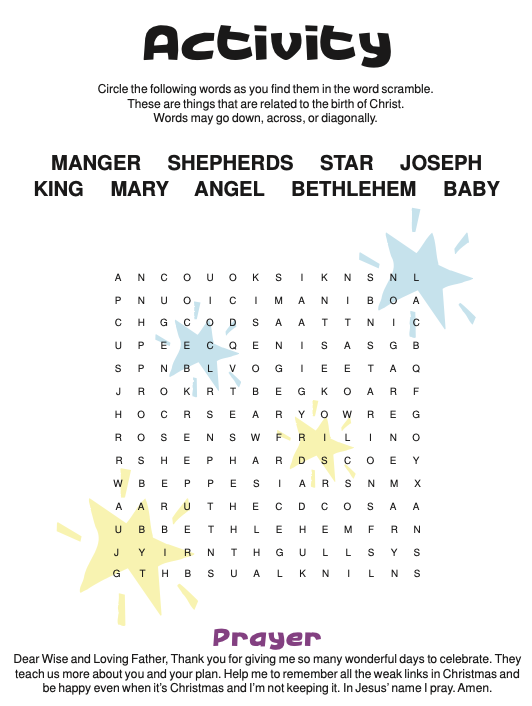
Thank you for giving me so many wonderful days to celebrate. They teach us more about you and your plan. Help me to remember all the weak links in Christmas and be happy even when it’s Christmas and I’m not keeping it.
In Jesus’ name I pray.
Amen.
Daily Devotions
Sunday - Jeremiah 10:1-6
Monday - Isaiah 40:18-21
Tuesday - Matthew 1:18-21
Wednesday - Matthew 2:1-11
Thursday - Luke 2:1-32
Friday - John 1:1-14
Saturday - 1 Timothy 1:6; 2 Timothy 4:4
Objectives
At the end of this lesson, students will be able to:
1. List at least five weak links in traditional Christmas celebrations.
2. Explain that a chain is only as strong as its weakest link.
3. Discuss why it is wrong to adopt things from pagan customs and use them to worship God.
4. Elaborate on how God’s Holy Days picture God’s plan, His greatness, and love for us.
5. State that there are no weak links in God’s plan.
Topics & Themes
Christmas
God’s Plan
Holidays, Christmas
Holy Days
Jesus, Birth of
Jesus, Savior
Pagan Traditions
Truth
Worship God
Materials Needed
Bible, YEA Students’ and Teacher’s books, attendance and memory verse charts, songbook, CD, CD player, construction paper, glue, pencils, paper, scissors, newsprint pad, marker, concordances
Preparation
“The word Christmas is derived from the Old En-glish Cristes Maesse, ‘Christ’s Mass.’ There is no certain tradition of the date of Christ’s birth. . . The first notice of a feast of the nativity of Christ occurs in a Roman Almanac (the Chronographer of 354, or Philocalian Calendar), which indicates that the festival was observed by the church in Rome by the year 336.
“It is commonly supposed that the emperor Constantine was influential in the institution of a Christian feast of ‘the birthday of the Sun of Righteousness’ (Mal. 4:2) as a rival to the popular pagan festival of the Unconquered Sun (Sol Invictus) at the winter solstice. . .
“The transformation of Nicholas into Father Christmas or Father January occurred first in Germany, then in countries where the Reformed church were in the majority, and finally in France, the feast day being celebrated on Christmas or New Year’s Day. Dutch Protestant settlers in New Amsterdam (now the city of New York) replaced Nicholas (“Sinter Claes”) with the benevolent magician who became known as Santa Claus. . .” (Encyclopaedia Britannica, Volume 4 and 7, pp. 603 and 324, respectively).
Juniors are at the age when parents and teachers are losing importance in relation to their peers. Therefore, not celebrating Christmas can be a most difficult thing for them to handle. As a parent or teacher, we must face the fact that Christmas is fun and attractive. A lot of sensitivity and love will be required. Pray for a balance in teaching the children that celebrating Christmas is wrong while showing them they should not judge or make enemies out of their friends who do. The purpose of this lesson is not to teach kids an adversarial or self-righteous approach. It is to help them understand their beliefs and to be comfortable and happy with them. Be careful to emphasize the positive aspects of keeping the Holy Days and the blessings they will receive from obeying God.
Before class, cut enough sheets of construction paper into strips so that each student can have 20. Also write your letter to a friend explaining in love why you don’t keep Christmas. You’ll likely be interrupted, so it won’t work to try to write it in class.
How to Teach This Lesson
Give each student 20 strips of construction paper and tell them they will be making a chain with these strips. But before they make their chain, they are to write at least one different thing on each strip that is associated with Christmas. Then they are to glue them together making a chain. When done, have each student read what they have written on their chain. List each different item once on the newsprint pad. Go through the list with the students and mark through the ones you and they are sure are in the Bible. Now use the concordances and have the students look up all of the doubtful words. Put a check by those.
Weak links - Explain that these are weak links in our chain and have nothing to do with God or Jesus. They can’t be found in the Bible, so they do not explain why we should keep Christmas. Give each student a pair of scissors and have them cut through all of their weak links (those not in the Bible). Have them hold up their chain. Ask: What happened to your chain? Ask a student to read the definition of “link” under Words to Know in their book.
Pagan links - What kind of chain do the links on the floor make? Have a student read Jeremiah 10:2b-4. Ask: What does the Christmas tree link you to? (Pagan customs.) Why shouldn’t we decorate a Christmas tree and use it to worship God? Ask a student to read Deuteronomy 12:32. Ask another student to read Deuteronomy 12:31.
Can’t have fun - Does God say that it is wrong to keep Christmas because He doesn’t want you to have fun? Why not? Briefly go through each Holy Day and let the kids tell you how they show God’s plan and how they are better than pagan practices.
Review Questions
1. Name five weak links that supposedly support Christmas celebration.
2. How strong is a chain?
3. What is wrong with using pagan customs to worship God?
4. Name ways that the Holy Days show God’s plan and His love for us.
5. Are there any weak links in the Holy Days?
Teacher-Directed Activity
Have the students write a pretend letter to a friend explaining what they believe about Christmas and God’s Holy Days. Suggest they make it positive, warm and friendly—not offensive. Then have each student share his or her letter with the class. This will help students express what they believe. You may also want to share your letter.
REACH Activity
Back to the Bible: God’s Holy Days
When you’re shopping around Christmastime, you’re likely to hear the phrase “The Most Wonderful Time of the Year” - either said by someone or in the music that is playing. It’s a catchy tune. Do you find yourself humming “It’s the most wonderful time of the year?” If you do, do you ever stop to think about what truly is the most wonderful time of the year? Let’s investigate!
Find a calendar for the next year, your Bible, and a highlighter. First, read Leviticus 23:1-3. The first holy day is the Sabbath! Read Isaiah 58:13. The Sabbath is supposed to be a delight - indeed, a wonderful time of the year. So highlight every Sabbath all the way through your calendar. It might take you a little while! There’s one every week on Saturday!!
Next read Leviticus 23:4-8. Have your parents help you figure out when the Passover and Days of Unleavened Bread will be. The first day and the seventh day are holy days, but the whole week is special. So highlight the whole thing, including Passover (eight days total).
Then read Leviticus 23:15. Count off seven full weeks of sabbaths until the Sunday after the seventh sabbath. This is Pentecost. Highlight Pentecost.
Then read Leviticus 23:23-24. This is the Feast of Trumpets. This is the first day of the seventh month in God’s calendar. Have your parents help you figure out what day it will be on your calendar. Then highlight it.
Then read Leviticus 23:27. This is the Day of Atonement. If you know when Trumpets is, you’ll count 10 days. That’s the Day of Atonement. Highlight it.
Read Leviticus 23:34. This tells you when the Feast of Tabernacles is. If Atonement is on the 10th day of the seventh month, and the Feast of Tabernacles starts on the 15th day of the seventh month, you can count to find out what day that will be. The first day of the Feast of Tabernacles is a holy day. The Eighth Day is also a holy day. But the six days in-between are a time of celebration. So highlight all eight days.
When you finish highlighting all of the days which God commands us to celebrate, flip through your calendar and think about all the special days which are coming this next year. These days are truly the most wonderful time of the year.
Journal Jot: The Birth of Christ
While we do not believe that Jesus was born on December 25th, we do believe the Biblical account of His birth. It’s just very important that we keep what is Biblical and get rid of what is not Biblical. In your Bible notebook, make a list of everything you can think of that is associated with Christmas. Then take your list and divide it into Biblical and non-Biblical.
Write a response essay in your Bible notebook based on what you discovered from this activity.
Word Study: worthless - hebel (H1892)
Jeremiah 10:3 (NIV) says that “the customs of the people are worthless.” What exactly does that word “worthless” mean? Strong’s concordance defines hebel as “vapor, breath.” It is translated in the various translations as breath, delusion, emptiness, fleeting, fraud, futile, idols, mere breath, nothing, useless, vain or vanity, vapor, or worthless. Sometimes the word is translated as “vanities” in one Bible version and the exact same verse in another translation says “idols.”
So what does this mean to you? If the celebration or custom or tradition is not based on God’s word, then it doesn’t have any value. It’s worthless. That’s startling to us! We like to think that maybe a fun time, like a Super Bowl party is an important event. But, can you remember who won the Super Bowl last year, five years ago, ten years ago. Do you remember who lost the Super Bowl two years ago? I’m truly not picking on sports and sporting events; it’s just one example of something that can take up a lot of our time - and really has no value if we’re talking about eternity. What does have value is seeking God. We should be doing things to help, encourage, and point people to God. God should be a central component of all that we do - and if He isn’t, then maybe we should choose a different activity to occupy our time.
Write about this in your Bible notebook. Then talk about it with your family. How many of the things you do are worthless?
Just Toolin’ Around: Christmas
Did you know that the word “Christmas” is nowhere found in the Bible? Did you know that we are not given the exact date for Jesus’ birth in the Bible? Did you know that the wise men probably visited Jesus when he was several months old - certainly not in Bethlehem in the stable? Check it out for yourself. Using your Bible, a Bible concordance, and other reference materials, find out what exactly is in the Bible about the birth of Jesus. Write down what you find in your Bible notebook.
Did you Know? When Was the Birth of Jesus?
God has not made Jesus’ actual birth date easy to find. (Hmm. Maybe there’s a good reason for that!!) But we do have clues. Based on when Zechariah was in the temple and received the news about the John the Baptist, we have an idea about when Elizabeth might have been pregnant with John. That gives us an idea of when Mary might have been pregnant with Jesus. Most serious Bible scholars will admit that Jesus was likely born in the autumn. But it’s hard to pinpoint exactly when. There’s support for His birth falling on the Feast of Trumpets: if we believe that Jesus’ second coming is on Trumpets, you could make a good case that His first coming was also on Trumpets. But there is also support for Him being born on the opening night of the Feast of Tabernacles - He came and tabernacled (dwelt temporarily) among us (John 1:14). What we do know is that Jesus was born as a baby in Bethlehem of the virgin Mary. And that choice to come to live and die and save His people from their sins was an amazing act of love. What do you think? Write about this in your Bible notebook.
Stretch It Out: Holy Day Mobile
God has given us wonderful holy days to celebrate. He wants us to not only rejoice, but rejoice because we have a relationship with Him. His holy days show us how God makes it possible for us to have that relationship with Him and what He has planned for us in the future.
Make a mobile using a hanger, string, construction paper or cardstock, tape, scissors, and coloring tools. Your goal is to create a colorful display of God’s holy days. You’ll not only want to put the names of the holy days on the mobile (one on each dangling piece), but also some information - like how each one points to Jesus Christ or what date that holy day will be on this coming year. You may want to include a scripture reference for where you can find more information about God’s holy days. Make your mobile colorful and inviting. Display it in the foyer of your church (after getting permission).
Music Notes: We Praise Thee, O God, Our Redeemer
This hymn is on page 30 of the CEM Hymnal. The author of the text is Julia Bulkley Cady Cory in 1902 when Julia was 20 years old.
“Due to the popularity of the 1626 hymn “We Gather Together,” the music director at her church requested that Julia write some new lyrics for the tune which is used with that song. After struggling for two weeks, Julia, who was not long out of school, produced three stanzas. The first public performance of her hymn was the next Thanksgiving Day.
A month later, the Julia’s father wished to use the hymn for a service on Dec. 25. Some older books erroneously say that the hymn "We Praise Thee, O God, Our Redeemer, Creator" was written by an unknown author and translated by Julia B. Cady Cory, but William J. Reynolds notes that while this hymn was written as a substitute for "We Gather Together" it is not another translation or version of the original.” [Source: https://hymnstudiesblog.wordpress.com/2010/05/10/quotwe-praise-thee-o-god-our-redeemerquot/]
Here is the text she wrote for the fourth stanza:
Thy love Thou didst show us, Thine only Son sending,
Who came as a babe and whose bed was a stall,
His blest life He gave us and then died to save us;
We praise Thee, O Lord, for Thy gift to us all."
Read all of the words to this hymn and then sing it. Write in your Bible notebook the reasons you praise God every day.
Questions?
Remember to write any questions that you have in your journal. That way you will remember to ask your parents, teacher, or minister.
Song
“I Have Decided to Follow Jesus” is on page 23 of Kids Classics Collection.
Closing Prayer
Have a volunteer lead in prayer thanking God for the Holy Days we can celebrate big. Ask for the right attitude when Christmas comes, within our own hearts and toward those who celebrate Christmas.
Printable Pages