YEA Lesson Library
What Do You Expect?
About This Lesson
This lesson teaches that Easter is not found in the Bible, is not when Jesus was resurrected, and does not please God if we celebrate it.
Scriptures
Exodus 20:3
Exodus 23:13
Numbers 33:50-56
Deuteronomy 4:2
Joshua 23:7
1 Kings 11:1-11
Jeremiah 7:18-21
Ezekiel 8:13-18
Matthew 12:40
Acts 12:4
Revelation 17:1-18
Revelation 18:1-14
Revelation 22:18
Words to Know
FORSOOK - to leave entirely or renounce
TRANSLATION - a book or a writing that has been changed from one language to another
The Lesson
Have you ever looked in a box or drawer expecting to find a certain thing, but it wasn’t there? If you peel an orange, you expect sections of an orange inside. You expect to eat it and enjoy the juicy flavor. But what if the orange was empty—nothing but air inside. Would you try to believe that you saw orange slices there? Of course not! When you look at a book, the picture on the cover usually shows something the book is about. But that is not always true. You’ve heard the saying, “You can’t judge a book by its cover.” Does that say you don’t always see what you expect to find?
For many, many years people have been told that Jesus was resurrected on Easter Sunday morning. They go to church that morning expecting that this is pleasing to God. They may even get up very early and go to a sunrise service as a special celebration of this event. They do these things because they think the Bible says Jesus was resurrected on Easter Sunday morning. Because they think the Bible says it, most people expect to find it there. But when we look inside the Bible, is that what we find? Is Easter even mentioned in your Bible? If so, how many times is it mentioned in your Bible? Do we find that Jesus was resurrected on Easter Sunday morning, and a command to celebrate that day? Let’s take the peel off the orange, so to speak, and see what we find.
You know what a concordance is, don’t you? It’s a book that lists every word in the Bible with the book, chapter, and verse where it is found. Let’s look in one to see how many times Easter is mentioned in the Bible, and what it says. Let’s see if we find what people expect to find about Easter.
Do you know what we find? We find the word Easter mentioned only once in the Bible. In Acts 12:4 it says, “And when he had apprehended him, he put him in prison, and delivered him to four quaternions of soldiers to keep him; intending after Easter to bring him forth to the people.”
There are several interesting things about the only verse in the Bible that mentions Easter. The first thing is that the King James Version of the Bible is the only translation that uses the word Easter. Even then, this is the only place where Easter is mentioned. And it doesn’t say a word about Jesus being resurrected on Easter. It says nothing about God commanding Easter to be celebrated as a religious holiday.
But there is another thing that’s even more interesting. The men who put Easter in the Bible used the wrong word. When these men translated this word from Greek to English they should have put in the word Passover, not Easter.
Through the years many people have worshiped gods other than the true God. In the spring, about the time of the Passover, a feast was celebrated to a goddess who had many names. In English she is called Easter. Before the sun came up on Sunday morning, the people would meet outside and face the rising sun to praise Easter, their goddess. This celebration included hiding colored eggs in the grass and finding them. This happened many years before Jesus was even born, so it could not have celebrated Jesus’ resurrection. Well then, did this please God?
No! “They forsook the LORD, the God of their fathers, who had brought them out of Egypt. They followed and worshiped various gods of the peoples around them. They provoked the LORD to anger because they forsook him and served Baal and the Ashtoreths.”
Who were the Ashtoreths? Astarte was one of the goddesses—a goddess of the evening star. Astarte is another name for Easter. In Exodus 20:3 we read, “Do not put other gods in place of me.” God is so pure, so good, so righteous. We must not confuse Him with other gods or goddesses.
God wants us to pay attention to this severe warning: “I am warning everyone who hears the words of the prophecy of this book. If you add anything to them, God will add to you the plagues told about in this book. If you take any words away from this book of prophecy, God will take away from you your share in the tree of life. He will also take away your place in the Holy City. This book tells about these things” (Revelation 22:18). God says this is serious business. He gave us days in the Bible to celebrate—Passover, the Days of Unleavened Bread, Pentecost, Trumpets, Atonement, the Feast of Tabernacles, and the Last Great Day. When we look in the concordance, we find these days are in the Bible. When we look them up in the Bible we find that God commands us to celebrate them. We see what we expect to see. God wants us to celebrate these days to worship Him and not add any other religious days to them. It’s very important that we read the Bible and see and do what it says.
Student Prayer
Dear Heavenly Father,
Thank you for showing me in the Bible what you expect me to do. Help me to be a good example to my friends who keep Easter.
It’s in Jesus’ name I pray.
Amen.
Daily Devotions
Sunday - 1 Kings 11:1-11
Monday - Ezekiel 8:13-18
Tuesday - Jeremiah 7:18-21
Wednesday - Exodus 23:13; Joshua 23:7
Thursday - Numbers 33:50-56
Friday - Revelation 17:1-18
Saturday - Revelation 18:1-14
Objectives
At the end of this lesson, students will be able to:
1. State that Easter is only mentioned one time in the Bible and only in the
King James version.
2. Explain that the word Easter in Acts 12:4 should have been translated Passover.
3. Talk about why people expect to see things in the Bible that simply aren’t there.
4. Discuss why it is wrong to observe Easter, and which days the Bible says we should celebrate.
5. Explain that people who keep Easter think they are pleasing God and we should not condemn them.
6. Give the sequence of what happened from Wednesday to Sunday the week Jesus was crucified.
Topics & Themes
Bible Study
Easter
Holidays, Easter
Jesus, Resurrection of
Ten Commandments
No Other Gods
Worship God
Materials Needed
Bible, YEA Students’ and Teacher’s books, attendance and memory verse charts, stars, songbook, CD, CD player, empty box of candy tied with ribbon, encyclopedia, concordance, Living and NIV Bible, two or three pieces of butcher’s paper, marker, pencils
Preparation
So much advertising is done for the holidays the world celebrates that it is almost impossible for your students not to feel left out of something that is fun. Peer pressure plays a major role in this age group. It’s easy for them to feel uncomfortable about being the only one who does something, or doesn’t do something. However, schools are emphasizing more and more that we must respect the beliefs and customs of others. Children’s friends are more accepting than adults. Often adults will have difficulty dismissing the observance of Easter without questions. Help students to understand how abstention from observing Easter can be an example and a light for God.
This age group learns so well from so many media. We suggest that you research encyclopedias to find additional information about Easter. For instance, Grolier’s Encyclopedia (1995) states “according to the Venerable Bede, the name Easter is derived from the pagan spring festival of the Anglo-Saxon goddess Eostre, and many folk customs associated with Easter (for example, Easter eggs) are of pagan origin.” Showing the class, from an encyclopedia, what can be found by anyone who researches it, is very effective.
How to Teach This Lesson
Candy Box - After opening the class with prayer, show the students your candy box tied with a ribbon. Don’t tell them it is empty. Ask the students to guess what is in the box. Give everyone a chance to guess. Ask: Why did you guess candy? They will most likely say because it’s a candy box. Ask: Why did you expect to see candy in a candy box? Can you always tell what a book is about by looking at its cover? Can you tell what’s in a candy box by its cover? Take off the ribbon and cover and let them see that nothing is in it.
Easter in the Bible - Why do you think people celebrate Easter? Give one student the concordance and ask her to look up the word Easter. She should tell the class how many times it is found and where it can be found in the Bible. When the student tells the class that it can be found in Acts 12:4. Give another student the Living Bible and another the NIV Bible and tell them to find Acts 12:4 and read it. Ask: How many of you expected to hear (give the name of the reader) say the word Easter? Why do you think that she didn’t? If the students don’t mention it, point out that the students didn’t read that verse from the King James Version of the Bible. And it is the only translation that uses the word Easter. We expected to hear Easter read, but we didn’t hear it, why? (Because the correct word is Passover).
What people expect to find in the Bible vs. what is really there - Why do you think people expect to see that God commands us to celebrate Easter? (They believe what everyone tells them, and they don’t read their Bibles care- fully). Now read what you found in the encyclopedia. Are we better than they are? (No! We should not condemn other people for keeping Easter. We should always be ready to answer their questions and set the right example).
Review Questions
1. How many times is Easter mentioned in the Bible? Which translation is it mentioned in? How should Easter be translated?
2. What day was Jesus crucified? How do you know this?
3. Why is it wrong to celebrate Easter?
4. What days does the Bible say we should celebrate?
Teacher-Directed Activity
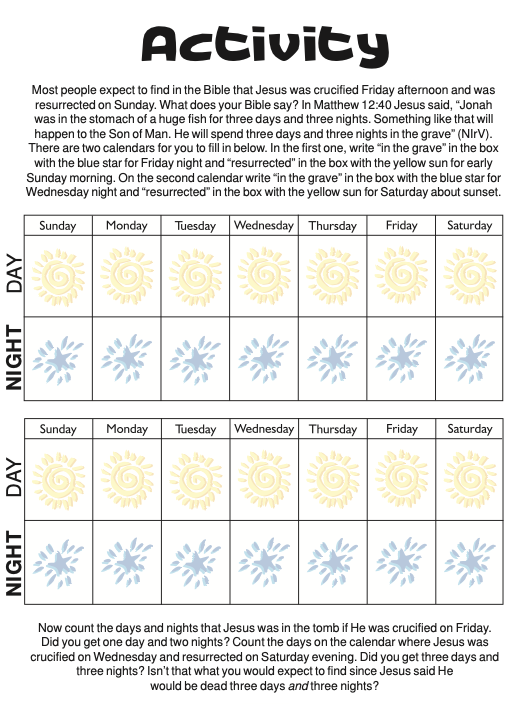
Before class, draw the calendars from the Students’ activity on one or two pieces of butcher’s paper and attach to the wall. Briefly write the event that happened and the Scripture on the correct day. Wednesday (crucifixion, rushed to get Jesus in the tomb before sunset because the Sabbath was approaching - John 19:31), Thursday (the Sabbath— the First Day of Unleavened Bread - Mark 16:1), Friday (Mary Magdalene, Salome, and Mary the mother of Jesus bought and prepared spices to embalm Jesus. They rested on the weekly Sabbath - Luke 23:56) Sunday (The women took the spices they had prepared and went to the tomb. Jesus had been resurrected and was already gone - Luke 24:1). Have students read the progression of Scriptures and add them and what took place each day to the activity in their books. Have them count the days and nights. Ask: How many days and nights are there from Friday night to Sunday morning? How many days and nights did Jesus say that He would be in the tomb? According to Scripture, which calendar is correct, the one that shows Jesus died on Wednesday and was resurrected Saturday evening, or the one that shows He was crucified on Friday and rose on Sunday morning? Did you find in your Bible what you expected to find about Jesus’ resurrection?
REACH Activity
Back to the Bible: Astarte
Read Jeremiah 7:18 and Jeremiah 44:19-26. These passages talk about the Queen of Heaven for whom the Jewish people were baking bread. These actions were part of their worship of Astarte - which is another name for Easter. [Source: https://biblehub.com/commentaries/jeremiah/7-18.htm] This pagan goddess was worshipped long before the birth of Jesus Christ. Therefore, the celebration of Easter has more to do with the pagan worship of a goddess of fertility (life) than the resurrection of Jesus Christ. Some Christians see no problem with incorporating a worship of fertility into a worship of our great God because of the resurrection of Jesus Christ. But God views it much differently, as you can see from these passages in Jeremiah 7 and 44.
Using these passages in the Bible as your foundation, write an essay in your Bible notebook to explain to a friend why you don’t celebrate Easter. Share with your family.
Journal Jot: Easter
If you had to make a list of the things associated with Easter, what would be on your list? In your Bible notebook, make a list now. . . . What things were on your list? Rabbits, eggs, Easter bonnets, hot cross buns, ham, Easter sunrise church services, the resurrection of Jesus Christ? How many of these things are truly Christian - that is, how many of these things are pleasing to God in our worship of Him? Next to each of the items in your list in your Bible notebook, put an X next to the ones which are not pleasing to God.
Rabbits and eggs have to do with fertility - and worship the goddess of fertility, Astarte or Easter. Easter bonnets are just clothes - new clothes in celebration of the day. Hot cross buns have their origin in the cakes baked to the Queen of Heaven. But even if you were just making a fun food, many years Easter falls during the Days of Unleavened Bread. Eating a hot cross bun would be eating something leavened. Likewise, ham is a meat from pigs. It’s unclean and not pleasing to God. Easter sunrise services supposedly point to the time when Jesus came out of the tomb. But we know from our calendar activity (YEA book) that Jesus came out of the tomb at the end of the Sabbath on Saturday. So the sunrise service isn’t at right time or isn’t really about Jesus. If this pagan holiday isn’t about Jesus, why would you want to participate in it - especially when God tells you not to use pagan things to worship Him?
Now, in your Bible notebook, write a short paragraph about why you should or should not celebrate Easter.
Word Study: Heart - kardia (G2588) and Earth - gé (G1093)
If you look up Matthew 12:40 in several translations, you will see that almost all of them say that Jesus would be three days and three nights in the heart of the earth. What does this phrase “heart of the earth” mean? Kardia is the Greek word from which we get cardiac arrest or cardiologist (someone who studies the heart; heart specialist). Here it means “the middle or central or inmost part of anything, even though inanimate.” Gé is the Greek word that simply means the physical earth where we live. [Sources: https://biblehub.com/greek/1093.htm; https://biblehub.com/greek/2588.htm]
If you look up word commentaries on this phrase, you will find long explanations of how this could not have possibly have meant a literal three days and three nights in the grave because most commentators believe in a Friday crucifixion and Sunday resurrection. However, if you follow the clues in the Bible which support a Wednesday afternoon death and Saturday evening resurrection, there’s no problem believing that Jesus meant just what He said: He would be in the grave - the heart of the earth - for three days and three nights.
Write these Greek words and a short paragraph about what actually happened to Jesus in your Bible notebook.
Just Toolin’ Around: Prophets
God sent prophets to His people to turn them from their sin and turn them back to the true worship of God. Using a Bible encyclopedia or other reference source, make a list of ten prophets. (One source said there are 88 prophets!!) Find out where they lived, who they preached to, what their main message was, and other interesting information. You may also wish to define what makes a prophet. Record what you find in your Bible notebook.
Did you Know? Whales
One of the arguments that critics of Jonah’s story make is that a whale couldn’t have swallowed Jonah because whales don’t live in the Mediterranean Sea. But archaeological evidence was found, specifically “bones of whales in the ruins of five Roman fish-processing factories located at the Strait of Gibraltar.” Experts believe that the Romans hunted the Right Whale and Gray Whales to extinction.[Source: https://aleteia.org/2018/07/19/archaeological-evidence-may-support-jonahs-whale/]
Write about this in your Bible notebook. Then write a paragraph about whether you believe the story of Jonah is real or just a fable. What you believe about Jonah will impact what you believe about Jesus saying the only sign He would give would be the sign of Jonah. Think about it.
Stretch It Out: A Sign
It’s amazing how many people try to find a way around the only sign that Jesus said He would give to the people who wanted to know if He really was the Messiah. They try to say that Jesus’ words don’t really mean a literal three days and three nights. On poster paper, create a sign-like poster. Include your memory verse, a drawing of a whale (or large fish), and a title like “Jesus’ Words Are Trustworthy and True” or “Do You Believe the Sign?” or “Not a Fish Tale.” Add color using your favorite color tools. Display at church.
Music Notes: Yield Not to Temptation
This hymn is on page 195 of the CEM Hymnal.
The words and the music were written by Horatio R. Palmer. He came from a musical family and joined a church choir when he was seven. He became a music professor, wrote theory books, edited a musical journal, organized a church choral union, and once led a 4000-voice choir in a concert of sacred music in Madison Square Garden.
Horatio Palmer wrote about how this hymn came to be: “I am reverently thankful God gave me the song, and has used it as a power for good. The song is an inspiration. I was at work on the dry subject of [music] ‘Theory’ when the complete idea flashed upon my mind. I laid aside the theoretical work and hurriedly penned both words and music as fast as I could write them.”[Source: Morgan, Robert J. Then Sings My Soul. Vol. 2, Thomas Nelson, Inc, 2004, pg 114-115.]
Sing this hymn, paying special attention to the words. Then in you Bible notebook, write a paragraph explaining how this hymn relates to the non-observance of Easter.
Questions?
Remember to write any questions that you have in your journal. That way you will remember to ask your parents, teacher, or minister.
Song
“Come Bless The Lord” is on page 85 of Kids Classics Collection.
Closing Prayer
Ask for a volunteer to lead in prayer thanking God that they can find in their Bible that Jesus was resurrected the third day. Thank God also for showing them why they should not observe Easter.
Printable Pages