YEA Lesson Library
The Greatest Day
About This Lesson
This lesson teaches that the Eighth Day is the greatest day of the Feast because it pictures us living in God’s kingdom without any evil, sin, or pain.
Scriptures
Leviticus 23:35-39
Numbers 29:35-40
Nehemiah 8:18
Ezekiel 37:1-28
John 6:44
John 7:37
John 7:37-39
John 14:2
1 Corinthians 2:9
1 Thes 4:12-18
Revelation 20: 5-12
Revelation 21:1-17
Words to Know
TERRORIST - someone who uses violence or threats for political purposes
MOLESTER - a person who makes indecent sexual advances
FOUNDATION - the base on which something is built
The Lesson
From the very beginning, God had days He wanted us to know about. As the children of Israel wandered in the wilderness, God told them about days to celebrate. This book gives a lesson on each of these holy days so you can understand what God told Israel to do. More important, God wants you to know what He expects you to do. You’ve learned why these days are important to remember and celebrate. These days are so wonderful that God does not want us to ever forget them.
In the last lesson, we learned about the Feast of Tabernacles. It shows us that our bodies and everything in this world are temporary. They weren’t made to last forever. They wear out. God has something so much better for us than the bodies we live in. The body God has for you won’t get sick or hurt. In the world that He has waiting for you, houses won’t burn down. Things won’t rot and decay. They will last because they will be eternal! “No eye has seen, no ear has heard, no mind has conceived what God has prepared for those who love him” (1 Corinthians 2:9). God is telling us that He has something so wonderful waiting for us that our minds can’t begin to imagine it.
God commands us to celebrate the Feast of Tabernacles for seven days. Yet we stay at the Feast for eight days. Why? It’s because there is yet another Feast to celebrate. God said, “On the eighth day, come together for a special service. Bring an offering that is made to me with fire. That special service is the closing service. Do not do any regular work on that day” (Leviticus 23:36 NIrV). Your memory verse says this is the greatest day of the Feast! Since it is the greatest, don’t you think that we should really celebrate big? But why?
This day symbolizes something so great and wonderful. God has a beautiful description of what He has in store for us. “Then I saw a new heaven and a new earth, for the first heaven and the first earth has passed away, and there was no longer any sea. I saw the Holy City, the new Jerusalem, coming down out of heaven from God, prepared as a bride beautifully dressed for her husband. And I heard a loud voice from the throne saying, ‘Now the dwelling of God is with men, and He will live with them. They will be His people, and God Himself will be with them and be their God. He will wipe every tear from their eyes. There will be no more death or mourning or crying or pain, for the old order of things has passed away.’ He who was seated on the throne said, ‘I am making everything new!’” (Revelation 21:1-5a).
Imagine a beautiful place where everything is sparkling clean, brand new, and perfect. There won’t be any evil—no wars, no terrorists, no drug dealers, no child molesters, no divorce, no pain or crying. God will wipe away every tear from your eyes. What a wonderful place to be!
But will the new Jerusalem look like your home town? The new Jerusalem will be laid out like a square with the brilliance of jewels. Look at the foundation of your house. It is probably just concrete or wood beams. But the foundation of the new Jerusalem will be made of jewels. It will have three gates in each of the four walls—a total of twelve gates in all. Those gates will have the twelve tribes of Israel written on them.
“The great street of the city was of pure gold, like transparent glass. The city does not need the sun or the moon to shine on it, for the glory of God gives it light, and the Lamb is its lamp.” Do you remember who the Lamb is? It is Jesus Christ! But there’s one other thing that will make this city so wonderful. God Himself will also be there. This will be such a place of great happiness that no one will want to miss out on being there.
What must we do so that we can live in the new Jerusalem with Jesus Christ and God the Father? Believe that Jesus Christ is our Savior—that He died so that we can have forgiveness. We have to be really sorry for our sins and be determined, with God’s help, to never do them again. When we are old enough we must be baptized to show God that we are serious about these things. Then we have to live as Jesus would have us live.
Keeping the holy days, the Sabbath and God’s commandments are not what gets us into the new Jerusalem. But these things show God that we love Him. Doing these things make your life better because sin always has bad consequences.
“Nothing impure will ever enter it, nor will anyone who does what is shameful or deceitful, but only those whose names are written in the Lamb’s book of life.” When you see how wonderful God’s plan is for you, isn’t it worth doing what it takes to be a part of the new Jerusalem? It’s so wonderful that God said that it is the greatest Feast of all!
Student Prayer
Dear Heavenly Father,
Thank you for the promise of eternal life. Please be with us always guiding us and teaching us your way. Help us to continually grow closer to you.
In Jesus’ name I pray.
Amen.
Daily Devotions
Sunday - Leviticus 23:36-39
Monday - Numbers 29:35-40
Tuesday - Nehemiah 8:18
Wednesday - John 7:37-39, 6:44
Thursday - Revelation 20: 5-12
Friday - 1 Thessalonians 4:12-18
Saturday - Ezekiel 37:1-28
Objectives
At the end of this lesson, students will be able to:
1. State that God has something planned for us that is much better than this present life or world.
2. Describe the new Jerusalem and show where it is found in the Bible.
3. State that the eighth day is a separate commanded Feast from the Feast of Tabernacles.
4. Explain why the Last Great Day is a happy day for God’s people.
5. Describe some of the ways that the new heaven and new earth will be different from this world.
6. Name all of the Holy Days in order.
Topics & Themes
Eighth Day
God’s Kingdom
God’s Plan
Holy Conduct
Holy Days
Holy Days, Eighth Day
Jerusalem
Jesus, Savior
New Heavens, New Earth
Obedience
Materials Needed
Bible, YEA Students’ and Teacher’s books, attendance and memory verse charts, butcher’s paper chart of Holy Days from Lesson 1, songbook, CD, CD player, white construction paper, scissors, glue
Preparation
Biblical references for the Feast that we call “The Last Great Day” are few. The two Old Testament Scriptures are Leviticus 23:36 and Numbers 29:35-38. The NIV calls this Feast the closing assembly. Different meanings have been associated with it: the closing assembly for the Feast of Tabernacles, the closing of the fall Holy Days, and the closing assembly for the yearly Holy Day cycle signifying the completion of God’s plan of salvation for mankind. Layers of meanings can be seen in each Holy Day.
Leaving the Feast has a sad note because the children may not see their good friends again until next Feast. But this festival signifies the greatest joy of all when we will live with God throughout all eternity. Try to keep kids focused on what a wonderful thing lies ahead for them, if they will follow God. Nothing can compare with it.
Encourage students to bring friends and neighbors with them to class. This is not only a way to build attendance, but to do a lot of eternal good in your community. From time to time, add this to the reminder you give students to take home.
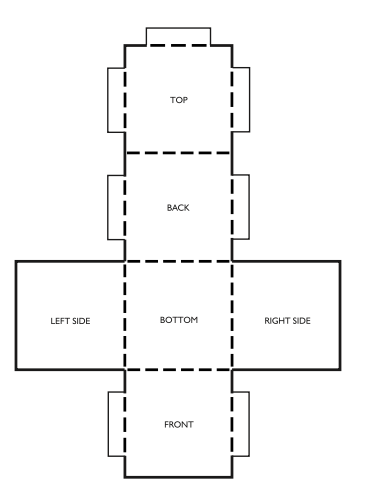
Before class, make and enlarge photo copies of the box pattern (see next page) on white construction paper. Each student will need seven patterns. Put a box together by folding along the dotted lines and gluing the tabs. Make one before class to show the students what they will look like when they are finished. To save time during class, cut out the boxes for the students beforehand.
How to Teach This Lesson
Using the chart that you started at Passover (Lesson 1), try to balance the past and the future in this lesson. Let the children explain what they remember from each Holy Day for the entire year. As one remembers something, another will build on that memory. You will feel good knowing that they really are remembering what you’ve taught in class.
Bridge the past and future - To instill within these young minds the chronology of events, each lesson has taken students back to the first time the children of Israel kept that particular feast. Talk about how each of the lessons has history in it and prepares them for what is ahead. Show them how Jesus Christ is in each holy day.
Plan of God - Explain that from the very beginning, God wanted a family. He wants to share his glory and honor with us. Man sinned and cut himself off from God. The Passover provides the only way for man to be restored to God. It is through the death of Jesus Christ that everyone from Adam on has forgiveness of his sins. During the Days of Unleavened Bread, leaven is a symbol of sin. We get leavening out of our homes and sins out of our lives. For seven days we eat unleavened bread which symbolizes putting Christ in our lives. We put Christ in our lives when we do such things as pray and study our Bible. Pentecost is the day when God empowered His church with His Spirit. His Spirit is a gift—a power that helps us live a godly life. The Feast of Trumpets pictures Christ coming back to this earth to save us. The Day of Atonement is a time for communal or national forgiveness. The Feast of Tabernacles shows us that life and this world are temporary when we look for a city whose builder and maker is God. The Last Great Day is the greatest Feast, when God Himself will live with man.
Meaning and joy - God had special days from the beginning of time. All of the Holy Days have meaning and point to Christ. They give us hope and joy. They are a time to celebrate!
Teacher-Directed Activity
Give each student seven box patterns (above)—one for each Holy Day (Passover, Days of Unleavened Bread, Pentecost, Trumpets, Atonement, Tabernacles, and The Last Great Day). Label each side as follows:
Top and Bottom - Put the name of the Holy Day on the top and the Scripture where that Holy Day is found on the bottom.
Right and Left - Write the previous Holy Day on the left side of the cube and the next Holy Day on the right side.
Front and Back - Write things that you associate with that particular Holy Day.
They are to fold the box at the dotted lines and then glue it together when they’ve finished labeling each side.
REACH Activity
Back to the Bible: Water Ceremony
During the Feast of Tabernacles, there was a water ceremony which involved a daily procession of carrying water from the Pool of Siloam to the temple. It would have been while this ceremony was going on, or just after, that Jesus stood up and said in a loud voice, “‘If anyone is thirsty, let him come to me and drink. Whoever believes in me, as the Scripture has said, streams of living water will flow from within him” (John 7:37, NIV). Read Isaiah 55:1 and Isaiah 58:11. How do these verses take on new meaning after reading what Jesus said in John 7:37-39? Write about this in your Bible notebook.
Journal Jot: God’s Holy Days
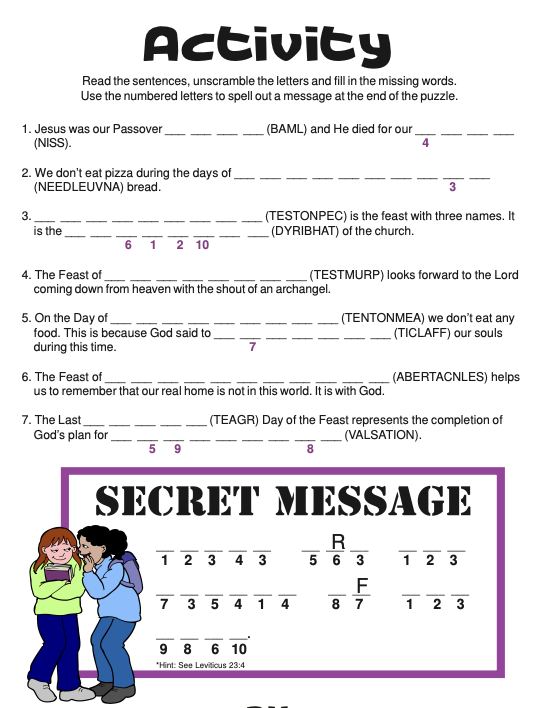
This holy day is the last of God’s seven annual holy days. Can you name all seven? In your Bible notebook, write down the seven annual holy days and a brief description of why we celebrate each. If you have trouble remembering what they are, look them up in Leviticus 23. If you have trouble remembering what each one symbolizes, look back through your YEA lessons. God has given us these days for a purpose - so that we can see His plan of salvation for each one of us. It’s important that we learn and remember what each one means!
Word Study: Érchomai (G2064) - to come
Jesus called anyone who was thirsty to come. This word literally means to come and denotes motion from one place to another. But in New Testament usage, to come to Jesus means to believe on Him. So in John 7:37-39, Jesus states it twice, in different ways, so there is no misunderstanding! He calls us to come (to believe on Him). Then He says if we believe on Him, living water will flow from within. Thirst - come (believe); Believe - water. It’s a very cool use of language to provide a very visual concept of the blessings of believing in Jesus Christ.
Do you believe? How has believing in Jesus Christ changed your life? Write about this in your Bible notebook.
Just Toolin’ Around: Water Ceremony
Using a study Bible, Bible encyclopedia, or other reference source, find out what you can about the Pool of Siloam and the Water Ceremony. How many times are there references to the Pool of Siloam in the Bible? Find a diagram of Jerusalem which shows the location of the Pool of Siloam. Add a copy of it to your Bible notebook.
Did you Know? Hezekiah’s Tunnel
“There were actually two pools [of Siloam]. The first, ‘lower’ or older ‘Pool of Siloam,’ collected water from the Gihon Spring, east of the city [of Jerusalem], via a short channel. The second, or ‘Upper’ Pool, also received water from the Gihon Spring, but it came through an underground tunnel that had been cut through rock by King Hezekiah around 701 B.C. Hezekiah strategically situated the Upper Pool within the city walls to serve as a secure water supply.”
The construction of this tunnel was an amazing engineering feat since the two ends started digging and met in the middle. What makes it so amazing is that this winding tunnel was cut through solid rock for 1750 feet!! There’s an inscription about 20 feet from the Siloam end of the tunnel. “The inscription commemorates the dramatic moment when the two original teams of tunnelers, digging with picks from opposite ends of the tunnel, met each other.” [Source: NIV Archaeological Study Bible. Zondervan, 2005. p. 564, 1739.]
Stretch It Out: The Last and Greatest Day
Research the water ceremony. Then read John 7:37-39. Draw a picture of what it might have looked like - the priests pouring the water, Jesus standing and calling the crowd of people to Him, the final holy day crush of people celebrating in Jerusalem. Write your memory verse across the bottom of the page. Then use your favorite color tools to finish your project. Display the drawing where your family or sabbath school class can enjoy it.
Music Notes: Jesus Is Tenderly Calling
This hymn is on page 195 of the CEM Hymnal.
The text to this hymn was written in 1882 by 60 year-old blind songwriter, Fanny Crosby. She “spent most of her life in New York City, where she went to rescue missions in the Bowery neighborhood to ‘tenderly call’ alcoholics, homeless people, and wayward teens and children to the Savior.” The composer of the music was George Stebbins. He “had been raised on a farm and had been introduced to music by learning to play an accordion. Soon he began a new trend in church music by arranging songs for male quartets. When evangelist Dwight L. Moody went to England and Scotland, he took George – as a young man – with him… and George saw thousands of people respond to the tender call of Jesus Christ. Shortly after George returned from England, he was given the words that Fanny Crosby had written, and he wrote the music. God sometimes speaks through thunder and lightning, but – more often – He speaks to our hearts tenderly… with a still, small voice, saying ‘Come home’.” [Source: https://thescottspot.wordpress.com/2016/05/04/jesus-is-tenderly-calling-written-in-1882/]
Sing this song. Pay close attention to how this song relates to John 7:37-39. Write your reflections in your Bible notebook.
Questions?
Remember to write any questions that you have in your journal. That way you will remember to ask your parents, teacher, or minister.
Song
“His Banner Over Me is Love” is on page 36 of
Kids Classics Collection
Closing Prayer
Have students form a circle and join hands. Lead them in prayer thanking God for revealing such a wonderful and complete plan to us.
Printable Pages