YEA Lesson Library
Better Than Birthdays
About This Lesson
This lesson teaches about the importance of celebrating the Feast of Tabernacles.
Scriptures
Leviticus 23:33-44
Leviticus 23:42-43
Numbers 29:12-25
Deuteronomy 14:22-29
Deuteronomy 16:13-17
Zechariah 14:16-19
2 Corinthians 5:1-4
Hebrews 11:8-16
Hebrews 11:38-40
Words to Know
TEMPORARY - not permanent
GENERATION - a group of individuals who are born and live at the same time; the term is usually about 30 years
MEMORABLE - something that is easy to remember
The Lesson
What do you want for your next birthday? Do you want your mom to bake your favorite cake and invite your friends over to celebrate your birthday? What kind of cake would you want? Do you really think that you could blow out all ten, 11, or 12 candles with one big breath?
Birthdays are special celebrations. Since this party is to celebrate your birthday, what kinds of decorations would you want? How about a huge bouquet of balloons that says “Happy Birthday”? Do you have a special party favor that you want your friends to receive so they will remember your birthday? What would it be? Kids like action. So what really neat games do you want to play to make your birthday truly memorable?
Your birthday is a big deal to you. It’s the day you become one year older. It’s a time to celebrate. God knew that people need times to celebrate. So five days after the children of Israel kept the Day of Atonement in the wilderness, God gave them something to really celebrate. It was the Feast of Tabernacles! They were to celebrate not just one day, but seven days! This Feast was also a harvest festival. It was to be a joyous celebration. On the first day Israel was to have a worship service to honor God. And no work, except for the preparation of food, could be done on that day.
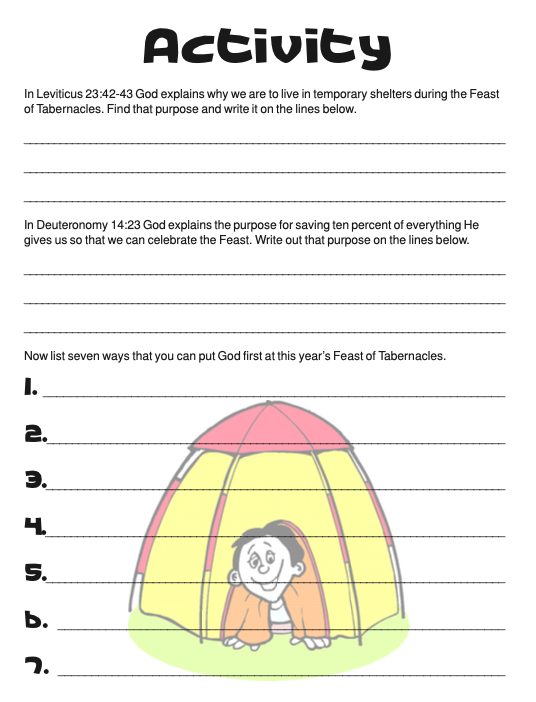
This celebration also has several names. We all know it is called the Feast of Tabernacles. But it is also called the Feast of Booths and the Feast of Shelters. Why “Tabernacles,” “Booths,” and “Shelters”? Well, these all mean basically the same thing. They are temporary places in which to live. “During those seven days, all of you who are native Israelites are to live in these shelters. The purpose of this is to remind the people of Israel, generation after generation, that I rescued you from Egypt, and caused you to live in shelters. I am Jehovah Your God” (Leviticus 23:42-43 TLB). All year we live in comfortable homes with our familiar things around us. But for seven days God wants us to move out of our permanent homes and live someplace else. Why?
Because He wants us to celebrate that, way back then, God rescued Israel from Egypt! He not only wants you to celebrate, He wants you to do it with God’s people. This will cost money and God knew that. So He even provided a way for you and your family to have enough money to celebrate the Feast. In Deuteronomy 14:22-26, God tells us to save ten percent of all He gives us so we can celebrate the Feast. You may want to call it the festival tithe. This is a different tithe from the one we are to give to God. You are to set aside ten percent of all that God gives you so you can celebrate at the Feast. This tithe can be used to cover your expenses for a trip to the Feast, a temporary home, food to eat, and fun things to do.
If you set aside one dime out of every dollar you receive for allowance or for jobs you do, you will have some money to do some really neat things at the Feast. You may be able to buy your parents a gift, or take a friend to 31 Flavors and buy him or her a double-dip ice cream cone. Buying gifts, treating friends, going to Mazzio’s or Pizza Hut are all fun ways to celebrate. But is there more to the Feast of Tabernacles than that? “The purpose of this tithe is to teach you always to put God first in your life” (Deuteronomy 14:23b TLB).
God wants you to go to the Feast and celebrate, and He wants you to put Him first. How do you do that? One way is to get up early and attend every YEA class. These are really neat classes with lots of fun and action. You’ll have your very own YEA book to read your lesson and learn your memory verse before class. There are games to play, lessons to learn, songs to sing, and prayers to say. You will learn how to obey and serve God better. You will learn some neat ways to help people. Maybe you can even be in a play or sing with the children’s choir on Youth Day. These are fun ways to celebrate and put God first in your life.
God also wants you to attend the worship service each day. He wants you to sing and praise Him with songs. He wants you to listen quietly to the sermon. The minister will help you learn more ways that you can put God first in your life.
The family picnic and the fun show are really cool events to attend. Look for ways you can put God first in your life while you are there. Can you help a person in a wheelchair, or take care of a baby while a mother goes through the line to get her hamburger? Can you help set up chairs or help clean up? When you give of your time to help others, this is putting God first in your life.
What can you do in your temporary house to put God first in your life? Mom needs time to celebrate as well. Can you do such things as clean the table, make your bed, set the table, and clean your room? Your mom will be happy and enjoy the Feast even more. These things can help her to put God first in her life at the Feast. Then the whole family can celebrate big—the way God wants us to. This celebration is much better than birthdays!
Student Prayer
Dear Heavenly Father,
Thank you for showing us that the Feast of Tabernacles is a time to celebrate big. Thank you for showing me that the purpose of this is to teach me to put you first in my life.
In Jesus’ name we pray.
Amen.
Daily Devotions
Sunday - Leviticus 23:33-44
Monday - Numbers 29:12-25
Tuesday - Deuteronomy 14:22-29
Wednesday - Deuteronomy 16:13-17
Thursday - Zechariah 14:16-19
Friday - Hebrews 11:8-16, 38-40
Saturday - 2 Corinthians 5:1-4
Objectives
At the end of this lesson, students will be able to:
1. Explain the purpose of saving a festival tithe.
2. Discuss the purpose of living in temporary shelters during the Feast.
3. Talk about things they can do to put God first in their lives at this year’s Feast of Tabernacles.
Topics & Themes
Booth
Feast of Tabernacles
Harvest
Holy Days, Tabernacles
Putting God First
Temporary
Tithe
Worship God
Materials Needed
Bible, YEA Students’ and Teacher’s books, attendance and memory verse charts, songbook, CD, CD player, camouflage tarp, tree branches, table or frame, spray bottle, water, newsprint pad, marker, play money (enough for each student to have $120 in fives, tens, and ones), pencils, paper
Preparation
What do preteens want? They want friends, food, fun, and focus. Preteens are bombarded with hormonal changes. Food is both a felt need and a real need. Keep in mind that kids are easier to work with when their stomachs are full.
“It is difficult for early adolescents to sit still for long periods of time. Their growing bodies need to be active and moving. Although they are easily tired, they also have surges of energy that need to be burned up. Growth spurts make them need more food, yet eating more gives them more calories to burn. Exciting activities or competition can overtire early adolescents since their stamina and endurance are not adequate to match their love for activity: They tend to be poor self-regulators when it comes to balancing fun activities and rest or sleep” (Dynamic Preteen Ministry, by Group).
Your students will be left with a more vivid impression of what it was like for ancient Israel to live in booths by erecting one in class and having them sit in it while the lesson is taught. Build a booth by covering an eight foot folding table with a camouflage tarp and tree branches. If you don’t have a suitable table, you may be able to find some other frame to use in erecting a booth. As the students arrive, have them help with the project. When it is finished, have them sit in the booth while the lesson is taught.
How to Teach This Lesson
Booth-living was hard - Begin the discussion by talking about the hardship Israel experienced by having to take up their booths every time they journeyed from one place to another. Then they had to set them up again to provide shelter from the wind and cold. Discuss how these booths didn’t provide a lot of protection from the weather. Spray students with water to show how easy it would be to get wet inside a booth if it rained. Continue the discussion with the different types of weather Israel could have experienced during their 40 years of wandering in the wilderness. They didn’t have central heat or air conditioning, nor even a ceiling fan. There was no electricity, so they didn’t even have one of those portable electric heaters. Campfires had to be built. Ask: Do you think they played games and told stories around the camp- fire at night? How do you think roasted manna would have tasted? (Like coriander seed.)
Tabernacles, shelters, and booths - Discuss their meanings. Ask: Why are we to live in temporary shelters during the Feast of Tabernacles today? (Because Israel dwelt in booths when they came out of Egypt.)
How can we afford to go to the Feast? - Ask students to turn to Deuteronomy 14:22-26 and ask for a volunteer to read it. Ask: What is this talking about? (Tithing.) But it doesn’t say we are to give it to God. What are we to do with it? (We are to use it to rejoice before God at the Feast. We can buy food with it.) What is the purpose of saving this festival tithe? (It is to teach us always to put God first in our lives, v. 23b).
Putting God first in our lives - What are some ways that you can put God first in your life while you are at the Feast of Tabernacles? (Answers should include such things as attending YEA Feast classes, attending the worship service, listening to the sermon, praising God with song, helping others as well as their parents during the Feast.) As students give you answers, write them on the newsprint pad.
How is this celebration better than birth- days? Discuss how it lasts for seven days, they can be with friends they only see once a year, the festival tithe gives them money to spend on fun things and special foods, etc. It teaches them to put God first in their lives.
Christ is in all of the festivals - Read John 1:14 to the class and explain that the Greek word for “made His dwelling” is connected with the word tent or Tabernacle. Jesus may have even been born on the night of the first day of the Feast of Tabernacles. His physical life on this earth symbolized that it was temporary—that He looked for a more permanent existence with the Father in Heaven. We too should look forward to the day when Christ returns and we have a permanent home with Him in His Kingdom.
How long is the Feast? - After students explain that the Feast lasts for seven days, have them list one thing they can do each day of the Feast to put God first in their lives. They can refer to the activity in their lesson. List these on the newsprint pad. When the Feast is over, what do you do? You take down your temporary shelter and go home. No, you don’t go home yet. There is one more Feast. It is the the Last Great Day which is the day after the Feast of Tabernacles is over. Have students help you take down the booth and clean everything up.
Review Questions
1. Why should you save a festival tithe?
2. Why does God want us to live in a temporary shelter at the Feast?
3. How can you put Christ first in your life at the Feast?
4. How can you put Christ first in your life every day?
5. How is celebrating the Feast of Tabernacles better than having a birthday?
Teacher-Directed Activity
Give each student $120 in play money and explain that, if they are lucky, they might get $100 allowance every month. They would then have $120 in festival tithe to rejoice before God, share with others, give gifts, buy special foods, and go to fun activities. Each student is to make a list of things they would want to spend their festival tithe on, then divide their “money” into those stacks. Debrief by having each student tell how they will spend their festival tithe. Praise the children who are generous toward others.
REACH Activity
Back to the Bible: Tabernacling in the Wilderness
Leviticus 23:42-43 gives God’s commandment that His people should live in booths or tabernacles during the Feast of Tabernacles. Read these verses to find out the reason specifically why they (and we) are to live in temporary dwellings. Write this in your Bible notebook.
Now, let’s answer another question. Why did God make the Israelites wander in the wilderness for 40 years? Read Numbers 14:26-35. God’s judgement was based on the rebellion of the Israelites. We are to remember what they did and how God responded.
But why didn’t they obey God?! They had seen all of His power displayed in Egypt and crossing the Red Sea! Read Hebrews 3:15-19. What does this say is the reason the people didn’t obey God?
Do you believe God? Do you believe that He exists? Do you believe that He wants you to obey Him? Do you believe that He cares for you and only wants your good? Do you believe it enough for it to change your life? That’s the depth of the belief God wants from you! Think about these things and write about this in your Bible notebook.
Journal Jot: Dwelling Place
Read Revelation 21:3-4. Then read Isaiah 11:6-9. It will be absolutely incredible when God’s dwelling place is with us. After reading these two scriptures, write the description in your own words. Then, in your Bible notebook, write a thank you note to our Great God for planning such a wonderful future for us.
Word Study: temporary dwelling - sukkah (H5521)
This word is translated booth, pavilion, temporary shelter, tabernacle, or tent. These types of temporary dwellings were used by warriors in the field, watchers of a vineyard, people trying to escape the heat of the sun, as temporary shelters for cattle, as a description of the clouds, and as the temporary dwelling during the Feast of Tabernacles.
Read 2 Corinthians 5:1-4. It is not a coincidence that the Apostle Paul uses the imagery of the Feast of Tabernacles and living in temporary dwellings to describe our lives today. We are just temporary. These physical bodies will not last forever. It’s important that we look to what is eternal - God - and put our trust in Him.
Write about this in your Bible journal.
Just Toolin’ Around: Tabernacle
Using a concordance, look up the word “tabernacle.” Find three places it is used in the Old Testament and three places it is used in the New Testament. Then look up John 1:14 and see if you can find the word that means “tabernacled.”
Write about this in your Bible notebook.
Did you Know? Rejoice
Read Leviticus 23:40. This is the first time that this word “rejoice” is used in the Bible. The Feast of Tabernacles is very special to God. It is a time of joy and rejoicing before Him. Which activities at the Feast of Tabernacles will cause you to rejoice the most? Which activities are most pleasing to God? Hopefully the answer to both of these questions was the same!! Think about this and write your thoughts in your Bible notebook.
Stretch It Out: sukkah
Read Leviticus 23:40 and Nehemiah 8:14-17. Research the different kinds of trees mentioned in making the booth (aka tabernacle, aka sukkah) for the Feast of Tabernacles. In your Bible notebook, make a detailed drawing of the leaves. Add notes about the trees, their uses, and their prevalence in Israel.
Make a miniature model of what a sukkah might have looked like. You might have to do some research on the internet. Take a picture of your model and add your photo to your Bible notebook with the sukkah notes.
Music Notes: A Child of the King
This hymn is on page 137 of the CEM Hymnal.
The words to this hymn were written by Harriet Buell as she walked home from a church camp meeting in 1876. The morning song service reminded Harriet “of the greatness of a God who had made the earth, the skies, and the great universe, yet loved and cared for us, His children. The speaker that morning chose as his topic our relationship to God through His Son, Jesus Christ. How man, as a sinner, was alienated and far from God; but how he became an heir of God and a joint heir with Jesus Christ through faith in His finished work on the Cross. In the course of the message, the speaker could control himself no longer and shouted, ‘Christian friends, we are the children of a King! Our Heavenly Father’s a King! Poor ones, take heart, you’ll have a palace someday built for you by Jesus Himself!’ ”
Harriet wrote, “I don’t have to tell you that I felt as if I were walking on air as I left that service and as I walked toward my cottage. The complete set of words had come to me and I entitled them, “The Child of a King’.” She sent the text to a magazine, Northern Christian Advocate, where it was seen by a music teacher, John Sumner. He composed the music for Harriet’s words without her knowledge. Mr. Sumner had been praying for a gospel song to write, to replace the one that Philip Bliss had promised to write before his unexpected death. Once John Sumner saw Harriet’s words, he knew his prayer had been answered and he set a melody to her poem. [Source: Morgan, Robert J. Then Sings My Soul. Vol. 2, Thomas Nelson, Inc, 2004, pg 169.]
Here’s another example of how this hymn changed someone’s life. In 1883, the evangelist Peter Bilhorn was traveling up the Missouri River, headed for Bismarck. The boat stopped in Blunt to unload some freight. While there, Bilhorn unloaded his little organ and sang a few gospel songs to the people gathered at the the riverfront. Among those songs was “A Child of the King.” Two years later, a man came up to Bilhorn after a church service in Chicago where he again had sung this song. The man told Bilhorn that he’d heard the song when Bilhorn had sung it in Blunt. It got him to thinking and changed his life. He became a christian and devoted his life to following Christ. [Source: https://dianaleaghmatthews.com/a-child-of-the-king/#.ZGUNAdbMKLU]
Read the words to this hymn; then sing it. Think about how we never know when our testimony about God and how we follow His ways will change someone’s life forever. Write about this hymn and how it relates to keeping the Feast of Tabernacles in your Bible notebook.
Questions?
Remember to write any questions that you have in your journal. That way you will remember to ask your parents, teacher, or minister.
Song
“Do Lord” is on page 72 of Kids Classics Collection.
Closing Prayer
Ask for a volunteer to lead in prayer thanking God for giving us days to celebrate so that we can remember to put Him first.
Printable Pages