YEA Lesson Library
A Temple Play
About This Lesson
This lesson teaches about what happened on the Day of Atonement and why it’s important to Christians today to fast (afflict their soul).
Scriptures
Leviticus 16:1-34
Leviticus 23:26-32
Leviticus 23:27-28
Romans 5:6-11
Hebrews 9:1-7
Hebrews 9:11-28
Hebrews 10:1-6
Revelation 19:11-16
Words to Know
HIGH PRIEST - The highest ranking priest in the Temple service and the only one who could go into the Holy of Holies
ATONEMENT - covering our sins
The Lesson
Have you ever been in a play at school? Everyone has a part to act out and lines to learn. They know where to stand on the stage and what to do. The stage has a curtain that is pulled between acts. People watch the play as it tells a story. The story has a lesson for people to understand.
Every year, on the Day of Atonement, a ceremony or play was acted out by the High Priest in the Temple. This play told a story. The High Priest had certain things God said he must do. He was not free to do what he wanted. He had to do every- thing just as God said it should be done.
The Temple had different rooms. There was a golden altar for incense. A wooden chest called the Ark of the Covenant held the gold jar of manna, Aaron’s wooden staff that budded, and the Ten Commandments. This was covered by a curtain like the stage at your school. You couldn’t see behind the curtain when it was drawn.
The priests could come into the Temple daily and do their work for God. But only once a year could anyone go behind that curtain. And then, only the High Priest was allowed. This was very serious. If anyone went behind this curtain when they were not supposed to, they would die. Behind this curtain was the Most Holy Room. God was there.
God told Moses, “Speak to your brother Aaron. Tell him not to come into the Most Holy Room just anytime he wants to. Tell him not to come behind the curtain that is in front of the cover of the ark. The cover is the place where sin is paid for. If he comes behind the curtain, he will die. That is because I appear in the cloud over the cover” (Leviticus 16:2). God is so powerful that physical human beings can’t come into His presence.
God instructed Moses to bathe on the Day of Atonement and put on a white linen robe before he could go behind this curtain. This ceremony was so special, so sacred, that Aaron, the High Priest, had to do everything exactly as God commanded.
As part of this ceremony, the High Priest was to take two male goats and a ram. The ram was to pay for the Priest’s sin and the sin of his whole family. Then he cast lots to see which goat would be for the sins of the people. He took the blood of that goat behind the curtain and made an atonement for the people.
On the Passover, a lamb was slain to symbolize Jesus dying for our sins. On the Day of Atonement, God said a goat must be used to make an atonement for the sins of Israel. But, He said there were to be two goats. What happened to the other goat? This goat was to remain alive. Aaron was to lay both hands on its head. While he did that, God required the High Priest to tell Him all of the sins and evil things and the times the people of Israel disobeyed. Aaron laying his hands on the head of the goat was a symbol. He was symbolically putting all of the sins of Israel on this goat’s head. This goat was to be sent into the wilderness by a fit man. This goat had another symbol. He symbol- ized carrying all of the sins of Israel away.
How is the Day of Atonement different from the Passover? Both ceremonies required an animal’s blood to be shed for our sins. Jesus gave His life on the Passover so that you personally might be forgiven of your sins. This forgiveness includes all the evil things you have done, and all the things that you should have done, but didn’t do. If you were the only person who ever sinned, Jesus would have had to die for your sins.
You are not the only one who needs to be forgiven of your sins. Our whole nation has sinned and needs to be forgiven. This ceremony was for everyone to be forgiven of their sins, all the evil things they had done, and all the things that they should have done. This is so serious that God commands us to fast on the Day of Atonement. We keep the Day of Atonement every year to remind us that our nation has sinned and needs to be forgiven. On this day we are to ask forgiveness for our sins and the sins of our nation.
We all like to eat. And going without food isn’t much fun. But it’s not much fun to God when we sin. He gave His Son to die for our sins. Seeing His Son die was much harder than going without food for 24 hours. Think very seriously about that.
Talk with your parents about how you should afflict yourself this year. Discuss with them whether you should do a total fast for 24 hours. If you and your parents decide that you are ready to fast this Atonement, try very hard to think about Jesus Christ taking our punishment, never once com- plaining. Think how proud God will be of you at the end of the day. And think how good you will feel for having afflicted yourself.
At the end of the Day of Atonement, when you ask the blessing on your food, thank God that you have been forgiven of your sins. How wonderful it is to know you have been made right with God! You know that you can go before Him with gladness inside!
Student Prayer
Dear Heavenly Father,
Thank you for the atonement that your Son, Jesus Christ made for us. Thank you for accepting Him as He died for me. Help us to learn to follow you ever more closely, choosing your way and making wise decisions. We thank you and praise you for your mercy to us.
It’s in the name of your Son, Jesus Christ, that I pray.
Amen.
Daily Devotions
Sunday - Leviticus 16:1-19
Monday - Leviticus 23:27-32
Tuesday - Romans 5:6-11
Wednesday - Hebrews 9:1-7
Thursday - Hebrews 9:11-28
Friday - Hebrews 10:1-6
Saturday - Revelation 19:11-16
Objectives
At the end of this lesson, students will be able to:
1. Explain the difference between the Passover and the Day of Atonement.
2. Tell that the High Priest acted out a play in the Temple on the Day of Atonement.
3. State what part each goat played in this ceremony.
4. Discuss why the High Priest has to carefully follow God’s instructions in this ceremony.
Topics & Themes
Ark of the Covenant
Cloud
Curtain
Day of Atonement
Fasting
Forgiveness
Goats
God’s Presence
High Priest
Holy Day, Atonement
Holy of Holies
Jesus, Death of
Putting God First
Reconciliation
Sin
Symbol
Temple
Materials Needed
Bible, YEA Students’ and Teacher’s books, attendance and memory verse charts, stars, songbook, CD, CD player, articles from newspapers or magazines, markers, crayons, newsprint pad, poster paper, scissors, stars, basket, hole punch, bookmark tassels, patriotic stickers
Preparation
This lesson may be taught on the Sabbath before or after Atonement or on the Holy Day. Instructions for this Holy Day should be given on the reminder you send home with each student the Sabbath before Atonement. Write a personal note explain- ing to the parents that they should discuss with their child how they will afflict their soul on this day. The child’s health is certainly a consideration. If the child decides to do a total fast on Atonement, the parents should give a lot of positive reinforcement. It would be better if the evening meal before Atonement starts is high in protein and fat rather than fast-burning sweets and carbohydrates. These can be saved as a reward when the fast is broken. Be sure the child has plenty of liquids before sunset.
“The upper elementary years mark what might be considered ‘the last hurrah’ or brain connections. Half of a child’s brain connections—or synapses—disappear by puberty due to lack of interaction with the outside world (Kotulak, 1006). This makes the upper elementary age level a critical time to encourage strong brain connections on all aspects of faith and Bible learning” (Reaching Every One You Teach, David C. Cook Church Ministries).
Before class, cut out several short articles showing different national sins. These articles should show such things as idolatry, the break up of the home, greed, stealing, disrespect for parents, etc. Arrive early enough to set up the room attractively and arrange the seats in a semicircle.
How to Teach This Lesson
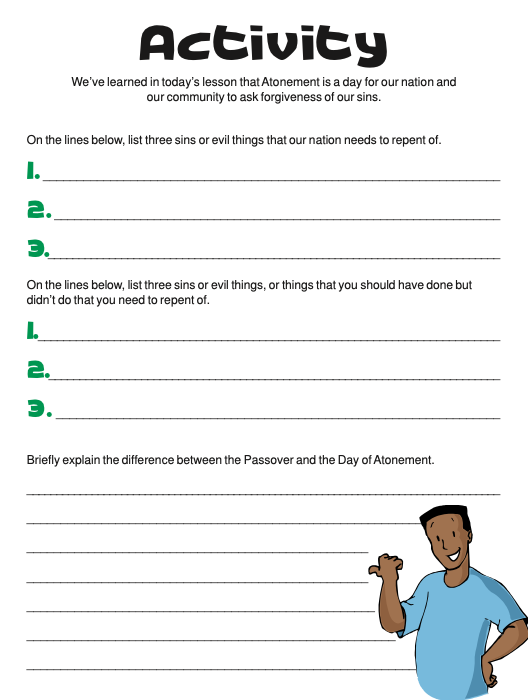
After opening the class with prayer, begin the lesson by having the students draw from a basket one of the articles depicting a national sin. Give them a few minutes to read the article. After they finish reading the article, tell them to go to the newsprint pad and write the national sin that their article tells about. Then go around the room and have each student read the article he drew. After each article has been read, ask what this shows that our nation is doing wrong, what the class thinks the punishment will be if we don’t repent, and what we, as Christians, can do to change the situation. Ask students if they wrote any other national sins in the activity in their book that are not on the newsprint pad. Have them add to the list any that are not already there.
Passover and Personal Sins - Discuss that in Old Testament times, a lamb was slain on the Passover. This lamb was a symbol of Christ coming to die for our sins. The Passover pictures the forgiveness of our individual sins. Our relationship with God is a very personal thing. So is our salvation. If you were the only person who had ever sinned, God would have had to send His Son to die so that we might have forgiveness. Had He not done this, we would have to die for our own sins.
Atonement: a community or national forgiveness? - Explain that the sins the students wrote on the newsprint pad are so enormous, so bad, that God had to provide a way for them to be forgiven. Discuss how every time Israel of old forgot God and became a sinful nation, they were captured by their enemies and went into captivity.
Sin is serious business - Lead students in a discussion of how serious sin really is. Have one of the better readers to read Exodus 20:4-6. Point out that this sin is putting something ahead of the true God. This is called idolatry. God is to always come first in our lives. If a nation doesn’t put God first, He will punish them to the third and fourth generation. That means that God’s blessing will be withheld from their grandchildren and even their great-grandchildren if they don’t repent of putting something before the true God.
The play in the Temple - Talk about how God provided a way for a nation to be forgiven of their sins. This story is told in a play that the High Priest acted out in the Temple on the Day of Atonement every year.
The two goats - Ask a student to explain the part the first goat played in the ceremony on the Day of Atonement. See if other students have anything they can add to it. Let another student talk about the part the second goat had in this play. Give other students the opportunity to add to it. If they don’t tell about the goat being sent into the wilderness after the High Priest put the sins of all Israel on its head, prompt them to tell this. Ask if they can think of any Scripture that shows how good this is for us. Have a student read Psalm 103:12. Ask: Do you think this is what the Day of Atonement shows us? God doesn’t like sin and He wants it out of His sight. The High Priest put all of the sins of Israel on the head of the second Goat and sent him away. God wants a loving relationship with us. He wants to bless us and do lots of good things for us. He wants to help us get rid of our sins personally and nationally.
Review Questions
1. What did the High Priest do in the Temple on the Day of Atonement?
2. What part did the two goats play in this drama?
3. How is the Passover different from the Day of Atonement?
4. Why was it important that the High Priest carefully follow God’s instructions?
Teacher-Directed Activity
Before class, cut out a bookmark pattern (6" x2” with a point on one end and a hole in the other), for the students to trace on poster paper. Each student should cut out a bookmark and punch a hole in the top for the tassel. These are to remind them that the Day of Atonement pictures our national sins being forgiven. Have them write “Atonement” on one side and come up with their own national slogan for the other side. It can be such things as: “God Bless America,” “One Nation Under God,” etc. Let them select patriotic stickers and decorate their bookmarks.
REACH Activity
Back to the Bible: Two as a Single Offering
Do you think it’s odd that Leviticus 16:5 says that the two goats are a sin offering? The two of them together make a single sin offering. This is not the only place two things make a single offering. Look up Leviticus 14:49-53. This offering uses two birds for the cleansing of a house. One bird is killed; the other bird is released alive. Look up Leviticus 23:17. Here two loaves are an offering which is waved before the LORD on Pentecost.
In the case of the two goats, let’s investigate why there were two. Leviticus 16:15-16 says that the blood of the first goat is sprinkled on the mercy seat to make atonement for the Most Holy Place because of the uncleanness and rebellion of the Israelites. Leviticus 16:18-19 says that some of the goat’s blood is also sprinkled on the altar to cleanse it from the uncleanness of the Israelites. Then Leviticus 16:21-22 says that the High Priest confesses all of the sins of the Israelites, all of their iniquities, on the head of the second goat and he carries their sins away from camp into a wilderness area. The two goats are needed to show two aspects of Jesus’ sacrifice for us: He purifies us from sin and takes our sins away from us, as far as the east is from the west (Psalm 103:12).
Write about this in your Bible notebook.
Journal Jot: Reconciliation
Have you ever had a serious conflict with someone? But, of course. We all do. It is an enormous blessing when the conflict and tension is finally resolved and you are reconciled again. Your friendship and connection is restored. In your Bible notebook, write about a time when this happened to you. How did the reconciliation happen? How do you feel now that the conflict is gone?
Then draw a comparison to the reconciliation that Jesus provides to us, symbolized by the Day of Atonement. He is the One who intercedes on our behalf with the Father, with His blood. Write about how much that reconciliation means to you - knowing that Jesus has restored our relationship with the Father so that we can come before Him.
Word Study: afflict, humble, deny - anah (Strongs 6031)
In Leviticus 23:27, the NASB says that we are to humble ourselves. The NIV translation uses the word “deny.” The ESV and KJV say we are to afflict ourselves.
This word means to be bowed down or afflicted, by men or by God. It can also mean to humble oneself because you have afflicted yourself, especially by fasting. [Source: https://biblehub.com/hebrew/6031.htm]
How interesting that the word, that is used in Exodus 1:11-12 where the Egyptians were afflicting the Israelites with hard labor, is the same word that is used in Leviticus 23:27 and means to afflict yourself!! The implication is, then, that our bondage to sin is something that bows us down and afflicts our souls. We are released from the bondage by the blood of Jesus Christ and His intercession before the Father on our behalf.
Draw a diagram in your Bible notebook comparing the use of the word anah in Exodus 1:11-12 with its use in Leviticus 23:27. You may also just want to do a simple drawing depicting each use. Remember to label a scripture reference and make a note so you remember this word.
Just Toolin’ Around: The Tabernacle and Temple
Using a Bible reference (encyclopedia, study Bible, charts book, etc.), find a depiction of the layout of the tabernacle and the temple. Where were the lampstand, table of showbread, altar of incense, and the ark of the covenant with the mercy seat? What were the dimensions given for the tabernacle? How was that different for the temple? Make a copy of the diagrams to add to your Bible notebook. Jot down some of the Biblical references about the tabernacle and temple, i.e. Exodus 36 and 1 Kings 6.
Did you Know? Fasting
Read Leviticus 23:27, 29. God’s command is to deny (NIV), humble (NASB), or afflict (ESV, KJV) ourselves on the Day of Atonement. God goes on to say anyone who doesn’t do this shall be cut off from his people. That’s a pretty serious consequence! So we need to know exactly what that means. How do we arrive at “fasting” when the word says to deny, humble, or afflict ourselves? Daniel used fasting to humble himself (Daniel 10:2, 12). Ezra 8:21 and Psalm 35:13 cite using fasting to humble themselves before God. Isaiah 58 describes the kind of fasting (afflicting yourself) that is pleasing to God.
Write about what you have learned in your Bible notebook.
Stretch It Out: Isaiah 58
Read this chapter and see if there’s something in those verses that convicts you about doing something to help someone else. God isn’t interested in us just going through the motions of not eating; He wants our attitude toward Him and towards others to change. He wants our hearts to be open to helping others and following God’s ways with all of our hearts - not because we have to, but because we love Him. Talk with your family about how to apply this chapter to your lives on this very important holy day. Make plans. Write about it in your Bible notebook.
Music Notes: To God Be The Glory
This hymn is on page 26 of the CEM Hymnal.
Many of Fanny Crosby’s more than 8000 hymn texts are a subjective testimony or a Christian experience type of song. This one is objective praise of God! [Source: Osbeck, Kenneith W. Amazing Grace. Kregel Pub., 1990. p. 357.]
How appropriate this hymn is for the Day of Atonement! On a day when the community of believers comes before God to recognize His provision to reconcile us to Himself, we should be singing a song of objective praise to Him! He has provided atonement and opened the doors to eternal life for us all through the blood of Jesus Christ, His Son!
Look up the text of this hymn and write it on drawing paper in your neatest handwriting. Focus on the words as you are completing this art project. Find a good place to display it when you are finished. Then sing the hymn with rejoicing!
Questions?
Remember to write any questions that you have in your journal. That way you will remember to ask your parents, teacher, or minister.
Song
“Fairest Lord Jesus” is on page 79 of Kids Classics Collection.
Closing Prayer
Ask a volunteer to lead in prayer thanking God for having a way to forgive our personal and national sins when we repent of them.
Printable Pages