YEA Lesson Library
The Trumpet Sounds
About This Lesson
The lesson teaches about the times when a trumpet was used in the Old Testament and how it points to the return of Jesus Christ. This is an important holy day to celebrate!
Scriptures
Exodus 19:16-24
Exodus 20:18-21
Leviticus 23:23-25
Numbers 10:1-5
Numbers 29:1-5
Psalm 81:2-3
Ezekiel 33:1-6
1 Corinthians 15:50-58
1 Thes. 4:13-18
1 Thessalonians 4:16
Revelation 11:15-29
Words to Know
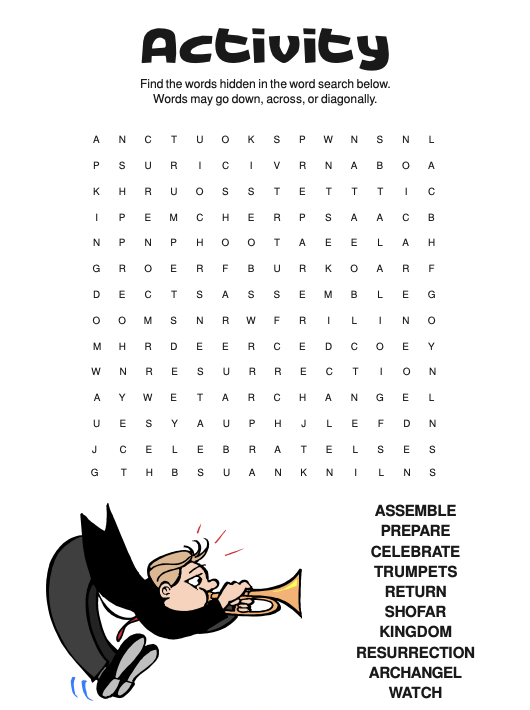
ASSEMBLE - to gather together, in this case, to worship God.
PREPARE - to get ready
CELEBRATE - in this case, to joyfully keep the Holy Day as a Sabbath of rest.
SUMMON - a call to appear
The Lesson
When the children of Israel came out of Egypt, there were at least 600,000 men plus women and children. That’s a lot of people! They didn’t have modern conveniences like cell phones to communicate with each other. Think about it. How would they notify that many people about an assembly, to break camp, or when to begin marching toward the Promised Land? Since the trumpet blast could be heard over a large area, it was the answer to this problem. Leaders used the trumpet to let people know what they were supposed to do. There was one trumpet call for them to assemble, and another call to set out on the day’s march which was different for each of the tribes of Israel. There was still another call to set up camp.
“Now the Lord said to Moses, ‘Make two trumpets of beaten silver to be used for summoning the people to assemble and for signaling the breaking of camp. When both trumpets are blown, the people will know that they are to gather at the entrance of the Tabernacle. But if only one is blown, then only the chiefs of the tribes of Israel shall come to you. Different trumpet blasts will be necessary to distinguish between the summons to assemble and the signal to break camp and move onward” (Numbers 10:1-6 TLB).
Does it sound strange that the trumpet was also used a long time ago to let people know what was going on? The trumpet is still used today, especially in the military. You may be familiar with some trumpet calls. You have heard the trumpet sound for “Charge!” There’s another for sadness and respect at funerals. It is called “Taps.” Then there’s “Reveille.” It is played early in the morning to awaken soldiers and sailors from sleep. The bedtime tune is “Day is Done.”
You have something similar at school. Instead of trumpets to announce changes or things about to happen, you hear a bell—the recess bell, the bell for dismissal, the lunch bell, etc. They all sound the same, but you know they are different because of the time of the day they ring. Occasionally other bells sound at school. There are fire alarms or maybe a tornado alert siren, depending on where you live. When they sound, you already know what it is, even if you don’t hear it every day. You also know that you’ve got to move quickly, following directions so that you will be safe from danger.
Just as you are used to bells, the Israelites were used to trumpets. In fact, God named one of His Holy Days the “Feast of Trumpets.” Your memory verse this week says that Christ will return when a trumpet sounds. It will be with an incredible sound—the trumpet blast of God! It’s won’t be a sound that you have ever heard. But, we will recognize what it is, just as you recognize the fire bell.
Schools have fire drills and other safety drills so students can be as prepared as possible if a real fire does occur. Students learn what to do when they hear the fire alarm.
God’s people are blessed with the Feast of Trumpets. It reminds us to be ready because Christ is coming. Jesus told His disciples, “There- fore keep watch, because you do not know on what day your Lord will come” (Matthew 24:42). Just as we don’t know when a fire will start, we don’t know when Jesus will come back. And, just as your teachers expect you to do certain things when you hear the tornado siren, Jesus Christ expects His people—and that includes you—to be obeying Him when He comes back.
Christ’s return will be very different from a disaster like a fire or tornado. After Christ returns, little children won’t be stolen from their parents. You’ll be able to walk home from school by your- self without fear. Christ will end violence in schools, homes, and cities. You’ll be able to play outside by yourself after dark without your parents worrying about your safety. There won’t be any more stealing or lying. You’ll be able to leave your house unlocked all the time. There won’t be any more babies killed just before they’re born. After Christ returns, all things that are wrong and bad in this world will come to an end. The world that Christ will bring will be a wonderful, crime-free place.
Don’t you want to live in a safe world with peace and joy? For you to be a part of that, you have to make the right choices and you must be doing the right things when Christ returns. You must believe on Jesus Christ as your Savior. And you must try to obey and please Him every day. We can’t wait to do these things, we must always be ready. Remember, we don’t know when Christ will return. Celebrating the Feast of Trumpets on the first day of the seventh month is the right thing to do and a good reminder to be ready for Christ’s return.
Student Prayer
Dear Heavenly Father,
Thank you for the Feast of Trumpets which reminds us of the return of your Son, Jesus Christ. Thank you for the kind of world that you have planned for us when Christ returns. Please help me learn to live the kind of life that I should. I very much want to be a part of your Kingdom.
In Jesus’ name I pray.
Amen.
Daily Devotions
Sunday - Leviticus 23:23-25
Monday - Exodus 19:16-24, 20:18-21
Tuesday - Numbers 29:1-5
Wednesday - Ezekiel 33:1-6
Thursday - 1 Corinthians 15:50-58
Friday - 1 Thessalonians 4:16-18
Saturday - Revelation 11:15-29
Objectives
At the end of this lesson, students will be able to:
1. State that Christ will return at the sound of a trumpet.
2. Explain the importance of preparing oneself for the return of Christ.
3. State that the Feast of Trumpets is celebrated on the first day of the seventh month.
4. State that God commands us to celebrate the Feast of Trumpets.
5. Discuss why we should celebrate the Feast of Trumpets.
Topics & Themes
Feast of Trumpets
God’s Kingdom
Holy Day, Trumpets
Jesus, Return of
Obedience
Resurrection
Symbols
Trumpet
Materials Needed
Bible, YEA Students’ and Teacher’s books, attendance and memory verse charts, songbook, CD, CD player, trumpet, pencils, paper, marker
Preparation
A beautiful tapestry is woven as God’s plan unfolds in the meaning of each Holy Day. God uses symbols to teach us about Himself. Often the same typology is found in more than one Holy Day. We believe that the Feast of Trumpets looks forward to the return of Christ. But that does not necessarily mean that it couldn’t hold other meanings as well. Emphasize to the class that we believe that it symbolizes the return of Christ, but don’t limit it to only that event. We are constantly learning about God and the richness of His nature. All of us want to remain open to learning more of Him.
The students’ activity involves writing poetry about the Feast of Trumpets. When writing poetry, they have to think about all aspects of the topic to find words that will work. This is a great way to get their brains actively thinking about the things of God—in this instance, the Feast of Trumpets. The Japanese haiku is an easy form of poetry to use because its lines don’t have to rhyme. The three lines only follow one set of rules: the first line must have five syllables, the second line has seven, and the third line has five again. To prepare students to write a haiku or two, try your own hand at them before class. If you can write one of your own out in calligraphy on construction paper, it will encourage students to take a risk and write one.
How to Teach This Lesson
Trumpet Sounds - Find someone in your church who can play the trumpet. So much the better if a child in your class plays the trumpet in the school band. Have “Charge!” played and ask the students if they know which message that sends. Then have “Reveille” played and ask the students if they know what message that sends. Then have “Day is Done” and “Taps” played and discuss the message they tell us.
Trumpets and Israelites - Involve students in a discussion about how difficult it must have been to notify all the Israelites of an assembly, or to break camp and be ready to march on toward the Promised Land. Ask: Who told Moses to use trumpets to summon the people? What were the Israelites to do when two trumpets were blown? (Gather at the entrance of the Tabernacle.) What were the Israelites to do when only one trumpet was blown? (Only the chiefs of the tribes of Israel should come.)
Bells today - Continue the discussion by comparing of bells in school today with the sounds of trumpets.
Trumpet signals a new month - Now have one blast on the trumpet played and ask: Does anyone know what that means? Ask a student to read Psalm 81:2-3. Explain that the trumpet was blown at the beginning of every month.
The seventh trumpet is blown - Ask: What happened when the trumpet was blown on the first day of the seventh month? (The Feast of Trumpets was celebrated.) What does the Feast of Trumpets picture? (The return of Christ.) Would you be ready if Christ came today? What things would you want to do to get ready for that great event? Would you want to practice to make sure you have everything right? What are some actual events you have practiced before they took place? (Piano recitals, taking a test, playing sports, entering a spelling contest, etc.) Discuss the idea that God wants us to practice being the kind of people He wants in His Kingdom. The first time you try something you may not be very good at it, so work at it daily and be ready.
Review Questions
1. When does the Feast of Trumpets come, according to God’s calendar?
2. How were trumpets important to the children of Israel?
3. What is one event that the church believes is symbolized by the Feast of Trumpets?
4. What does the return of Christ mean to you?
5. How do you get ready for the return of Christ?
Teacher-Directed Activity
Lead the children to think about their lives and the things that are not godly. Some- times there are things which we are very aware of, things that we know God would not approve of. Other times, we need to be shown our faults. You may wish to tell the students that David prayed that God would show him his faults, and encourage them to pray this as well. Depending on the students, journaling is a good way to keep track of where they are and where they want to be. They could be encouraged to keep a prayer journal—with the understanding that no one else ever sees it.
Let students partner to create their haiku poem. Before they begin, brainstorm and write what they give you on the board. This should include such things as: Feast of Trumpets, celebrate, blast, assemble, return of Christ, Israelites, march, Promised Land, etc. Then if appropriate, display their creations on the church bulletin board.
REACH Activity
Back to the Bible: Trumpets
You know that the Israelites didn’t have cell phones or television or radio when they were coming out of Egypt. So how did they know when to set out on the march? How did they know to break camp (take down their tents and get ready to move)? How did they know when to assemble at the tabernacle? How did they know who was supposed to assemble - everyone or just the leaders? How did they know when it was a new month? Read Numbers 10:1-10. God told them how to solve their communication problem - using the silver trumpet. These long, straight instruments were used later in the temple. In your Bible notebook, write down all of the different times the silver trumpets were blown according to Numbers 10:1-10
The shofar (ram’s horn) was the more common trumpet. It was used to summon warriors to battle and signaled the beginning of the attack; it was used at Jericho; it summoned worshippers to Jerusalem; it was blown by watchmen to announce important news; it was used during coronation ceremonies; and it was sounded on holy occasions. In your Bible notebook, next to your list of when the silver trumpets were used, add a note of when the shofar was used as well. [Source: NIV Archaeological Study Bible. Zondervan, 2005. p. 898.]
Journal Jot: Communication
Communication is extremely important. If your communication is misunderstood, you will have problems! In your Bible notebook, write about a time when someone misunderstood you and the problems it caused.
Now, think about someone intentionally (maliciously or not) trying to confuse communication between people. For example, no one would misunderstand the trumpet order “Charge!!” We’re very familiar with that sound. But what if you didn’t understand the different signals of the trumpets? In your Bible notebook, write the pros and cons of using trumpets for communication. Then read 1 Thessalonians 4:16. There’s no doubt that we’ll understand the trumpet call of God when Jesus Christ returns! That communication will be clear.
Word Study: archangel - archággelos (Strong’s #743)
The word “archangel” in 1 Thessalonians 4:16 is a Greek word which comes from two words: árchō (to rule) and ággelos (angel or messenger). According to Zodhiates, “this denotes the first or highest angel, archangel, leader of the angels. It denotes a definite rank by virtue of which one is qualified for special rank and service.”
[Source: Zodhiates, Spiros. “Archággelos,” The Hebrew-Greek Key Word Study Bible (KJV). AMG International, Inc., 1991, pg.1695.]
There is no doubt that everyone who is alive will be watching the return of Jesus Christ! All of the angels will almost certainly attend this epic event!
Write your memory verse in your Bible notebook. Then add a note about this word - archangel.
Just Toolin’ Around: The Feast of Trumpets
Relatively little is said about the Feast of Trumpets in the Old Testament. Look it up. Leviticus 23:23-25 and Numbers 29:1-9 give the command. Using a concordance, find every place in the Bible that the Feast of Trumpets is mentioned. Write these in your Bible notebook. Then write a summary of what you found.
Did you Know? The Sound of the Trumpet
Because of the trumpet blasts recorded in Exodus 19:16-19 when God met with the Israelites just coming out of Egypt, the Israelites would have associated the sound of the trumpet with the visible manifestation of God. Then when God gave the instructions for the use of the trumpet, they would have learned to associate the trumpet with guidance and direction from God - as well as a promise that God would remember them and rescue them from their enemies in battle when God heard the trumpet (Numbers 10:9). Later, the Israelites would have added to their understanding of what the sound of the trumpet meant when God caused the walls of Jericho to fall with the sound of the trumpets (Joshua 6:16)! [Source: NIV Archaeological Study Bible. Zondervan, 2005. p. 186.]
Think about these instances and extrapolate in your Bible notebook about how each of these could apply in your life and to the Feast of Trumpets today.
Stretch It Out: Research Current Monarchs
A strong case can be made that Jesus Christ will return to set up His kingdom on this earth on the Feast of Trumpets. He will be crowned King! Every knee will bow before Him. The coronation of the Supreme Monarch will be something we’ll never forget!
Using the internet or encyclopedia, research current world monarchs. How many are there? When were they crowned? How long have they reigned? What country do they rule over? And, if you’re really intrigued, find out if any of them are related?
Music Notes: “Joy to the World”
This hymn is on page 121 in the CEM Hymnal.
Although many people view this hymn as a Christmas carol, it is actually a paraphrase by Isaac Watts of Psalm 98 and was originally entitled “The Messiah’s Coming and Kingdom” when it was published in 1719. It was, then, penned to be sung as a hymn of rejoicing at Jesus’ second coming, His return as conquering King! Read through the verses and see how much more these words will apply to the second coming of Jesus on the Feast of Trumpets than to His birth as a baby in Bethlehem.
Write your favorite lines from this hymn in your Bible notebook. Then find the specific verses in Psalm 98 they are taken from. Then sing this hymn! And if someone asks, it’s not a Christmas carol! [Source: Osbeck, Kenneith W. Amazing Grace. Kregel Pub., 1990. p. 368.]
Questions?
Remember to write any questions that you have in your journal. That way you will remember to ask your parents, teacher, or minister.
Song
“Dare to Be a Daniel” is on page 9 of Kids Classics Collection.
Closing Prayer
Lead the children in prayer thanking God for the Feast of Trumpets, for giving all of us the reminder to live a godly life in anticipation of Christ’s return. Include in your prayer “Thy kingdom come.”
Printable Pages