YEA Lesson Library
Three Names - One Feast
About This Lesson
This lesson explains the three different names for Pentecost and emphasizes our need to celebrate this important holy day.
Scriptures
Leviticus 23:9-22
Leviticus 23:15-16
Numbers 28:26-31
John 3:8
John 7:37-39
Acts 2:1-47
1 Corinthians 15:20-28
Galatians 5:22-23
Words to Know
FIRSTFRUITS - the first harvested grain; symbol for Jesus and Christians who will be resurrected at His return
CEREMONY - a formal act or observance, like a wedding ceremony
The Lesson
America’s first Thanksgiving day was celebrated by Pilgrims who came to this country looking for freedom to worship God. In the fall, when their crops had been harvested, they held a feast. Thanksgiving is a harvest feast celebrated because God blessed the Pilgrims with a good crop. God also has harvest festivals He wants us to celebrate.
During the Days of Unleavened Bread, a very important event happened in Israel. After the Sabbath was over, the very first stalk of grain was cut. This stalk of grain was waved in a ceremony before God as the Wave Sheaf offering. God required this to happen before the Israelites could harvest and eat any of the spring crop. This ceremony was very symbolic, as you will see in this lesson.
Once the first sheaf was offered, seven weeks of harvest began. After seven weeks of harvest, the people had another Holy Day—the Feast of Weeks. This feast has several different names which express different meanings. It is called the Feast of Weeks because the people harvested the first crop of the year for seven weeks. Another name for this feast is Pentecost—that’s what we usually call it. Pentecost means 50, as in your memory verse. It is also called the Feast of Firstfruits because it came when the first crop of the year was harvested in the spring.
Jesus Christ was crucified on the Passover day—a Wednesday. He was raised from the dead three days later during the Days of Unleavened Bread. The Wave Sheaf was required by God to be offered on the first day of the week. It was the very first stalk of grain cut. It had to be offered to God before the harvest could begin. This was a symbol of what Jesus was born to do for us.
So after Jesus was resurrected from the dead, He presented Himself to God, His Father, as the Wave Sheaf offering. This happened on the first day of the week—the Sunday during the Days of Unleavened Bread. The “Wave Sheaf” is another symbol for Jesus Christ.
Jesus was the very “Firstfruit” to be harvested and offered up to God. He was the very first per- son to be resurrected from the dead and become a spirit being with eternal life. This makes the name “Feast of Firstfruits” very important to us. God’s children will also be resurrected someday if we continue to love, obey, and serve God.
Seven weeks after Christ’s resurrection, another interesting thing happened. People were gathered to celebrate Pentecost in Jerusalem. Suddenly there was a sound like the roaring of a mighty wind. Then, what looked like flames or tongues of fire settled on their heads. On the Day of Pentecost, the Holy Spirit came with great power. Everyone was filled with the Holy Spirit.
Because of this event, many people believed on Christ and 3000 people were baptized that very day. Do you think all of these people were just old people? How old do you think the youngest person was? The church grew enormously in just one day. How would you like to see 3000 people baptized in your church in one day? Wouldn’t that be a wonderful event? That would really be something to celebrate! And Pentecost is a day to celebrate!
What does Pentecost have to do with you today? First it helps us to see how powerful God’s Spirit is and how it can change lives. It shows us that God will resurrect His people to be the “firstfruits” when Christ returns. The resurrection is like a great harvest of God’s people. This is a time when God will make us His very own sons and daughters. You and I have to make sure that we are ready to be harvested. To be ready, you must have God’s Spirit living in you.
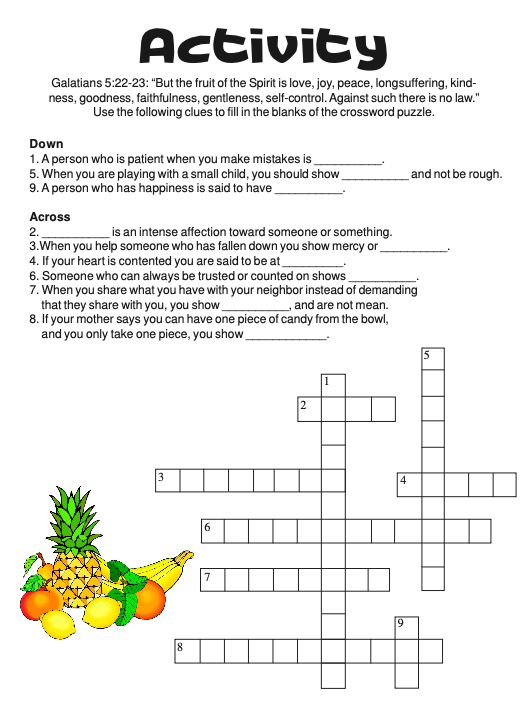
When God’s Spirit lives in us it produces fruits in our lives. Galatians 5:22-23 lists these fruits as: love, joy, peace, patience, kindness, goodness, faithfulness, gentleness and self-control. Those are all good characteristics to have in your life. One way we can get ready to be a firstfruit at Christ’s return is to show the fruits of God’s Holy Spirit in our lives today. These fruits will help you be a better person. They will help you grow so that you will be ready for God’s harvest.
On the Last Great Day of the Feast, Jesus described the Holy Spirit as living water. The Holy Spirit came with great power on Pentecost. Plants grow best when they have plenty of water. Your Christian life is like a plant—it needs to be watered with God’s Spirit. Then the Holy Spirit will help you grow into the person God wants you to be. The Holy Spirit works to remind you to do what is right. When you choose to do wrong, you may not hear the Holy Spirit as well the next time.
It is for your good that you make the right choices. The Holy Spirit is there to help you. Don’t you want to be in the harvest of firstfruits? See how many of the fruits of the Spirit you can put in your life. This will be pleasing to God.
Student Prayer
Dear Heavenly Father,
Thank you for the symbols that you give to help us understand your plan. Thank you for your Son, who was our Wave Sheaf offering. Thank you for Pentecost and for giving your Holy Spirit. Help us learn to live as you would have us to.
In Jesus’ name I pray.
Amen.
Daily Devotions
Sunday - Leviticus 23:9-22
Monday - Acts 2:1-13
Tuesday - Numbers 28:26-31
Wednesday - John 3:8
Thursday - Acts 2:14-36
Friday - Acts 2:37-47
Saturday - 1 Corinthians 15:20-28
Objectives
At the end of this lesson, students will be able to:
1. Explain that Pentecost means “Count 50.”
2. Tell that Pentecost comes seven weeks after the Wave Sheaf offering.
3. State that the church was empowered with the Holy Spirit on the first Pentecost after Christ’s resurrection.
4. Explain that the Holy Spirit is given to produce good fruits in our lives.
5. State that the Wave Sheaf offering is another symbol for Jesus Christ.
6. State that water is a symbol of the Holy Spirit.
7. Explain that from the Wave Sheaf offering until Pentecost is a harvest season.
Topics & Themes
Eternal Life
Feast of Firstfruits
Feast of Weeks
Fruit of the Spirit
Harvest
Holy Days, Firstfruits
Holy Days, Feast of Weeks
Holy Days, Pentecost
Holy Spirit
Jesus, Resurrection of
Obedience
Pentecost
Symbols
Wave Sheaf
Materials Needed
Bible, YEA Students’ and Teacher’s books, attendance and memory verse charts, 3 sheets of poster paper, markers, crayons, magazines, glue, calendar with space to write, Holy Day calendar, pencils, scissors, construction paper, glitter, songbook, CD, CD player, basket, fruit, tape, hymnals
Preparation
Before class, collect magazines and old calendars so the children can cut water pictures from them to make a collage. Country magazines, Nature Conservancy, state wildlife magazines, etc. are good sources for water scenes. Write and cut out the words, love, joy, peace, patience, kindness, goodness, faithfulness, gentleness, and self-control. Tape each of the words on different pieces of fruit. Make a list of the dates of important events to go on the calendar for this year.
Juniors are making the transition between concrete and abstract. Symbols they already know which stand for Jesus Christ should be reviewed. Introduce the Wave Sheaf offering and firstfruits so that symbolism will be very clear before you begin the lesson.
Kids this age can chatter endlessly with their friends on the telephone, yet go silent in class. However, if you surveyed them on their favorite teacher, you might be surprised to learn that they prefer teachers who promote lively discussion in class.
How to Teach This Lesson
Start the class by having students help you make three charts showing the different names for the Feast of Pentecost and what each one means. This can be done on three separate sheets of poster paper attached to the wall. Caption each one with the following: Feast of Weeks, Pentecost, and Firstfruits. Encourage students to think of things to represent each name for this festival. Have them write or draw these on the charts to make each meaning visual and memorable. You may have to prompt them by giving clues from their lesson.
Such things as seven weeks should find their way under the Feast of Weeks; 50 and 3000 people being baptized under Pentecost; and harvest, Christ, and Christians being resurrected under Firstfruits.
When they have completed the charts, lead them in discussing each thing they added to it. Encourage students to contribute their ideas as much as they will—as long as their comments are on topic.
Feast of Weeks - Seven weeks of harvest began when the first sheaf of grain was cut and offered on Sunday after Passover. Nothing could be harvested or eaten from this crop until this was done.
The Wave Sheaf was a symbol of Jesus ascending to the Father on the Sunday after His resurrection. Jesus was our Wave Sheaf offering.
Pentecost - means 50. This is the only Holy Day that does not have a specific date on the calendar. God told us that we have to count 50 days from the Sunday after Passover to know when we should keep this day. God empowered His church with His Spirit on Pentecost and 3000 people were baptized that day.
Firstfruits - Jesus was the Firstfruit of the harvest. When Christians are resurrected from the dead they will also be “firstfruits.” This festival is a harvest festival—a spring harvest. When a crop is planted, it should produce fruit, and that fruit is intended to be reaped or harvested. Jesus was the first to be reaped in God’s harvest and Christians will be reaped at the resurrection.
Holy Spirit - Lead the students to understand why they need the Holy Spirit—that it is God’s power that He gives to help them to be like Christ.
Fruits of the Spirit - Fruits must be produced before you have anything to harvest. Since we will be part of God’s harvest, we must bear fruit. Have students turn in their Bibles to Galatians 5:22-23 and read it aloud. Pass around the basket of fruit. Let each student pick one piece of fruit out of the bowl. It will have one of the fruits of the Spirit taped to it. Ask them to tell how they can show that fruit (the word on their fruit) by the life they live each day.
Review Questions
1. Who was our Wave Sheaf offering? When was the Wave Sheaf offered?
2. Why is Christ also called the First of the Firstfruits?
3. How do we figure out when Pentecost is?
4. What is harvested during the seven weeks before Pentecost?
5. What are the three names of this Holy Day? Why does it have three names? What do they mean?
6. Why is the Holy Day important to each person?
7. What sorts of actions does God look for from us when He gets ready for His harvest?
Teacher-Directed Activity
Let students cut out water scenes from old magazines and calendars (or draw their own if magazines aren’t available). Then glue the pictures on a piece of construction paper (collage), leaving room at the bottom for a small caption. Let students skim through the hymnal looking for references to water (i.e., “Showers of Blessings,” “It is Well,” “God Shall Wipe Every Tear,” etc.). Then have them write one of the titles or a line from the hymn at the bottom of their collage as a caption. This is to remind them of the abundance of the Holy Spirit.
REACH Activity
Back to the Bible: Three Names
The Feast of Weeks, the Feast of Firstfruits, and Pentecost are all names for this holy day. Find where each name is used in the Bible. Write the names and the scripture citations in your Bible notebook. Then using your Bible and YEA lesson, write a rationale for each name. Why was it used? What does it point to? Which name do you prefer? Why?
Journal Jot: Acts 2
Read Acts 2 in its entirety. Can you imagine what it would have been like to be there to witness all of the events - the Spirit like tongues of fire, all speaking in tongues, the crowd hearing them in their own language, Peter’s sermon, the hearers cut to the heart, 3000 people repenting, the community of believers? As you read the passage, make notes in your Bible journal about the amazing events that all occurred on the Day of Pentecost. Then, ask yourself this question: Why is Pentecost special to me? If you can’t figure out a reason, go ask your parents. God has a special and individual lesson for each of His holy days. There’s a reason He wants you to celebrate. There’s something specifically for you. What is it? Write about this in your Bible notebook.
Word Study: Count - saphar (H5608)
This word used in Leviticus 23:15 means “to score (with a mark as a tally); to inscribe; to enumerate; to recount, tell, narrate, make known; to praise, speak; to celebrate; to polish.” In some way, then, God commands His people to count or mark the days between the Wave Sheaf Day and the day of Pentecost. 50 days! One of the interesting pieces of this word is that when it’s used as a participle (a word formed from a verb and used as an adjective - like counting chart or celebrated event), it means writer or scribe. [Source: Zodhiates, Spiros. The Hebrew-Greek Key Word Study Bible (KJV). AMG International, Inc., 1991.]
Using this definition, you could make a strong case for keeping a Pentecost journal - writing in a journal every day for 50 days. Make it your goal to start a Pentecost journal on Day One of the count. Write in it every day. Then, next year, get out your journal and write a new entry on Day One of that new year. Over the years you will see amazing coincidences and similarities as you count down (write your way) to Pentecost.
Just Toolin’ Around: The Nations of Pentecost
Acts 2:5-11 mentions a lot of nationalities (16, to be exact) present in Jerusalem! Using a Biblical Maps and Charts reference or a Biblical encyclopedia, find a map of the Mediterranean region. Copy it. Find out where all of these places were. Label all of the nations mentioned in their proper location. Add this to your Bible notebook.
Did you Know? Wine
The people hearing the gospel spoken in their own languages were sure that the disciples were drunk! What else could be the explanation? (Acts 2:13) “In the New Testament, the primary Greek word for ‘wine’ is oinos. The word gleukos (‘new, sweet wine’) occurs only here. [Source: NIV Archaeological Study Bible. Zondervan, 2005. p. 1768.]
Although wine would have been part of the Mediterranean culture and would have been completely acceptable, drinking to excess is never pleasing to God (Proverbs 20:1, Proverbs 23:20; Isaiah 5:11) and priests were prohibited from drinking while ministering at the sanctuary (Leviticus 10:9). Some people have tried to use Acts 2:13 to say that the disciples never drank wine; that’s highly unlikely. Wine would have been one of the few ways to use the grapes year round. And we know that Israel had (and still has) many vineyards.
What do you think? Write about it in your Bible notebook, or spend some time talking about this with your parents or pastor.
Stretch It Out: Tares vs. Wheat
In Matthew 13:24-30, 36-43, Jesus tells the parable of the wheat and the tares and then gives the explanation. Do some research about what tares are, using a Bible encyclopedia or the internet. Interestingly, tares do not produce a head (fruit), so the stalks do not have the weight that wheat would have just prior to harvest. That means the head of the wheat will bow under the weight of the grain; the head of the tares will not. There’s an interesting object lesson there: God’s people will produce fruit and will bow to God’s sovereignty. People who are in rebellion to God and His ways will not bow the knee - at least right now - and do not produce godly fruit.
Make a drawing of wheat vs. tares in your Bible notebook. Label which would be considered firstfruits. Add some color.
Music Notes: I Sing the Mighty Power of God
This hymn is on page 33 in the CEM Hymnal. The text was written by Isaac Watts (1674-1748).
Isaac Watts first published this song, “I Sing the Mighty Power of God” in 1715 in a hymnal for children. Most of the songs in the church at this time were taken, word for word from the psalms, and they were more chanted than sung. Nineteen year-old Isaac complained to his father that the songs were boring. His dad challenged him to do something about it. He began writing songs like this one. It was not well-received by the church; they felt that anything not taken directly, word for word from the psalms was not inspired. Isaac Watts disagreed. He thought that if people were allowed to pray using their own words, they ought to be able to sing using their own words. And it wasn’t a huge departure from word for word since most of his songs and hymns are paraphrases of scripture. This hymn is based on passages such as Jeremiah 10:12-13: He hath made the earth by his power, he hath established the world by his wisdom, and hath stretched out the heavens by his discretion. When he uttereth his voice, there is a multitude of waters in the heavens, and he causeth the vapors to ascend from the ends of the earth; he maketh lightnings with rain and bringeth forth the wind out of his treasures.
Sing this hymn and then write a responsive paragraph about the hymn, what it makes you think of and how it makes you feel, in your Bible notebook. [Source: Osbeck, Kenneith W. Amazing Grace. Kregel Pub., 1990. p. 333.]
Questions?
Remember to write any questions that you have in your journal. That way you will remember to ask your parents, teacher, or minister.
Song
“I’ve Got Peace Like a River” is on page 63 of Kids Classics Collection.
Closing Prayer
Ask for a volunteer to lead in prayer thanking God for His Spirit that gives them power to become like Christ and to be in His Kingdom.
Printable Pages