YEA Lesson Library
No Pizza For a Week
About This Lesson
This lesson teaches the Old Testament foundation for the Days of Unleavened Bread and then ties this holy day to Jesus Christ and our need to celebrate it.
Scriptures
Exodus 12:14-20
Exodus 12:15
Exodus 12:34-39
Exodus 13:6-10
Exodus 23:14-15
Leviticus 23:4-8
Numbers 28:17-25
John 6:35, 48-51
1 Corinthians 5:2-13
Words to Know
YEAST - ingredient that helps bread products to rise, to be puffed up
LEAVEN - ingredient that helps bread products to rise, to be puffed up
WICKED - doing things against God’s laws SINCERITY - meaning what you say, and saying what you mean
SYMBOL - something that stands for or represents something else
The Lesson
One spring day, Jason came running into the house after school. He was really hungry. Mom was in the kitchen. “Mom,” he said, “what’s for dinner?” “We’re having tacos, Spanish rice, a salad, and brownies. “But I wanted pizza tonight,” Jason exclaimed. “Jason, have you forgotten that these are the Days of Unleavened Bread?” Mom said. “Oh, that’s right,” said Jason. “That means I can’t have pizza, hamburgers, or sandwiches in my lunch for a whole week.” “You’re right, Jason,” Mom said. “God wants us to do this every year as a reminder.” “What kind of reminder?” Jason asked. Read your Sabbath School lesson and you’ll discover the answers.
Have you heard the old saying, “You are what you eat”? In a sense, that’s true. You have learned in school that nutrients such as proteins, carbohydrates, fats, vitamins, and minerals are needed for a healthy body to grow and repair cells. Some people eat things that are not good for them and are not fit to eat. These should be avoided. Your parents try to make sure that you eat the right things. Remember, God is our Heavenly Father. Why did He command us to eat unleavened bread? Why is it good for us to do this?
In our lesson on the Passover, God’s people were commanded to place the blood of a lamb on the their doorways. When the death angel went through the land, he passed over the houses where there was blood on the doorway. After that, Pharaoh told Moses and all of the Israelites to leave Egypt.
The people packed what they could carry. They left in such a hurry there was not time for their bread to rise. But they were on their way to freedom.
On the first night of the Days of Unleavened Bread, a huge crowd of Israelites left Egypt, “with a high hand.” It is this “Exodus” we remember when we keep the Night to Be Much Observed. God led His people in a cloud by day and a pillar of fire by night—a symbol of how God saved us from sin.
This is a really important event in the history of God’s people. Exodus 12:14-15 tells us, “You shall celebrate this event each year (this is a permanent law) to remind you of this fatal night. The celebration shall last seven days. For that entire period you are to eat only bread made without yeast” (The Living Bible). God felt this time was so important He wants us to celebrate the event every year, and to eat unleavened bread when we do.
We know that the Apostle Paul celebrated the Days of Unleavened Bread long after Christ had been crucified. We also know that God wants us to celebrate them today. It’s that important. But, why is this event so important to God?
We learned that the lamb killed on Passover was a symbol of Jesus Christ. You know how very important it is to God’s children that Jesus came to be the Passover Lamb. There is another symbol that stands for Jesus Christ during the Days of Unleavened Bread. Christ said in John 6:51, “I am the living bread that came down from heaven.”
Leaven in the Bible is a symbol for sin. Since Jesus Christ was completely without sin, He was symbolically unleavened. The Apostle Paul tells that we, too, should cleanse our lives of the leaven of sin and evil. Instead we should celebrate the feast with unleavened bread of sincerity and truth.
For seven days during the Days of Unleavened Bread, leaven is a symbol for sin—for the wicked- ness God does not want in His children. Jesus came to die because of the sin in each of us. So we want to get rid of the sin in each of our lives. Symbolically, we do this by getting rid of all the leaven in our houses. Then we eat unleavened bread as a reminder to choose God’s way.
We often face choices between right and wrong. Obeying God is always best. Since pizza crust is made with leaven, would you be willing to eat No Pizza for a Week? God blesses those who choose to do what is right. The symbol of unleavened bread helps to remind us that Jesus is our Passover Lamb, and that we must avoid sin.
So, why did God command us to eat unleavened bread? God wants us to be what we eat— symbolically—without sin. Getting rid of leavened bread for seven days is a really good reminder to avoid sin in our lives all year long. It reminds us to take in the things of God in every choice that we make. Jesus is our Friend. He wants us to be healthy physically and spiritually. But that means we must make the right choices—we have to choose to live the way God wants us to. Then we can be His children in the Kingdom.
Student Prayer
Dear Heavenly Father,
Thank you for saving your people from Egypt. Thank you for saving us today, too. We appreciate your giving the Days of Unleavened Bread to us as a reminder of the kind of lives we should live. Help us to make the right choices every day.
In Jesus’ name I pray.
Amen.
Daily Devotions
Sunday - Exodus 12:15-20
Monday - Exodus 13:6-10
Tuesday - Exodus 23:14-15
Wednesday - Leviticus 23:4-8
Thursday - Numbers 28:17-25
Friday - John 6:35, 48-51
Saturday - 1 Corinthians 5:2-13
Objectives
At the end of this lesson, students will be able to:
1. Explain why God tells us to eat unleavened bread for seven days.
2. Recite the historical significance of the Days of Unleavened Bread.
3. Repeat that yeast and leavened products are only sinful during the Days of Unleavened Bread.
4. Take an active part in their family’s observance of the Days of Unleavened Bread.
Topics & Themes
Bread of Life
Days of Unleavened Bread
Eating Unleavened Bread
Egypt, Coming Out
Holy Days, Unleavened Bread
Leavening
Night To Be Much Observed
Obedience
Passover
Sin
Symbols
Materials Needed
Bible, YEA Students’ and Teacher’s books, attendance and memory verse charts, songbook, CD, CD player, food labels, chart for Holy Days (see Preparation on page 4), dry erase board and markers, pencils, bowls, flour, salt, vegetable oil, sugar, water, honey or jam, butter, napkins, toaster oven, cookbooks, recipes, bread pan(s), spoon, measuring cups, measuring spoon
Preparation
Prior to class, collect lists of ingredients from boxes of cereal and crackers, Hamburger Helper boxes, loaves of bread, soups, cans of vegetables, pastries, etc., for students to look at for leavening. By discovering what things are likely to be leavened, they’ll learn what things to exclude for the Days of Unleavened Bread. To help them out, cookbooks and recipes can be brought to class.
Paul said that a little yeast works through the whole batch of dough, just as a little sin in our lives will continue to spread until it works throughout our lives. Yeast is a living, growing organism. An explanation of that aspect of yeast would be good.
Juniors are at the age when symbols are very much a part of their lives, but they may not understand the deep, religious significance of those symbols that are so important to God’s people.
How to Teach This Lesson
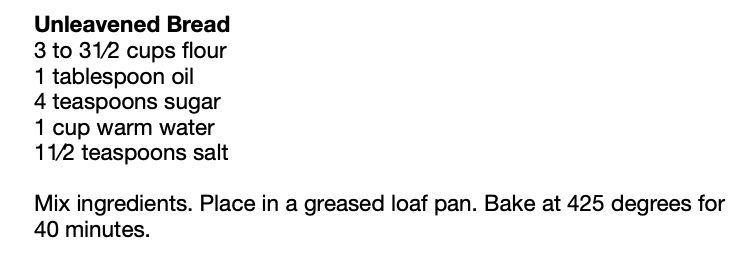
Begin class by making a batch of unleavened bread with your students. This will create a positive, lasting impression upon them. Have the toaster oven hot and the pan oiled. Mix the bread when the students arrive and start it baking so that the students can have a piece of it at the end of the class. The following is a recipe you can use:
Unleavened Bread
3 to 31⁄2 cups flour
1 tablespoon oil
4 teaspoons sugar
1 cup warm water
11⁄2 teaspoons salt
Mix ingredients. Place in a greased loaf pan. Bake at 425 degrees for 40 minutes.
While the bread is baking, have students make a list of symbols they see all the time and what they stand for. Then branch into some of God’s symbols; i.e., the Passover Lamb symbolizing Jesus Christ. Be very cognizant of their depth of understanding of what yeast symbolizes to us and emphasize that yeast is not a bad thing outside of the Days of Unleavened Bread. Jesus compared the Kingdom of Heaven to yeast worked through dough (Matthew 13:33).
Emphasize that although we are not to eat leavened products during the Days of Unleavened Bread, God also commands us to eat unleavened bread. To simply not eat leaven for seven days is not enough. Jesus symbolizes the sweet, unleavened bread. He is the “Bread of Life.” By daily eating some unleavened bread, we are symbolically taking Jesus into our lives.
Discuss how keeping the Days of Unleavened Bread is a choice that God would have us make. Explore the idea of making choices in accordance with the laws of God. It is true that God wants us to make the right choices. It’s also true that we’re not always going to do the right thing. Purposely sinning and then expecting Christ to pay the price is not going to work. However, when we try our best and fail, God will forgive us when we are truly sorry. The Days of Unleavened Bread are like an exercise that we do for seven days to help us remember to make right choices.
Have students tell some choices they are confronted with during the Days of Unleavened Bread and at other times. List these on the board as they give them. Once they get rolling, they will understand what you’re talking about. You may want to give them these examples: going to see an R-rated movie, reading Goosebump books, lying to protect themselves, letting a friend copy their homework, saying something unkind to or about someone, eating pizza or a sandwich during the Days of Unleavened Bread.
Review Questions
1. When do the Days of Unleavened Bread happen each year? Why do they come right after the Passover?
2. Who can explain what happened in Egypt that caused the bread to be unleavened?
3. What does that early event in Egypt have to do with us today?
4. What did the Apostle Paul have to say about yeast? What did he mean?
5. Can you give me three examples of choices you make every day which demonstrate that you are a child of God?
6. Why does God want us to eat unleavened bread for seven days each year?
Teacher-Directed Activity
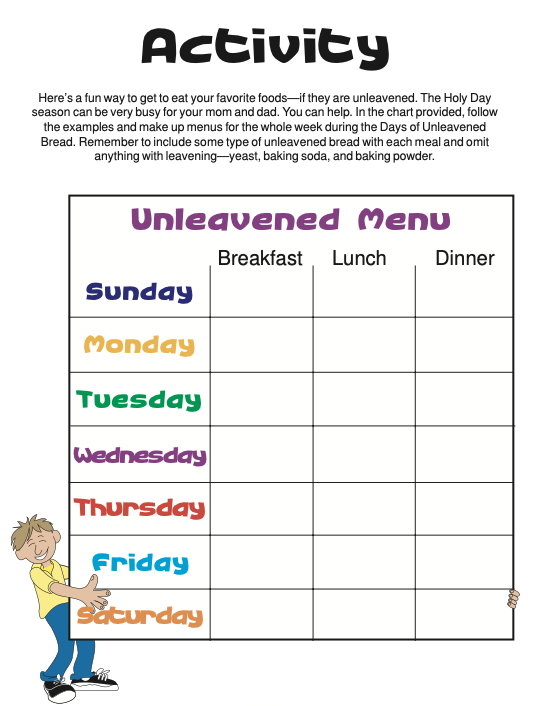
To help students to be more familiar with what they can and can’t eat during the Days of Unleavened Bread, have them use the ingredient labels to explore this. Have them check and correct the menus they made in their book. Give each student a piece of the freshly baked bread with butter and jam or honey on it. Give them the recipe so they can make more bread at home.
REACH Activity
Back to the Bible: Crossing the Red Sea
Read Exodus 14:21-31. There are some who think that the Israelites crossed the Sea of Reeds whose water was only about 4 inches deep. Would that particular idea fit with this passage in Exodus 14? Why or why not? Pick out some of the words which would refute this idea, i.e. wall of water. Write them in your Bible notebook.
Oftentimes during the Days of Unleavened Bread, we focus on the exodus from Egypt - and rightly so. But this second miraculous deliverance also deserves our attention. Take special note of the reaction of the Israelites to the approaching Egyptian army (Exodus 14:10-12). Why would the people have reacted like this? They had just seen all of the plagues in Egypt! Then read Moses’ and God’s responses (Exodus 14:13-18). There would be absolutely no doubt that the LORD is God! Write about this amazing episode in your Bible notebook. You may also want to make a drawing of the walls of water or the drowning Egyptians.
Journal Jot: Leaven
We encounter leaven again in Jesus’ ministry (Matthew 16:6, 12). Read this passage. Then read 1 Corinthians 5:6-8. What kinds of attitudes are connected with being “leavened”? Write what you find in your Bible notebook. Then spend some time thinking about how leaven might have applied to Pharaoh too. Add these ideas to your Bible notebook.
Word Study: Leaven - seor (H7603)
This word in Exodus 12:15 is “yeast,” translated from Hebrew, but is rendered “leaven” in some of the modern translations. There are three different kinds of leavening in our world today: 1) mechanical; 2) chemical; and 3) biological. An example of mechanical leavening is egg whites. Air is captured by the beaten whites and retains the puffed up state during baking. An example of chemical leavening is baking soda. If you didn’t mix the baking soda thoroughly throughout your dough, it would only react and produce air bubbles where the soda is. It cannot spread on its own. 3) True Biblical leavening is yeast, specifically the kind that is used in sourdough. A small bit can be put into the batch of dough. It will divide and spread.
So you may be wondering if you have to avoid things that are leavened with mechanical and chemical leavening products during the Days of Unleavened Bread. Because they are puffed up, it would be best to avoid even the appearance of evil out of reverence for God. Think about this. Write a response in your Bible notebook.
Just Toolin’ Around: Leavening Experiment
Of course, you won’t be able to do this experiment during the Days of Unleavened Bread because there is no leavening in your house. But, either leading up to the days or after the feast is over, try this:
1. Make your favorite cookie recipe as written with leavening (baking soda, baking powder, beaten eggs). Make the same recipe, but leave out the leavening. If it calls for beaten eggs, just don’t beat them. Compare the results. Write about what you did and what happened in your Bible notebook.
2. Mix up a basic recipe of bread (4 cups flour, 1.5 cups water, 3/4 t. salt, 1 T. sugar). Do not add the yeast. Once it is thoroughly mixed, cover the bowl with a clean towel and see how long it takes for the yeast in the air to start working. Check on your dough every couple of hours. Keep detailed notes about what you see in your Bible notebook. Once the dough is leavened, bake it and sample it. Sourdough tastes different than what many are used to eating. What do you think? Write about this in your Bible notebook.
3. Come up with another experiment using leavening. Write about what you did and what you discovered in your Bible notebook.
Did you Know? Economy Destroyed
It was a big deal when the Israelites left Egypt! The plagues destroyed the economy: crops ruined, trees destroyed, livestock killed, and the firstborn dead. Without the Hebrew slaves to work, the entire country would have been scrambling to function. There were an estimated 600,000 men, plus a million women and children, who left Egypt - all of them slaves. They would have been working in construction, brick making, weaving, farming, music, metalworking, leather making, and glass blowing. [Source: Beers, V. G. The Victor Journey Through the Bible. Cook Communications Ministries, 1996. p. 63.]
Do you think any of this was going through the mind of Pharaoh in Exodus 14:5? Could there have been other reasons to pursue the Israelites? Write your thoughts in your Bible notebook.
Stretch It Out: Crossing the Red Sea
Draw a picture of the Israelites crossing the Red Sea. You will want to read the description in Exodus 14 before you begin. Include the pillar of cloud and the Egyptian army. Add color to your drawing using your favorite color tools.
Music Notes: Redeemed
This hymn is on page 117 in the CEM Hymnal.
Fanny Crosby, who was blinded as a toddler, wrote the text to this hymn. It is one of more than 8000 poem/hymn texts written by her. It first appeared in 1882 in a hymnal entitled Songs of Redeeming Love, using William Kirkpatrick’s tune. Fanny Crosby is an incredible example of praising God for the gift of salvation and the hope of eternal life, rather than focusing on the present circumstances of life. [Source: Osbeck, Kenneith W. Amazing Grace. Kregel Pub., 1990. p. 92.]
Think about a slave being bought and then being set free. Sing this hymn with a spirit of rejoicing, knowing that Jesus Christ has paid the ransom for you to be released from slavery to sin.
In your Bible notebook, write down the phrases in this song which you really like.
Questions?
Remember to write any questions that you have in your journal. That way you will remember to ask your parents, teacher, or minister.
Song
“Everybody Ought to Know” is on page 11 of Kids Classics Collection.
Closing Prayer
Guide the children to thank God for the reminders He has given us through His holy days and their symbols.
Printable Pages