YEA Lesson Library
Plagues to Passover
About This Lesson
This lesson teaches about the Old Testament Passover, linking it to Jesus Christ, Our Passover Lamb.
Scriptures
Exodus 12:1-14
Leviticus 23:5
Numbers 9:1-5
Matthew 26:2, 17-30
Mark 12:26
Mark 14:1-2
Luke 22:7, 11-23
John 13:1-30
1 Corinthians 11:20-34
Words to Know
PHARAOH - the ruler of Egypt
PASSOVER - the night when God told Israel to put blood on their doorposts to prevent the death angel from killing their firstborn; we observe it today as a memorial of Jesus’ death
PLAGUE - a severe problem or disease
FIRSTBORN - the oldest son
KNEADING TROUGH - container to make bread in
The Lesson
John’s family drove out to the lake for a picnic. Mom spread a cloth on the picnic table. She had a big plate of fried chicken, fresh tomatoes, potato salad, watermelon, and chocolate cake! Everyone sat down to enjoy the delicious meal, but soon John started stomping his feet. There was a big ant hill under the table. Ants were climbing up the table leg. They were climbing up John’s legs. Then Mom began fanning the flies away from the food. She had to cover the cake to keep the flies away. And, as Dad picked up his can of soda, he saw a yellow-jacket sitting on top of the can. There were bugs everywhere! This was just awful.
These insects ruined their picnic. But this is not the first time people were bothered with insects. Many years ago the Egyptians were bothered with far more bugs and critters. But that was only part of the Egyptians’ problem. They were mean to God’s people and wouldn’t obey Him. God didn’t like this and He had a way of dealing with the problem.
Long ago, God’s people lived in Egypt. They were called the children of Israel, or Israelites. They were in a terrible situation. As slaves in Egypt, they were forced to work very hard. Pharaoh and the Egyptians were very cruel to them. Things got so bad that the children of Israel called out to God— and God heard their prayers.
He decided to help them by sending Moses to lead them out of Egypt. God told Moses to do everything He commanded. God sent Moses and his brother, Aaron, to Pharaoh to tell him to let the Israelites go. But, God said that He would harden Pharaoh’s heart. Even when God used Moses to work wonders and signs, Pharaoh would not listen to him. God promised that He would bring them out with mighty acts of judgment, and that all of Egypt would know that He was the Lord.
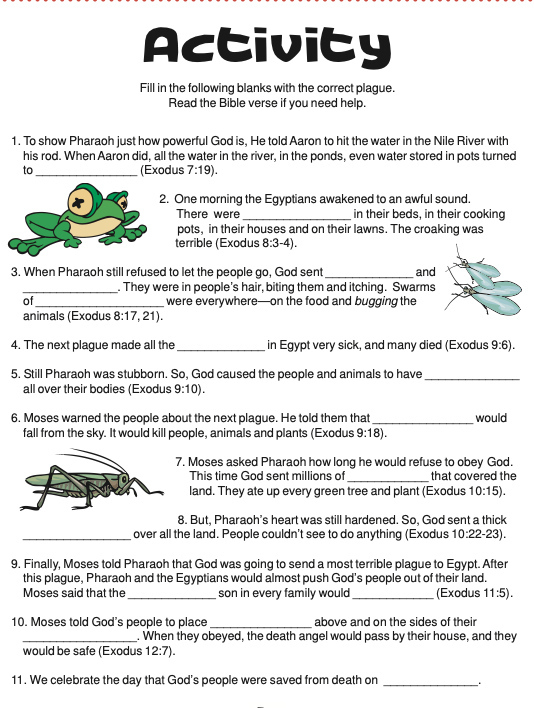
That’s exactly what happened. Moses and Aaron told Pharaoh to let God’s people go, but Pharaoh refused. God began sending plagues against Egypt. The first was a plague of blood. All the water turned to blood—water in the Nile River, in ponds, canals, streams, even wooden buckets and stone jars! There was no water for animals or people to drink. But, still Pharaoh’s heart remained hard. He wouldn’t let God’s people go.
Then God sent another plague—frogs! They came up from the Nile River and were everywhere. Imagine frogs in your bed or frogs hopping in the food your mom is preparing. They were in all the houses, even in Pharaoh’s palace. Frogs were everywhere in Egypt! But, once the frogs were gone, Pharaoh refused to let God’s people go.
God sent more plagues, one at a time. Gnats and flies were on everyone and everything, buzzing and biting. Livestock began dying. Boils tortured their bodies, hail beat their crops down, locusts ate what vegetation was left. Finally there was great darkness over the land. None of these things convinced Pharaoh to allow the Israelites to leave.
Finally, God sent one last plague—the death of the firstborn. God told Moses to tell Pharaoh, “Israel is my firstborn son. . . you refused to let him go; so I will kill your firstborn son.” This plague was on every family that didn’t follow God’s directions.
God told His people to kill a lamb and sprinkle the blood on the sides and tops of their doorposts. The people inside were to eat the lamb and they were to be ready to travel. Once the death angel came through Egypt, the Egyptians would make the Israelites leave.
On Passover night, the death angel came through Egypt. Where there was no blood on the doorpost, the firstborn son and animal died. But, the death angel passed over the houses where there was blood—as God had commanded.
This is important in Israel’s history. But what does it have to do with you? You are one of God’s children. Because everyone sins, you have also sinned. You have done things wrong in your life. And, the Bible tells us that the price for breaking God’s law is death (Romans 6:23). But, God has given you a way out, just as He gave the children of Israel a way to escape the death angel. The way out for each of us is Jesus Christ!
The Passover shows us that God loves us so much that He gave His firstborn Son, Jesus, to die for our sins. He is called the Passover Lamb. When we accept Jesus as our Savior, we accept that He paid the price for the things we have done wrong. We must also try very hard not to sin any more.
You may have wondered why adults are so serious at Passover. It is because they are thinking about what Christ did for each of us. It is a very serious thing. We also thank God for the Passover. The Passover, the sacrifice of Jesus Christ, makes it possible for us to be His children. And we all very much want to be the children of God.
Student Prayer
Dear Heavenly Father,
Thank you for Jesus Christ, our Passover Lamb. We know that He makes it possible for us to be your children. Help us learn how to truly act like your children.
In Jesus’ name I pray.
Amen.
Daily Devotions
Sunday - Exodus 12:1-14
Monday - Numbers 9:1-5
Tuesday - Matthew 26:2, 17-30
Wednesday - Mark 14:1-2, 12:26
Thursday - Luke 22:7, 11-23
Friday - John 13:1-30
Saturday - 1 Corinthians 11:20-34
Objectives
At the end of this lesson, students will be able to:
1. Explain why God sent Moses to Egypt.
2. Describe the plagues that God sent upon Egypt.
3. State why God sent the plagues upon Egypt.
4. Recite why the Passover is important to us today.
5. State that Jesus Christ is our Passover.
Topics & Themes
Aaron
Angel, Death
Blood
Death
Egypt
Egypt, Coming Out
Firstborn
Israelites
Jesus, Death of
Lamb
Moses
Passover
Pharaoh
Plagues
Prayers
Sin
Slaves
Symbols
Materials Needed
Bible, YEA Students’ and Teacher’s books, attendance and memory verse charts, butcher’s paper, markers, crayons, pencils, songbook, CD, CD player, award, paper, chart, pictures of frogs, flies, gnats, and locusts
Preparation
Prior to class, familiarize yourself with the sequence of the plagues (Exodus 7:14 through Exodus 11). As you tell the story of the plagues, give Pharaoh’s reaction to each. If possible, bring in pictures of frogs, flies, gnats, and locusts. Being able to see what was infesting the country will help the children understand how awful it truly was.
A chart can be started for recording each of the Holy Days and their significance. Because the Holy Days stretch out over several months, it is very helpful to the student to review what they’ve learned about each Holy Day as you begin each new lesson. The chart could be made by the students, divided into sections for each Holy Day. It could be comprised of words, drawings, pictures, or any combination of these.
Juniors are at an age where they can be easily distracted by external things such as a friend, music, hunger, allergies, the smell of food, etc. Concentrating on reading and studying the Bible may be difficult because they are easily distracted. Learning is unlikely to take place without their attention. Keeping the students involved is your best way to ensure you have their attention.
How to Teach This Lesson
Before class, attach a long piece of butcher’s paper to the wall with ten divisions and one of the following statements written in each of them for the students to complete by filling in the blanks:
1. For the ______ plague, God had Aaron hit the Nile River with his rod and the water turned to ___________.
2. The ______ plague made all the ______ very sick.
3. For the ________ plague, ________ fell from the sky.
4. For the _________ plague, God sent a thick _________ over all the land and the people couldn’t see.
5. For the ___________ plague, God sent swarms of __________ that were on the food and bugging the animals.
6. For the _________ plague, God told them to put _______ on their houses or the ________ would die.
7. For the ____________ plague, God sent __________. They were in their beds, in their cooking pots, and everywhere.
8. For the ___________ plague, God sent millions of ________ that covered the land, They ate up every green tree and plant.
9. For the _______ plague, God caused the people and animals to have __________ all over their bodies.
10. For the ________ plague, God sent an infestation of __________ that caused people and animals to __________.
Logical thinking drives preteens to put their reasoning and sorting abilities into action. Start the class by giving each student a chance to select one plague, then go up to the butcher’s paper and fill in the blanks. Go around as many times as it takes to get all of the blanks filled in. Give one point for every blank and a bonus point to those who can tell you where this story is found in the Bible. Give an award to the student who has the most points. This exercise will reinforce the activity in the Students’ book giving them the opportunity to memorize the plagues in order.
Debrief by ensuring that the students under- stand why God sent the plagues on Egypt. This age group loves to tell the story and will remember details that you won’t. Passover is an extremely important concept for this age group to really begin to comprehend. Unfortunately because of Nintendo and television, death doesn’t seem as real to this age group. Their creative stories may be peppered with death or dying, without demonstrating any real understanding of its significance.
Also, remember to address both the historical and present day significance of the Passover. When our children tell their friends why our church commemorates the Passover, we want them to be able to explain all of it, not just the Israelites coming out of Egypt. Christ being our Passover is the part that is most important and applicable to their lives.
Review Questions
1. Why did God send Moses to Egypt?
2. Why did God bring plagues on Egypt?
3. Why do you think God hardened Pharaoh’s heart?
4. Can you recite the ten plagues in order?
5. What was the way out of the tenth plague for the Israelites?
6. What does the Passover mean today?
Teacher-Directed Activity
Lead students in a discussion of what they would say if someone asked why we keep this night. Discuss what their response would be for different people; i.e., friends at school, an adult at church, a next door neighbor, a teacher at school. Give them a sheet of paper and have them draw each plague and number them in order. The picture can then be colored. (Some students this age may not want to color anymore.)
REACH Activity
Back to the Bible: The LORD, He is God
When you read Exodus 7:1(NIV and ESV), are you surprised to see that God tells Moses, “See, I have made you like God to Pharaoh”? The NKJV states it this way: See, I have made you as God to Pharaoh.
In Egyptian culture at that time, the pharaoh was considered to be a god. Because of this, Pharaoh believed he had the right to decide what people should do (so he enslaved the Israelites) and even who should live or die (so he ordered the wholesale murder of Israelite baby boys). Our Great God showed Pharaoh and the world that there is no one like Him. There are no other true gods, period. The snakes worshipped by the Egyptians were shown to be inferior to God when Aaron’s staff-turned-snake swallowed up the Egyptian magician’s staff-turned-snakes (Exodus 7:12). Every one of the plagues on Egypt proved that the LORD is God; there is no other! Find three other scriptures in the Bible that states that our God is God; there is no other. Write them in your Bible journal.
Journal Jot: Perspective Comparison
Imagine you are an Israelite child in Egypt. You have been watching the plagues come. You’ve been hearing the adults talking about Moses and Aaron and Pharaoh. Write a paragraph summarizing the events and how you feel about living through them, i.e. frogs everywhere and the plagues only in Egypt after the first three (Exodus 8:17, 22-23). How would you feel if you were the firstborn of your family?
Now imagine you are an Egyptian child in Egypt. One of your best friends is an Israelite child. You have been watching the plagues come. You’ve been hearing the adults talking about the Israelites and Pharaoh. Write a paragraph summarizing the events and how you feel about living through them, i.e. frogs everywhere and the plagues only in Egypt after the first three (Exodus 8:17, 22-23). How would your perspective be different? How would you feel if you were the firstborn of your family?
Word Study: Exodus
Webster’s dictionary defines “exodus” as "a flowing or going out.” The word itself was adopted into English (via Latin) from Greek Exodos, which literally means "the road out.” The Greek word was formed by combining the prefix ex- (meaning "out of") and hodos, "road" or “way." Other English words derived from hodos include episode, method, odometer, and period. https://www.merriam-webster.com/dictionary/exodus
In your Bible notebook, write the word, its definition, and origin. Then write a short response to this question: Do you need to find a “road out” of your slavery to your carnal nature?
Just Toolin’ Around: Egypt
Using a Bible atlas, Biblical encyclopedia, or Bible dictionary, look up Egypt. Copy a map of Egypt to put into your Bible notebook. Make a note of distances between Rameses, Succoth, Jerusalem, Giza, and Memphis. Then find three other times in the Bible that Egypt was important to God’s people (other than in Genesis and Exodus). Write these citations in your Bible notebook.
Did you Know? Rameses
During their Egyptian sojourn, the Israelites lived at Rameses (Exodus 12:37). Although some experts have asserted that the royal residence of Pharaoh was in Memphis, this is unlikely because that palace was approximately 75 miles southwest of Rameses. Various Biblical references suggest that a royal residence was located near the Israelites [Source: NIV Archaeological Study Bible. Zondervan, 2005. p. 103.]:
* Pharaoh’s daughter regularly bathed in the Nile River (Exodus 2:5; Acts 7:20-21).
* Moses, once he was a young man, wandered easily to the area where the Israelites working as slaves (Exodus 2:11).
* The Israelite foremen were able to meet with Pharaoh face-to-face (Exodus 5:14-15).
* Moses met with Pharaoh during the whole time period of the plagues and there’s no indication that it took a long time for him to get to Pharaoh’s throne room or residence.
Write a response in your Bible notebook. Do you think there’s enough Biblical evidence to believe that the Pharaoh lived in Rameses?
Stretch It Out: Plagues to Passover
Using your Bible (Exodus chapters 7-11) and the YEA lesson and activity, do a comic strip-like project. Use 11x17 drawing paper. Divide the paper into 12 frames. The first frame would be a title frame. The last frame would show the exodus. Each of the other ten frames would be one of the plagues. Keep the plagues in order. Finish the project by adding color with your favorite coloring tools.
Music Notes: “When I See the Blood”
This hymn is on page 116 in the CEM Hymnal.
John G. Foote wrote the text and composed the music for this hymn. Mr. Foote and his brother evangelized in the Chicago area in the 1890s, but very little is known about John Foote or the background of this hymn. It was published around 1892 by the Foote brothers, but was never copyrighted. In fact, a note often accompanying the song reads, "Not copyrighted. Let no one do so. May this song ever be free to be published for the glory of God.”
“The chorus then reminds us that just as God passed over the Israelites during the death of the firstborn in Egypt because they had sprinkled the blood on their doorposts and lintels, so He will pass over us if we are washed in the blood of the Lamb. Not only should we encourage others to be cleansed in the blood of Christ, but also we who are Christians can be thankful for what God has promised us when He tells us, ‘When I See The Blood’.” [https://hymnstudiesblog.wordpress.com/2008/11/29/quotwhen-i-see-the-bloodquot/]
Sing this song and write down some of your favorite lines in your Bible notebook.
Questions?
Remember to write any questions that you have in your journal. That way you will remember to ask your parents, teacher, or minister.
Song
“I Will Sing The Mercies Of The Lord” is on page 17 of Kids Classics Collection.
Closing Prayer
Ask for a volunteer to lead in prayer thanking God for giving His Son as our Passover Lamb.
Printable Pages