YE3J.1 · Activity Page
Exodus 25:1-2
Exodus 25 - 31
Exodus 36:3-7
Psalm 24:1
Matthew 6:1-4
Matthew 6:19-21
2 Corinthians 9:6-7
1 Peter 3:15
ELABORATE - with a lot of detail and very complex
DETAILED- with attention even to the smallest parts
FURNISHINGS - what is put into a place so that it can be used
POSSESSIONS - what is yours, your belongings
SPARINGLY - not generously
RELUCTANTLY - not willingly
UNDER COMPULSION - someone makes you do something
I wanted to teach my 16-month old daughter, Jennifer, to share. So one day I gave her two M&Ms. I told her she could eat the first one. The second one I told her to give to her older brother Jonathan. Jennifer looked at me like I'd lost my mind. She loves chocolate! She couldn't imagine why I would give her a piece and then ask her to give it up. With much coaxing and scolding, she finally decided to give the M&M to Jonathan. He thanked her and praised her. I praised her and gave her another M&M, which I told her she could eat.
I repeated this several times. Then suddenly, she changed her behavior. When I gave her the two M&Ms, she hurried both of them over to Jonathan to give to him. She liked the praise so much she was willing to give up the treasured candy she loves. I was amazed!
Then it was Jonathan's turn to surprise me. He graciously took both M&Ms from Jennifer, thanked her, ate one, and then gave one of them back.
The Israelites had just come out of Egypt. God had freed them from being Pharaoh's slaves. God had saved them from the Egyptian army. He had miraculously opened the Red Sea for the Israelites to walk across on dry ground. He gave them water in the wilderness twice. He gave them manna and quail. God had defeated the Amalekites who attacked them. Then He gave them the two stone tablets of the Ten Commandments. This whole time, God went before them in a pillar of cloud by day and a pillar of fire by night to guide them. God did many miracles for the Israelites. They had water and food. God protected them from their enemies. The Israelites knew God was with them all the time. He had given them so much!
Then God gave Moses the instructions for building the Tabernacle in the wilderness. This was to be a place where God would dwell with the people. It was a large tent that could be taken down and moved as the Israelites moved.
God also gave Moses detailed directions for building the Ark of the Covenant, the table, the lampstand, the incense altar, the altar of burnt offering, the courtyard, the oil for the lampstand, the priestly garments, including the breastpiece and other garments, the basin for washing, the anointing oil, and the incense. Wow! This was not just a hastily-built tent. It was elaborate and detailed, made from the finest of materials exactly as God described it to Moses.
It was going to cost a lot of money to build God's Tabernacle. So where did all of the money come from to buy all of the materials it would take to build this beautiful building? God told Moses, “Tell the Israelites to bring me an offering. You are to receive the offering for me from each man whose heart prompts him to give" (Exodus 25:2). The Israelites were in the desert far away from stores. Money wouldn't do them a lot of good. What they needed were the materials for building the Tabernacle.
When the Israelites left Egypt they brought all of their possessions with them. But do you remember the night the Israelites left Egypt? They went to the Egyptians and asked them for gold and silver and other things. The Egyptians wanted to get rid of them so badly that they were very generous with their gifts - gold, silver, fine fabrics, flocks, and herds. Now these things were coming in handy. They could be used in building and furnishing the Tabernacle. Their gold and silver could be used to make furnishings for the Tabernacle. They could use animal skins to make the Tabernacle and wool from sheep for weaving cloth. They gave so much for the building of the Tabernacle that Moses had to tell them to stop giving (Exodus 36.3-7).
So what about you? What has God given to you? Has He given you good health? A nice place to live? Great parents? Lots of toys? Talent to do math or write good stories? The food you eat? The air you breathe? What is it that God has given to you? Everything! God has made it all. It all belongs to Him (Psalm 24:1). God has given you everything you have. So, now He wants to see what you're going to do with it. Will you share with others? Will you use what God has given you to bring glory and honor to Him?
How can you give? You can make sure you share with people who do not have as much as you. Perhaps you want to start a food drive once a month in your church. Perhaps you and your Sabbath School class can organize it and find a food pantry that needs donations. It doesn't have to be food. It could be toys. It could be school supplies or clothes. It could be coats, blankets, and gloves. It could be fans. Get an adult to help you organize and share what you have with others who need it.
Are there other ways that you can give? You can make sure you share your talents for God's glory. If you sing beautifully, sing songs of praise to God. If you have a talent to write, write encouraging stories and notes that remind people to depend upon God. Send cards to people who are sick. Draw pictures for people who have been in the hospital. Pray for people who are hurt. Shovel snow from the sidewalk for someone who can't. Make a casserole for a sick family. Volunteer to walk the dog for the person who broke his leg. There are lots of ways to give of yourself and your time to make God and others happy. Remember, the Bible says "It is more blessed to give than to receive." “Giving is Good!”
Teaching the Lesson:
Legacy Lesson: Student book/Teacher book - Teaching Time: 25 mins.
Lesson Prep - Teacher book - Time: 30
Activity: What Will You Choose - Teacher book - Time: 15 mins.
Song: "Jesus Bids Us Shine" - page 37 of Kids Classics Collection - Time: 5 mins.
Activity: Making a List - Student Book - Time: 15 mins.
Extending the Lesson - REACH Activities:
*Back to the Bible: In Proportion
*Journal Jot: Generous
*Word Study: Generously - eulogia
*Just Toolin’ Around: All Good Gifts
*Did you Know? A Bowling Ball Gift
*Stretch It Out: The Five Love Languages
*Music Notes: More Love To Thee
*Questions? - Writing Prompt - 10 mins.
Dear Heavenly Father,
Help me to be generous with what You have given to me.
In Jesus' name.
Amen.
Sunday: Psalm 24:1
Monday: 1 Peter 3:15
Tuesday: 2 Corinthians 9:6-7
Wednesday: Matthew 6:19-21
Thursday: Exodus 36:3-7
Friday: Exodus 25:1-2
Saturday: Matthew 6:1-4
Exodus 20:3-6
Exodus 32:1-35
Deuteronomy 4:23
Isaiah 40:19-20
Acts 17:27-29
Acts 17:28
Acts 19:24-25
CREDIT - to say that someone is responsible for a certain action
JEHOVAH - God's name, also translated "I AM THAT I AM”
LAUGHINGSTOCK- something that is so silly, ridiculous, absurd that people make fun
PROVIDE - to give, usually what is needed
When you were younger, did you watch "Clifford the Big Red Dog"? In one of the programs, the dogs were digging on the beach where they uncovered a treasure chest. When Jetta saw the chest, she got very excited. While looking inside she and the dogs found that the chest belonged to Captain Birdwell, the founder of Birdwell Island where they lived. The chest contained all sorts of memorabilia and treasures that the islanders were thrilled to see. Jetta took all of the credit for finding the chest. And of course, the dogs couldn't say anything to let people know she was lying. There was a special Founder's Day ceremony where they planned to reward Jetta for finding the chest. But in the end, Jetta felt badly about taking credit and told the crowd she was wrong.
This is a simple kids' cartoon. But taking credit for something you didn't do, or giving credit to someone who doesn't deserve it, is an old sin. The Israelites did it at the very time when God was writing the Ten Commandments with His own fingers into tablets of stone.
Moses had been up on Mount Sinai with God for 40 days and nights. The Israelites got tired of waiting for him to return. They went to Aaron and told him to make them a god to lead them, because they didn't know what had happened to Moses. Aaron told the people to take off their golden earrings and give them to him. He made an idol out of them in the shape of a calf. The people said that was their god that had brought them out of Egypt. Aaron built an altar in front of the calf and said, "Tomorrow there will be a festival to the LORD.”
God knew exactly what was going on. He told Moses to get back down to the people. They were out of control - making idols, worshiping and sacrificing to them, and partying. Try to imagine this scene Moses walked into. Moses was mad. He threw the stone tablets of the Ten Commandments to the ground where they smashed into pieces. Wow! That's very serious. God had written the Ten Commandments on those tablets. Moses was so angry he broke them!
The people didn't have enough faith and patience to wait for Moses and God. They forgot all about the plagues God sent to rescue them from the Egyptians. They forgot about the miraculous parting of the waters of the Red Sea. They forgot about God leading them with a pillar of cloud and a pillar of fire. They forgot how God provided water and fed them with manna and quail. They asked Aaron to make them an idol that couldn't even walk to lead them. Then they gave this idol credit for bringing them out of Egypt. Wow! How do you think God felt when He saw all of this happening? They did these things when they knew better.
To make matters worse, Aaron lied about the whole thing. He told Moses that he took the earrings and threw them into the fire and out came the calf. Aaron, as the leader of the people, made several bad choices. He should have reminded them Moses was with God and would return. He should never have asked for their earrings to make this calf. He should have never built the altar for a place to worship and sacrifice to this dumb calf. He shouldn't have allowed the party. It made them the laughing-stock to their enemies. Their enemies knew God had brought the Israelites out of Egypt with many miracles. Now they watched the Israelites' wild behavior. This is not how God's people should have acted. They certainly weren't obeying the Second Commandment that they had just heard God thunder from Mount Sinai.
"You shall not make for yourself an idol in the form of anything in heaven above or on the earth beneath or in the waters below. You shall not bow down to them or worship them; for I the LORD your God, am a jealous God, punishing the children for the sin of the fathers to the third and fourth generation of those who hate me, but showing love to a thousand generations, of those who love me and keep my commandments" (Exodus 20:4-6 NIV).
Making idols to worship, giving credit to the wrong people, especially when the credit should be God's, and wild behavior is very serious to God. God was ready to destroy the whole group of people and start over with Moses!
We don't do this today, do we? We don't make idols to worship, do we? We always give God the credit for what He has done, don't we? We don't behave badly and bring dishonor to God, do we? We don't lie to cover up our actions, do we? If we're honest with ourselves, we know that there are many things in our lives that we put before serving God.
Too often we don't think about giving God credit. We don't thank God for what He's done for us. We either think it was just luck or that we did it ourselves. God is with us and He provides us with so many things. We owe Him praise and thanks. We need to be careful to give Him the glory and honor for being near us every day. Today's memory verse says, "For in him we live and move and have our being... We are his offspring" (Acts 17:28). We have so much for which to be thankful to God.
Teaching the Lesson:
Legacy Lesson: Student book/Teacher book - Teaching Time: 25 mins.
Lesson Prep - Teacher book - Time: 30 mins.
Activity: Give God the Glory - Teacher book - Time: 25 mins.
Song: "Heavenly Father, I Appreciate you" - page 82 of the Kids Classics Collection - Time: 5 mins.
Activity: Just This Week - Student book - Time: 15 mins.
Extending the Lesson - REACH Activities:
*Back to the Bible: The Nations Heard
*Journal Jot: Breaking the Covenant
*Word Study: Live - zaō
*Just Toolin’ Around: False gods
*Did you Know? Impossibility
*Stretch It Out: Thanksgiving
*Music Notes: O Worship the King
*Questions? - Writing Prompt - 10 mins.
Dear Father,
Show me where You have worked in my life. I want to see what You have done so I can thank You for it.
In Jesus' name.
Amen.
Sunday: Exodus 20:3-6
Monday: Acts 17:27-29
Tuesday: Exodus 32:1-4
Wednesday: Deuteronomy 4:23
Thursday: Isaiah 40:19-20
Friday: Acts 19:24-25
Saturday: Exodus 32:5-6
Exodus 25-27, 35-40
Exodus 25:8-9
2 Corinthians 6:16
Hebrews 8:5
Hebrews 9:24
CUBIT - a unit of measurement; 1 cubit was about 1.5 feet
LINEN - cloth woven from flax
FURNISHINGS - things that go into a place to be used
INCENSE - a special combination of fragrant spices, ground into powder
CHERUBIM - spirit beings who serve God
TABERNACLE - temporary dwelling
A couple of years ago, Ron and Cynthia decided to build a log home. They decided on a floor plan and ordered the logs. Soon two long, flatbed semis arrived loaded with bundles of uniformly-cut logs from the factory. As the forklift unloaded the bundles of logs, it was Ron's job to check to make sure all of the logs were in the bundles and all of the bundles were there. Then the fun started.
The carpenter, Bill, and his crew had three sets of directions to help them. The blueprints showed the overall instructions for building the house. The diagram pages showed where each numbered log went. Each log had its own place. The bundle sheets showed where each numbered log was in the bundles. The carpenters would figure out which log they needed from the diagram and then go to the bundle sheets to figure out where to find that log. It was like a huge jigsaw puzzle! When the crew became frustrated and tried to use a log that looked like it would work, but wasn't the right number, they would often end up taking it apart. It wouldn't work without the exact log.
The blueprints, diagrams, and bundle sheets were detailed, but nothing like the instructions God gave to Moses for building the Tabernacle. He gave exact measurements, materials, and even colors they were to use. Here's a brief description of the Tabernacle and the furnishings.
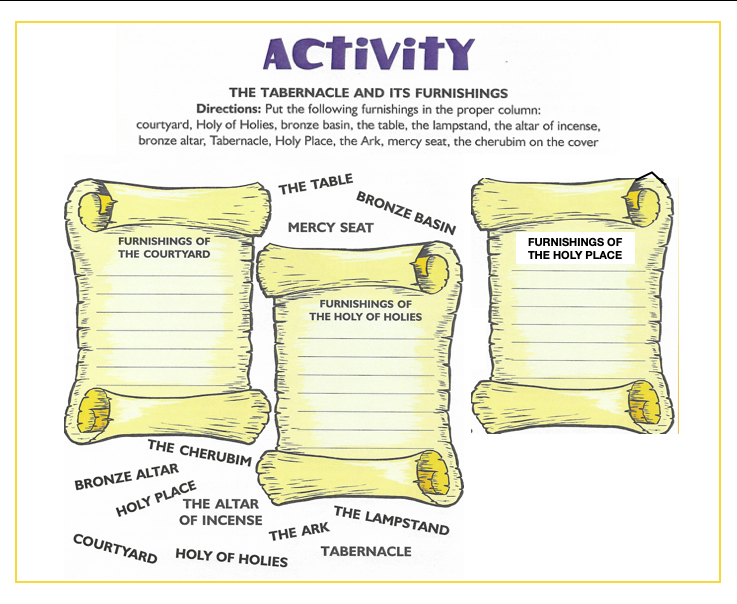
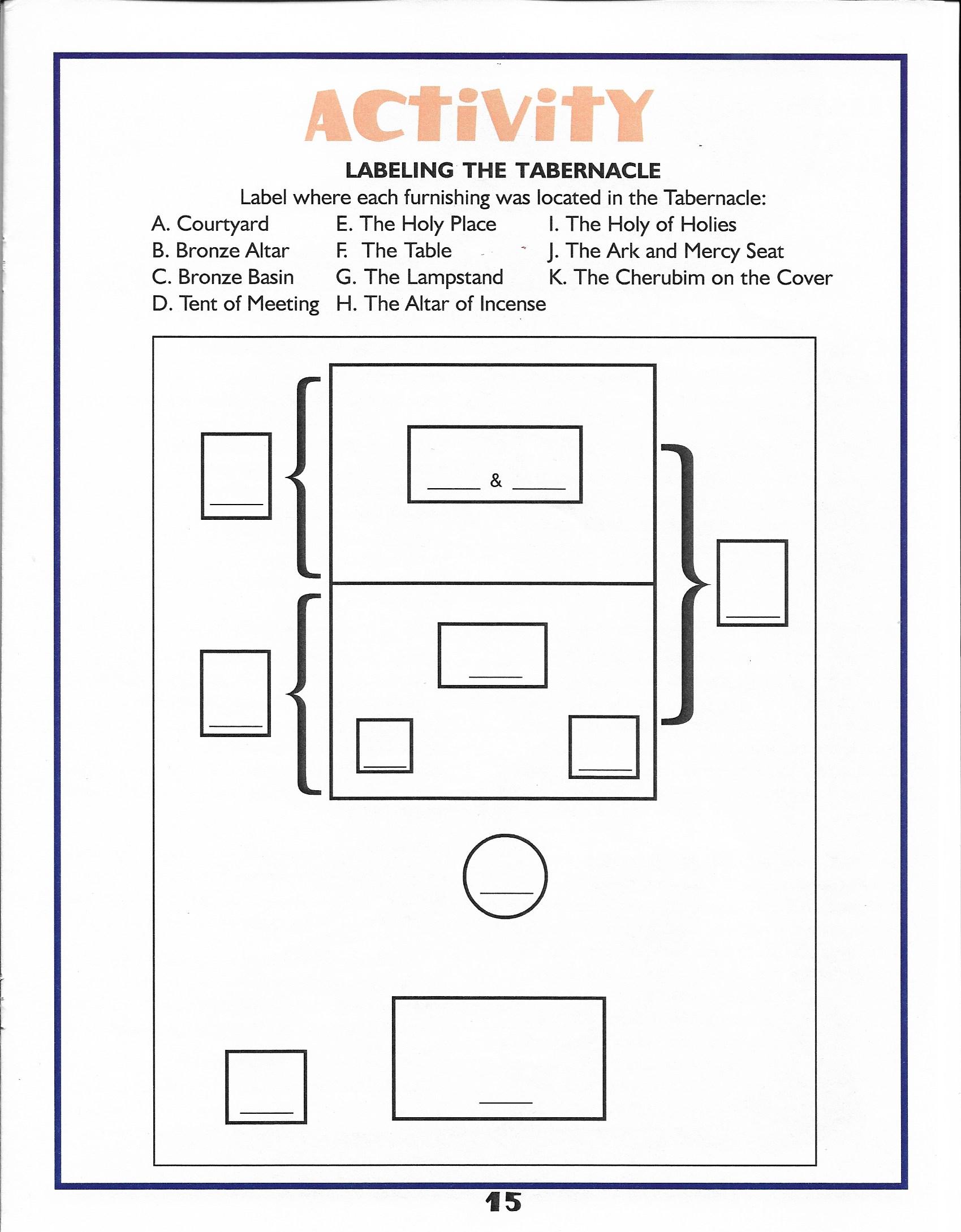
The courtyard was made by setting up curtains of finely twisted linen. These curtains formed a rectangle, about 100 cubits long and 50 cubits wide. The entrance was made on the east side. So as you walked into the courtyard, you would be looking towards the west.
The first Tabernacle furnishing you'd have seen would have been the bronze altar, or altar of burnt offering. This was made of wood covered with bronze. The four horns at each corner of the altar were made so that the altar and the horns were one piece. All the altar utensils were also made of bronze: pots to remove ashes, shovels, sprinkling bowls, meat forks, and fire pans. The bronze altar was used for presenting burnt offerings to God.
Past the bronze altar, before you would have come to the Tent of Meeting, was the basin for washing. It was made of bronze, with a bronze stand. They made it from the mirrors of the women who served at the entrance to the Tabernacle. The priest had to wash his hands and feet in the water of the bronze basin before going into the Tent of Meeting and also before presenting an offering on the bronze altar.
Past the bronze altar was the Tent of Meeting. It was also made of curtains of finely twisted linen and blue, purple, and scarlet yarn. It was covered with a curtain of goats' hair. This was covered with a covering of rams' skins dyed red. Over that was a covering of hides from sea cows, possibly manatees or dugongs.
When it was finished, the Tent of Meeting was 30 cubits long and 10 cubits wide. The Tent of Meeting was divided into two parts: the Holy Place and the Most Holy Place. When you walked past the bronze basin into the Tent of Meeting, you would have been in the Holy Place. It was 20 cubits long and 10 cubits wide. Here you would have seen three important furnishings.
The table was to the right as the High Priest walked into the Holy Place - the north side. The table, holding the bread of the presence or showbread, was made of wood, covered with gold. All of its plates, dishes, pitchers and bowls were to be made of gold. The pitchers and bowls were used to pour out the drink offerings. The bread of the presence, or showbread, was always on the table.
The lampstand was to the left, on the south side, as the High Priest walked into the Holy Place. The lampstand was made of pure gold. All the cups, buds, blossoms, and branches were made of one piece. Three branches came from one side and three came from the other side. Each branch had three cups shaped like almond flowers, with buds and blossoms. The center of the lampstand also had four cups shaped like almond flowers, with buds and blossoms. On this lampstand, they set the seven lamps.The wick trimmers and trays were also of pure gold. About 75 pounds of gold was used in making the lampstand, lamps, trimmers and trays. The lamps were to always be kept burning from evening to morning.
The altar of incense, also made of wood overlaid with gold, was in between the lampstand and the table, right in front of the curtain to the Most Holy Place. Here the priest was to burn a special incense each morning when he tended the lamps, and again at twilight when the lamps were lit. Nothing but special incense (the recipe given by God) was to be burned on this altar. Like the bronze altar, the altar of incense had four horns, one at each corner, which were part of the altar. Atonement was made on its horns once a year on the Day of Atonement.
Are you getting an idea of how detailed and special God's instructions were? There was a very good reason for it.
Teaching the Lesson:
Legacy Lesson: Student book/Teacher book - Teaching Time: 25 mins.
Lesson Prep - Teacher book - Time: 30 mins.
Activity: Watch Tabernacle video - Teacher book - Time: 30 mins.
Song: "Come Bless the Lord" - page 85 of the Kids Classics Collection - Time: 5 mins.
Activity: The Tabernacle and Its Furnishings - Student book - Time: 15 mins.
Extending the Lesson - REACH Activities:
*Back to the Bible: 2 Corinthians 6:16
*Journal Jot: Lively Stones
*Word Study: dwell - shâkan
*Just Toolin’ Around: Tabernacle and Temple
*Did you Know? Fine Linen
*Stretch It Out: A Tabernacle Model
*Music Notes: The Church’s One Foundation
*Questions? - Writing Prompt - 10 mins.
Dear Heavenly Father,
Help me to understand why You gave Moses such detailed instructions for building the Tabernacle. Help me understand what it means to me.
In Jesus' name.
Amen.
Sunday: Exodus 26:1-2
Monday: Exodus 26:3-6
Tuesday: Exodus 26:7-10
Wednesday: Exodus 26:11-14
Thursday: Exodus 26:15-19
Friday: Exodus 26:20-25
Saturday: Exodus 26:26-30
Exodus 25-27, 35-40
2 Corinthians 6:16-7:1
2 Corinthians 7:1
Ephesians 3:17
Hebrews 8:5
Hebrews 9:24
Hebrews 10:20
CONTAMINATE - to make dirty, stain, corrupt, or infect; contact with dirt or foulness from an outside source
PURIFY - to free from guilt, dirt, or imperfection
HOLINESS - state of being set apart for God
REVERENCE - honor or respect felt or shown
Jonathan and Christopher were so excited! They were finally going to get to see what was behind the counter at the post office. The postmistress had agreed to give them a tour. It was very interesting to see how the mail dropped from the slots into the baskets, how the mail was sorted, how the
postage meter worked, how the mailboxes were filled, and how the postmistress collected mail from the big blue boxes outside. This had been a really good day. After all, it's not every kid who gets to go behind the counter at the post office to see how things work.
There are many places in our world where we're not allowed to go. They are off limits to us, just as behind the counter at the post office is off limits to most of us most of the time. That's how it was in the Tabernacle too. We've already talked about the courtyard (with the bronze altar and the
bronze basin) and the Holy Place in the Tent of Meeting (with the lampstand, the table, and the altar of incense). But we didn't get to the most important part of the Tabernacle - the place that only the High Priest was allowed to go. He was only allowed to go into the Holy of Holies once a year on the Day of Atonement.
The last third of the Tent of Meeting was the Holy of Holies, or Most Holy Place. It was separated from the Holy Place by a curtain of finely twisted linen and blue, purple, and scarlet yarn, with a cherubim worked into its design. The Most Holy Place was a ten by ten cubit square.
The Ark of the Covenant was inside the Holy of Holies. It was a chest made of wood, covered with pure gold both inside and out. The Ark had a top called the Atonement Cover, which was made of pure gold. Two cherubim hammered out of gold were placed, one at each end of the cover. The cherubim faced each other, looking at and overshadowing the cover, with their wings spread out.
This was also known as the Mercy Seat. God told Moses to put the Stone Tablets into the Ark.
Wow! God gave Moses instructions for building the Tabernacle and all of its furnishings in great detail. God told Moses to build it exactly as He described it. Hebrews 8:5 and 9:24 tell us that this Tabernacle is a copy of the sanctuary in heaven - a copy of the throne room of God! That's one reason why God warned Moses to be exact (Hebrews 8:5). Stop and think for a moment.The Tabernacle was built as a place for God to dwell with the people. Where does God dwell today? He dwells in each of us, through the Holy Spirit (Ephesians 3:17). That is why we are called the temple of the living God (2 Corinthians 6:16).
If God was very precise, and He was, in the building of the Tabernacle in the wilderness, don't you think He is very concerned about building you? He wants you to seek Him and look to Him for guidance in laying a firm foundation. He wants to see you walk in His ways and live a godly life of doing quality work that will last. He wants you to make wise choices, like building with pure gold.
The Courtyard and the Holy Place were visible to many people. In the same way, your actions are visible to many people. They know whether you act like a Christian or not. That's why it is so important to stop and think before you say or do anything. What you say and what you do are two of the building blocks in what you are constructing - a life that is pleasing to your Heavenly Father.
The Most Holy Place was only visible to the High Priest, once a year. It was where God would dwell. When Jesus Christ died, the curtain between the Holy Place and the Most Holy Place was torn from top to bottom. Now everyone could go directly to God because of Jesus Christ. No longer did anyone have to go to the High Priest for access to God. Instead, we have a new High Priest, Jesus Christ, who goes to God the Father on our behalf.
But the Holy of Holies is kind of like what goes on inside you - the stuff that only God knows about - when you tell Him your thoughts and what's in your heart. And that's the hardest place for us to be like Christians if we really aren't. Because God knows. You can clean up the outside, but inside, God knows what's really there. That's why Paul encourages us to purify ourselves from everything that contaminates us (2 Corinthians 7:1).
So you have your assignment before you. You want God to dwell within you. You want to serve Him. Let's start building according to God's plan.
Teaching the Lesson:
Legacy Lesson: Student book/Teacher book - Teaching Time: 25 mins.
Lesson Prep - Teacher book - Time: 25 mins.
Activity: Oral Tour - Teacher book - Time: 20-30 mins.
Song: "One Door and Only One”- page 4 of the Kids Classics Collection - Time: 5 mins.
Activity: Labeling the Tabernacle - Student book - 10 mins.
Extending the Lesson - REACH Activities:
*Back to the Bible: The Throne Room of God
*Journal Jot: Coming Boldly Before God
*Word Study: contaminates - molusmos
*Just Toolin’ Around: The Heavenly Throne Room
*Did you Know? Cherubim
*Stretch It Out: Do It and Do It Right
*Music Notes: Holy, Holy, Holy
*Questions? - Writing Prompt - 10 mins.
Dear Heavenly Father,
Thank You for giving me Your Son, Jesus Christ, so that I can go to You directly. Help me to learn how to purify myself out of reverence to You.
In Jesus' name.
Amen.
Sunday: Ephesians 3:17
Monday: 2 Corinthians 6:16-18
Tuesday: Hebrews 8:5
Wednesday: Hebrews 9:24
Thursday: 2 Corinthians 7:1
Friday: Exodus 25:1-9
Saturday: Exodus 26:33-34
Exodus 28-29
Psalm 62:2
Romans 13:14
Galatians 3:27
Ephesians 6:10-11
Ephesians 6:13-17
Colossians 2:12
VESTMENT - piece of clothing
BREASTPIECE - the outer vestment set with precious stones, used for for making decisions
EPHOD - a sleeveless linen vestment
ROBE - a long, flowing outer garment
TUNIC - a simple, slip-on garment, made with or without sleeves, usually knee length or longer
TURBAN - a cap around which is wound a long cloth, to be worn on the head
SASH - a band worn around the waist or over one shoulder
Cathy and Lisa could hardly wait for the wedding. They were to be junior bridesmaids for their older cousin Janice's wedding. Their moms were making new dresses for them to wear. The long flowing dresses were beautiful. It was going to be such fun to wear these special dresses. Cathy and Lisa were sure they would feel as happy and beautiful as Janice.
Think about all of the different reasons for wearing special clothes: weddings, police or firefighter uniforms, astronauts, divers, race car divers, nurses, surgeons... the list goes on and on. Why, even you get to wear special clothes. You have school clothes, play clothes, pajamas, and church clothes. You wear your best clothes to church. Why? You should wear your best clothes to honor God, to show your love and respect for Him. Also, your best clothes should not be a distraction to other people. A halter top, short shorts, mini-skirt, a loud T-shirt, or a tank top with your favorite gym shorts could be a distraction to others. They are also not clothes to be worn when we appear before God. God really cared about the clothes that Aaron, the High Priest wore. God was very detailed about just what He wanted the High Priest to wear (Exodus 28-29).
The Ephod was of gold, blue, purple, and scarlet yarn and finely twisted linen. It had two shoulder pieces with onyx stones set with the names of the 12 tribes of Israel. It also had a woven waistband.
The Breastpiece was used for making decisions. It was to be square, made similarly to the Ephod, with four rows of precious stones, symbolizing the 12 tribes of Israel. The Breastpiece was attached to the Ephod. Under the Ephod was a robe, made entirely of blue. On its hem "a golden bell and a pomegranate, a golden bell and a pomegranate, all around on the hem of the robe. And it shall be upon Aaron when he ministers: and its tinkling may be heard when he enters and leaves the holy place before the LORD, that he may not die" (Exodus 28:34-35 NASB).
On Aaron's head was a turban. Attached to the turban with a blue cord was a pure gold plate that said "Holy to the Lord." "And it shall be on Aaron's forehead, and Aaron shall take away the iniquity of the holy things which the sons of Israel consecrate, with regard to all their holy gifts" (Verse 38 NASB). After Aaron died, every High Priest after him was to wear this.
The High Priest and other priests were to have tunics, sashes, and headbands to give them dignity and honor as they served before God. God wanted the priests to present the various offerings and sacrifices wearing these clothes. They were not to wear just any old thing. God was very specific about the design of the clothes He wanted them to wear. Why do you suppose that was?
Everyone around them saw what they were wearing, just as everyone around you sees your actions. People know whether you are acting like a Christian. Colossians 3:12 says: "Therefore, as God's chosen people, holy and dearly loved, clothe yourselves with compassion, kindness, humility, gentleness and patience." People see you choosing to act as Jesus would. They can also see how you make your decisions. This is much like using the Breastpiece for making decisions. Your friends and family know if you are making decisions based on the Bible, your parents' religion, peer pressure, a TV show, or your own desires.
But we need to go further than just acting as a Christian would. We need to "put on Jesus Christ" (Romans 13:14). Do you know what that means? Paul gives us a clue in Galatians 3:27: "For all of you who were baptized into Christ have clothed yourselves with Christ." We know that a change in your heart and mind happens at baptism.
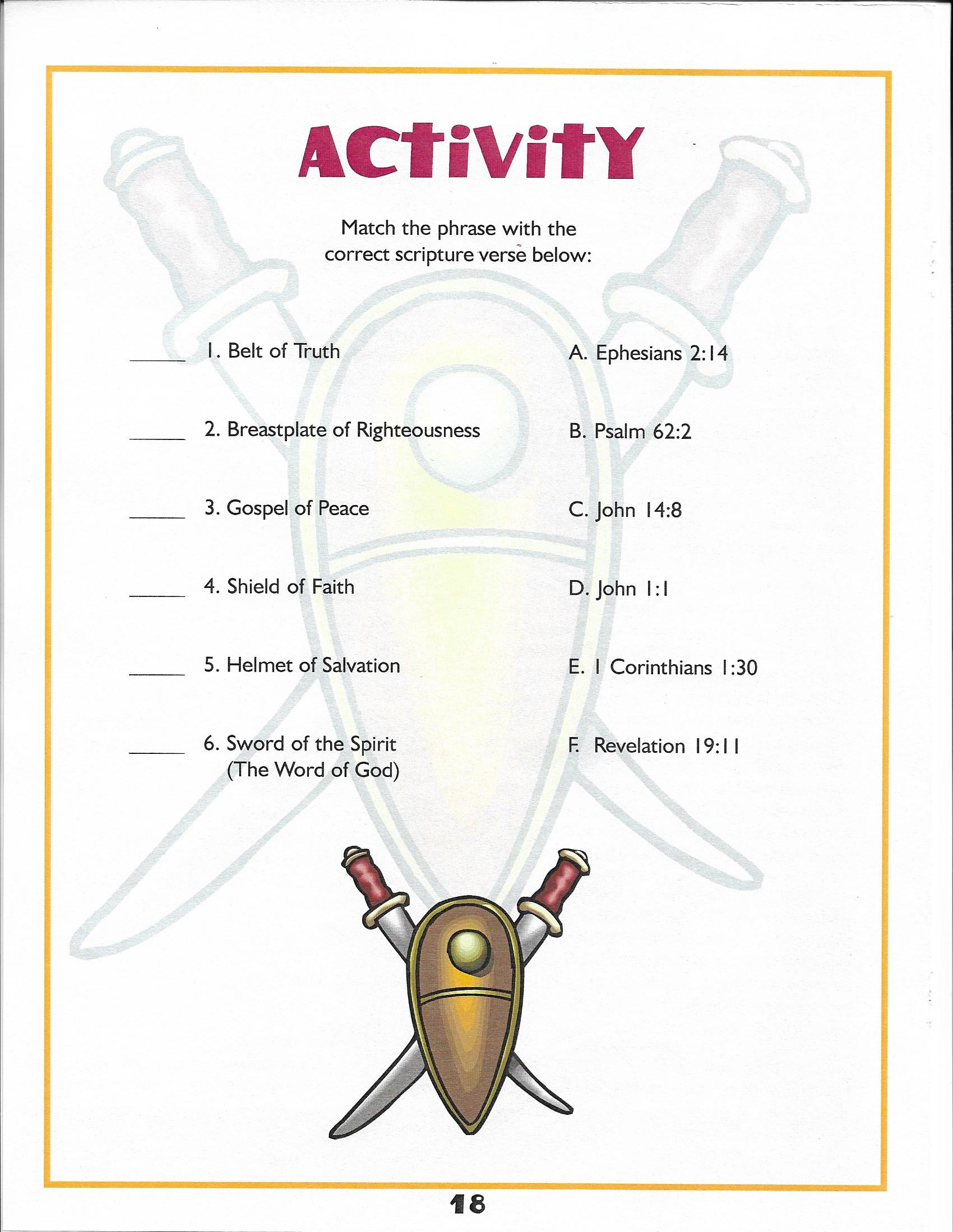
Then in Ephesians 6:13-17, we have Paul's beautiful word picture of putting on the full Armor of God. We want to put on the Armor of God to stand firm against the devil's schemes. First we stand with the belt of truth buckled around our waist. Does that make you think of the sash the priest wore? Then we have the breastplate of righteousness. It reminds us of making decisions. Our feet are to be fitted with readiness that comes from the Gospel of Peace. Next we are to take up the shield of faith, like the Ephod. We put the helmet of salvation on our heads. Do you remember that the plate on the turban worn by the High Priest said, "Holy to the Lord"? The sword of the Spirit was the last part of the armor. It is the Word of God - the Bible.
Now notice: Truthfulness, righteousness, peacefulness, faithfulness, holiness are not just characteristics worn on the outside. They are more than clothing. They go right to your heart. When you put on the whole Armor of God it is not just covering you; it goes deep into who you are. The last part of the Armor is the Word of God. It is also called the Sword of the Spirit. It is only an effective Sword if you know the Word of God. To do this you need to read the verses in your daily devotionals every day, memorize your Bible verses, and live by them.
Here's the cool part. As you do your activity below, you'll find the scriptures which show that it is Jesus Christ who is the Armor of God. So, the clothing of the High Priest ultimately pointed to Jesus Christ, as did the Tabernacle, the sacrifices, and the High Priest himself. God's design is so complex, detailed and wonderful! The next time you get dressed, remember that what we wear really does matter to God.
Teaching the Lesson:
Legacy Lesson: Student book/Teacher book - Teaching Time: 25 mins.
Lesson Prep - Teacher book - Time: 45 mins.
Activity: Sword Drill - Teacher book - Time: 20 mins.
Song: "Fairest Lord Jesus" - page 79 of Kids Classics Collection - Time: 5 mins.
Activity: Matching Full Armor of God - Student book - Time: 10 mins.
Extending the Lesson - REACH Activities:
*Back to the Bible: Inside and Out
*Journal Jot: What You Wear
*Word Study: schemes - methodeia
*Just Toolin’ Around: methodeia
*Did you Know? Urim and Thummim
*Stretch It Out: Paper Dolls
*Music Notes: Fairest Lord Jesus
*Questions? - Writing Prompt - 10 mins.
Dear Father,
Help me learn to dress to please You, in my actions, and in my heart.
In Jesus' name.
Amen.
Sunday: Ephesians 6:10-11
Monday: Romans 13:14
Tuesday: Galatians 3:27
Wednesday: Colossians 2:12
Thursday: Exodus 28:34-35
Friday: Ephesians 6:13-17
Saturday: Psalm 62:2
Genesis 7:2
Leviticus 11
Ephesians 6:13-17
1 Thessalonians 4:7
CHEW THE CUD - when an animal chews its food more than once
FINS - the outside membranes of a fish used in propelling or guiding the body
SCALES - the small, clearly defined plates which form the outer covering on a fish
SCAVENGERS - an animal (bird, fish, etc.) which eats garbage or dead and decaying animals
CEREMONIAL - having to do with a ceremony or religious service
RIGHTEOUS - acting according to God's Law
CARCASS - a dead body: corpse; especially: the dressed body of an animal
“Hey, Cassie! Come play Dungeons and Dragons with us," Tara called to her best friend.
"No, thank you," Cassie gently, but firmly, replied.
"Come on, Cassie!" her friend persisted.
"I'm not interested," said Cassie quietly.
Tara walked over to Cassie to ask, "Why won't you play with us, Cassie? Really?"
Sighing, Cassie said, "It has to do with the clean and unclean meat laws in Leviticus 11. Still want to know?"
Tara nodded. "You know I do. Tell me abut Leviticus... what was it?”
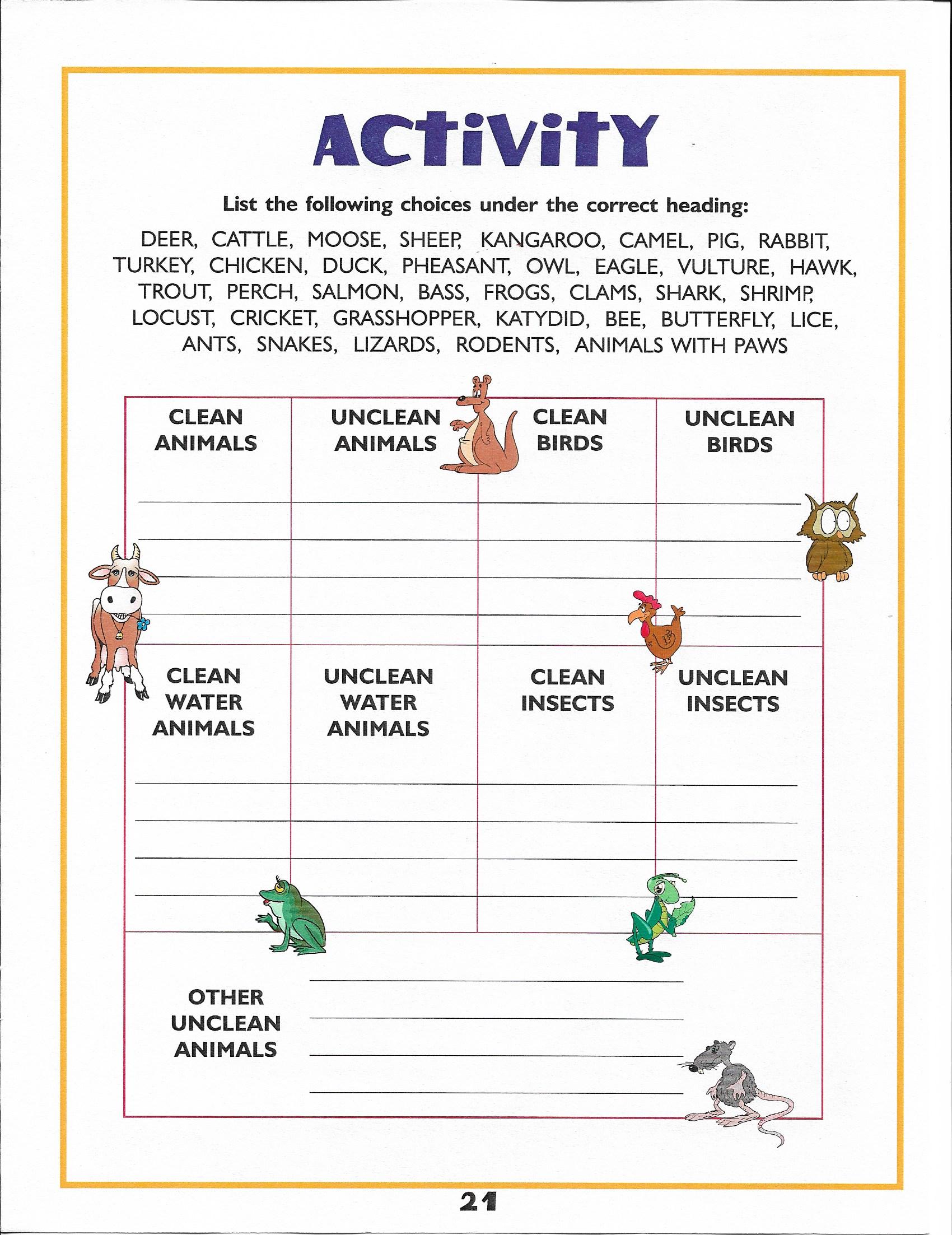
Leviticus 11 gives several rules for which animals, birds, fish, and insects may be eaten. Any animal that has a completely split hoof and that chews the cud is clean. That means it is okay to eat. Any animal that does not have a split hoof and does not chew the cud is unclean. That means God told the Israelites they couldn't eat those animals. In fact, they weren't even supposed to touch their carcasses, which means their dead bodies.
Animals such as dogs and cats with paws are unclean. Rodents such as weasels, rats, rabbits, and squirrels are unclean.
The rule God gave for water animals is that fish must have both fins and scales to be clean and something we can eat. If it doesn't have both, it is unclean. All scavengers in the bird families are unclean. That means all of the eagles, vultures, owls, kites, herons, etc. are not allowed to be eaten.
There are also clean insects and unclean insects. The ones that have jointed legs for hopping on the ground are clean, even if they also had wings. All other flying insects and other insects are unclean.
This is very important to God. In Leviticus 11:44-45, God says twice, "I am the LORD your God. . . be holy, because I am holy." God doesn't want His people to eat unclean animals or touch their dead bodies.
"But Cassie," Tara protested, "that was for the Israelites! They had to do all sorts of ceremonial things.”
"Tara, read Genesis 7:2 with me. You'll see that God told Noah to take seven pairs of clean animals and two unclean animals on the ark. Noah knew what that meant."
"But it really goes deeper than that, Tara. The clean and unclean meat laws are all good lessons that there are certain things in this world that are not good for you to have in your body. They can make you sick. They can even kill you. We're not just talking about food either. Games like Dungeons and Dragons, R-rated movies, Harry Potter books or Goosebump books - these are all thing that many children's minds feed on. Do you understand why these things are not good for you? Your mind is like a filing cabinet. Everything you ever see, read, do, or experience is filed away and becomes part of you whether you like it or not. And secondly, those games, movies, and books are not godly. They are just the opposite. They are against God. When we take them into our minds, we have made a huge hole in our armor.
“Remember the Armor of God in Ephesians 6:13-17? One of the pieces Paul told us to put on is the breastplate of righteousness. Ungodly books, movies, and games are not righteous. And, think about it, it's not a good idea to have a hole in your armor right over your heart!
"Tara, I guess the best way to answer you would be to quote 1 Thessalonians 4:7: 'For God did not call us to be impure, but to live a holy life.’ And I think playing Dungeons and Dragons would be impure.”
"You know what, Cassie? I think you're right. Do you want to ride our bikes to the park?”
"You bet."
Teaching the Lesson:
Legacy Lesson: Student book/Teacher book - Teaching Time: 25 mins.
Lesson Prep - Teacher book - Time: 45 mins.
Activity: Clean and Unclean - Teacher book - Time: 25 mins.
Song: "Dare to Be a Daniel" - page 9 of Kids Classics Collection - Time: 5 mins.
Activity: Sorting It Out - Student book - Time: 20 mins.
Extending the Lesson - REACH Activities:
*Back to the Bible: Leviticus 11
*Journal Jot: Answering the Legalists
*Word Study: impure - akatharsia
*Just Toolin’ Around: A Filing Cabinet
*Did you Know? Food vs. Meat
*Stretch It Out: A Closet Never Cleaned Out
*Music Notes: How I Love Thy Law, O Lord!
*Questions? - Writing Prompt - 10 mins.
Dear Heavenly Father,
Help me to be more aware of the choices I make every day - whether they are healthy for me physically and mentally.
In Jesus' name.
Amen.
Sunday: 1 Thessalonians 4:7
Monday: Genesis 7:2
Tuesday: Ephesians 6:13-17
Wednesday: Leviticus 11:1-8
Thursday: Leviticus 11:9-12
Friday: Leviticus 11:13-20
Saturday: Leviticus 11:21-28
Leviticus 25
Leviticus 25:10
Isaiah 61:1-3
Matthew 11:28-30
Luke 4:18-19
CONSECRATE - to set apart, to devote to God
JUBILEE - every 50th year, according to God's plan
PROCLAIMED - to be announced
LIBERTY- the state of being free
ALIEN - a foreign-born resident who has not been naturalized and is still a subject or citizen of a foreign country
TENANTS - people who pay rent to live in a place
When Bill and Sally bought a new home, they also bought a little over two acres. The children were excited. There was a lot of room to run and play, a barn with all kinds of nooks and crannies, a huge hill behind the house to slide down after a snowstorm, and lots of room for a big garden. The first six years, the garden did really well. In fact, the fifth year they canned more tomatoes than they would use for a couple of winters. When the seventh year came, Bill and Sally didn't plant a garden. That was okay with the kids! They were very tired of weeding, harvesting and canning - all of the work that goes with a big garden.
But they did have one question: How did Bill and Sally know that was the seventh year, according to Leviticus 25? Bill and Sally didn't know, the kids were told. But the principle in Leviticus 25 of letting the land rest for a year is a good principle. Besides, having the summer off from the garden work would be a good rest for the family too. God had blessed the garden the past several years. There would be enough until the next year. And then, everyone would be ready to work again. Well, at least maybe the weeding wouldn't seem so bad.
Leviticus 25 talks about giving the land a Sabbath rest every seven years. The people were allowed to eat whatever came up voluntarily, but they weren't allowed to weed or harvest the fields or vineyards like they would in the first six years.
Then, in the 50th year - after seven Sabbaths of years - the people sounded the trumpet on the Day of Atonement. It was the Year of Jubilee! They proclaimed liberty throughout the land.
The way God set it up, if a person became poor and had to sell his property to get money to live, he would get his land back in the Year of Jubilee. Why? Because God said the land belongs to Him. The people are aliens and tenants. That means, according to God, the people didn't really own the land. They were only there because God gave it to them. In a similar way, if a person became so poor that he sold himself as a slave, he would again be free in the Sabbatical year. Why? Because the people belong to God as servants (verse 55). After all, it was God who rescued them from Egypt.
If someone from one of the countries around Israel sold himself as a slave, he would be a slave forever. He wasn't released during the Sabbatical year. Why? Because that person wasn't one of God's people. God had a very special relationship with Israel. They were His chosen people. That wasn't something the nations around Israel could claim. If an alien or temporary resident bought an Israelite, the Israelite would again be free the seventh year. He would be allowed to go back to his land in the Year of Jubilee. It didn't matter who owned the Israelite, he would be free.
God's plan is full of meaning. Think about counting seven sets of seven years each. In the Bible, the number seven seems to picture completeness. This can be seen from Creation all the way to Revelation with the seven trumpets. So why did the Jubilee Year start after seven sets of seven years?
Well, think about when the Year of Jubilee and the Sabbatical years started. The trumpets were blown on the Day of Atonement! That's the tenth day of the seventh month. That's not the first day of the year. That's not even the first day of a month. Why in the world would God start the Year of Jubilee and the Sabbatical Year on the Day of Atonement? Think about what else happened on the Day of Atonement. The High Priest went into the Holy of Holies and made atonement for the sins of the entire community of Israel. All of their sins were forgiven! Their spiritual debts were forgiven on this day. Since this was also when the Year of Jubilee and the Sabbatical Year began, it was also the day their physical debts were forgiven.
Talk about complete freedom. They were free from slavery. They were free to live on their own land. And they were free from their sin! No wonder God told them to proclaim liberty throughout the land! They were free in every possible way. They were free to make a clean start.
When you keep the Sabbath this week, think about how wonderful it is to be free to rest! When you observe the Day of Atonement next time, think about the Year of Jubilee and how wonderful it is to be free in Jesus Christ. Completely.
Teaching the Lesson:
Legacy Lesson: Student book/Teacher book - Teaching Time: 25 mins.
Lesson Prep - Teacher book - Time: 30 mins.
Activity: Proclamation - Teacher book - Time; 30-40 mins.
Song: “I Will Sing of the Mercies of the Lord Forever" - page 17 of Kids Classics Collection - Time: 5 mins.
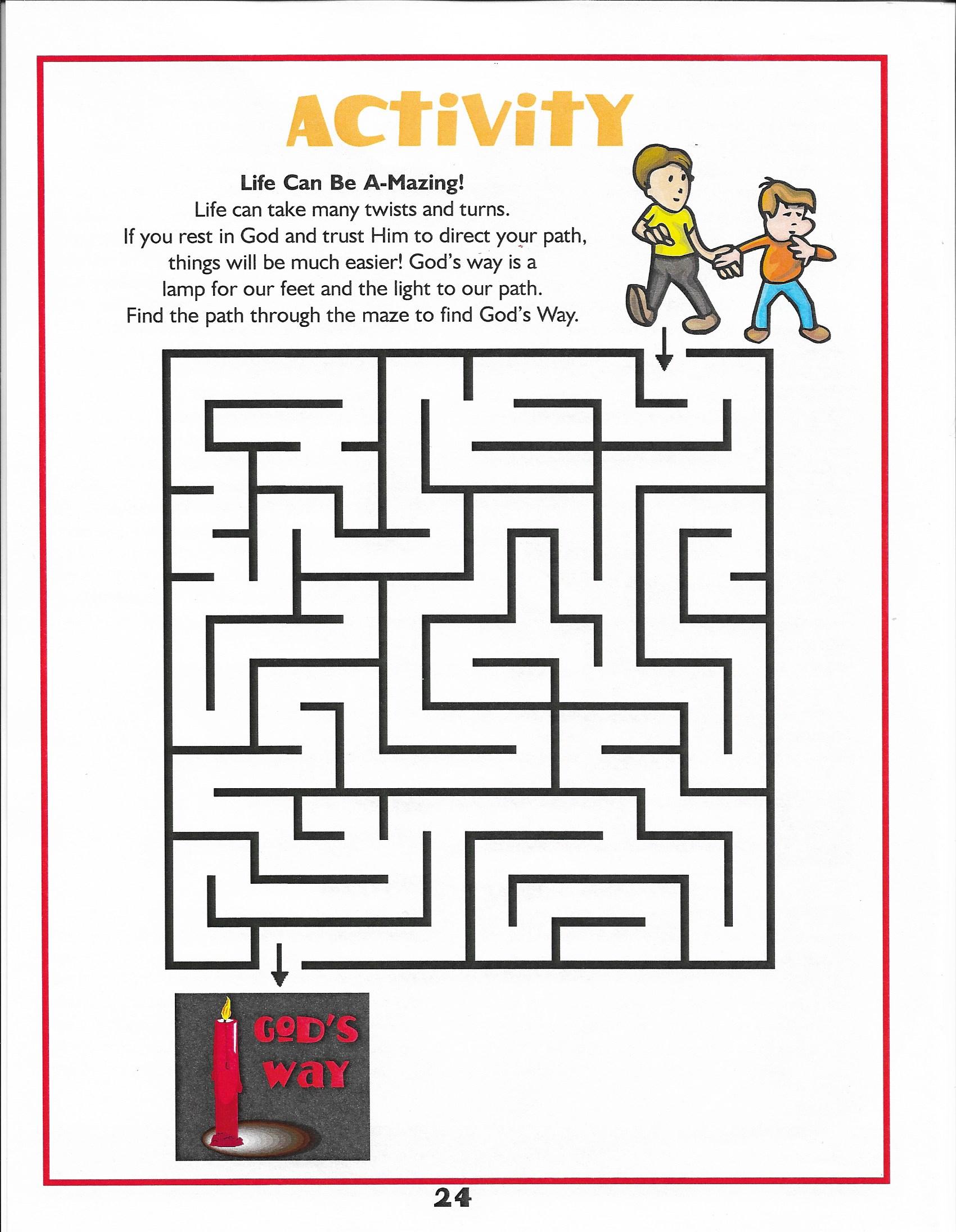
Activity: Life Can Be A-Mazing - Student book - Time: 5-7 mins.
Extending the Lesson - REACH Activities:
*Back to the Bible: Matthew 11:28-30
*Journal Jot: Let Freedom Ring
*Word Study: Seven and Oath - sheba and shaba
*Just Toolin’ Around: Give You Rest
*Did you Know? Jubilee
*Stretch It Out: Jesus is Our Jubilee
*Music Notes: On Jordan’s Stormy Banks
*Questions? - Writing Prompt - 10 mins.
Dear Father,
Please teach me to value the rest and freedom there is in being Your child.
In Jesus' name.
Amen.
Sunday: Isaiah 61:1-3
Monday: Luke 4:18-19
Tuesday: Matthew 11:28-30
Wednesday: Leviticus 25:1-7
Thursday: Leviticus 25:8-12
Friday: Leviticus 25:13-17
Saturday: Leviticus 25:18-22
Numbers 10-11
Numbers 10:35-36
QUAIL - a wild, edible bird, like a chicken
ORGANIZE - to make a plan to do something and follow it
WAILING - loud crying
Kevin and Liz invited the church youth group to their house for a scavenger hunt one Sunday. Soon after everyone arrived, their friends chose Kevin and Liz as their team captains. Kevin gathered his group, handed out the scavenger lists, and told them to hurry and find everything on the list.
Liz also gathered her team together, but she told them to spend time working out a plan so they would have a much better chance of finding everything on the list. Liz's team read the items on the list: a feather, a blue balloon, a paper clip, plastic cup, a small rock, a button, an oak leaf, and a wildflower. She asked if anyone knew where they might find each of these items. When someone did, she put their name by the item until every item was assigned to a person. Liz's teammates were eager to be on their way, but Liz reminded them that spending time getting organized wasn't wasted time; it could make all the difference. They could, and probably would, win. Kevin and Liz only had a few friends doing the scavenger hunt with them. So taking time to organize them would really pay off. How much more does organization help when you’re dealing with a large group? A lot!!
There is a major example of organization in the Bible. It was moving the many thousands of Israelites from the Desert of Sinai towards the Promised Land. When the cloud lifted, the people set out, at the LORD's command. But everyone didn't get up and move at once. That would have created an incredible traffic jam. And it would have been very difficult to keep track of children and animals.
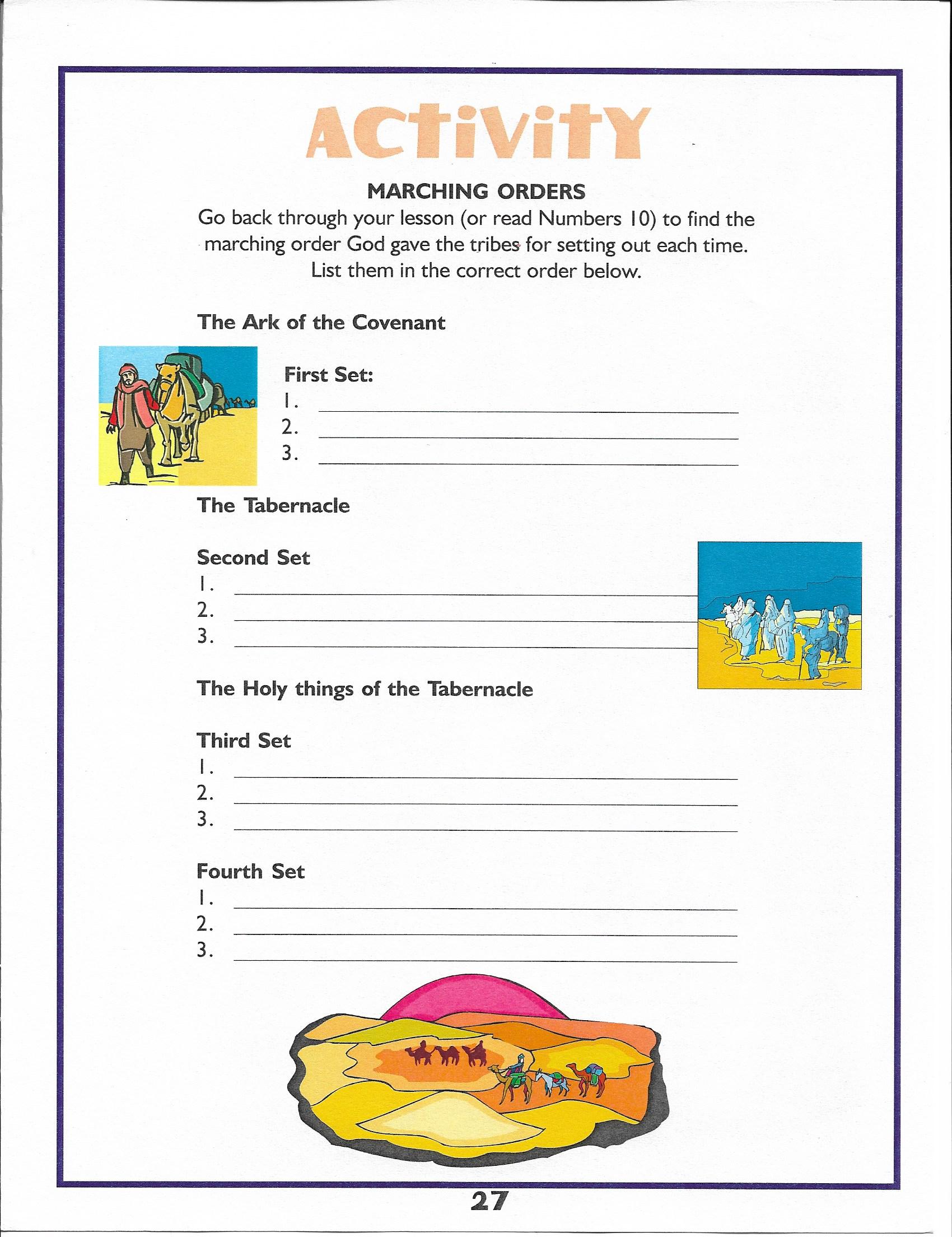
So God said that the tribe of Judah would go first, followed by the tribes of Issachar and Zebulun. Next the Tabernacle was to be taken down and would follow these first three tribes. The tribes of Reuben, Simeon, and Gad would go next. Then the holy things of the Tabernacle would follow this second set of three tribes. That way the Tabernacle could be set up and waiting when the holy things arrived at the next camp. The tribes of Ephraim, Manasseh, and Benjamin came next. The rear guard were the three tribes of Dan, Asher, and Naphtali. Whenever the Israelites set out, this was the marching order.
When they set out that first morning, the Ark of the Covenant went before them. And the cloud of the LORD was over them.
The Israelites had been moving for only three days before the people started complaining about how hard it was. God was very angry! "Then fire from the LORD burned among them and consumed some of the outskirts of the camp." Moses prayed to the LORD, and the fire died down (Numbers 11:1b). You would think the people would have trusted God after having been out of Egypt for over a year. But the Israelites complained many times after Moses brought them out of Egypt. And the fire from the LORD didn't slow them down very much either. Soon every family started wailing! Yes, that's what the Bible says! Why were they wailing? "If only we had meat to eat! We remember the fish we ate in Egypt at no cost - also the cucumbers, melons, leeks, onions, and garlic. But now we have lost our appetite; we never see anything but this manna!" (Numbers 11:4-6).
Moses didn't know what to do with the people. There were so many of them to deal with. So God had Moses call 70 of the elders to the Tent of Meeting. God put His Spirit on these elders to help Moses lead the people of Israel.
God also told the people that He would give them meat to eat, until they hated it, because the people had rejected God and wailed that they would rather have stayed in Egypt. Then God sent a strong wind from the sea that brought quail until they surrounded the camp about three feet deep! People gathered quail, about 60 bushels for each person! While they were still eating, God sent a plague. Many people died because they wanted food other than what God was providing them.
This was not a good start to their journey to the Promised Land. And you'll learn in the next week's lesson, the people weren't yet done complaining.
Teaching the Lesson:
Legacy Lesson: Student book/Teacher book - Teaching Time: 25 mins.
Lesson Prep - Teacher book - Time: 25 mins.
Activity: Moving Day - Time: 15 mins.
Song: "Onward Christian Soldiers" - page 26 of Kids Classics Collection - Time: 5 mins.
Activity: Marching Order - Student book - Time: 15 mins.
Extending the Lesson - REACH Activities:
*Back to the Bible: Time Frame
*Journal Jot: Complaining
*Word Study: Rejected - mâ’aç
*Just Toolin’ Around: Who Carried the Tabernacle
*Did you Know? Quail
*Stretch It Out: Marching Order
*Music Notes: Onward, Christian Soldiers
*Questions? - Writing Prompt - 10 mins.
Dear Heavenly Father,
Please teach me to be grateful for the things You give me. Please stop my mouth before I complain against You.
In Jesus' name.
Amen.
Sunday: Numbers 11:1-5
Monday: Numbers 11:4-9
Tuesday: Numbers 11:10-11
Wednesday: Numbers 11:12-15
Thursday: Numbers 11:16-17
Friday: Numbers 11:18-20
Saturday: Numbers 11:21-23
Numbers 12:1-16
Proverbs 17:11
James 4:1-2
CONFINE - to keep in a certain place
DISRESPECT - not showing honor
LEPROSY - a serious skin disease where the nerves don't work properly
LEPROUS - having leprosy
AUTHORITY - a position of being in charge of something or someone
Ten year-old Matthew had a younger brother, Tim, who was eight, and a younger sister, Amy, who was seven. Most of the time the children got along very well. Other times, Tim tried to prove that he was just as big as Matt, especially when other people were around. The three children loved having their cousins come visit. Mary and Rachel, the twins, were Amy's age. Amy loved having girls around to play with. Benjamin was nine, but he and Tim got along really well. The oldest of their cousins, Becky, was 11. Becky and Matt also shared a special friendship. All of the cousins knew that Matt and Becky were in charge when their parents were out of sight and they were left by themselves.
One afternoon, Mary, Rachel, Benjamin, and Becky came to visit. Tim was thrilled. He could hardly wait to show the new kittens to Benjamin. He excitedly grabbed Benjamin's arm and began dragging him towards the children’s tree house. Suddenly, Tim heard Matt say, "Tim, you can't take Benjamin up there." Tim ignored Matt and continued talking and pulling Benjamin as fast as he could into the trees. Matt ran ahead of the two boys and stood in their way. Tim couldn't ignore Matt this time, but he wasn't ready to listen yet.
The children's mother heard the commotion, came out on the porch, and called the children. She asked, "Matt, didn't you tell Tim not to go to the tree house today?"
Matt told her that he had tried, but Tim wouldn't listen.
Tim knew he was in trouble, but wasn't ready to admit it. Tim asked, "Why couldn't I take Benjamin to see the kittens?"
His mom replied, "First of all, I told Matt to keep everyone away from the tree house because I saw some poison ivy growing along the path yesterday. I want to take care of it before one of you comes down with a bad case of poison ivy again. Secondly, Tim, you know that Matt is in charge when l'm not outside with you. You know he doesn’t abuse that responsibility. So you should have known that when he stopped you, he had a good reason to do so. Tim, you need to go to your room and think about this for a while.”
Sometimes the rivalry between brothers and sisters is very obvious. The rivalry can also be very strong between people who are in charge of a project. So when brothers and sisters are in charge of a project together, there can be some jealousy and insults and disrespect. There's a good example of this in the Bible in Numbers 12.
Miriam and Aaron began talking against Moses, supposedly because he had married a Cushite, instead of an Israelite. They asked, "Has the LORD spoken only through Moses? Hasn't he also spoken through us?" (verse 2). They were challenging Moses' leadership!
Well, God's reaction was immediate! He heard what they said, and called them to the Tent of Meeting. This is what God said to them: “When a prophet of the LORD is among you, I reveal myself to him in visions, I speak to him in dreams. But this is not true of my servant Moses; He is faithful in all my house. With him I speak face to face. Clearly and not in riddles; He sees the form of the LORD, Why then were you not afraid to speak against my servant Moses?" (verses 6-8).
When the cloud of the LORD lifted from the Tent of Meeting, Miriam was leprous. Leprosy is a terrible disease of the skin. It is also very contagious. Whenever someone got leprosy, they had to be kept away from everyone else. Aaron immediately asked Moses to forgive them and begged that Miriam not stay leprous.
Moses didn't say that Miriam got what she deserved. He immediately cried out to God to heal her. Then God said that if Miriam's father had spit in her face, she would have been in disgrace for seven days. God told them to confine Miriam outside the camp for seven days and then bring her back. And that's what happened. There was still a punishment for her disrespect towards the leader God had chosen - even if he was her brother. But Miriam would not have to live with leprosy. The Israelites did not move their camp for the entire week that Miriam was confined outside the camp.
What about you? How do you treat the people who have authority over you - your teachers (even the one you don't especially like), your pastor, your older brother or sister, your parents, your babysitters, whoever? If they have been given authority over you, then you are expected to respect that authority.
Teaching the Lesson:
Legacy Lesson: Student book/Teacher book - Teaching Time: 25 mins.
Lesson Prep - Teacher book - Time: 30 mins.
Activity: Acting Out - Teacher book - Time: 20-30 mins.
Song: "Heavenly Father, I Appreciate You" - page 82 of Kids Classics Collection - Time: 5 mins.
Activity: Gratefulness is Great! - Student book - Time: 20 mins.
Extending the Lesson - REACH Activities:
*Back to the Bible: David and the LORD’s Anointed
*Journal Jot: Respect and Competence
*Word Study: Fights and Quarrels - Fight and Quarrels - polemoi and machai
*Just Toolin’ Around: Researching Gratitude
*Did you Know? Leprosy
*Stretch It Out: Lesson Learned
*Music Notes: Come, Ye Thankful People, Come
*Questions? - Writing Prompt - 10 mins.
Dear Heavenly Father,
Please gently show me where I have been disrespectful to those in authority over me. Teach me to show respect to them.
In Jesus' name.
Amen.
Sunday: Numbers 12:1-2
Monday: Numbers 12:3-5
Tuesday: Numbers 12:6-8
Wednesday: Numbers 12:9-10
Thursday: Numbers 12:11-13
Friday: Numbers 12:14-16
Saturday: Proverbs 17:11
Numbers 13
Numbers 14
Numbers 14:7-9
EXCEPTION - the one that doesn't fit all of the others
Once upon a time there was a man who owned a camel. This camel was absolutely amazing! He could carry more weight than any other camel anywhere in the desert. The man was very proud of the camel, so he fed him lots of good food, gave him special treats, and curried his coat every day.
One day, one of the man's friends was boasting about the camel. From the back of the crowd, a loud voice said, "I think you're just blowing hot air.” It wasn't long before a huge argument erupted. Soon, the man's friend had agreed to a contest to see how much weight the camel could actually carry. Although the man didn't like it, he agreed to the contest. Soon his favorite camel was loaded down with as much as could be tied on top of him. Loud cheers sounded. This camel was absolutely amazing. Then the man put one more straw on the load, and the camel collapsed. His back was broken and the camel had to be destroyed. It was the straw that broke the camel's back. The straw itself was not heavy. It was no big thing by itself. But it was just enough to be too much when added to everything else the camel was carrying.
In Lesson 2, “The Golden Calf,” and in Lessons 8 and 9, “On to the Promised Land” and “Expect to Respect,” we talked about the wailing, complaining, and grumbling of the Israelites after God brought them out of Egypt. God gave them everything: freedom, protection, clothing, money, food, water, and guidance. But they continually cried out and often wanted to go back to Egypt.
Finally the Israelites made it to the border of Canaan, the Promised Land, the land God promised to give them. God told Moses to send a man from each tribe to explore the land. Moses told them to look over the land, to see whether it was good or bad, what kind and how many people lived there, what kind of cities they lived in and if the cities were protected, if the soil was rich or poor, and whether there were trees. He also told them to try to bring back some of the fruit of the land.
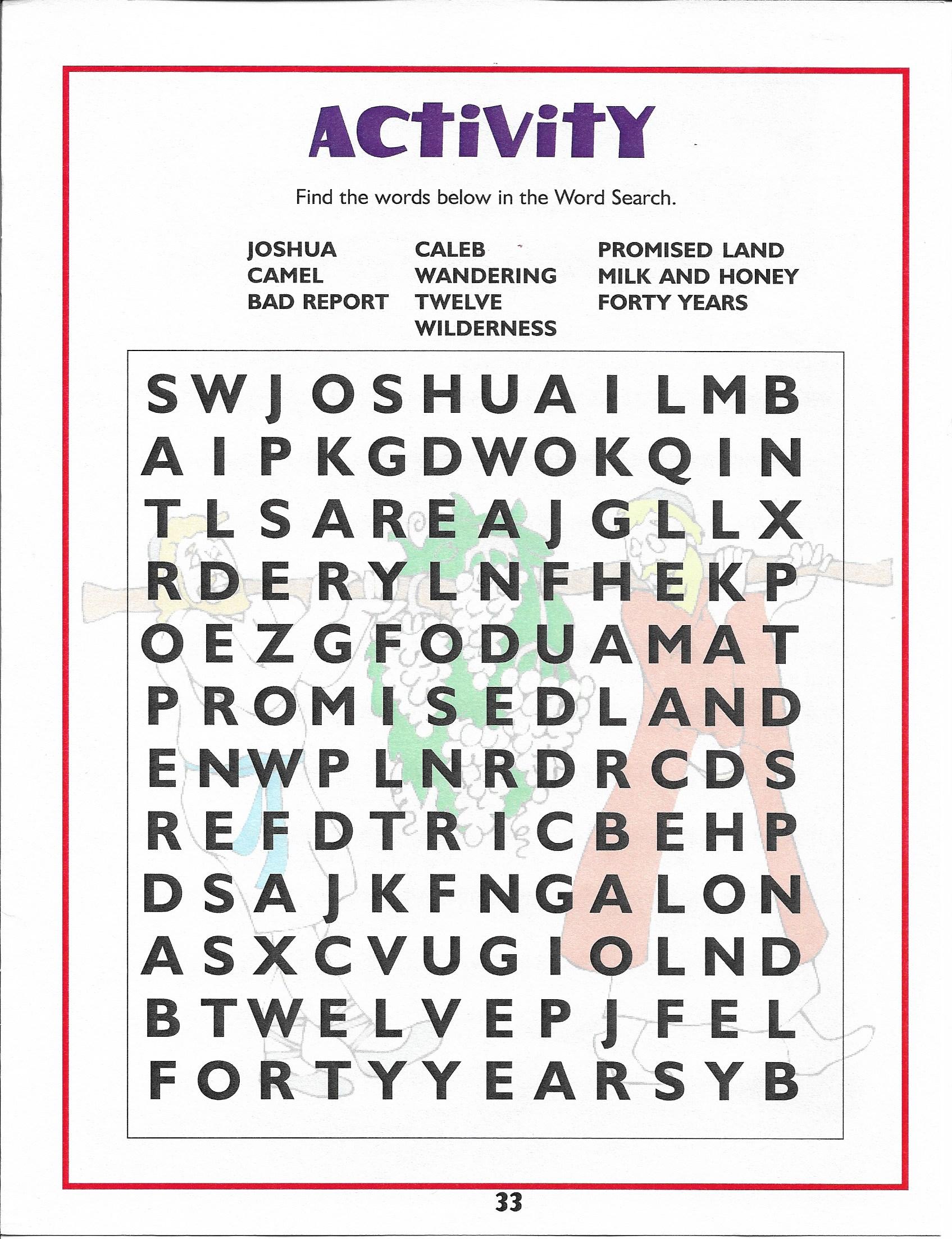
It took 12 men 40 days to explore the land. They found it to be very good land, flowing with milk and honey. One amazing thing was a cluster of grapes they cut off the vine. It was so big it took two men to carry it between them on a pole. But that wasn't all. The people of the land were very big and strong, and the cities were large and well-protected. This caused ten of the men to become very afraid. They gave a bad report that spread through all the Israelites. The Israelites grumbled and wept and said it would have been better to have stayed in Egypt or to have died in the desert. They were sure their wives and children would be taken captive. They even thought it would be a good idea to find a new leader to take them back to Egypt.
Caleb and Joshua didn't agree with them. Caleb told the people, "The land we passed through and explored is exceedingly good. If the LORD is pleased with us, he will lead us into that land, a land flowing with milk and honey, and will give it to us. Only do not rebel against the LORD. And do not be afraid of the people of the land, because we will swallow them up. Their protection is gone, but the LORD is with us. Do not be afraid of them" (Numbers 14:7-9). Do you know what the Israelites thought about what Caleb said? They wanted to stone him to death!
God was angry that the Israelites refused to trust in Him. He told Moses He would kill them all and start over with Moses. But Moses said He shouldn't do that. If God did that, the Egyptians would hear about it and say that God wasn't able to take His people into the Promised Land as He had promised. Moses asked for God to forgive the Israelites. God said He had forgiven them as Moses asked, but they would be punished. The punishment would be on those who were 20 years and older. These Israelites saw the miracles and God's glory both in Egypt and in the desert. But they still disobeyed and tested God ten times!
Not trusting God once was bad enough, but ten times! It was much like the straw that broke the camel's back. God is extremely patient and long-suffering. But enough was enough! Those who were 20 years or older would die in the desert. Their children would be shepherds in the desert, suffering for their parents' unfaithfulness. They would wander in the desert for 40 years, one year for each of the days the 12 men explored the Promised Land. When the last of those who were 20 years or older died, then their children would go into the Promised Land.
Caleb and Joshua would be the exception. They trusted God. They had not disobeyed. They would go into the land with the children of Israel. But the ten who brought the bad report were struck with a plague and died.
When Moses told the people what God said, they mourned bitterly. They said, "We have sinned. We will go up to the land the LORD promised." Moses told them it was too late. It would be a mistake to go now, because God would not be with them. They didn't listen - as usual. While the Ark of the Covenant and Moses stayed in camp, the people went into the land. The people of the land, who were truly very large and powerful, attacked them and beat them all the way to Hormah.
It's a powerful lesson for each of us today. How many times does God have to do something for us before we will trust Him with all of our hearts? It's much better to respond as Caleb and Joshua did, believing that God is greater than any of our enemies, or problems, or fears. Caleb and Joshua are great heroes because they stood up and showed their belief in God. And you can too! There are lots of people around who don't know our great and awesome God. There are lots of ways you can tell them about Him. One way is by trusting God in everything.
Teaching the Lesson:
Legacy Lesson: Student book/Teacher book - Teaching Time: 25 mins.
Lesson Prep - Teacher book - Time: 30 mins.
Activity: Presentation of Projects/Party - Teacher book - Time: 30 mins.
Song: "Dare To Be A Daniel" - page 9 of Kids Classics Collection - Time: 5 mins.
Activity: Word Search - Student book - Time: 10-15 mins.
Extending the Lesson - REACH Activities:
*Back to the Bible: Daniel
*Journal Jot: A Rewarder
*Word Study: is pleased - châphêts
*Just Toolin’ Around: Honey In The Rock
*Did you Know? What Tribes?
*Stretch It Out: The Report
*Music Notes: O For a Closer Walk With God
*Questions? - Writing Prompt - 10 mins.
Dear Heavenly Father,
Help me learn from the mistakes of the Israelites. Help me trust You no matter what.
In Jesus' name.
Amen.
Sunday: Numbers 14:1-2
Monday: Numbers 14:3-5
Tuesday: Numbers 14:6-8
Wednesday: Numbers 14:9-10
Thursday: Numbers 14:11-12
Friday: Numbers 14:13-14
Saturday: Numbers 14:15-20