YEA Lesson Library
A Mighty Construction Project
About This Lesson
This lesson teaches about the Tower of Babel, why it was bad, why God confused their languages, and what God is doing in each of us.
Scriptures
Genesis 8:21
Genesis 11:1-9
Proverbs 3:5-6
Luke 14:28-30
Romans 12:1-3
Romans 12:2
1 Corinthians 3:9-16
1 Corinthians 7:14
2 Corinthians 5:17
Ephesians 2:8-10
2 Timothy 3:1-4
Words to Know
"BON JOUR" - good day
"RÉPÉTEZ" - repeat
"S'IL YOUS PLAÎT" - please
"LA PORTE EST VERTE" - the door is green
MORTAR - cement for holding bricks together
CONFUSED - to be unable to think clearly
SUPERVISOR - the person in charge of a project
CONFORM - to act like the people in the world around you
The Lesson
“Bon jour, classe." "Bon jour, Madame.” Ben was tired of repeating the French phrases over and over again. "Répétez, s'il vous plaît: La porte est verte." "No," thought Ben, "the door isn't green. It's brown!” As Ben lost interest in the French words for different colors, his mind began to wander. After all, it's pretty easy to repeat words without ever really thinking about what you're saying. First Ben thought about the soccer game after school. Then he imagined telling his friends, "La porte est verte." They’d just laugh at him . But, what if he could only speak French. What if he didn't speak any English! They wouldn't laugh then. They probably wouldn't even be his friends. What a horrible thought! Why did there have to be different languages anyway?
A long time ago, after the Great Flood, the sons of Noah had many children.And his children had many children as well. Soon, there were a lot of people spreading out across the countryside. Everyone spoke the same language. They moved to a plain and decided to build a city.
These people decided to build a tower that would reach to the heavens. They wanted to do this to make a name for themselves, and not be scattered all over the earth. That doesn't sound like a bad thing to do, does it?
They used brick instead of stone to build their city. Tar was used for mortar. The bricks were baked a long time to make them really strong. They were going to make the first skyscraper! That's a mighty construction project!
But look at what God thought about the project! “But the LORD came down to see the city and the tower that the men were building. The LORD said, ‘They are one people, And all of them speak the same language. That is why they can do this. Now they will be able to do anything they plan to. Come, let us go down and mix up their language. Then they will not understand each other.’ “ (Genesis I 1:5-7 NIrV Kid's Devotional Bible). So God scattered them all over the whole earth. This put an end to building this city.This city was called Babel becauseGod mixed up the languages.
Why did God mix up the languages and scatter the people all over the earth? What was wrong with building a city and a tall skyscraper? It seems to have something to do with what is wrong with human beings in general. Do you remember in Genesis 8:21 that God said that human beings' hearts are always directed toward what is evil from childhood?
The Tower of Babel was not going to be for good. The people wanted to show how awesome they were instead of how awesome God is. God didn't want the people to become so evil that He would have to destroy the earth again. So, God's solution was to make the people all speak different languages.Think about how frustrating it would be if you were working on a project and all of a sudden you couldn't understand what the person next to you was saying. Your supervisor couldn't give you instructions any more because you wouldn’t understand what he was saying. How confusing!
But this shows how self-centered people were. They did not stay and try to work things out and find some way to communicate with each other. They scattered all over the world.
What can we learn from this? Obviously, building the Tower of Babel was not what God wanted the people to do.They had not asked God if they should build that tower and city. The first thing we should always do is to go to God in prayer and ask Him to show us what we should do. God knows what is best for us; we just need to ask Him. Do you remember your memory verse from Lesson Seven? It said "Trust in the LORD with all your heart and lean not on your own understanding; in all your ways acknowledge him, and he will make your paths straight" (Proverbs 3:5-6).
The second thing God wants us to learn is that we're not to live the way the world lives. When we think like God thinks we will be able to test what God wants for us (Romans 12:2). What does it mean to not live the way the world lives? Well, you can't love what the world loves: R-rated movies, football games on the Sabbath, Halloween parties, getting drunk, doing drugs. In 2 Timothy 3:2-4 we have a list of the awful deeds that people in the world do. "People will love themselves. They will love money. They will tear others down. They will not obey their parents. They won't be thankful or holy. They won't forgive others. They will tell lies about people. They will be out of control. They will be wild. They will hate what is good" (NIrV Kid’s Devotional Bible). Wow! What an awful list! You can't be like that! You can't do these things!
But what does it mean to think like God thinks? God's Spirit will help you think like God when you accept Jesus Christ as your Savior. The Holy Spirit begins to work in your life, changing you into a new person. You are a new creation.The old has gone, the new has come! (2 Corinthians 5: 17) That new person doesn't even want to do those awful things listed in 2 Timothy 3! But it takes time for the Holy Spirit to work. You won't be perfect all at once. As you grow like Christ, you'll learn to recognize what God wants you to do.
The Tower of Babel was a mighty big project! But really, when you think about it, the construction of a new person in Christ is more amazing! You are the mighty construction project! After all, God is finishing the process of creating you in His image.
Student Prayer
Dear Heavenly Father,
Please teach me how to not conform to the ways of this world. Work in me so that I will always follow you, and choose actions pleasing to you.
In Jesus' name.
Amen.
Daily Devotions
Sunday - Genesis 11:4-9
Monday - 2 Timothy 3:1-4
Tuesday - Proverbs 3:5-6
Wednesday - Romans 12:1-3
Thursday - Ephesians 2:8-10
Friday - 1 Corinthians 3:9-16
Saturday - Luke 14:28-30
Objectives
At the end of this lesson, students will be able to:
1. Relate where different languages came from.
2. Retell what the people planned to do in Genesis 11:1-9
3. Explain why God confused the languages.
4. Explain what it means not to live like this world lives.
5. Explain what thinking like God thinks means.
6. State that God's building a new creation in them.
Topics & Themes
Holy Conduct
Obedience
Prayer
Relationship With God
Seeking God
Tower of Babel
Materials Needed
Bibles, YEA students and teacher's books, pens, pencils, blackboard, chalk, permanent markers, balloons, assorted sizes of boxes covered with white butcher paper or brown wrapping paper, attendance and memory verse charts, stickers, songbook, cassette tape/CD, player
Preparation
The Biblical account of the Tower of Babel doesn't explain what was so awful about the people building the city and the tower. Commentaries surmise that the people were proud, that it was a symbol of their rebellion against God. Perhaps they would have evolved the technology to destroy the earth much more rapidly. Perhaps they would have become so decadent and evil that God would have started over again with a new set of people. But all of that is conjecture. Although it's okay to share with the students what our guesses are, it's also important to let them know that we don't know for sure why God was against the building of the tower.
Find several medium boxes of different sizes. Cover them with white butcher or brown wrapping paper. The students will use them during the activity in class. Plan to use most of the lesson time on the activity - it could take a while!
How to Teach This Lesson
A Different Language - If you know another language, talk to the students in that language as you begin the discussion. Ask: How did you feel when you didn't understand what I was saying? What if I talked in this language the entire class? Then how would you feel?
The Tower of Babel - Have a student read or relate the Genesis 11:1-9 account. Discuss all people working together to build the city and tower. Discuss the reaction of God. Note that this is again the plural Elohim. Ask: Why would God react this way? Emphasize the difference between what the account states and what is conjecture.
God's Direction - Proverbs 3:5-6. Discuss the importance of relying on God for guidance and direction, not taking it upon ourselves to decide what's best.
God's will - Ask: Did the people ask for God’s will when deciding to build the tower? How do you know? How important is it to ask for God's will?
Romans 12:2 - Have the students recite their memory verse. Then dissect it. Discuss not conforming to this world. Refresh their memory about 2 Timothy 3:2-4 (discussed in Lesson 5). Then discuss the renewing of your mind in Christ Jesus, through baptism and the indwelling of the Holy Spirit. This is a good time to remind them that although the Bible does not set an age limit for baptism, 1 Corinthians 7:14 certainly applies to them. That is, the Holy Spirit is working with them now- until they reach the age where they are making the majority of their own decisions.
A mighty construction project - Remind the students that the new creature in Christ is a process, a lifelong process. God is finishing the creation He began in the Garden of Eden, the one that stopped when Adam sinned. When we are baptized, God again is able to continue the process of creating us in His image. Therefore, the mighty construction project is the one God is completing within us!
Review Questions
1. What did the people after the Great Flood decide to do on the plain of Shinar?
2. What was God's reaction when He saw what the people were planning to do?
3. What did God decide to do to stop the construction?
4. What does it mean to conform to this world?
5. What does it mean to be transformed by the renewing of your mind in Jesus Christ? How does that happen? Is it something you can do?
6. Where is the mighty construction project today?
7. What does it mean to be a new creation in Christ? How does that happen?
Teacher-Directed Activity
1 Corinthians 3:9-16 tells us that we are God's building and God's temple. Paul encourages us to build carefully on the foundation of Jesus Christ, building with good materials for they will be revealed for what they are when Christ returns.
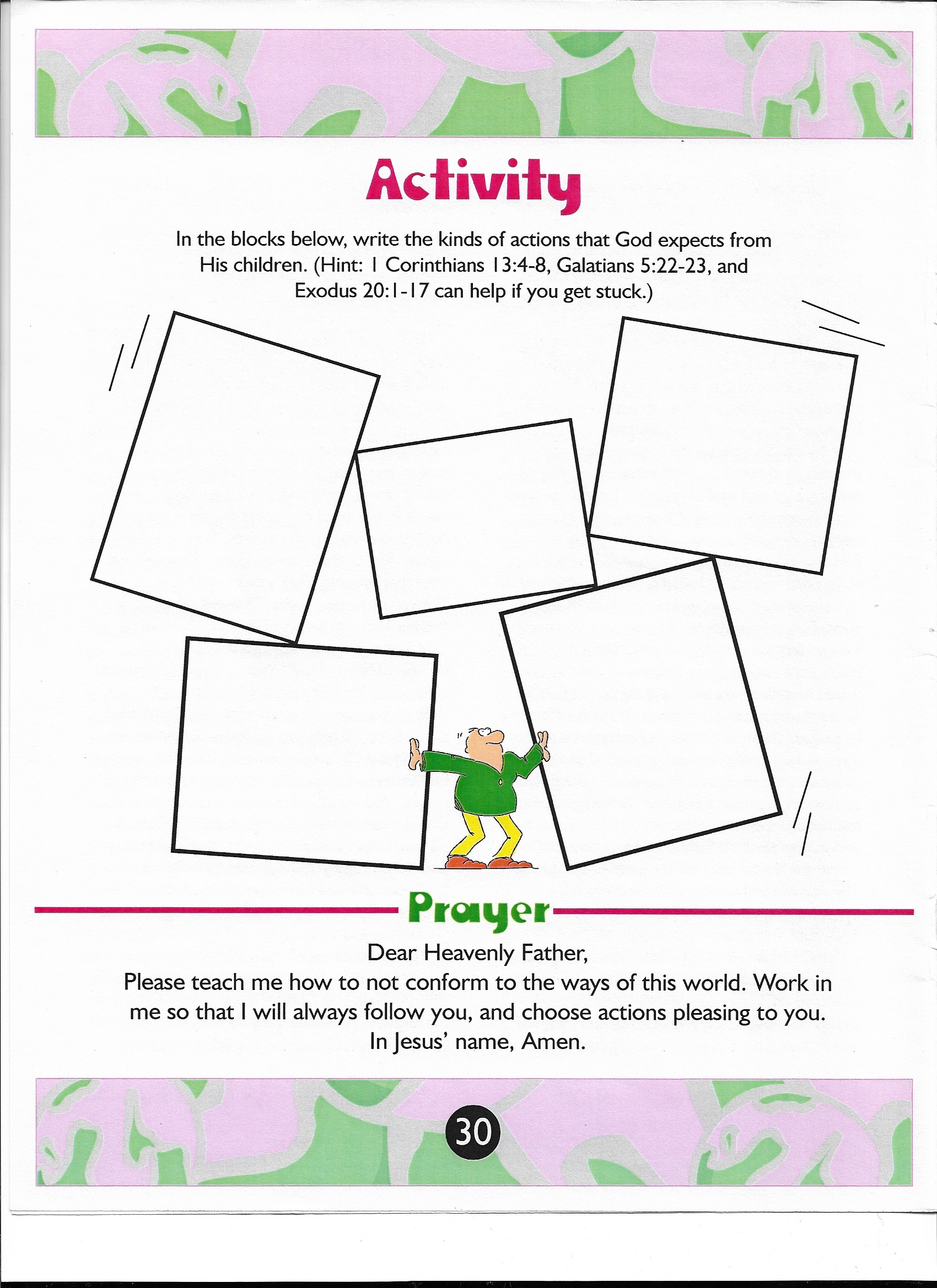
Have the students brainstorm two lists: wrong actions and thoughts (2 Timothy 3:2-4 is a good reference) and the actions and thoughts that are pleasing to God (Galatians 5:22-23, 1 Corinthians 13:4-8, Exodus 20:1-17 are good references). Write both lists on the blackboard as the students brainstorm. Then let the students write each wrong characteristic on a balloon with permanent marker. Let the students write the good characteristics on the building blocks (boxes) you brought in. Then divide the students into two groups. Have one group try to build with the balloons. Have the other group build with the boxes.
Ask them what happens when they build with ungodly characteristics vs. godly characteristics. How does this apply to their life?
REACH Activity
Word Study
Romans 12:2 in the King James Version says, “. . . be ye transformed by the renewing of your mind . . .” The word transformed is the Greek word metamorphoo. If you think it looks like metamorphosis, you’re right. This word means a “change of condition.” (Source: Zodiates’ Hebrew-Greek Key Word Study Bible, pp. 1737-1738.)
That’s exactly what happens in the life of a Christian. The old has gone; the new has come. The way you used to think about things no longer influences what you do now. The Spirit of God working in your heart changes you more and more into the likeness of God. It is very much like the metamorphic process of changing a caterpillar to a butterfly.
Did You Know?
Many of the ancient cities in Mesopotamia had a Temple complex, complete with a tower, called a ziggurat. These ziggurats were square at the bottom and had sloping, stepped sides that led up to a small shrine at the top. The idea was that the particular god of that city or region could use the ziggurat to come down to the people and receive their worship and sacrifices. They were given names “demonstrating that they were intended to serve as staircases from Earth to heaven: The House of the Link between Heaven and Earth (at Larsa), The House of the Seven Guides of Heaven and Earth (at Borsippa), The House of the Foundation-Platform of Heaven and Earth (at Babylon) and The House of the Mountain of the Universe (at Asshur).” (Source: NIV Archaeological Study Bible, p. 20.)
Back to the Bible
How does Proverbs 3:5-6 relate to today’s lesson of the Tower of Babel? Read Proverbs 3:5-6. Who were the people leaning on? If someone had walked up to them as they were building the tower and read the verses from Proverbs, do you think they would have stopped building? Explain your answer in your Bible journal.
Just Toolin’ Around
Use your Bible reference tools to find Scriptures comparable to Proverbs 3:5-6. For example, what verses explain how we should conduct ourselves in our daily lives? What verses would you find on trusting the Lord and the condition of a man’s heart? Record the verses in your Bible journal. Choose one or two to memorize this week.
Stretch It Out
Create a newspaper front page with a headline and article that relates the account of today’s lesson. Include illustrations with captions. Share it with your family or class.
Music Notes
Isn’t it sad that mankind’s natural tendency is towards evil? Imagine how much good could be accomplished if all people, everywhere, lived according to God’s laws. If everyone, from the very beginning, had been obedient to God and had looked to Him for guidance and direction, He wouldn’t have needed to confuse the language. Today, with the aid of computers and the Internet, our world is communicating again despite all of the different languages. Will we use all of those different languages to praise God?
There’s a song in the CEM Hymnal on page 13 called “O For A Thousand Tongues to Sing.” The word tongue could mean either “voice” or “language” in this usage. Most likely, it is “voice.” But either way, Charles Wesley desired the ability to more fully “sing my dear Redeemer’s praise.”
Charles and John Wesley had sailed for America after their graduation from Oxford University. They wanted to minister to the colonists in Georgia under General Oglethorpe and evangelize the Indians. They were very disillusioned at their unsuccessful efforts. As they were sailing back to England, they were very impressed by a group of devout Moravians. Once back in London, they met with a group of Moravians in Aldersgate Hall. It was here in May of 1738 that both John and Charles Wesley realized that, although they’d been very zealous for God, they’d never personally known God’s forgiveness or real joy. After this experience, their ministry efforts reflected this new relationship.
Eleven years later, Charles wrote the words to “O For a Thousand Tongues to Sing” based on a remark by the influential Moravian leader, Peter Bohler. Bohler expressed his spiritual joy this way: “Oh, Brother Wesley, the Lord has done so much for my life. Had I a thousand tongues, I would praise Jesus Christ with every one of them!” (Source: Amazing Grace, Kenneth Osbeck, p. 274.)
What about you? Do you praise God with the one tongue He has given you?
Journal Jot
Have you been around people speaking a language you couldn’t understand? How did that make you feel? Write about this in your journal.
Now think about a time in God’s Kingdom when we won’t have any communication problems. Write about how wonderful that will be!
Questions?
Reminds the child to write down (in their Bible journal) questions they may have as they are doing the activities, working through the lesson, or reading the Daily Devotionals.
Song
"Jesus Wants Me For A Sunbeam" is on page 21 of Kids Classics Collection.
Closing Prayer
Guide the students to ask God's help in not conforming to this world, but seeking His will and those actions pleasing to Him.
Printable Pages