YEA Lesson Library
Water, Water Everywhere
About This Lesson
This lesson teaches that Noah and his family had to trust God completely to save them from the flood and to let them know when they could leave the ark. We also must trust God all the time, even in calamity.
Scriptures
Genesis 7:6 - 8:16
Psalm 5:8-12
Psalm 9:8-10
Psalm 31:5-8
Psalm 37:5-9
Proverbs 3:5-6
Romans 8:28
1 Corinthians 10:13
James 1:2-4
Words to Know
EXASPERATION - a feeling of frustration
INCLINATION - leaning toward a thought or action; favor for one thing more than another
The Lesson
Carrie sighed as she glanced at the rain hitting her bedroom window. It had been raining for a week now. A whole week! She was tired of sitting inside reading books and playing Monopoly with her little brother. Even helping Mom bake cookies had gotten a little old. "How long is it going to rain?" she asked herself in exasperation. Just as soon as she could get outside, she was ready to plant flowers in her own little flower bed. She wanted to roller blade with her best friend, Theresa. She would even be happy to take the dog for a walk. Anything! She just wanted to get out of the house. Suddenly, Carrie thought of a time when it rained for a much longer time than just a week. It was the Great Flood when God destroyed the entire earth.
Just thinking about all that water made her shake her head. It was hard to understand how water could cover everything. Maybe she should not be so impatient for the rain to stop. After all, it could be a lot worse.
Why did God flood the entire earth with water? Why did He completely wipe out all life on land - except for those on the ark? Remember: "The Lord saw how bad the sins of all people had become on the earth. All of the thoughts in their hearts were always directed only toward what was evil.The LORD was very sad that he had made human beings on the earth. His heart was filled with pain. So the LORD said, ‘I created human beings on the earth. But I will wipe them out. I will destroy people and animals’. . .” (Genesis 6:5 NIrV Kids Devotional Bible). Imagine a society where every thought was only evil all the time!
People must have been pretty bad for God to be sorry that He created them. In Lesson 6 we learned that Noah walked with God. Because he did, God decided to use Noah to save the land animals, Noah's family, and Noah himself. Noah built an ark to hold the animals that God sent to him. When Noah, his wife, his three sons, and their wives and all of the animals were all on
the ark, God shut them in. Then it began to rain. Not only did it rain, but all of the springs at the bottom of the ocean burst open. God also opened the windows in the skies. You’ve never seen a rain like this one! Think about it raining for forty days. This wasn't just a gentle rain but such a heavy rain that the Bible says the windows of heaven were opened. And remember, it wasn't just raining, the springs at the bottom of the ocean burst open! Not a trickle! Not a fountain! They burst! That's a lot of water. Think about how tall Mt. McKinley and Mt. Evert are. There was enough water to cover even them to a depth of more than twenty feet! (Genesis 7:20). Of course, everything that lived on the land died.
Has anyone ever told you that Noah and his family were on the ark forty days and forty nights? This could be one of those trick questions. Read Genesis 7:24 carefully. Did you notice what it says? It rained for forty days and forty night. Noah and his family were on the ark much longer than forty days and nights. Keep reading. "The waters flooded the earth for a hundred and fifty days.” What? That's five months! Imagine floating on the water for five months. Noah and his family cared for all of those animals for five months - in the ark! Do you think that was an easy job?
Thankfully, God sent a wind to begin to dry up the water. Exactly five months after the rain started, the ark came to rest on the top of Mount Ararat. But there was still too much water for anyone to leave the ark. Noah, his family and the animals had to stay put for a while longer.Three months later, the tops of the mountains could be seen! Forty days later Noah sent out a raven and a dove to see if the water had gone down enough for everyone to leave the ark. The dove couldn't find any place to rest, so she returned to the ark. Seven days later, Noah sent her out again. She brought back an olive leaf! Can you imagine how Noah and his family must have felt when they saw that olive leaf? Even though the dove brought back an olive leaf, Noah waited seven more days. Then he sent out the dove again, and she didn't come back.
Five months after the ark had come to rest on the top of Mount Ararat, Noah took the covering off the ark. He looked out and guess what he saw? He saw dry land! But Noah still waited. What do you suppose he was waiting for? He was waiting for God. God had just saved them from being destroyed with the rest of people. Don’t you think it made good sense for them to wait for God to tell them they could leave the ark? Almost two months later, God told Noah that everyone could leave the ark. Noah, his family, and the animals had been in the ark for almost a year!
What if Noah hadn't waited for God or if Noah had left the ark too soon? There would not have been any dry ground for them. They could have been in mud up to their knees! What did it mean for the dove to bring back an olive leaf? It meant that plants were again growing. The earth needed time to grow plants for the animals to eat. If they had left the ark too soon, they would have starved. But most important, Genesis 7:16 says that God shut Noah and the animals in the ark. Noah's family needed to trust that God would let them out again when He was ready. Noah saw that the ground was dry a month and a half before God said they could come out. They had to have the faith that God was in control and would take care of them. They just had to wait.
You will never experience a flood like Noah did. But you may go through some pretty scary and dangerous things in your life. What will you do? Will you walk with God like Noah did and trust Him to protect you from the disasters? Or will you decide that you are ready to do whatever you want to do? Will you wait on God even though it looks like you could do something else? But
most important, when something awful happens to you, will you trust God to take care of you? Christians don't always have good things happen to them. Sometimes we may have to go through some pretty bad things. Will you always trust God? It's important that you do. It could save your life.
Student Prayer
Dear Heavenly Father,
Please help me to learn to wait on you and to trust you.
In Jesus' name.
Amen.
Daily Devotions
Sunday - Genesis 7:11-14
Monday - Genesis 7:17-22
Tuesday- 1 Corinthians 10:13
Wednesday - Psalm 5:8-12
Thursday - Psalm 9:8-10
Friday- Psalm 31:5-8
Saturday - Psalm 37:5-9
Objectives
At the end of this lesson, students will be able to:
1. Relate the time line of events in the Flood.
2. Understand the concept of trusting God in the midst of calamity.
3. Explain that sometimes bad things happen to Christians.
Topics & Themes
Death
Dove
Faith
Flood
God's Judgment
Mount Ararat
Noah
Olive
Trusting God
Materials Needed
Bible, YEA student and teacher's books, pens, pencils, markers, crayons, blackboard, chalk, animal books and pictures, poster paper, attendance and memory verse charts, stickers, songbook, cassette tape/CD, player
Preparation
Remember to bring the animal picture books from last week and the ark floor plan that the students started in the last lesson. Do some research on historic floods and be prepared to discuss the heights of the world's highest mountains. Try to give the students some idea of the awesomeness of this destruction.There are
many documented events throughout history where God's hand was evident in the outcome, i.e. major World War I battles and the settlement of the US. Also think of several well-known biblical examples of God's deliverance, i.e. David vs. Goliath, Joshua and the Battle of Jericho, Gideon, Shadrach, Meshach, and Abednego and the fiery furnace, Esther, Moses and the parting of the Red Sea, etc. Be prepared to discuss with the students how God can save His people from calamities, according to His will. Also be prepared to give examples of bad things happening to God's people; Daniel, Shadrach, Meshach, and Abednego in captivity, etc.
How to Teach This Lesson
Rain, rain go away - Discuss being stuck day after day in the house because of rain or foul weather. Contrast that with rain for forty days and forty nights.
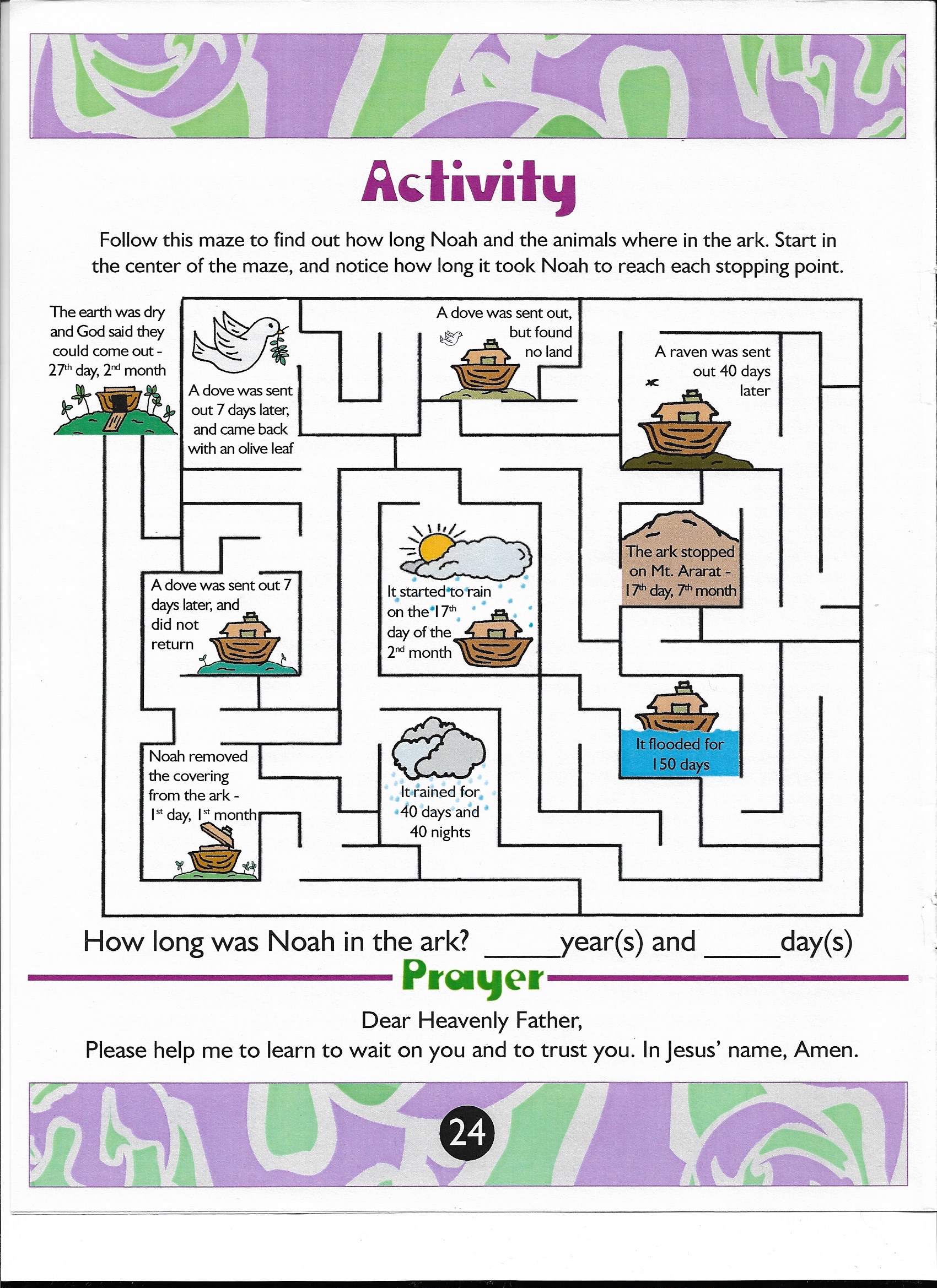
Time line of events - Draw a diagram of the events on the board: entering the ark and the beginning of the flood on the seventeenth day of the second month. The next graphics would be: I) it rained for forty days and forty nights, 2) it flooded for 150 days, 3) the ark came to rest on Mount Ararat on the seventeenth day of the seventh month, 4) a raven was sent out forty days later, 5) a dove was sent out and found no land, 6) the dove was sent out again and came back with olive leaf seven days later, 7) the dove was sent out seven days later, but didn't return. 8) the land was dry on first day of first month, Noah removed the covering from the ark, 9) the earth was completely dry on the twenty-seventh day of the second month.Then God said they could come out.
Waiting for God - Discuss Noah's action of not coming out of the ark on the first day of the first month - 10 months after he'd first gone in. Genesis relates that Noah saw the earth was dry. Ask: Are there times in your life when you don't want to wait for God - when you think you know how to do it fine on your own? Give the example of Abraham and Sarah not wanting to wait for God to give them a son.
Bad things happen to good people - We believe that God takes care of His people, so why do bad things sometimes happen to the people of God? Give the example of Jesus Christ suffering. Reference James 1:2-4. Explain that God knows what it's going to take to help us become people who He can use. Sometimes we have to suffer to grow in our Christian life. When we have the faith to trust God in every situation, we begin to realize He's working everything to our good (Romans 8:28). Discuss some of the biblical examples of calamities where God was with His people and delivered them. Some examples are that it was not a good thing to go into slavery in Egypt, nor to be facing a wall of water on one side and Egyptian soldiers on the other. But Moses said, "Stand firm and you will see the deliverance the LORD will bring you today" (Exodus 14:13).
Trust God - No matter what happens we have to trust God. Our attitude must be like that of Shadrach, Meshach, and Abednego: "If we are thrown into the blazing furnace, the God we serve is able to save us from it, and he will rescue us from your hand, O king. But even if he does not, we want you to know, O king, that we will not serve your gods or worship the image of gold you have set up" (Daniel 3:17-18). We need to be that firm in our convictions of serving and trusting God.
Review Questions
1. When did Noah enter the ark? (On the seventeenth day of the second month.)
2. How long did it rain? (For forty days and forty nights.)
3. How long did water cover the entire earth? (For 150 days or five months.)
4. How deep was the water in the shallowest spot? (twenty feet!)
5. What happened after 150 days, on the seventeenth day of the seventh month? (The ark came to rest on Mount Ararat.)
6. What was happening until the first day of the tenth month? (The waters were receding.)
7. What could be seen on the first day of the tenth month? (The tops of mountains.)
8. After forty days, what did Noah do? (He sent out a raven.)
9. What did Noah send out after the raven? (He sent out a dove.)
10. What did the dove find the first time out? (Nothing.)
11. How many days did Noah wait until he sent out the dove again? (He waited seven days.)
12. What did the dove bring back this time? (The dove brought back an olive leaf.)
13. What happened the third time Noah sent out the dove? (The dove didn't return.)
14. What had happened by the first day of the first month, ten months of being in the ark? (The earth was dry and Noah removed the covering from the ark.)
15. When did Noah, his family, and the animals leave the ark? (They left the ark on the twenty-seventh day of the second month.)
16. Why did Noah wait for almost two months after he saw the earth was dry?
17. Why is it important to wait and trust God for direction?
18. Why do bad things sometimes happen to God's people?
19. What should our attitude be when bad things do happen to us?
Teacher-Directed Activity
This is a continuation of last week's activity: Have the students continue to work together to design rooms for the animals and for the food. Encourage them to be as creative as possible in their design and organization of the rooms. Put this project on display to share with your church.
REACH Activity
Word Study
When you are experiencing one of life’s storms, it’s comforting to know that you can trust God. But what does it really mean to trust Him? The word “trust” in Proverbs 3:5-6 is batach, which means “to trust, feel safe, be confident, secure; to be careless. . . The basic idea is associated with firmness of solidity.” This trust is a strong hope, so strong that it becomes a confident expectation. (Source: Zodiates’ Hebrew-Greek Key Word Study Bible, p. 1602.)
If this word batach’s strong picture of reliance weren’t enough, Proverbs 3:5 says to trust, to batach, with all your heart!! Solomon was serious about how much he wanted people to trust our Great God! That’s a good thing to remember the next time life gets a little rough.
Did You Know?
It’s hard to really comprehend how large Noah’s ark was. It was 450 feet long! That’s one and a half times the length of a football field! It was 75 feet wide. So think very long and very narrow. Then it was 45 feet high. That’s like a four-story building. Still shaking your head? O.K. it was very, very big! (Source: The Victor Journey Through the Bible, p. 15.)
Back to the Bible
In your Bible journal, make a list of all the times you had to wait and the feelings you had while waiting for an answer or an outcome. Looking back, do your feelings surprise you? If you were waiting for the same thing now, would you feel the same way? You may have discovered that when you ask God for help or guidance, or for something that you want, you have had to wait. When you wait patiently and trust God for his answer you show God that you know He is in control. Is it easy? No! Noah’s family probably gave him suggestions while they waited behind the closed door of the ark, about when they could open the door and when they could leave the ark. But after waiting, it was finally opened by the very One who had closed it; God Himself.
Just Toolin’ Around
Using your Bible reference tools, find Scriptures that relate to “trusting the Lord.” How do they compare with your memory verse? In your Bible journal, write your own proverb(s) about your experience with trusting the Lord.
Stretch It Out
Get several different color pens or markers and your Bible journal. Think about some things that you are waiting upon, and then write them in your journal. Remember to date your list. Use different color pens to record a prayer for each of the things you wrote in your journal. As each prayer is answered record the answer in your journal next to your prayer. If you can, write your reactions and feelings for the answers you receive.
Music Notes
Okay, so you know you’re supposed to trust God when you are in the middle of a problem. What does that look like? How can you tell that you are really trusting God? Through your actions! No matter what comes your way, you resolve to trust and obey!
“Trust and Obey” is on page 193 of the CEM Hymnal. It was written by John H. Sammis. One night in 1887 in Brockton, Massachusetts, D. L. Moody was holding an evangelistic meeting. At one point, a young man stood up and said, “I am not quite sure, but I am going to trust, and I am going to obey.” This statement caught the attention of the song leader Daniel B. Towner.
Towner wrote down the sentence and what had happened. Then he mailed it to his friend and pastor, John Sammis. He asked Sammis if he could write words for a hymn. Sammis did. Then he sent the words back to Towner, who set it to music. It was published the same year, 1887, as “Trust and Obey.” (Source: 52 Hymn Story Devotions, Lucy Neeley Adams, p. 72.)
Journal Jot
What is the hardest thing to trust God with? Is it your family? Is it the future? Write it down in your Bible journal. Be sure to date your entry. Then pray, asking God for His involvement in the areas which concern you the most. Several years from today, resolve to look back at this entry and see how God has dealt with your issues.
Questions?
Reminds the child to write down (in their Bible journal) questions they may have as they are doing the activities, working through the lesson, or reading the Daily Devotionals.
Song
"Rise and Shine" (Arky, Arky) is on page 28 of Kids Classics Collection.
Closing Prayer
Guide the students to trust God no matter what happens, counting it all joy because they recognize God's control and His love for them.
Printable Pages