YEA Lesson Library
Noah’s Ark
About This Lesson
This lesson retells the story of God saving Noah, his family, and the animals from the flood. It teaches that, while God might not save you from every bad thing, you can trust Him to take care of you if you have a relationship with Him.
Scriptures
Genesis 6:9 - 7:24
Matthew 24:37-39
Romans 8:28
Romans 8:37-39
Hebrews 11:7
Words to Know
CALAMITY -terrible thing that happens
RIGHTEOUS - without guilt or sin
ACKNOWLEDGE - to admit that something is, i.e. that God lives and is in control
The Lesson
When your mom buys grapes at the store, she brings them home. Then she washes them in the kitchen sink with soap and water to get the pesticides and dirt off them. And she picks out the bad ones from the good ones. The good ones are saved to eat! Yum! The bad ones are thrown away. That makes sense! Why would anyone want to keep rotten grapes?
When you are writing a story for school and it's just not going very well, sometimes your dad will help you pick out the one sentence that is really good. You write it down on a fresh sheet of paper. Then you crumple up the first sheet of paper and throw it away. It is a mess and it's no good to you anymore. But you have a new piece of paper in front of you. You know what you're going to write about, and you start over again.
When God created this world, people became evil very quickly! Do you remember last week’s lesson? God decided to destroy all human beings and then start over. This was kind of like the rotten grapes and your story for school. God told Noah, "I am going to put an end to all people, for the earth is filled with violence because of them. I am surely going to destroy both them and the earth." How was God going to destroy the people? He was going to send a great flood that would cover the entire earth. Everything would drown.
But why did God tell Noah this? Because Noah had a special relationship with God. The Bible says that Noah found grace in the eyes of God. "Noah was a righteous man, blameless among the people of his time, and he walked with God" (Genesis 6:9.) That doesn't mean that Noah was perfect or that he never sinned. It does mean that, like Enoch, Noah had a good relationship with God. He asked for forgiveness for his sins. He listened to God. He did what God told him to do.
It's a good thing that Noah did what God told him to do because it saved his life! Remember, God was going to destroy the whole earth, everything that lived on the dry land. But God decided to save Noah. God told Noah to build a boat - a big boat called an ark. The ark would be 450 feet long, 75 feet wide, and 45 feet high. Okay, so how big is that? Well, imagine a boat that is as long as one football field and a half of another one! It was 75 feet wide. That's 25 yards - you know, like a 25 yard dash. And it was 45 feet high. That would be about like a four-story building! This was a big boat!
But God wasn't finished with the directions that He gave Noah. God told Noah to build rooms. He also had to build three levels in the ark and put a roof on it. When he was finished, Noah was supposed to coat the inside and the outside with pitch.That would waterproof the ark so that it wouldn't leak and sink. But why did Noah need such a big boat? Why did it need three levels? And why did it need rooms? Noah and his family certainly wouldn't need that much space!
God was going to save Noah and his family, and God was also going to save the animals. Noah needed the room to take two pairs of every kind of unclean animal, seven pairs of every kind of clean animal, and seven pairs of every kind of bird on the ark. God also told Noah to take every kind of food and store it on the ark, for both his family and for the animals. Think of all that food!
Noah was certainly going to have his hands full building this huge ark and getting it ready for the Flood. Then he had to gather all the food that the animals and his family would need.
Thankfully, Noah didn't need to go find all the animals. They came to him. Can you imagine the animals all arriving to come onto the ark just before the Flood? What a sight that must have been!
As Noah worked, it seems certain that his neighbors and all the people around him made fun of him. What was Noah doing building such a big boat? But Noah knew that everything and everyone who wasn’t in the ark when it started to rain would drown. God could no longer put up with how evil everyone had become. Everyone would drown in the coming flood except Noah and his family. Then he would repopulate the earth with that one family.
It's really something to think about. Our loving Heavenly Father has a lot of patience with us. He gives us a lot of time to learn to walk with Him and to do His will. The people who want to do His will, who want to please Him, and who believe that He is their God are special to Him.They are the ones God will be good to when He is angry towards everyone else. God saved Noah from the Flood that killed all the rest of the people who were alive at that time.This doesn't mean that everything will be perfect for Christians. After all, it wasn't a lot of fun feeding and cleaning up after all those animals in that ark. That was a lot of hard work.
But Noah and his family knew that this was what God wanted them to do. And it's the same for you. If you love and obey God nothing will happen to you that He doesn't allow, because He loves you. So if something bad does happen (maybe not exactly like a huge Flood), you should ask God what lesson He wants you to learn. Do you think Noah and his family learned a lot while they were building the ark? Do you think it was hard for them when bad people laughed at them for obeying God and building the ark? Noah and his family must have learned a lot about praising God and waiting for God to show them what to do. When the rains started, you can bet they were very glad that God was in control of their lives. They were very happy that they had listened to Him.
Can you praise God for being in control of your life no matter what happens? Why do you think that God allows people to laugh at us and for us to be uncomfortable? Our loving Heavenly Father wants us to live with Him for eternity. He knows exactly what it will take for us to do that. He knew these people had to go through a Great Flood to do it. Whatever you go through, remember this promise, "And we know that in all things God works for the good of those who love him, who have been called according to his purpose."
Student Prayer
Dear Heavenly Father,
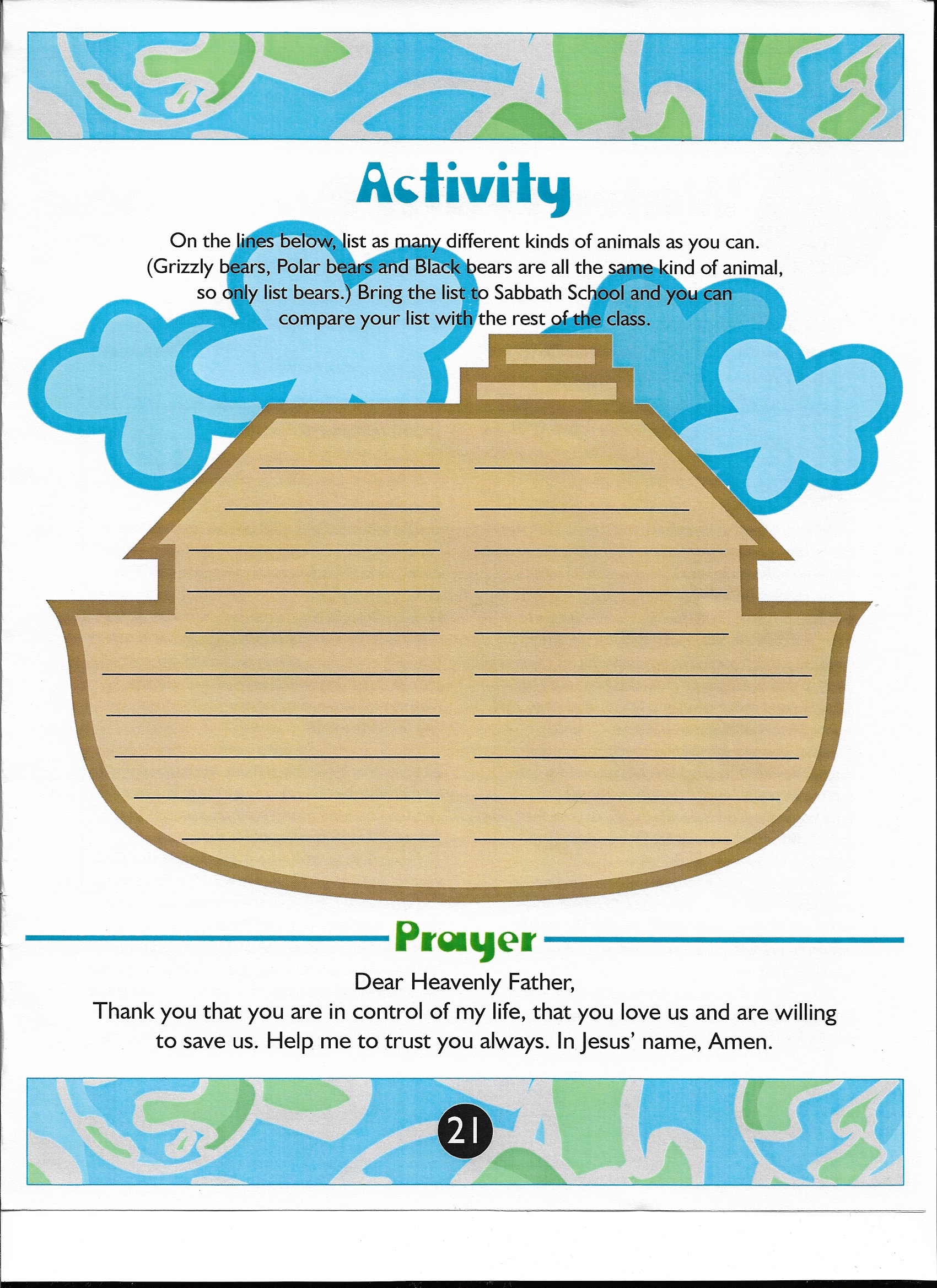
Thank you that you are in control of my life, that you love us and are willing to save us. Help me to trust you always.
In Jesus' name.
Amen.
Daily Devotions
Sunday - Genesis 6:8-11
Monday - Genesis 6:12-16
Tuesday - Genesis 6:17-22
Wednesday - Genesis 7:1-6
Thursday - Matthew 24:37-39
Friday - Hebrews 11:7
Saturday - Romans 8:28, 37-39
Objectives
At the end of this lesson, students will be able to:
1. State God's intention to destroy all living land-based creatures with a great flood.
2. Explain why God told Noah of His intentions.
3. Explain that Noah had a special relationship with God.
4. Describe the dimensions of the ark.
5. Relate the numbers of animals and birds that Noah took on the ark.
6. Explain that God is in control even when we don't understand how things will work out in our lives.
Topics & Themes
Ark
Flood
God's Judgment
Noah
Obedience
Relationship With God
Trusting God
Materials Needed
Bible, student and teacher's books, pens, pencils, markers, crayons, blackboard, chalk, animal books and pictures, grapes, two bowls, corrugated board or board for ark base, poster paper, attendance and memory verse charts, stickers, songbook, cassette tape/CD and player
Preparation
Find many animal pictures to take to class. National Wildlife is a great magazine source, as are old calendar pictures. Spend some time at your local library finding animal books to take to class. Remember, these will be relatively simple books for this age group. National Geographic’s Animal Encyclopedia is a great, age-appropriate source. Display the different animal pictures and animal books around the room before the children come in. This will help them understand the magnitude of Noah's task of taking the different kinds of animals onto the ark, as well as feeding and caring for them during the flood. Plan to bring the pictures and books for next week's lesson too.
The student's activity asks them to list as many kinds of animals as they can think of. They are only listing kinds: that is, bears instead of grizzly bears, black bears, Kodiak bears, polar bears. You may also want to do this activity prior to class. They will appreciate the effort you made to help them come up with different kinds. The list is limited to land-based animals, including birds and probably insects, but no whales, fish, octopuses, etc.
How to Teach This Lesson
A Grape Object Lesson- Bring a bunch of grapes to class with you. As the students are reciting their memory verse, separate the good grapes from the ones that are getting rotten. Allow the students to help, if they wish. When you are finished, discuss why you sorted out the good from the bad. Ask the students what they would do with the bad ones. Link this to God’s decision to destroy the earth with water because "every inclination of the thoughts of (man's) heart was only evil all the time" (Genesis 6:5).
Noah found grace - The NIV says “Noah was a righteous man, blameless among the people of his time, and he walked with God" (Genesis 6:9). Just prior to that we see that Noah found grace in the eyes of the Lord. If Noah was completely without sin, there would have been no need for God's grace. Therefore, Genesis 6:9 tells us that Noah found his righteousness in God, that he'd repented of his sins, and that he followed the law of God. It's important that the students understand this distinction because otherwise they may believe that Jesus and Noah were the only men who never sinned. We know that's not true. Only Christ was without sin.
God's saving grace - Because Noah loved God, God decided to save Noah, his family, and the land-based animals. Discuss with the students how God's plan for Noah's physical salvation was going to take a lot of work on the part of Noah. Discuss the dimensions of the ark, the number of animals, the huge amounts of food, the care the animals would require. Also discuss the ridicule Noah and his family would have engendered from the wicked people around them as they were building this ark. Explain that following God's will is not always easy, but it is right and they will be rewarded in the end.
An arkful of animals - Ask the students to share their lists of animals. Discuss taking two of every kind of unclean animal, seven of every kind of clean animal, and seven of every kind of bird. Note that this is two pairs and seven pairs. Noah was to take seven of every kind - male and female. Male and female make the requirement an even number.
Romans 8:28 - Ask the students to explain what their memory verse means.Too many people recite: Al things work to the good - and stop there. The entire verse clarifies that situations work to the good for those who first love God, and then, who are called according to His purpose. Discuss how the flood was a calamity that God worked to the good for Noah and his family, because they loved God and they were called according to His purpose.
Preview next week's lesson - Ask the students to give thought this next week to how important it is to love God (displayed by the actions and choices that they make) and to be called according to His purpose.
Review Questions
1. What did God decide to do because of the wickedness of the people in Noah's time?
2. Why did God tell Noah?
3. What kind of a person was Noah? What do we know about him?
4. How big was the ark?
5. What special features did the ark have?
6. What did God tell Noah about taking animals onto the ark? How many? What kinds?
7. What can we learn about doing exactly what God says from the story of Noah and the ark?
Teacher-Directed Activity
The children are going to design a model of the three levels of Noah’s ark. You'll need three large pieces of poster paper. Each piece will represent one of the three levels Noah was told to build in the ark. Have the students work together to design rooms for the animals and for the food. Suggest that they invent a system (i.e. a waterfall system) for using the rainwater to water the animals. Encourage them to discuss the problems of putting certain animals together. Then draw( or write the names of the animals) in the various rooms. Don't forget to plan a way for Noah to get up and down from all levels. You'll continue this project next week.
REACH Activity
Word Study
Do you want things to work out well for you? Well, of course. But most people just want things to be good all the time. They don’t want to wait for the good to come. Romans 8:28 does not promise a life without pain and disappointments. It does not promise to only give you good all your life. What it does say is that God will work things out to your good, if you love Him and are called according to His purpose. What kind of good do you think God will work out? The Greek word translated “good” in Romans 8:28 is agatthos. It means good and benevolent, profitable and useful. Wow! This is the kind of good that means good for you personally and good for others too. So take heart! God has plans for you, good plans for you. (Source: Zodiates’ Hebrew-Greek Key Word Study Bible, p. 1609.)
Did You Know?
Have you ever wondered exactly what kind of wood was used to build the ark? One kids’ song calls it gopher wood. Was the ark really built out of gopher wood? And what, exactly, is gopher wood? Well, no one knows for sure. But here’s what one Bible resource had to say: “Gopher wood is not mentioned anywhere else in the Bible. Some say it was cypress pine, or cedar. Others suggest that ‘gopher’ did not refer to the type of wood, but rather to wood covered with pitch, the substance used to seal the cracks in the ark.” (Source: The Victor Journey Through the Bible, p. 15.)
Back to the Bible
Read Genesis 6:18-22. Do you see the word “covenant” in verse 18? Use your Bible reference tools to find its meaning and then write it in your Bible journal. This is a very important word that you will find and read throughout Scripture. (Besides Noah, God will later establish a covenant with Abraham, too.) God made a promise to Noah that, although everything would perish, he and his family would survive. Can you imagine how happy and grateful Noah felt?
Just Toolin’ Around
Using Bible reference tools, find the meaning of grace. Write the definition in your Bible journal. Include the Strong’s concordance numbers for both the Greek and Hebrew definitions. Finally, in your Bible journal, explain the meaning of Genesis 6: 8-9.
Stretch It Out
Interview at least four people with this question: What lessons have you learned while trying to live according to God’s way? Or perhaps you can think of a question or two yourself that you would like to ask them. With permission, share their answers with your class or family.
If you were to interview Noah, what questions would you ask him, and why? How do you think he would answer your questions, and why?
Music Notes
There’s no doubt about it: you are going to have some difficult things in your life. You are going to experience pain. You will see people whom you love die. You will have problems. That’s just how this life is. But there’s good news! If you love God, as Noah loved God, then you can quit worrying. Oh, there will still be hard times, but you know that God is in control. You can trust Him. He will take care of you. Hey, that sounds like a song! It is.
“God Will Take Care of You” is on page 69 of the CEM Hymnal. It was written by Civilla D. Martin one day when she was ill. Dr. W. Stillman Martin and his wife, Civilla, were an evangelistic team at the turn of the 20th century. They traveled around the United States. Dr. Martin preached and Civilla Martin sang hymns and led others in singing.
In 1904, while visiting the Practical BIble Training School in Lestershire, NY, Civilla became very ill. She was so sick, she couldn’t leave her bed. One evening Dr. Martin did not want to leave his wife because she was especially weak, even though he was expected to preach. Their young son simply asked, “But Father, don’t you think that if God wants you to preach today, He will take care of Mother while you are away?” Convicted by his son’s words, Dr. Martin did leave to preach. Several people in the audience were so moved that they made commitments to follow Jesus following his sermon. Dr. Martin hurried home to share this good news. When he returned, Civilla had her own good news. She was feeling much better. She also showed him a poem she’d written—the words to this hymn. Liking the words very much, Dr. Martin walked over to their reed organ and set her words to music. It was performed at the Bible Training School later that week. (Sources: 52 Hymn Story Devotions, Lucy Neeley Adams, p. 26-27; Hymns of Faith and Inspiration, Pamela J. Kennedy, pp. 104-105.)
Journal Jot
Romans 8:28 is quoted often. What does it mean to you? Does it mean you will always have good things in your life? How would you explain what this verse means? Write your explanation in your Bible journal. Then share it with your friends and family.
Questions?
Reminds the child to write down (in their Bible journal) questions they may have as they are doing the activities, working through the lesson, or reading the Daily Devotionals.
Song
Rise and Shine (Arky, Arky) is on page 28 of Kids Classics Collection.
Closing Prayer
Guide the students to look to Christ as their Savior in all areas of their lives and recognize God's will and His love for them.
Printable Pages