YEA Lesson Library
I’ll Make a World
About This Lesson
This lesson details examples of what was created on each day of Creation week, days 1-6.
Scriptures
Genesis 1:1-25
Psalm 95:1-6
Psalm 148:1-13
Psalm 148:5
Isaiah 40:21-26
Isaiah 42:11-13
Isaiah 45:5-12
John 1:1-5
Words to Know
SUPERNOVA - an exploding star a million times larger than our sun
BIOLOGIST - a scientist who studies life and all living matter
ANTIDOTE - a cure
The Lesson
J.K. Rowling probably never imagined how popular her books about Harry Potter would become. You know, the little orphan wizard who rides around on a broom stick and has a magic wand. All of these books were in the top ten adult list even though they are kids books! People were amazed at the incredible things that Happy Potter did. But have you thought about who it is that really did some incredible things? After all, Harry Potter is fiction. Let’s look at something far greater and more exciting!
Imagine a world where there is nothing: no land, no oceans or streams, no life, and no light. Genesis 1:2 tells us, "The earth didn't have a shape. And it was empty. Darkness was over the surface of the ocean. At that time, the ocean covered the earth. The Spirit of God was hovering over the waters" (NIrV Kids Devotional Bible). Then one day, the great God of the universe decided to create a world for you and me. He said, "Let there be light," Think about that. At God's command there was light. God thought, “This is good!” So He separated the light from the darkness. The light was day and the darkness was night. This was the very first day. Don't you think that was a lot of work for just one day?
Day Two of creation was also a very busy day! God created sky. Imagine what that means! Before God created the sky, there was no atmosphere, no clouds, no oxygen to breathe. Before God separated the sky from the water, the earth was like a huge fog. How would you describe what the earth was like before God separated the sky from the water on the second day of creation?
Have you ever created your own town or community in a sandbox complete with running water from the hose? Imagine digging out the channels for the rivers and streams, scooping out sand for the lakes and oceans, piling up mounds for mountains and hills and plateaus. What fun! That's what God did on Day Three. He created land, separating the waters so that continents and islands would appear. This is landscaping in a huge way! But that's not the only thing God did Day Three. He also created all the seed-bearing trees and plants.
Whoa! All of them? Yes! The fruit trees and pines trees, the maples and sweet gums, the tomatoes, spinach, carrots, peppers, celery and mustard and. . . Are you beginning to get the idea of just how much God created on Day Three? This is not just some easy landscaping project. This is awesome! Just think about all of the different seeds there are. Acorns are much different than pumpkin seed, which are very different than pine cones.
So God created all of the plants and their seeds and all of the things that each plant does. For instance, did you know that oftentimes where you find poison ivy growing naturally, you'll also find jewel weed nearby. It's a natural antidote to the poison ivy oil. Have you seen how jewel weed, explodes away from the plant? You can think of many examples of the neat things plants do. God not only created the ones you know about, but many more. In fact, biologists are still discovering new plants in the tropical rain forests around the world! Wow! Yes, Day Three was a very busy day.
If you were God, what would you have created next? He created something every plant needs. What do you think that might be? Plants must have sunlight to live. So God created the sun. He also created the moon and all of the stars! Think about the black holes, billions of galaxies, and exploding nebula. Scientists think that some supernovas actually exploded thousands of years ago. They think that because they are so far away, we're just now getting the light from the explosion. When you think of all that space and all of the stars God created in that space, that is a lot to do on Day Four.
On Day Five,God created the birds and all of the creatures in the sea. Dolphins and penguins, sea otters and falcons, chickens and octopuses, cardinals and sharks. How long do you think it would take for you to list all of the different kinds of birds and sea creatures? Imagine creating each one unique, different from every other creature in some way. Think about designing an eagle's eyes or a whale's blow hole, a pelican's bill or a manta ray's shape, or an emu's feathers or a turtle's shell. How amazing all of the flying and sea creatures are!
On Day Six, God created all of the land animals! Chimpanzees and duckbill platypuses, horses and dogs, pandas and lizards, elephants and giraffes, hippos and mountain lions, tigers and bears ... And again, you can spend all day thinking about the different animals, but God spent all day making them unique and wonderful in their own way.
Think about designing an elephant’s trunk or a kangaroo's pouch, a cow's digestive system or a cat's claws, a polar bear's insulating hair or a porcupine's quills. Amazing! Each one of God's creations makes sense. The creatures were given instincts and senses and abilities to help them survive and reproduce.
The plants were created to balance the animals so that they exist in a web each dependent on the other. And God created physical laws to make it all work. One of His laws is gravity. Can you imagine trying to walk to school if there was no gravity holding you to the ground? God's creation was done right! It wasn't thrown together like one of man's inventions which needs improvements almost immediately!
The creation shows God is wise and intelligent beyond words. It also show God’s sense of humor. Look at the way a duckbill platypus is put together. When it was first discovered, people thought it was a fake. Think about how foals play or how a kitten bats a ball of yarn. God created them to do that!
Harry Potter may have captured the imaginations of many adults and children around the country. But God's wonderful creation should capture your imagination even more. Spend some time exploring our world. And give God the thanks and the glory for the wonderful things He has done!
Student Prayer
Dear Heavenly Father,
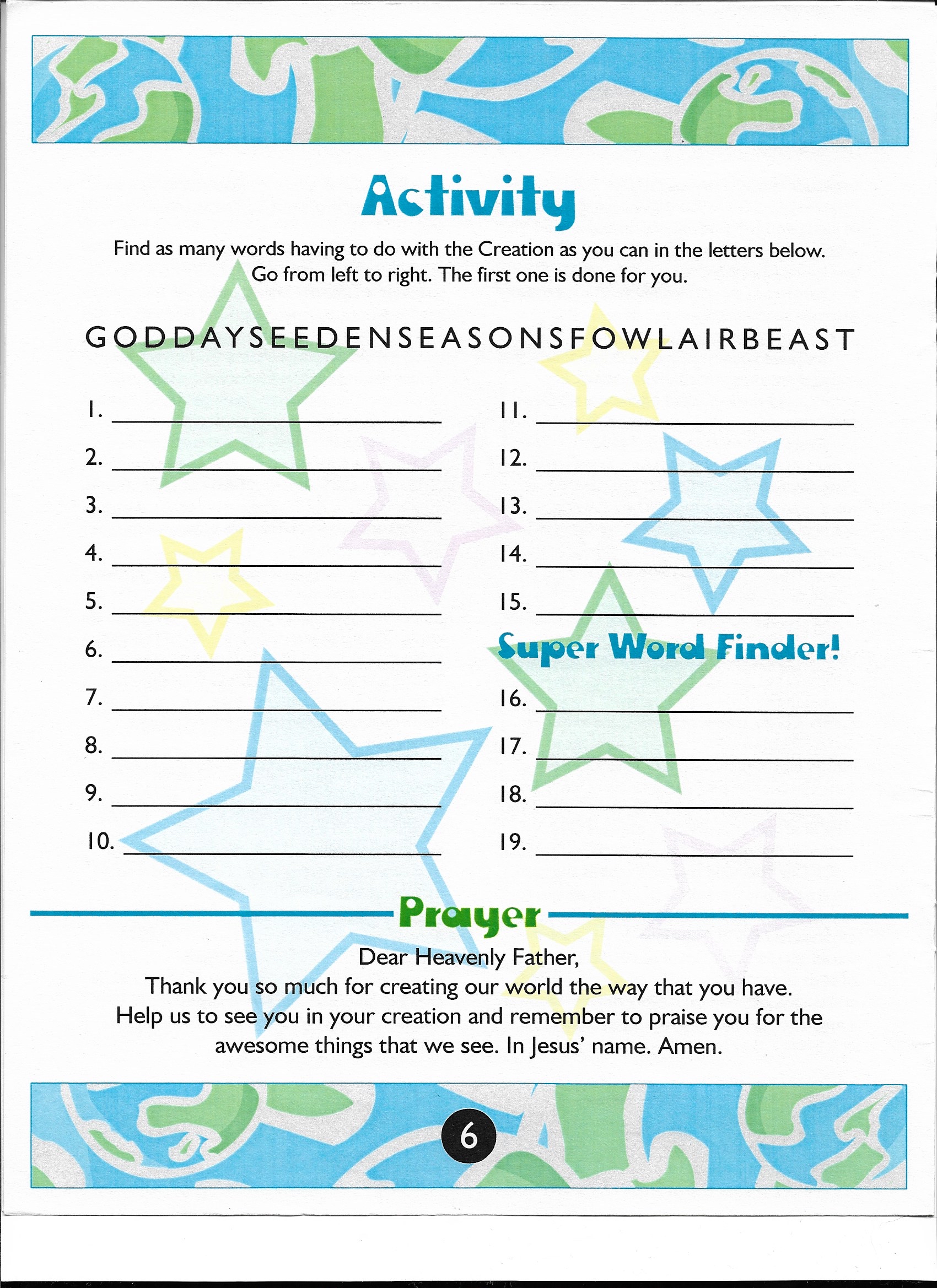
Thank you so much for creating our world the way that you have. Help us to see you in your creation and remember to praise you for the awesome things that we see.
In Jesus' name.
Amen.
Daily Devotions
Sunday - Psalm 148:1-13
Monday- Isaiah 40:21-26
Tuesday - Isaiah 42:11-13
Wednesday- John 1:1-5
Thursday - Genesis I:1-10
Friday- Isaiah 45:5-12
Saturday - Psalm 95:1-6
Objectives
At the end of this lesson, students will be able to:
1. Recite what was created on each day of creation week.
2. Compare the awesomeness of God's ability to man's limited power.
3. Gain an appreciation for the creation of God and for the Creator.
Topics & Themes
Creation
God’s Omnipotence
God’s Plan
Materials Needed
Bible, YEA student and teacher's books, pencils, animal and plant pictures, glue, scissors, poster board, clear contact paper, blackboard and chalk, seeds, markers, crayons, zip lock storage bags, songbook, cassette tape/CD and player, memory verse and attendance charts, stickers
Preparation
It is truly mind boggling to consider what God did during creation week! Whether you believe the account as written or that each day represents a thousand years, you cannot escape the awesomeness of our Creator. Spend some time reading Genesis 1:1-25 and be prepared to answer questions like: How was there light on Day One when the sun, moon, and stars were not created until Day Four? Was there gravity before Day One - otherwise what held the earth where it was, although it was formless and void? What does it mean that the Spirit of God was hovering over the waters? How big is the universe? How old is the universe? How did it all start? Was it all like one big black hole in space that collapsed on itself and then exploded into all directions at God's command? As you're pondering some answers to these almost unanswerable questions, know that it is very acceptable to students for adults to say "I don't know" when there truly is no way of knowing.
Find some calendar or magazine pictures of animals and plants to bring to class. Using one of birds, sea animals, plants, and land animals make medium-sized jigsaw puzzles. That is, glue the pictures onto poster board, laminate or cover with clear contact paper for preservation, then cut them up into jigsaw pieces. Put each puzzle into a separate zip lock bag. You'll use these puzzles to help teach the lesson.
Since the junior class spans three years, some of the memory verses may be too long for younger or slower children. Use your discretion and shorten memory verses for children who may
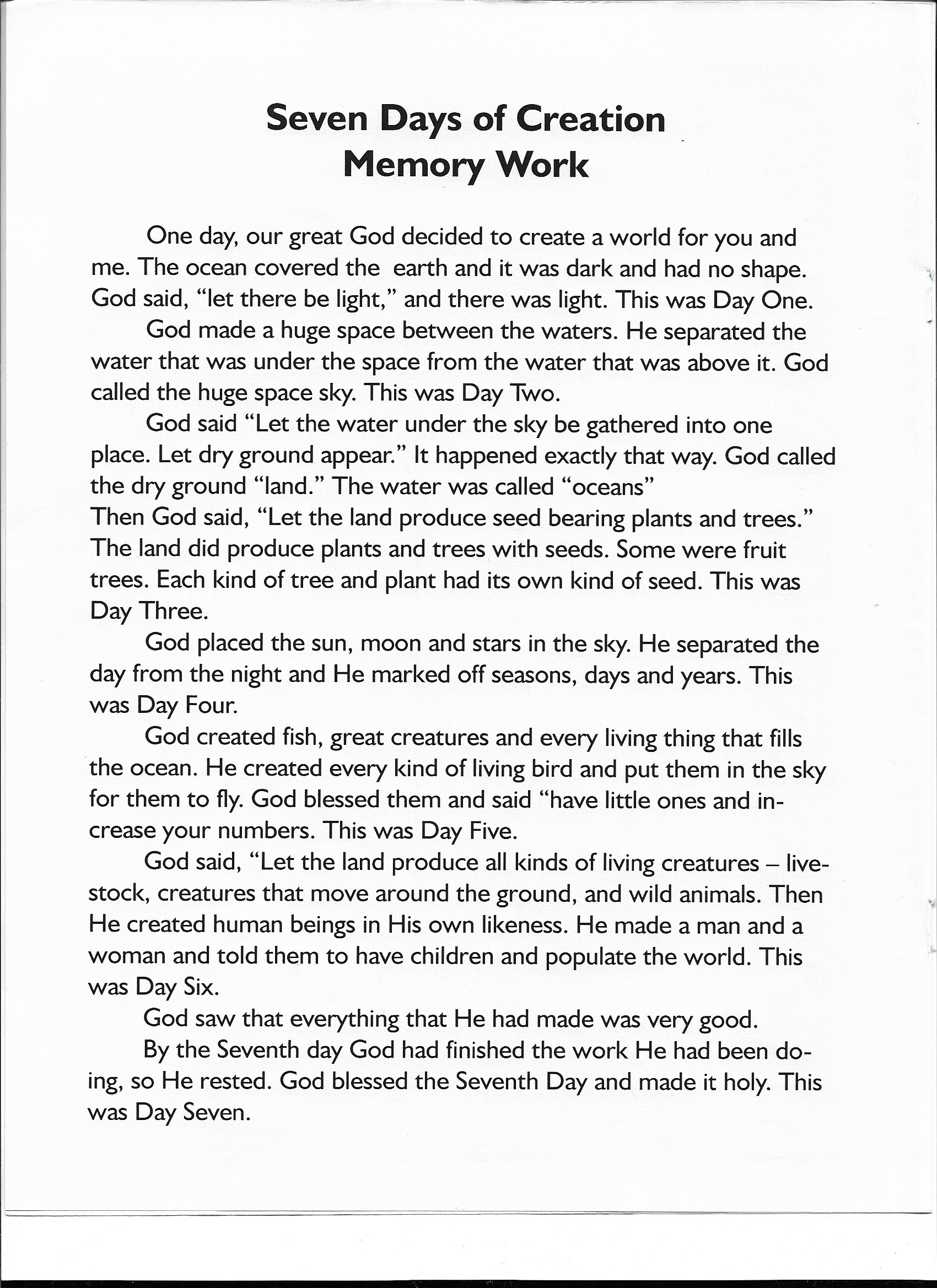
have difficulty in memorizing longer verses. For the larger memory work assignment for this book, have the students memorize what happened on each day of creation and recite it at the end of Lesson 10. An example of what they can memorize is on the pattern page.
How to Teach This Lesson
Harry Potter - discuss with the students the popularity of the series. Why do people find it so interesting? What's the attraction? Contrast his powers and adventures with the powers of God, fiction versus reality.
Day One - What did God create first? (light) Ask: When did God create the sun, the moon, and the stars? (Day Four) Revelation 21:23 says the New Jerusalem "does not need the sun or the moon to shine on it, for the glory of God gives it light." Discuss with the students the possibility that just as God will be our light in the New Jerusalem, He was the light over the earth in the beginning. Then, ask a student to read Genesis 1:5-6. Ask: which comes first, day or night? (night- it says evening and morning were the first day.)
Day Two - What did God create on Day Two? (the sky or atmosphere) What is in our atmosphere? (oxygen, layers of air and ozone)
Day Three - What did God created on Day Three? (land, seed-bearing plants and trees) If possible, bring in some different seeds. Ask the students to name seeds as quickly as they can think of them. Write them on the board as they name them. If you have lots of time, let the students make a seed collection from the seeds you bring in.
Day Four - What did God create on Day Four? (sun, moon, stars) Discuss that according to the Bible, the earth existed before the sun. School will try to teach the students that the sun came first and then the planets. Ask: what are the three reasons God gave for creating the sun, moon, and stars? (to separate night from day, signs to mark seasons, days, and years, and to give light on the earth)
Day Five - What did God create on Day Five? (winged birds and water animals) The NIV commentary states that the winged bird denotes anything that flies, including insects. As stated in the Preparation section, have some easy homemade jigsaw puzzles of birds and water animals. Have the students put them together - quickly. Point out that the students struggled a little with just putting a picture of the animals together. God thought through everything that they would need in order to survive. Talk about some of the amazing things in the animal kingdom. Lead directly into the next day.
Day Six - What did God create on Day Six? (land animals) Continue the discussion about abilities, unique characteristics, and traits of animals. Make a list of al the birds, animals, etc. on the blackboard as the students enumerate them.
Creation vs. man's invention - How difficult was it for people to invent a computer or a car or space shuttle? How much more difficult would it be to create life? God created every living thing - and with such humor, love, and tenderness. Psalm 148 - Ask for a volunteer to read all of Psalm |48 out loud. Bring the lesson back to discussing the present craze for Harry Potter. It maybe entertaining, but it doesn't begin to compare with our Great Creator. Let's give Him the praise.
Review Questions
1. What did God create on Day One? Day Two? Day Three? Day Four? Day Five? and Day Six?
2. What's the difference between God's creation and man's inventions?
3. What should our response be towards our Creator God?
Teacher-Directed Activity
The students are going to make creation puzzles to help them remember what God created each day. They will also have a reminder of how all of creation fits wonderfully together.
Have each student cut a piece of poster board into seven large jigsaw pieces. Have them number each piece, one through seven. Then decorate around the numbers - only on the front side. Then take piece number one. On the back, draw and explain what God created on Day One. Take piece number two. On the back, draw and explain what God created on Day Two. Do the same for Days Three, Four, Five, and Six. Leave some room on piece number six for next week's lesson. The students will be able to continue working on pieces 1-6 next week. Keep piece number seven for lesson three. Give each student a zip lock bag in which to keep their puzzle.
REACH Activity
Word Study
The word “created” in the memory verse is bara, which means to create, form, make, produce. It emphasizes the initiation of the object, not manipulating it after its creation. God alone is able to create. (Source: Zodiates’ Hebrew-Greek Key Word Study Bible, p. 1604.)
There’s a joke that illustrates this point: One day some scientists went to God and said, “Okay, we don’t need you anymore. We know how to create life.” They left and began working in the lab. God said, “Hey! What are you doing? Get your own dirt.”
God created everything. Man just tries to change God’s creation parts around to form something new. But the building blocks all came from God. He alone is Creator.
Did You Know?
Many ancient creation stories (outside of the Bible) present a god of creation in one specific location. That god competes for importance among the other gods of that culture. Those gods may include a moon god or a sun god. Sometimes these creation myths relate battles between gods and monsters. Victory over the monsters results in that god rising to supremacy. The creation of humans, in these cultures, is seen as a way to get slaves for the gods. Often the humans are used to feed them with their sacrifices. (Source: NIV Archaeological Study Bible, p. 5.)
Aren’t you glad to know that our God is God alone? He is good, all the time. He is Creator and Lord. There is no confusion about how He created the world. There is no battle for supremacy. There is no doubt of His love for mankind. What an awesome God we serve!
Back to the Bible
Reading the Genesis 1-2 account of creation can be a fascinating Bible study. And although there are many Bible versions to choose from, each one states God as the Creator of all things. Read at least two or three versions of Genesis 1 that differ from your Bible to prove the point. Perhaps you can share the Bible reading with your friends or family.
How many times does the phrase “and God saw that it was good” appear? Use Bible reference tools to study that phrase (Genesis 1:4 is the first time it is in Scripture) and find the meaning of the word “good.”
God saw that all He made was right and pleasant. Do you find God’s creation good? Make a list of all God’s creations that you find good, right, and pleasant. How do you, or can you, take care of the world that God created? Talk it over with your friends and family.
Finally, the Book of Psalms records David’s and other writers’ thoughts regarding God as the Creator, and the wonderful world He created. Use Bible reference tools to find each psalm that has the word “creator” or another form of the word “create.” How many are there? Which is your favorite “creation” psalm? Share it with a friend or your family.
Just Toolin’ Around
For each day of creation, find corresponding Scriptures that speak of that specific creation. For example, on the first day God said, “Let there be light,” and there was darkness and light. Now, use a concordance and other Bible reference tools to search for Scripture verses about light and darkness. Find a Scripture from both the Old and New Testaments for each of the days’ creations. Record your Scriptures in your Bible journal. Choose at least one Scripture to memorize from each of the seven creation days.
Stretch It Out
Take time to walk or hike around the block or neighborhood to observe God’s creation around you. Take your camera along and shoot some pictures, or take a drawing pad and sketch pictures along the way. Put the pictures in your Bible journal and write a psalm that describes your neighborhood observations.
Music Notes
Have you thought about the mighty power of our Great God recently? He’s the one who formed the mountains, who set the volcanoes in place and molded the majestic peaks. He’s the one who organized the tides and seasons. God’s the one who planted the earth with every good food. He didn’t have to make healthy food taste good, but He did. God’s hand is evident in His creations, from the tiny hummingbird to the mammoth blue whale, from the marine iguana to the wombat. Isaac Watts was thinking about our awesome Creator when he wrote the words to “I Sing the Mighty Power of God” on page 33 of the CEM Hymnal.
Isaac Watts (1674-1748) has been called the father of English hymnody. He was appalled at the dismal congregational singing he heard in church services. So he wrote many hymns, paraphrased versions of the psalms, to replace the slow, boring hymns. In 1715 he published a book of songs, the first ever exclusively for children, called Divine Songs for Children. “I Sing the Mighty Power of God” was first published in this book. (Source: Amazing Grace, Kenneth Osbeck, p. 333.)
As you read the words Isaac Watts wrote, think about our Great God, the Creator of the universe.
What is your favorite part of God’s creation? What amazes you? What intrigues you? When was the last time you thanked and praised God for His creation?
Journal Jot
Talking about God and what He has made becomes more meaningful when you think about how God and His creation impact you. Spend some time thinking about what part of God’s creation means the most to you and why. Then write about it in your journal. Then write a prayer of thanksgiving to God for what He has made and done for you.
Questions?
Reminds the child to write down (in their Bible journal) questions they may have as they are doing the activities, working through the lesson, or reading the Daily Devotionals.
Song
“My God Is So Big” is on page 14 of Kids Classics Collection.
Closing Prayer
Guide the students to praising our Creator God for the awesome creation!
Printable Pages