YEA Lesson Library
The Third Day He LIves!
About This Lesson
This lesson recites the multiple times Jesus said he would be dead for three days and three nights and would then be resurrected.
Scriptures
Matthew 12:40
Mark 8:31-32
Mark 10:32-34
Luke 24:1-8
John 2:19-22
John 20:1-16
Acts 13:33-35
Romans 6:5-9
Words to Know
RESURRECTION - coming back to life after being truly dead.
REBUKE- to criticize, to strongly disapprove of an action or speech.
The Lesson
Have you ever noticed what happens when someone important or famous dies? When England’s Princess Di was in a terrible car wreck the world waited anxiously to see if she would live. Then the sad news came that she was dead. For days, television stations showed pictures of her royal wedding to Prince Charles (now King Charles III) and told about her many good works.
What happens when someone you know really well dies? All of a sudden, you are the one who is crying and looking for a hug to try to help you feel better. Death is some- thing that we all have to experience at one time or another. That’s just life.
Let’s imagine that you became a good friend of someone who told you that he was going to die a horrible death.
Wouldn’t you be really sad and hope and pray that it wouldn’t happen? But what if he told you he was going to live again after three days? Would you think he was just talking or dreaming? After all, when someone dies, they are dead. We don’t get to talk to them again in just three days.
Jesus told His disciples that He was going to die a horrible death. His death would be like we’ve talked about in the last three lessons. Jesus also told them that He would remain in the grave for three days and three nights. Jesus didn’t just tell them once. We read in the Gospels that He told them several times.
One day Jesus was talking with His disciples and, “He began to teach them that the Son of Man must suffer many things and be rejected by the elders, and teachers of the law, and that he must be killed and after three days rise again. He spoke plainly about this, and Peter took him aside and began to rebuke him” (Mark 8:31-32).
Another time Jesus and the disciples were on their way to Jerusalem. He told them what was going to happen to Him when they got to Jerusalem. He said that He would be arrested and tried before the chief priests and Jewish leaders. These religious people would sentence Him to die at the hands of the Roman soldiers. Before the Romans would kill Him, they would mock Him, spit on Him, and flog Him with a whip. But after all of this bad news, Jesus gave them some good news. He said that He would only be dead for three days and then He would come back to life.
During Jesus’ trial He also told the religious leaders that He would come back to life in three days. The way Jesus put it was, “Destroy this temple, and I will raise it again in three days.” They didn’t understand what He was saying. (They thought He was talking about the Temple rather than His own body.) So they replied back to Him, “It has taken forty-six years to build this temple, and you are going to raise it in three days?”
In Matthew 12:40 Jesus told the Pharisees and teachers of the law, “For as Jonah was three days and three nights in the belly of a huge fish, so the Son of Man will be three days and three nights in the heart of the earth.” Why is this so important? It is important because Jesus said the length of time He was in the grave was proof that He was the Messiah, or the Savior of the world. He was dead for three days and three nights. It was not any more or any less! That’s very important!
Since Jesus said we would know that He was the Messiah by the length of time that He was in the grave, was He really there for three days and three nights? For us to know if He was, we have to know what happened those three days. Jesus was crucified on Wednesday, which was the Passover. After He was pronounced dead, a rich man named Joseph of Arimathea went to Pilate and asked for Jesus’ body. Joseph had to rush to get the body ready for burial, because a Holy Day would begin at sunset and he couldn’t work (John 19:31, 42). That Holy Day was Thursday, the First Day of Unleavened Bread. Holy Days are also called High Days or Sabbaths in the Bible.
It’s wrong to work or buy things on a Holy Day. Mary Magdalene, Salome, and Mary, the mother of James, rested on the Holy Day. After sunset on Thursday they went to buy spices to embalm Jesus’ body (Mark16:1). It must have taken a lot of time to prepare the spices for embalming. They spent Friday doing this. By the time they had finished, the sun was setting. The Sabbath began at sunset, and they rested that day (Luke 23:56).
Very early Sunday morning these same ladies took the spices, which they had bought and prepared, to the tomb where Jesus had been buried. When they walked up, they were surprised. The stone had been rolled away! An angel was sitting inside the tomb. All of the linen cloths that Joseph had wrapped Jesus in were there as well. But Jesus wasn’t. The angel said, “Jesus, which was crucified, is not here, He is risen. Go tell the disciples that He is risen. Go, and you will see Him.”
It was unbelievable! They knew Jesus was dead. But they saw inside the tomb and He wasn’t there. Jesus was alive! Not only that, Jesus Christ lives today! That’s the wonderful truth for you and me!
Student Prayer
Dear Heavenly Father,
Thank you for raising your Son, Jesus Christ, from the dead after three days and three nights, just like you had planned. Help me to live my life knowing that Jesus still lives today.
In the name of your Son, Jesus Christ.
Amen.
Daily Devotions
Sunday - Mark 10:32-34
Monday - Acts 13:33-35
Tuesday - Luke 24:1-8
Wednesday - John 2:19-22
Thursday - John 20:1-10
Friday - John 20:11-16
Saturday - Romans 6:5-9
Objectives
At the end of this lesson, students will be able to:
1. Cite at least one scripture where Jesus predicted His resurrection.
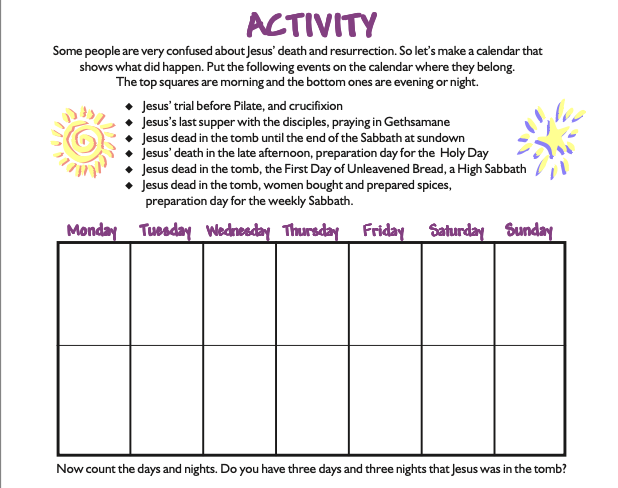
2. Make a calendar of the events from the Last Supper to the Resurrection.
3. Relate that Jesus lives today.
Topics & Themes
Death
Jesus, Death of
Jesus, Resurrection of
Passover
Resurrection
Spices
Three Days/Nights
Tomb
Materials Needed
Bible, student’s and teacher’s books, attendance and memory verse charts, pencils, chart paper, crayons, markers, board and chalk, index cards, tape, CD/cassette tape and music player, and songbook.
Preparation
The most difficult part of this lesson is counteracting the teaching that Jesus was crucified Friday afternoon and resurrected Sunday morning. Merchants have made a huge business out of selling Easter; it is as inescapable as Halloween or Christmas. Therefore, the activity in this lesson is extremely important to the students. They will have memorized Matthew 12:40, which emphasizes three days and three nights. Even if you count partial days, there is no way to get three nights between Good Friday and Easter Sunday. It’s extremely important to let the students discover that for themselves. It’s very important that you have the time line securely in your own mind before class. (See the activity section.)
Be prepared to construct the calendar on the board for the students. It will be an excellent reinforcement of the activity that they should have done before they came to class.
You may wish to have the events written out on index cards (without the days) that the students can put in order as a reinforcement of the activity.
How to Teach This Lesson
REAL LIFE APPLICATION - Talk with the students about watching a newscast of the death of an important figure. Talk about how those stories make them feel. How do the newscasters sometimes seem to make us feel? Then ask them to share how they felt when they lost someone close to them.
JESUS’ DEATH - Ask the students if Jesus knew beforehand that He was going to die. How do they know? Ask what the reaction of the disciples was. How do they know?
JESUS’ PROPHECY - Ask the students to tell what else Jesus told His disciples about His death. (Resurrection after three days) Ask if they think the disciples believed Jesus was serious.
TIME - Ask which scripture tells exactly how long Jesus would be in the tomb. This is a good time to check which students can recite their memory verse.
PHARISEES - Ask the students who Jesus told about His resurrection besides the disciples. (the Pharisees and teachers of the law) Why did He do that?
RESURRECTION - Ask if Jesus was resurrected as He said. How do we know that? Who told the women that Jesus was no longer in the tomb?
JESUS LIVES! - Ask the students how long Jesus lived after His resurrection. Tell them it’s a trick question. (He’s still alive now!)
CALENDAR - Go through the calendar activity with the students. Hopefully they’ve done the activity in their book, and this will be a good review. If they haven’t done it, do it together on the board anyway (See activity).
REINFORCEMENT - Use index cards with the various events, from Gethsemane to the Resurrection, listed separately on each one. Mix them up. Give each student one card. Have them arrange themselves in order according to the event. Provide assistance if necessary. Then read the events on the cards in the correct sequence.
If you have a small class, label different parts of the classroom wall with the days of the week. Hand an index card to each student. When they have correctly placed the card on the wall, they may come get another card.
Review Questions
1. Where can you find a scripture where Jesus told about His resurrection?
2. In the year Jesus was crucified, on what day of the week was He killed? (Wednesday)
3. In the year Jesus was crucified, on what day of the week was He resurrected? (at the end of the Sabbath)
4. In the year Jesus was crucified, on what day of the week did the women buy spices (Thursday evening, Mark 16:1), and prepare spices? (Friday, Luke 23:56).
5. Is Jesus alive today?
Teacher-Directed Activity
The students were asked to make a calendar, putting the events on the calendar in the correct places. Be prepared to go over the sequence of events with them.
1. Tuesday night: Jesus’ last supper with the disciples, praying in Gethsemane.
2. Wednesday: trial before Pilate, crucifix- ion, death in the late afternoon, preparation day for the Holy Day on Thursday (Note: because Jesus is our Passover Lamb, many believe that He died exactly when the High Priest would have cut the throat of the lamb in the Temple.)
3. Thursday: Jesus was dead in the tomb, the First Day of Unleavened Bread, a High Sabbath.
4. Thursday evening: After sunset, Mary Magdalene, Salome and Mary the mother of James purchased spices. (Mark 16:1).
5. Friday: Jesus was dead in the tomb, women prepared spices, preparation day for the weekly Sabbath(Luke 23:56).
6. Saturday: Jesus was dead in the tomb until the end of the Sabbath at sundown – exactly three days and three nights from the time He was placed in the tomb.
Now ask the children to count the days and nights. Do you have three days and three nights that Jesus was in the tomb?
REACH Activity
Word Study: Kardia (kar-dee’-ah)
The Greek word for “heart” in Matthew 12:40 is kardia, which comes from a more primitive word kar. In Latin it is cor or heart. It means heart. In Matthew 12:40, it is used as an analogy. That is, Jesus was in “the middle” of the earth for three days.
Did You Know?
Matthew 27:66 says the Chief Priests and Pharisees secured the tomb where Jesus was buried by putting a seal on the stone and posting the guard. The seal was likely a cord attached both to the stone and to the tomb, with wax imprinted with the Roman seal anchoring both ends so that tampering could be detected. (Source: NIV Archaeological Study Bible, p. 1616.)
Music Notes: He Lives
“He Lives” on page 112 of the CEM Hymnal was written by Alfred H. Ackley (1887-1960). While conducting evangelistic meetings, a young Jew asked Alfred Ackley, ‘Why should I worship a dead Jew?’ Ackley responded, ‘He lives! I tell you, He is not dead, but lives here and now! Jesus Christ is more alive today than ever before. I can prove it by my own experience, as well as the testimony of countless thousands.’ After trying to convince the young man of his sincerity and the truthfulness of this statement, Ackley reread the Gospel accounts of the crucifixion and resurrection. ‘The scriptural evidence, his own heart, and the testimony of history’ so thrilled him that he sat down at the piano and composed both the words and the music! Ackley simply stated, ‘The thought of His ever-living presence brought the music promptly and easily.’”
Read the words to the hymn. In your Bible notebook, write down the evidence Alfred Ackley points to in this hymn that Jesus Christ lives. Then write down how you know Jesus lives. What evidence would you use to prove He lives if someone asked you? (Source: Amazing Grace, Osbeck, K., p. 128.)
Journal Jot
Pilate told the Chief Priests and Pharisees to “make the tomb as secure as you know how” (Matthew 27:65). Jesus had told them that He would rise again after three days. So they were afraid that Jesus’ disciples might steal the body of Jesus and then tell everyone that He had risen. Jesus’ death was only half of the equation. Without His resurrection, Christianity would die. Everything Jesus had taught would be forgotten. But the truth is that Jesus did rise again, resurrected to sit at the right hand of God. Through Jesus’ death, we have forgiveness of our sins, and through His resurrection, we have hope of eternal life.
Think about this. Then write in your Bible notebook how we need both Jesus’ death and His resurrection from the dead in order to have eternal life in God’s Kingdom.
Back to the Bible
Just who was Joseph of Arimathea? Each of the four Gospel writers, Matthew, Mark, Luke, and John wrote of this man who asked Pilate for Jesus’ body. Read each Gospel account.
In your Bible notebook make four vertical columns. At the top of each column write the name of one of the Gospel writers. Draw horizontal lines through the columns to form small squares. Within each square write one detail from each Gospel about Joseph of Arimathea, and Jesus’ burial in the tomb. If a detail is in one Gospel but not the other three put an “x” in the three boxes next to the one with the detail. What events are told only in one Gospel? What events are told in all four Gospels?
From the information that you gather from all four Gospels, write a paragraph of information in your Bible notebook on Joseph of Arimathea.
Read your paragraph with family or with your class. Discuss how Joseph might have felt taking care of Jesus’ body and preparing it for burial.
Just Toolin’ Around
What kinds of spices were used for burial preparation? Use Bible tools to find out what kind of spices were used and why. Write the information in your Bible notebook. Draw and label each spice or find pictures to put in your Bible notebook.
Stretch It Out
Use Bible tools to locate Arimathea. Draw and label a map that shows the location of this village. Keep the map in your Bible notebook. Add this event to your timeline.
Questions?
Remember to write any questions you have in your notebook. That way you will remember to ask your parents, teacher, or minister.
Song
“Alive, Alive” is on pg. 55 in Kids Classics Collection.
Closing Prayer
Lead the children in thanking our Heavenly Father for resurrecting Jesus on the third day as He had planned.
Printable Pages