YEA Lesson Library
Jesus is Killed
About This Lesson
This lesson teaches about Jesus’s suffering and death.
Scriptures
Isaiah 53:4-7
Matthew 27:27-51
Mark 15:15-41
Mark 15:39
Romans 5:6-10
Words to Know
CRUCIFY - to lift up a person on a cross or stake, to nail the hands and feet to the cross, and leave until dead.
CENTURION - Roman military officer.
GOLGOTHA - the Place of the Skull, where Jesus was crucified.
AGONY - extreme pain or suffering.
SACRIFICE - giving up or suffering something, in this case, Jesus’s life.
The Lesson
Bob was waiting for the afternoon service to start at the Feast of Tabernacles. A stranger walked up to him and asked if he could tell him the time. Bob turned to him and said, “No, I’m sorry. I don’t have a watch.” Then the stranger did something amazing. He gave Bob a brand-new, expensive watch. What a wonderful thing to do!
What was the most wonderful thing that someone has ever done for you?
Jesus Christ dying for our sins is the most wonderful thing that anyone ever did for us. He died so that we wouldn’t have to die. To make it even more incredible, Jesus Christ died a horrible death. It was not easy or fun. Christ died for each person who believes and trusts in Him. Let’s look at the story.
After the trial, Pilate handed Jesus over to the soldiers to be crucified, but they didn’t crucify Jesus right away. First they made fun of Him. “They stripped him and put a scarlet robe on him, and then twisted together a crown of thorns and set it on his head. They put a staff in his right hand and knelt in front of him and mocked him. ‘Hail, king of the Jews!’ they said. They spit on him, and took the staff and struck him on the head again and again. After they had mocked him, they took off the robe and put his own clothes on him” (Matthew 27:28-30, NIV). Do you see that they not only made fun of Him, they also spit on Him and beat a crown of thorns into His head? This was all part of Jesus’ sacrifice for us.
Next they led Jesus away to crucify Him. Jesus had to carry His own stake to Golgotha, which was where He would be crucified. He had been beaten so badly that He couldn’t carry His stake. A man named Simon, from a city called Cyrene, in North Africa, carried the stake for Jesus.
When they got to Golgotha, they offered Jesus wine mixed with gall to drink. Tradition says that the women of Jerusalem would give this pain-killing drink to the prisoners who were about to be crucified. Jesus refused to drink it. As He suffered, the soldiers who crucified Jesus gambled to see who would get His seamless robe.
A sign was nailed to Jesus’ stake that said, “This is Jesus, the King of the Jews.” As people walked by the stake, they shouted insults at Jesus. These people included the Chief Priests, teachers of the law, and the elders. They said, “Let God rescue Him now if He wants Him, for He said, ‘I am the Son of God.’” Even the robbers, who were crucified on either side of Jesus, made fun of Him. Breathing was difficult for a prisoner with his feet nailed to the stake and his hands nailed above his head. Imagine the pain! Now imagine how you would feel if you were the prisoner and people all around you are making fun of you. Jesus did it all for you – so your sins can be forgiven. But you must believe and trust in Him.
“About the ninth hour Jesus cried out in a loud voice, ‘Eloi, Eloi, lama sabachthani?’ – which means, ‘My God, my God, why have you forsaken me?’” Then after He had cried out once more, He died. “At that moment the curtain of the temple was torn in two from top to bottom. The earth shook and the rocks split” (Matthew 27: 46, 50, 51). “And when the centurion, who stood there in front of Jesus, heard his cry and saw how he died, he said, ‘Surely this man was the Son of God!’” (Mark 15:39).
The men who were crucified on either side of Jesus were robbers. But Jesus had done nothing wrong. He lived a perfect life, yet He died a horrible and painful death. But, that’s not the end of the story!
Student Prayer
Dear Heavenly Father,
Thank you for giving your Son to die for the sins of those who believe and trust in you.
In the name of your Son, Jesus Christ.
Amen.
Daily Devotions
Sunday - Matthew 27:27-33
Monday - Matthew 27:34-44
Tuesday - Matthew 27:45-50
Wednesday - Isaiah 53:4-7
Thursday - Mark 15:15-23
Friday - Mark 15:24-31
Saturday - Romans 5:6-10
Objectives
At the end of this lesson, students will be able to:
1. Relate the sequence of events leading up to Christ’s crucifixion.
2. Explain why Christ died.
3. Compare and contrast nice things that others have done, to the ultimate sacrifice of Jesus Christ.
Topics & Themes
Fulfillment of Prophecy
God’s Love
God’s Plan
God’s Will
Jesus, Crucifixion of
Jesus, Death of
Jesus, Savior
Jesus, Suffering of
Materials Needed
Bible, student’s and teacher’s books, pencils, chart paper, crayons, markers, activity papers from lesson five, board and chalk, songbook, CD/cassette tape and music player.
Preparation
Talking about the suffering and death of Jesus Christ is never easy, even for adults. It becomes especially difficult for children of this age group. Because they are idealistic, they do not understand things that are unfair. Additionally, they are very impressionable and can be very sensitive. Talking about the agony of Jesus Christ can rapidly reduce some juniors to tears. Be prepared to comfort the students while emphasizing the sober nature of what Christ has done for His people. It’s a delicate balance.
We teach our children to believe and to trust in Jesus Christ. When they read that Jesus died for people who believe and trust in Him, they may feel very convicted and sorry that Jesus had to suffer for them. Be sure to explain to them that it was God’s will that Jesus suffer and die this way. Emphasize that our responsibility is to live our lives according to His will. We must accept Christ as Savior, follow in His footsteps, keep the commandments and love the people around us. Don’t minimize their feelings of conviction; would that adults could feel as convicted as our kids feel!
How to Teach This Lesson
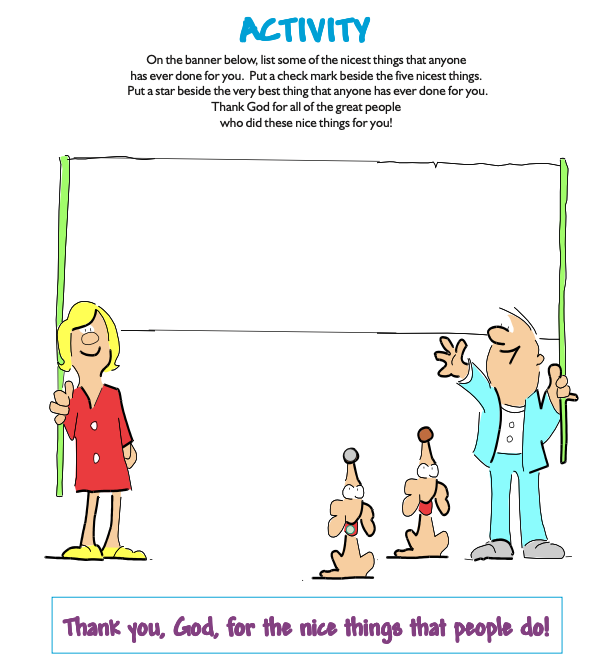
REAL LIFE APPLICABILITY - Ask the students to list on the board all the nice things that they wrote for their activity assignment in their student book. Add other things that they think would be really nice. Lead into the story of Jesus Christ’s suffering and death.
MOCKING - Have a volunteer read Matthew 27: 27-31. Review the events leading up to the soldiers mocking Jesus. Mentally draw a picture for the students; describe the scene of the crown of thorns, the scarlet robe, the mocking soldier’s taunts, and repeated blows to the head.
VIA DOLOROSA - Continue reading Matthew 27:32-33. The Via Dolorosa (the Way of Suffering) is the traditional route taken by the prisoners, carrying their own crosses, through the streets of Jerusalem on the way to Golgotha. Describe how Jesus had been so badly beaten that He could not carry His stake the entire route. Ask the students who Simon of Cyrene was.
CRUCIFIXION - Read verses 34-37. Explain that tradition says the wine mixed with gall was a narcotic pain-killer. Jesus refused to drink it. Ask why the soldiers cast lots. Then ask why the sign was placed over Jesus’ head.
INSULTS - Read verses 38-44. Ask who insulted Jesus and what the insults were. Jesus’s death - Read verses 45-51. Ask the students what Jesus cried out to God. Then ask what happened at the very moment that Jesus died.
MEMORY VERSE - Have the students recite their memory verse at this point. Discuss the reaction of the centurion soldier to the death of Jesus Christ.
TO BE CONTINUED - Don’t finish class with the death of Jesus. Let the students know that the story doesn’t end there. They’re going to have to read their lesson for next week and come to class to hear the rest of the story.
Review Questions
1. What are some really nice things that people have done for you?
2. What was the nicest thing that you can think of?
3. Who can tell us what happened after Pilate turned Jesus over to the soldiers to be crucified? Please list five things.
4. Why did Jesus have to suffer these things? Why did He have to die this way?
5. Because we know Jesus died for those who believe and trust in Him, how should we act? What kinds of things should we do?
Teacher-Directed Activity
Continue the activity from week five. Have the students work in teams of three to finish their miniature mural of the events of Christ’s death. Encourage them to look back at lesson five and begin today’s drawing with Pilate turning Jesus over to be crucified. Again, remind them that we don’t know what Christ looked like, and we certainly don’t want to make images of Him. Also impress upon them that Jesus wouldn’t have had long hair. Events they should include are: mocking by soldiers, carrying the stake to Golgotha, crucifixion, soldier casting lots for His clothing, insults by passers-by, chief priests, and robbers, splitting of the curtain in the Temple when Christ died, earthquake and splitting rocks, centurion’s statement.
Rationale: We want our students to completely understand the events of Jesus’ suffering, crucifixion and death. One way to internalize information is through tactile activity, like drawing.
REACH Activity
Word Study: Eloi, Eloi, lama sabachthani
This may be one of the few Aramaic/Hebrew phrases you will ever know. Because Matthew wrote it, and then translated it for us: “My God, my God, why have you forsaken me?” we have had the exact phrase preserved for us in Matthew 27:46.
It is hard to imagine the emotional pain Jesus felt which caused Him to say this. But knowing that He felt forsaken by God, His Father—because of my sin, and yours—should make us stop and consider what kind of life we should be living in gratitude and reverence to our Lord and Savior who gave so much for us.
Did You Know?
Jews limited the number of stripes given to 40 (in practice 39, in case of a miscount), but the Romans had no such limitation. Roman floggings were so brutal that sometimes the victim died before crucifixion. (Source: NIV Archaeological Study Bible, p. 1614.)
Music Notes: I Gave My Life For Thee
“I Gave My Life For Thee” on page 160 of the CEM Hymnal was written by Frances R. Havergal (1836-1879). She also wrote the words to “Take My Life and Let It Be” and “Like a River Glorious,” even though she was in poor health all her life.
“A vivid painting of Christ, wearing His crown of thorns as He stands before Pilate and the mob, is displayed in the art museum of Dusseldorf, Germany. Under the painting by Sternberg are the words, ‘This have I done for thee; what hast thou done for Me?’ When Frances Havergal viewed the painting during a visit to Germany, she was deeply moved. As she gazed at it in tears, she scribbled down the lines of this hymn text on a scrap of paper. After returning to her home in England, she felt the poetry was so poor that she tossed the lines into a stove. The scorched scrap of paper amazingly floated out of the flames and landed on the floor, where it was found by Frances’ father, Rev. William Havergal, an Anglican minister, a noted poet, and a church musician. He encouraged her to preserve the poem by composing the first melody for it. The present tune was composed for this text by the noted American gospel songwriter, Philip P. Bliss, and was first published in 1873.” (Source: Amazing Grace, Osbeck, K., p. 108.)
Read the words of the hymn again. Think about it and your YEA lesson. What kind of life should you live?
Journal Jot
The story in the YEA lesson book about Bob being given a watch during the Feast of Tabernacles actually did happen. The stranger probably gave my brother the watch because of the sermon the previous morning—a sermon encouraging us to go out of our way to do something nice for someone, someone who could not repay us. And that’s what Jesus did for us: He went out of His way to do something very nice for us at great cost to Himself—through the suffering, torture, and pain He endured. It is the sacrifice of Jesus Christ that gives us hope of redemption, of reconciliation with the Father, and of eternal life in God’s family. Think about this lesson. Then write a response in your Bible notebook about what the sacrifice of Jesus means to you.
Back to the Bible
One way to sort through the feelings that you may have as you read through the Gospel accounts of Jesus’ trial, suffering, crucifixion, and death, is to find Scriptures that foretell of His life and purpose. The Book of Isaiah is a good place to start. Read Isaiah 9:1-7 with your family or class and discuss verses 6-7. By what names would the child be called? List these names in your Bible notebook. Use Bible tools to find examples of when each of these names referred to Jesus during His life on this earth. Write these examples in your Bible notebook.
Your Bible tools will help you find other Old Testament Scriptures that relate to the coming Messiah, Jesus Christ. Ask for help if you have difficulty locating them.
Understanding God’s plans and purposes is important to realizing the significance of the life and death of Jesus Christ. Be a good student and learn from God’s Word. He wants you to have a relationship with His Son, Jesus Christ now and in the future.
Just Toolin’ Around
Telling “time” in Bible days was very different than the way we tell time today. Use Bible tools to find out what hour began the day as well as the hour or time that it ended. Draw a clock and label it in “Bible” time. How does it compare or contrast with how you tell time today?
Stretch It Out
Add this event to your timeline.
Questions?
Remember to write any questions you have in your notebook. That way you will remember to ask your parents, teacher, or minister.
Song
“Isn’t He Wonderful” is on page 42 in Kids Classics Collection.
Closing Prayer
Lead the students in thanking God for the gift of His Son for all of mankind. Encourage them to ask for help in truly understanding what Jesus did for all who believe.
Printable Pages