YEA Lesson Library
Trial Before Pilate
About This Lesson
This lesson teaches that, although completely innocent, Jesus suffered and died to pay the penalty for our sins - and didn’t say a word.
Scriptures
Proverbs 17:26
Isaiah 53:7
Matthew 27:11-25
Romans 2:1-3
Romans 3:21-26
Romans 6:15-23
1 Peter 2:13-20
Words to Know
PUNISHMENT - negative consequences to an action
PENALTY- suffering decided on by the law because of a crime
INNOCENT - not guilty
ACCUSE - to say someone did something wrong
NOTORIOUS - someone famous, usually unfavorably
FLOGGED - beaten very badly
CRUCIFY - to put to death by nailing the hands and feet to a cross or stake
The Lesson
Denise was four years old and loved riding her tricycle! She’d spend hours pretending she was driving her car to the grocery store. If she parked her tricycle at the doghouse, she would pretend she was at K-mart.
Kirsti was a year younger than Denise, but she was still great fun to play with. The two sisters spent many afternoons running errands on their tricycles and visiting each other. When the girls were done playing, they knew that Mom and Dad had one rule: The tricycles had to be out of the way.
One day Denise and Kirsti decided to switch tricycles. When it was time to go inside, they put the trikes in the garage. When Dad came home, Denise was in big trouble. Her tricycle was right in the middle of the back garage doorway! Dad was mad! Denise took one look at his face and knew better than to say anything. She was spanked soundly and sent out to put the tricycle where it would be out of the way.
Oh, it was so unfair! She’d just been punished for something that she hadn’t even done!
Have you ever been punished unfairly? Have you ever taken the rap for something that someone else had done?
That’s what Jesus Christ did. “Meanwhile Jesus stood before the governor, and the governor asked him, ‘Are you the king of the Jews?’ ‘Yes, it is as you say,’ Jesus replied. When he was accused by the chief priests and the elders, he gave no answer. Then Pilate asked him, ‘Don’t you hear the testimony they are bringing against you?’ But Jesus made no reply, not even to a single charge – to the great amazement of the governor” (Matthew 27:11).
The chief priests and elders were accusing Jesus of things He had not done to find a way to justify killing Him. To the amazement of Pilate, the governor, Jesus didn’t try to defend Himself. He stayed silent. Can you imagine being in a situation where you wouldn’t say anything when someone was accusing you falsely? The situation Jesus was in got worse after that.
“Now it was the governor’s custom at the Feast to release a prisoner chosen by the crowd. At that time they had a notorious prisoner, called Barabbas. So when the crowd had gathered, Pilate asked them, ‘Which one do you want me to release to you: Barabbas, or Jesus who is called Christ?’ For he knew it was out of envy that they had handed Jesus over to him. While Pilate was sitting on the judge’s seat, his wife sent him this message, Don’t have anything to do with that innocent man, for I have suffered a great deal today in a dream because of him’” (Matthew 27:15-19).
Pilate, the governor, knew that Jesus really hadn’t done anything wrong. Pilate’s wife was telling him that she also believed that Jesus was innocent. So Pilate gave the people a choice. He gave the crowd a chance to release an innocent man. Let’s look at the choices. Barabbas was a murderer! Jesus Christ was not guilty of anything! Look at what happened.
“But the chief priests and the elders persuaded the crowd to ask for Barabbas and to have Jesus executed. ‘Which of the two do you want me to release to you?,’ asked the governor. ‘Barabbas,’ they answered. ‘What shall I do, then, with Jesus who is called Christ?’ Pilate asked. They all answered, ‘Crucify him!’ ‘Why? What crime has he committed?’ asked Pilate. But they shouted all the louder, ‘Crucify him.’ ” (Matthew 27:20-23).
Here was Jesus Christ’s chance to be released from prison. Pilate knew He wasn’t guilty. But the people asked that a murderer be released instead. Can you imagine what Pilate must have been thinking? Can you imagine how Jesus felt?
Then, because the crowd was getting out of control, Pilate washed his hands of the whole thing. Pilate said to the people, “I am innocent of this man’s blood. It is your responsibility!” Then he released Barabbas. He had Jesus flogged, and then sent Him to be crucified.
Remember Denise? She calmly took the punishment that wasn’t hers. Jesus Christ calmly took the punishment that wasn’t His because He knew that it was God’s will. That was the only way to pay the penalty for all of the sins for each of us. Jesus knew exactly what He would have to suffer before the trial ever began. He willingly did it anyway. For you– and me. He didn’t say a word.
Student Prayer
Dear Heavenly Father,
Thank you for sending your Son, Jesus Christ, to pay the penalty for the sins of everyone who believes and trusts in Him.
In Jesus’ name.
Amen.
Daily Devotions
Sunday - Matthew 27:11-14
Monday - Matthew 27:15-25
Tuesday - Proverbs 17:26
Wednesday - 1 Peter 2:13-20
Thursday - Romans 2:1-3
Friday - Romans 3:21-26
Saturday - Romans 6:15-23
Objectives
At the end of this lesson, students will be able to
1. Relate the events before Pilate.
2. Relate that Barabbas was a murderer.
3. Explain that Pilate’s wife’s dream was significant to Pilate.
4. Relate the crowd’s reaction when Pilate washed his hands.
5. Explain how Isaiah 53:7 is a prophecy about Jesus Christ.
Topics & Themes
God’s Will
Jesus, Crucifixion
Jesus, Savior
Jesus, Suffering Of
Jesus, Without Sin
Pilate
Punishment
Sin
Materials Needed
Bibles, students’ and teacher’s books, attendance and memory verse charts, pencils, mural chart paper, crayons, markers, songbook, CD/cassette tape and music player.
Preparation
Juniors are at the age where things that are unfair are extremely disturbing to them. Therefore, this is a very delicate topic to explore with them. They absolutely need to understand what happened to Jesus Christ and why; that’s central to our faith. Nevertheless, be sensitive to their reactions when progressing through the lesson. Remind them often that Jesus willingly did this. He was not a powerless victim. He told his disciples, while they were still in the garden, that He could call legions of angels to effect His escape if He wanted. But He knew that wasn’t the will of God.
Discuss the consequences of sin, and help juniors understand why this had to happen. Be prepared to talk with them about the natural and spiritual consequences of sin. Because Jesus loves each one of us so much, He willingly endured all that He suffered to pay the penalty for the spiritual consequences, so that we wouldn’t have to. Explain that even though God forgives us of our sins, the natural consequences are still going to be there as a natural result of our actions.
How to Teach This Lesson
REAL LIFE SET - Ask the students if they have ever been accused unfairly. Allow them to explain, if they wish. Ask them what they did when they were falsely accused. Do they do what most people do? Ask for a volunteer to read Isaiah 53:7 aloud. Explain that it is a prophecy about Jesus Christ.
MATTHEW 27:11 - Continue reading with volunteers. Discuss why Jesus didn’t say any- thing when the chief priests were bringing accusations against Him. Talk about how unusual this was and Pilate’s amazement.
THE CHOICE - The next experience was the crowd’s preference for the release of a known murderer instead of Jesus Christ. Ask the students why Pilate gave the people the choice between Barabbas and Jesus.
THE DREAM - Pilate believed Christ had not done anything wrong. Next ask the students what Pilate’s wife sent him. She asked him not to have anything to do with that innocent man (Jesus). Because of Him she had suffered much in a dream that day. Explain that the Romans put a lot of stock in dreams. This was very strong motivation for Pilate to give the people the chance to release Jesus.
RELEASE AND CRUCIFIXION - Ask the students who persuaded the crowd to ask for the release of Barabbas. When Pilate asked why, the crowd became agitated. Have the students explain Pilate’s next action of washing his hands. Ask them to explain what the crowd’s reaction was when Pilate told them, “It is your responsibility.” How can we, two thousand years later, accept the responsibility – for ourselves and our children – for the blood of Jesus Christ. Explain that, in reality, we do accept the responsibility when we accept Jesus as our Savior.
CHRIST’S PERSPECTIVE - Ask the students why Jesus went through all of this. Remind them of the prayer in Gethsemane when He asked God, if it were possible, to take the cup from Him. Jesus Christ knew what He was doing. Why? It was the necessary part of God’s plan for the salvation of each one of us. Now read Isaiah 53:7 aloud again. Discuss how this prophecy is about Jesus.
Review Questions
1. What happened when the chief priests and elders accused Christ falsely?
2. Why was Pilate surprised Jesus didn’t answer the false accusations?
3. Who was Barabbas?
4. Why was Pilate’s wife’s dream important to Pilate?
5. What were the two reasons Pilate gave the crowd a choice between Barabbas and Jesus?
6. How is Isaiah 53:7 a prophecy about Jesus?
Teacher-Directed Activity
Have the students work in teams of three to create a miniature mural of the events to this point. Encourage them to look back at lesson four and begin their mural with Christ praying in the garden. Remind them that we don’t know what Christ looked like, that He didn’t have long hair and we certainly don’t want to make images of Him. So instead of drawing Jesus, they can write His name where His picture would be, or let them use their imagination as to how to portray Jesus praying without making an image of Him. They should leave space on the mural to continue with it for lesson six. Events that they will want to include: prayer in Gethsemane, betrayed by a kiss, false accusations by the chief priests and elders, release of Barabbas.
Rationale: We want our students to completely understand the events of Jesus’ suffering, crucifixion and death. One way to internalize information is through tactile activity, like drawing.
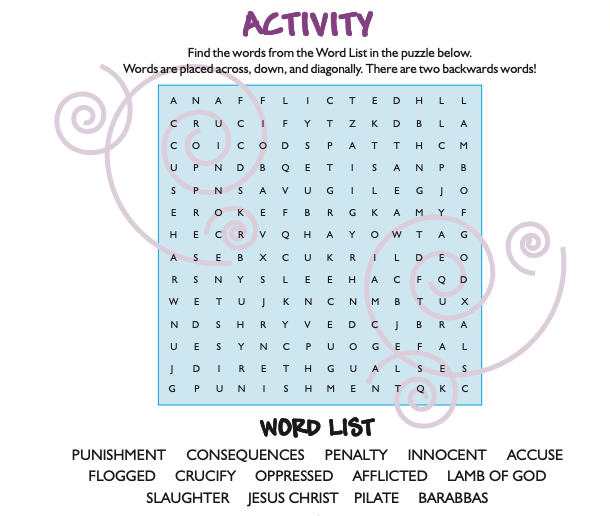
Use the answer key to the Word Search in the student book if some students need help finding the answers.
REACH Activity
Word Study: Tebach (teh’-bakh)
The Hebrew word for “slaughter” in Isaiah 53:7 is tebach, which means to slaughter or refers to the place where the animal was killed. It comes from the Hebrew word tebach, which means to kill, slaughter, or slay an animal or a man.
In English, the word slaughter (as in slaughter a lamb) creates the mental picture of a sheep which has no choice. This is the destiny of the animal. It will be killed. But it is not purposeless— the lamb will be used for food. Slaughter is closely related to butcher. That is, the lamb was killed for food.
In Isaiah 53:7, the word is used to show how Jesus did not speak up in His own defense; the trial before Pilate was a mockery of the Son of God, the Creator, the Savior of the world. But Jesus allowed them to do it silently—as a lamb. And, like the lamb, there was a greater purpose to the death than just dying. Just as the lamb is used for food for life, Jesus is the Bread of Life and makes our eternal life possible.
Did You Know?
Pilate was the Roman governor of Judea from A.D. 26 to 36. Ruling from Caesarea on the Mediterranean coast, he was primarily responsible for maintaining the peace and collecting taxes. The ancient Jewish writers Josephus and Philo portrayed Pilate as cruel and corrupt. Pilate was recalled to Rome after having massacred a group of Samaritans. (Source: NIV Archaeological Study Bible, p. 1714.)
Music Notes: Day By Day
“Day By Day” on page 34 of the CEM Hymnal was written by Lina Sandell Berg (1832-1903) when she was only 26. Although she had already written many hymns, this song was written after she and her father, a devout Lutheran minister, were traveling by ship to Bothenburg, Sweden across Lake Vattern. The ship gave a sudden lurch. Lina’s father fell overboard and drowned while Lina watched helplessly. Her response was this hymn, expressing the childlike faith and trust in God that we all must have regardless of the things we live through. Lina Sandell Berg wrote over 650 hymns, influencing the revival that swept through the Scandinavian countries during the second half of the 19th century. She has been called the “Fanny Crosby of Sweden.” (Source: Amazing Grace, Osbeck, K., p. 20.)
Read the words to the hymn again. Think about the incredible trust and faith that Jesus Christ had in His Father. Knowing the things He was about to suffer, Jesus submitted to the Father’s will, trusting in His love. Somehow, by thinking about the things Jesus endured for you and for me, our troubles don’t seem nearly so big. Even if you go through something really hard, like watching your father die in front of your eyes, you know that God is still there and He’s got a plan for your life.
Journal Jot
The story about Denise and Kirsti is a true story. (Names have been changed to protect the guilty!) It is not an unusual event to be blamed for something you didn’t do, to be accused unfairly. Think of a time when it happened to you, or when you accused someone else unfairly. Write about it in your Bible notebook. If it happened to you, know that Jesus completely understands. If you are guilty of falsely accusing someone else, you need to ask for their forgiveness.
Back to the Bible
In the Old Testament, Isaiah 53 speaks of the Messiah, Jesus Christ, who would come and suffer for the sins of all people. Isaiah 53:5 says, “But he was pierced for our transgressions, he was crushed for our iniquities.” This refers directly to the punishment described in Matthew 26:26 when Pilate had Jesus flogged. Jesus came to bear pain and suffering for our sins! It can be hard to imagine that anyone would willingly pay the price or consequence for our sin. But the Someone who died for our sins wants us to have eternal life with Him. When you read Matthew 26, read it slowly and carefully. Perhaps you can read it with your family or class and discuss certain events that you want to better understand. In your Bible notebook, write down some thoughts you have as you read Matthew 26.
Just Toolin’ Around
Use a Bible dictionary or encyclopedia to find out what materials were used to make Roman whips. Draw a picture of a whip and write a description of how it was used during Roman floggings.
Stretch It Out
Role play Jesus’ trial before Pilate. Add this event to your timeline.
Questions?
Remember to write any questions you have in your notebook. That way you will remember to ask your parents, teacher, or minister.
Song
“Jesus in the Morning” is on page 89 in Kids Classic Collection.
Closing Prayer
Lead the students in thanking God for the gift of His Son for all of mankind. Encourage them to ask for help in truly understanding what Jesus did for all who believe.
Printable Pages