YEA Lesson Library
The Agony in Gethsemane
About This Lesson
This lesson teaches that Jesus, having lived, suffered, and died in this world, understands our pain and suffering. We can go to Him for help; we trust that His will is best in our lives.
Scriptures
Matthew 26:36-46
Matthew 26:39
Luke 22:39-46
John 18:1-12
Romans 8:16-18
Romans 8:28
2 Corinthians 1:3-7
Hebrews 2:14-18
1 Peter 2:21-24
Words to Know
SUFFERING - pain and sorrow
AGONY - another word for pain or sorrow
TORTURE - when other people intentionally hurt you very badly
ENDURE - something that you have to go through, you have to put up with
ANGUISH - extreme pain or sorrow
GETHSEMANE - a garden on the lower slopes of the Mount of Olives where Jesus prayed
The Lesson
Have you ever had to do something that was so hard that you tried everything you could to get out of it? Perhaps you had to apologize for something you did to someone who was not kind. Maybe you had to clean up a mess – that you didn’t even make. Maybe you had to give a class report when you hadn’t done as good a job on it as you should have. Perhaps you have to walk past the bully’s house on your way to school every day.
Jesus knows what things you suffer through. He knows why. And most importantly, He cares. The Bible tells us many times that He cares about us. Part of the reason Jesus cares about the hard things you have to put up with is because of His sufferings when He was killed. Jesus knew He was going to be killed. He also knew how painful His death would be. He knew that He was going to be tortured. He knew that He would have to suffer many things. His Father sent Him to live on this earth so that we would know that Jesus understands what hard things we go through.
Okay! We know that Jesus understands our pain and our troubles. Doesn’t He love us enough to take the pain and trouble away? We may ask this question because we don’t completely understand what God is doing. We do know that Jesus experienced those same feelings of wanting God to take the suffering away. Matthew 26:36-46 tells us about it.
Jesus knew the suffering that was ahead of Him just before He died. He went into the garden of Gethsemane to pray. He told his disciples, “My soul is overwhelmed with sorrow to the point of death. Stay here and keep watch with me.” Jesus was so upset that He said it was, “to the point of death!” That’s extreme sorrow!
“Going a little farther, he fell with his face to the ground . . .” We often pray to God when we’re in trouble and need His help. But how many times have we been so in need of God’s help that we would fall on our faces? Jesus actions show us that He knew just what He was going to have to suffer!
Then Jesus prayed to His Father and asked Him to please find another way so that He wouldn’t have to suffer this way. Jesus was praying so hard that He sweat great drops of blood. Only a person feeling extreme anguish and strain would sweat great drops of blood. Jesus knew He was going to die, but He really didn’t want to have to suffer in that way.
Even though Jesus asked His Father not to make Him go through the suffering, Jesus prayed that not His own will, but God’s will be done. That’s the key. If there had been any other way for our sins to be forgiven, God would never have sent His only begotten Son to go through such terrible torture and to die such a horrible death. But it was the only way.
This teaches us several things. First, we know that Jesus understands when we are suffering. Secondly, we know that we can always go to God, our Heavenly Father, and ask Him to take away the suffering and pain if we don’t have to go through it. And finally, if He doesn’t take the hard things from us, there is some reason why it has to be just that way. If you love God, if you try to please Him by doing what He asks you can believe that God will not make you go through anything that you don’t need to go through. Romans 8:28 says, “And we know that in all things God works for the good of those who love him, who have been called according to his purpose.”
Being a Christian doesn’t protect you from all pain. Being a child of God will give you the peace of knowing that God is in control of your life. You have to believe that God never gives you more than you can bear. God truly wants the best for you. Because you know that your Heavenly Father loves you, you can pray, “Thy will be done.”
Student Prayer
Dear Father,
Thank you for sending your Son to experience the suffering and death that He did. Thank you for knowing and caring about the pain that we all go through. Help us to bring all of our sorrows and pains to you, because you really do care.
In Jesus’ name.
Amen.
Daily Devotions
Sunday - Matthew 26:36-41
Monday - 2 Corinthians 1:3-7
Tuesday - Romans 8:16-18
Wednesday - Luke 22:39-46
Thursday - 1 Peter 2:21-24
Friday - Hebrews 2:14-18
Saturday - John 18:1-12
Objectives
At the end of this lesson, students will be able to:
1. Describe how Jesus felt about His suffering and crucifixion.
2. Relate how Jesus did not want to endure the suffering He knew was coming.
3. Explain how Jesus asked His Father to take the suffering from Him, if possible.
4. State that Jesus submitted to God’s will.
5. Explain that each of us should follow that example when we’re faced with suffering.
Topics & Themes
Gethsemane
God’s Love
God’s Omnipotence
God’s Plan
God’s Will
Jesus, Suffering of
Loving God
Pain
Prayer
Suffering
Trouble
Materials Needed
Bibles, student’s and teacher’s books, attendance and memory verse charts, stars, pencils, chalkboard and chalk or dry erase board, markers, songbook, CD/cassette tape and music player, and small prize for the winner of the sword drill.
Preparation
Sometimes we adults shy away from talking with our kids about suffering. We want to shield them from the suffering that is almost certainly part and parcel of life. Nevertheless, children are in a unique position to understand about going through things that they don’t want: They have to go to bed just when the game was getting good; they have to take baths even when they don’t feel dirty; they have to eat broccoli and cauliflower because we tell them it’s good for them. If they can understand that parents have rules in place because they love and want the best for them, even if the rules seem unfair or painful, then they can make the transition to understanding why God would also ask them to go through some tough things. Some of our children live with lifelong illnesses like asthma or physical handicaps or unimaginably hard things. Don’t hesitate to bring up the suffering in the world; just be ready with some physical examples of things parents require of their children, to help them understand why God might allow suffering Emphasize that suffering is not an indication that God doesn’t love them.
How to Teach This Lesson
BRAINSTORM - List as many difficult things on the board as the students will give to you. Ask them why all of these bad things can happen to good people. Be sure to talk about natural consequences! Just because you’re a child of God doesn’t mean He’s going to take away the pain in your leg if you break it when jumping off a cliff.
GOD’S PERSPECTIVE - Emphasize that God knows the pain and suffering we go through. He knows why we’re going through it, that is, whether we caused it ourselves or it’s for His purpose. One thing we know is that God cares.
JESUS UNDERSTANDS - Read Hebrews 2:18 to the students. Explain that because Jesus Christ had to suffer on this earth, Jesus understands the suffering that we go through. Review with the students the events in Gethsemane.
JESUS’ SORROW - Jesus knew that He was going to suffer horribly before He died. This distressed Him, “to the point of death.” Ask: so what did He do about his distress?
JESUS PRAYED - Jesus knew that His Father loved Him. He prayed that if there was any other way that He wouldn’t have to go through the suffering set before Him.
THE FATHER’S WILL - Even though Jesus prayed so earnestly that He sweated great drops of blood, in the end He prayed “Thy will be done.”
JESUS’ EXAMPLE - When faced with some- thing very difficult, take it before God in prayer. Tell Him about it and ask that, if it is not necessary, that God would take it from us. Be willing to trust God if He doesn’t take it from us.
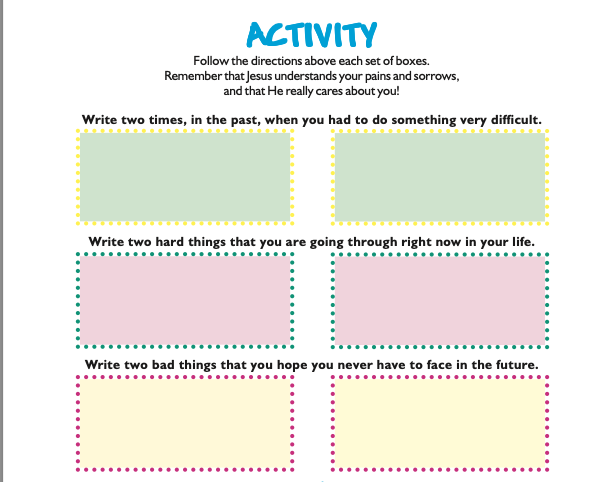
REAL LIFE EXAMPLES - Ask students to share their activity answers. List each on the board. Brainstorm why God might ask someone to go through these things (i.e. you didn’t ask Him to take them away; they are natural consequences of your behavior; they are for your good; etc.).
OUR RESPONSE TO HARDSHIPS - 1) Know that God cares about your suffering. 2) Pray that God will take it from you if possible. We can go to God and ask for relief. 3) Pray for and accept God’s will.
Review Questions
1. How did Jesus feel about the suffering and crucifixion that He had to go through?
2. How much do you think Jesus knew about what He was gong to have to suffer? (A lot; scriptures foretold it!)
3. When Christ was feeling overwhelmed with sorrow, what did He do?
4. Even though Jesus really did not want to go through the suffering, what did He pray to His Father?
5. What should we do when we’re faced with a hardship or overwhelming situation?
Teacher-Directed Activity
Sword Drill. The Bible speaks of the Word of God as being our sword. Ask each student to take their Bible with them. Line the students up with everyone facing towards you. Say, “attention.” The students should put their Bibles in their left hand with their arm hanging relaxed beside their hip. Then say, “draw swords.” The students may then bring their Bibles in front of them with it facing right. Their right hand should support the Bible and their left hand should be on top of it prepared to begin the search. Call out the first scripture and say, “charge.” Have the students race to find the following scriptures. The first one to the find the scripture takes one step forward. When everyone else has found the scripture, the winner reads the scripture out loud. Ask for a volunteer to explain how the scripture relates to the lesson. Then follow this procedure all over again by saying “attention,” etc.
1 Peter 2:20-21 - Sometimes you suffer for some wrong you committed; other times you suffer because Christ set an example for you.
Isaiah 30:18-19 - God doesn’t enjoy our suffering; He will answer our prayers.
Matthew 26:39 - God’s will be done.
Romans 12:12 - What our attitude should be.
2 Corinthians 1:8-9 - We learn to rely on God.
2 Corinthians 4:17 - Our present troubles are worth something.
Philippians 4:12-13 - Rely on God.
James 1:2-4 - Count it pure joy - our attitude.
2 Corinthians 12:7-10 - An example from Paul.
Luke 24:25-26 - Christ Himself explained that He had to suffer.
Isaiah 53:10 - It was God’s will that Christ would suffer.
Revelation 13:8 - From creation, Christ knew that He would be crucified.
There could be a small prize for the person who finds the most scriptures first.
REACH Activity
Word Study: Proseuchomai (pros-yoo’-khom-ahee)
The Greek word for “prayed” in Matthew 26:39 is proseuchomai, which means to pray to God, to supplicate, worship, to pray earnestly.
We all believe that Jesus was earnestly praying to God in the Garden of Gethsemane. We know that He came before God to supplicate (to ask humbly and earnestly). But did you ever stop to consider that Jesus was also worshiping God? When we pray, ask for something, but submit our will to God’s will, we are worshiping Him in a very real way. When you go to God, asking for His involvement in your life, do you worship Him? Do you actively submit your will to His— trusting Him even if the answer to your request is no?
Did You Know?
Luke tells us that the Garden of Gethsemane was a place where Jesus customarily went that was located on the Mount of Olives. This site is cared for now by the Franciscans, but the olive trees were likely destroyed by Emperor Titus in the siege of Jerusalem in 70 A.D. Nevertheless, the ancient olive trees found in the garden today certainly add to the atmosphere of this place. (Source: NIV Archaeological Study Bible, p. 1612.)
Music Notes: Go to Dark Gethsemane
“Go to Dark Gethsemane” on page 109 of the CEM Hymnal was written by James Montgomery (1771-1854). After attending the Fulneck Seminary in Yorkshire, James Montgomery worked at different jobs in various places until he took a trip to London, hoping to find a publisher for his youthful poems. He was unsuccessful. In 1792, he gladly left Wath for Sheffield to be assistant to Mr. Gales, auctioneer, bookseller, and printer of the Sheffield Register. In 1794, Gales left England to avoid political prosecution. Montgomery took the Sheffield Register in hand, changed its name to the Sheffield Iris, and continued to edit it for 32 years. During the next two years he was imprisoned twice, first for reprinting a song in commemoration of the fall of the Bastille, then for giving an account of a riot in Sheffield.
The editing of his paper, the composition and publication of his poems and hymns, the delivery of lectures on poetry in Sheffield and at the Royal Institution, London, and the advocacy of foreign missions and the Bible Society, gave great variety, but very little of stirring incident in his life, though he did find time to write 400 hymns. In 1833, Montgomery received a royal pension of £200 per year. (Source: www.cyberhymnal.org.)
Montgomery exhorts the singer to “Go to Dark Gethsemane.” How can we do that? Carefully read the account in the garden in Matthew 26:36-46, Mark 14:32-42, and Luke 22:40-46. Think about what Jesus was enduring there. Follow Jesus’ example of praying when you are tempted and when things are getting very rough in your life.
The next verse in the hymn tells us to follow into the judgment hall. Read Matthew 26:57-68, 27:11-26; Mark 14:53-65, 15:2-15; Luke 23:18-25; John 18:12-24,18:29-19:16. The “pangs His soul sustained” and “suffering, shame and loss” teach us how to bear our trials and persecutions.
Verse three reminds us of how Jesus died. Read Matthew 27:32-56; Mark 15:22-41; Luke 23:33-49; and John 19:17-24. These verses give us the example of how to die, giving glory and honor to God, and placing our lives completely in His hands.
Verse four is a glorious contrast to the suffering and death of Jesus Christ. It tells of the resurrection of our Savior. Having read through the suffering and death of Jesus and thinking about how His disciples would have felt, we can almost feel the joy of Mary and the rest of the disciples as we read Matthew 28:1-8; Mark 16:1-8; and Luke 24:1-10. The very last sentence in the hymn holds a wealth of meaning: It is only through Jesus Christ, our Savior, and because of what He did for us that we will also be resurrected unto eternal life.
Journal Jot
God never told us that being Christians and following Him would be easy. We must be willing to trust Him with our very lives, just as Jesus did. Write a prayer in your Bible notebook asking for God to strengthen you to do His will and endure whatever He brings into your life.
Back to the Bible
There are several accounts in the Bible of Jesus praying. He often went off by Himself to spend time with God, His Father, in prayer. Jesus also taught about prayer and how to pray.
Between Matthew 5:44 and Matthew 6:9, Jesus used the word “pray” or “prayer” a total of five times. Each time refers to how and why you should pray. Matthew 6:9 begins the outline of prayer that Jesus gave to the crowds while teaching on a mountainside in Capernaum. Read Matthew 6:9-13. Notice that it begins by praising the Father’s holy name. As you read each verse think about the meaning.
Share and discuss these verses on prayer with your family or class. Write your thoughts about prayer in your Bible notebook. Do you spend time each day in prayer? Consider setting a special time aside each day to pray. To get you started, write them down in your Bible notebook. Perhaps you can begin with the prayer requests at church or those who are needy in the church or in your family. And remember, when the prayers are answered, to praise God for them!
Just Toolin’ Around
Read Revelation 21:1-5. The word “mourning” in verse 4 is “sorrow” in the King James Version of the Bible. In your Bible notebook write down what God will do in the new heaven and new earth. Also write down the things that will no longer be.
Verse 5 is very important for us to remember because there is a promise there for us: “I am making everything new!” When Jesus Christ returns He will make everything new and there will no longer be any sorrow or tears. His resurrection will make everything new and alive!
Write down your thoughts about these verses in your Bible notebook.
Stretch It Out
Use Bible tools to find other examples of Jesus praying. What were His prayers? Write an example of one of His prayers in your Bible notebook. How did you feel reading His prayers? Add this event to your timeline.
Questions?
Remember to write any questions that you have in your notebook. That way you will remember to ask your parents, teacher, or minister.
Song
“Jesus Loves Me” is on page 6 in Kids Classics Collection.
Closing Prayer
Ask for a volunteer to thank God for His Son, Jesus Christ, who understands our sufferings. Encourage them to ask for God’s guidance in teaching them to come to Him when they have problems and pain.
Printable Pages