YEA Lesson Library
The Last Supper
About This Lesson
This lesson teaches the reason behind our yearly observance of the Passover, taking the bread and the wine as symbols of Jesus’ broken body and shed blood on our behalf.
Scriptures
Psalm 37:3-5
Ecclesiastes 5:1-5
Matthew 26:17-30
Mark 14:12-25
Luke 22:7-38
1 Corinthians 11:26
1 Corinthians 11:23-30
Hebrews 9:15-22
Words to Know
SYMBOLIZES - stands for something else.
REPRESENTS - stands for something else; in this case, the bread represents
Christ’s body.
COVENANT - agreement, deal.
COMMITMENT - a promise to do something.
REMEMBRANCE - to bring back the memories of something.
The Lesson
The Passover was approaching. Jesus’ disciples went to Him and asked: “Where do you want us to prepare for you to eat the Passover?
“He said, ‘Go into the city. Go up to a certain man, and say to him, ‘The Teacher says, My time is at hand: I am to keep the Passover at your house with My disciples.’ And the disciples did as Jesus had directed them; and they prepared the Passover” (Matthew 26:18,19 NASB).
After sunset, Jesus and His 12 disciples were sitting around the table. During this Last Supper, He said, “I have something hard to say to you: One of you is going to betray me tonight.” That came as a real shock to these men. All of them considered themselves to be Jesus’ friends. They were very hurt by His statement. They all began to ask if they would be the one who would betray Him. Jesus told them that He would dip his bread in the bowl and give it to the person who would betray Him. He went on to explain that it would have been better had that man never lived. Jesus gave Judas the bread He’d dipped in the bowl. Later that very night Judas betrayed Jesus for 30 pieces of silver to the men who would kill Him. The next day Judas hung himself.
Taking this Passover was extremely important to Jesus. He knew it would be the last Passover He would observe before He died for our sins, was resurrected, went to heaven and returned to set up His Kingdom here on earth. He knew that He would be brutally killed on that very Passover.
Every year during the spring we observe the Passover. It is a very sober, but necessary ceremony. Why? It is because of what the Passover pictures that this lesson will show you.
Jesus continued the Passover observance with His disciples. He took a cup of wine and blessed it. He said, “This cup which is poured out for you is the new covenant in My blood.”
So first, what is a covenant? It is an agreement made between two parties. Jesus was one of the parties to this agreement. When we repent of our sins, accept Christ as our Savior and are baptized, we enter into an agreement, or covenant with Jesus. Jesus’ part of the agreement is to forgive you of your sins and give you eternal life. Your part of the agreement is to trust and obey Him. You commit to following Him, come what may, for the rest of your life. Why? Because you love Jesus so much and the reward of receiving eternal life is so awesome!
The reason we observe the Passover every year is to renew this covenant with Jesus Christ. Before we take the Passover, we think deeply on our sins. We confess that we’ve sinned and ask forgiveness. We purpose in our hearts to be faithful to our covenant with Jesus as our Savior.
So what about the wine that is in the cup that we drink at the Passover. It is used as a symbol of Jesus’ blood that He shed when He was crucified for our sins that Passover. He- brews 9:22 says, “without shedding of blood there is no forgiveness.” Sin is so bad that before anyone could be forgiven of his sins, blood had to be shed. Jesus never sinned. He lived a perfect life. So He didn’t deserve to die. But because He was perfect and never sinned, He qualified to die for our sins. He loved the world – the people in it – so much that He willingly shed His blood for our sins so we could be forgiven.
Then Jesus took bread, blessed and broke it and gave it to His disciples. He told them to eat it: “This is My body.” Just as the wine was a symbol for Jesus’ blood, the unleavened bread was a symbol for Jesus’ body. Why His body? Before Jesus gave the disciples this unleavened bread, He broke it. Why? Jesus knew that before He died, He would be beaten and His body would be broken for us. It wasn’t enough for Jesus to shed His blood and die for our sins.
Isaiah 53:5 says “But he was wounded and bruised for our sins. He was chastised that we might have peace; he was lashed – and we were healed!” Jesus took this beating so we can go to Him and ask Him to heal us when we’re sick. So taking the bread as a symbol of Jesus’ broken body is also very important.
Each year in the spring, Christians gather on the Passover night. We break bread and every person who has been baptized takes a little piece. We drink a tiny cup of wine. We read what Christ said to His disciples that night. We remember that the bread represents Christ’s broken body for us. We think about the wine being a symbol of Christ’s blood that was shed so we can have forgiveness for our sins. We renew our covenant with Christ and purpose to live a better life throughout the next year. This is a very serious night. But it is a night with awesome hope. It is the way to eternal life. On the Passover Jesus made it possible through His death for us to live with Him in His Kingdom.
How much do you love Jesus? Do you thank Him each day for being willing to die for your sins? When you’re baptized and begin taking the Passover, remember this lesson as you do. In the meantime, try to live a life that will please Jesus Christ, your Savior.
Student Prayer
Dear Heavenly Father,
Thank you for giving us the gift of your Son, and the reminder of what He has done for each of us. Help me to know when I am ready to make the commitment to follow you always.
In Jesus’ name.
Amen.
Daily Devotions
Sunday - Matthew 26:17-19
Monday - Ecclesiastes 5:1-5
Tuesday - Mark 14:12-25
Wednesday - 1 Corinthians 11:23-30
Thursday - Luke 22:8-21
Friday - Psalm 37:3-5
Saturday - Hebrews 9:15-22
Objectives
At the end of this lesson, students will be able to:
1. State that this evening was very important to Jesus.
2. Explain why Jesus gave His disciples bread and wine.
3. Explain that acceptance of Jesus as your Savior is a big commitment.
4. Relate why the Lord’s Supper’s annual observance is significant and serious to Christians.
Topics & Themes
Baptism
Betray
Bread and Wine
Covenant
Disciples
Judas
Eternal Life
Forgiveness
God’s Love
Jesus, Death of
Jesus, Resurrection of
Jesus, Savior
Jesus, Suffering of
Jesus, Without Sin
Judas
Loving God
Passover
Repentance
Sin
Materials Needed
Bible, student’s and teacher’s books, attendance and memory verse charts, stars, pencils, chalkboard and chalk or dry erase board and markers, songbook, CD/cassette tape and music player.
Preparation
Keep in mind there is no place in the Bible where an age is given when a person is old enough or mature enough to be baptized. Doubtless, a person has to be old enough to understand that Jesus died for their sins and come to repentance before they are old enough for baptism. Lydia and her household were baptized. We’re not told in Acts if she had children, if so, how old they were. Three thousand souls were baptized on Pentecost, yet nowhere does it tell if this included some teenagers and/or some children or if they were all adults.
Teachers should not confuse a person being baptized before they are really ready with the unpardonable sin. Many people have come to a deeper repentance after being baptized and have been re-baptized. There may be more danger in putting off baptism than in being baptized when one is not ready. Juniors naturally want to please their parents and teachers; they have no concept that their priorities are about to change.
It can seem unfair to them if parents and ministers don’t think they’re ready to make a commitment to Jesus Christ. They are quite capable of under- standing that Jesus died because of their own sins. They can feel remorse and incredible guilt. However, the hormonal changes of the coming years can blur the innocent clear-sightedness of nine, ten, and eleven year-olds. The Holy Spirit can give them help. Juniors have the faith that Jesus is who the Bible says He is – sometimes more rock-solidly than cynical adults. They can grasp theoretical concepts. In presenting this lesson, realize that the juniors may feel that they are ready to make that commitment, and subsequently partake of the Passover. Help your class to understand, through the activities and discussion, the enormity of the commitment. Encourage them to continue to seek God and ask for His guidance in knowing when they have repented of their sins and are ready for baptism.
How to Teach This Lesson
LAST EVENING - Discuss with the students what they might do if they knew they only had one night left before they died. Try to draw out of them what would be most important to them: i.e. being with family, sharing thoughts, doing something that everyone would remember.
DESCRIBE THE LORD’S SUPPER - Talk about the disciples’ preparation for the meal. Jesus was very specific on where they would share this meal. Then discuss Jesus pointing out that one of the twelve disciples would betray Him. Discuss that one of Jesus’ closest disciples, one of the twelve, was the one who brought about His death. Because all of us have sinned, we too are guilty of causing the death of Jesus.
SYMBOLS OF THE COVENANT - Ask the students what was most important about the evening. Make sure they understand that it wasn’t the meal, by itself. It was the institution of the symbols of the New Covenant. Discuss with the students the symbolism of the bread and the wine. Jesus gave thanks to God for both. That’s powerful in itself. The broken bread symbolizes Jesus’ broken body, which was given for our healing. The suffering, not just His death, was part of the sacrifice. The wine symbolizes the shed blood of Jesus. There is no forgiveness of sin without the shedding of blood. Jesus’ blood had to be shed in order that we could be forgiven of our sins.
COMMITMENT - Discuss the commitment necessary before a person partakes of the bread and the wine. In exchange for accepting Christ’s death on our behalf, we give our lives over to Christ. We no longer belong to ourselves; we have been bought and paid for by the blood of Jesus. Discuss the seriousness of this commitment; it is lifelong.
ANNUAL REMINDER - Because human beings tend to forget, God graciously gave us a reminder of our commitment to Jesus Christ. Once a year, on the Passover and the anniversary that Jesus partook of the bread and wine, we come together to renew our covenant with Jesus Christ and deeply reflect on our commitment.
Review Questions
1. Why was the evening of the Lord’s Supper so important to Jesus?
2. How do we know it important to Jesus?
3. Why did Jesus give His disciples broken bread? What did it symbolize?
4. Why did Jesus pass the cup of wine and ask them to drink from it? What did that symbolize?
5. What kind of commitment is it to drink of the cup and eat the bread, that symbolizes Jesus Christ’s broken body and shed blood?
6. Why is this such a big commitment?
7. Why do Christians keep the Passover?
8. Why is it important?
Teacher-Directed Activity
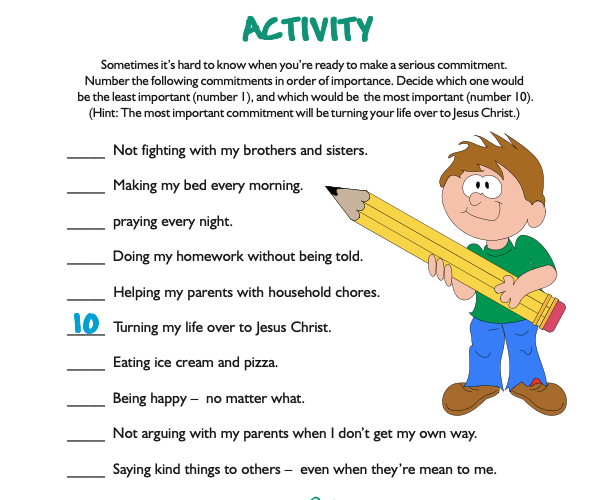
Because making the commitment to God and the decision to be baptized are so serious, work through the activity in the students’ book in class. Before class, have the choices written on the board. Work with the students to reach a group consensus in numbering the commitments. Decide which one would be number one (the easiest) and which would be number ten (the hardest).
_____ Not fighting with my brothers and sisters.
_____ Making my bed every morning.
_____ Praying every night.
_____ Doing my homework without being told.
_____ Helping my parents with house hold chores.
_____ Turning my life over to Jesus Christ.
_____ Not arguing with my parents when I don’t get my own way.
_____ Being happy - no matter what.
_____ Eating ice cream and pizza.
_____ Saying kind things to others - even when they’re mean to me.
REACH Activity
Word Study: Kurios (koo’-ree-os)
The Greek word for “Lord” in 1 Corinthians 11:26 is kurios. It comes from the Greek kuros which means supreme in authority, the controller. To show this, we use titles like kurios: God, Lord, master, Sir.
Think about what this verse is saying! The Supreme in authority has died. You are going to proclaim His death until He comes again. This is bigger than JFK, Elvis, Princess Diana, or any famous person you can name. Jesus is the Creator, the King, the Savior. His death is to be commemorated until He returns.
Did You Know?
It was a Greco-Roman custom to follow a meal with a period of music or extended conversation. Matthew 26:30 says they sang a hymn. This traditionally would have been Psalms 115-118. (Source: NIV Archaeological Study Bible, p. 1575, 1610.)
Music Notes: Break Thou the Bread of Life
“Break Thou the Bread of Life” on page 118 of the CEM Hymnal was written by Mary Ann Lathbury (1841-1913). She was asked to write a hymn to be used as a theme song for the Bible studies at a Methodist camp meeting on Lake Chautauqua in New York in 1877. Her text was then set to music by the camp’s music director, William F. Sherwin. (Source: Amazing Grace, Osbeck, K., p. 235.)
Jesus told us He was, and is, the Bread of Life (John 6:35). Bread was then, and still is, a basic staple of daily life. (A staple is a food item which makes up a large portion of your diet.) Bread, in a very tangible physical way, sustains our lives. Do you realize that Jesus shed His life’s blood so that we can have forgiveness of our sins? He suffered every pain we can imagine. He was beaten, tortured, and killed so that we can be healed. This is what the broken bread in the Passover service pictures. As we eat flat bread during the Days of Unleavened Bread, remember it pictures taking the pure, sinless Christ into our lives as the Bread of Life. Many people spend a large portion of their day thinking about food. Do you spend as much time thinking about Jesus Christ as you spend thinking about food?
Go back and read the words to this hymn again. What Scriptures do Mary Ann Lathbury’s words bring to mind? Write them in your Bible notebook.
Journal Jot
Write in your Bible notebook the reasons why the meal Jesus shared with His disciples was not the traditional Passover meal eaten after sunset at the traditional time. There are several good reasons. Share your thoughts with your parents. Discuss how this night is very special and unique in the Christian faith.
Back to the Bible
The first reference of the word “covenant” is found in Genesis 6:18. God made a covenant, or promise, to a man named Noah. Read Genesis 6. Write verses 17-18 in your Bible notebook. The story of the flood may be very familiar because of the ark that God asked Noah to build. Just as important was that Noah trusted and obeyed God’s command to build the ark. In your Bible notebook, draw several people standing around one man, Noah. Leave enough space between them to draw conversation bubbles above their heads. In the bubbles, write what you think they may have been saying about Noah as they saw him building the ark. For Noah, write what you think may have been going through his mind while he was building the ark.
God established another covenant with Noah in Genesis 9:9-11. Write this covenant in your Bible notebook. God said He would never again cut off all life by the waters of a flood. This promise that God made with Noah has never been broken. You can stand on the promises of God! God even gave Noah a sign of His covenant. What was it? Draw a picture of the covenant in your Bible notebook and write your own caption under the picture. Remember God is faithful and we can always trust Him to keep His promises!
Just Toolin’ Around
The word “proclaim” from 1 Corinthians 11:26, is the word “shew.” Use a Bible dictionary or concordance to find the meaning of this word and write it in your Bible notebook. What does the memory verse mean to you? Write your thoughts in your Bible notebook.
Stretch It Out
Read about God’s covenant with Abraham in Genesis 15. Compare and contrast God’s covenants with Noah and Abraham in your Bible notebook. Add this event to your timeline.
Questions?
Remember to write any questions you have in your journal. That way you will remember to ask your parents, teacher, or minister.
Song
“Jesus Loves Me” is on page 6 in Kids Classics Collection.
Closing Prayer
Encourage the students to ask for God’s guidance in knowing when they’re ready to make the commitment to accept Jesus Christ as their Savior.
Printable Pages