YEA Lesson Library
Thieves in the Temple
About This Lesson
Using the example of Jesus clearing the money changers and animals out of the Temple, this lesson teaches that we need to be careful what we put into our minds and bodies because we are the temple of God, if God dwells in us.
Scriptures
Ezekiel 44:23-24
Habakkuk 1:13
Matthew 21:12-13
John 2:13-17
1 Corinthians 3:10-17
2 Corinthians 6:14-18
2 Corinthians 7:1
1 Thessalonians 4:1-8
1 Peter 1:13-16
Words to Know
CONTAMINATES - makes unclean or dirty
REVERENCE - showing respect and honor to another
PURIFY - to make clean
TOXIC - has the ability to kill; a poison
The Lesson
You’ve heard stories in the news of people who got in trouble for tearing up the United States flag. Sometimes people get into trouble for breaking windows or perhaps for dumping toxic wastes near a creek. All of these actions upset us because we care about our schools, our country, our homes, and our environment.
How would you feel if you came to church next week and saw people trying to sell puppies, kittens, and parrots on the Sabbath? These people think this is okay because they are trying to make money. But won’t people be distracted when they try to talk to God in prayer? Won’t it be difficult to hear the sermon while dogs are barking, cats are meowing and parrots are squawking? How can you sing songs to praise and worship God with all of this noise going on? We all love our puppies, kittens, and parrots, but they just don’t belong in church.
How did Jesus feel when He came to the Temple and saw the people selling animals and exchanging money? This was God’s house! Those sellers had no business in the Temple of God! Jesus told them, “It is written, ‘My house will be called a house of prayer,’ but you are making it a ‘den of robbers’” (Matthew 21:12-13).
Because Jesus felt so strongly that people should not sell cattle, sheep, and doves or exchange money in the Temple, He did something about it: “He made a whip out of cords, and drove all from the temple area, both sheep and cattle; he scattered the coins of the moneychangers and overturned their tables. To those who sold doves he said, ‘Get these out of here! How dare you turn my Father’s house into a market!’” (John 2:13-16).
There are some things that just don’t belong in God’s house! There are certain behaviors that are not appropriate in God’s house. The Temple is God’s house. But God can live in more than one place. Paul tells us that we are God’s temples, too, if we are Christians! “Don’t you know that you yourselves are God’s temple and that God’s Spirit lives in you?” (1 Corinthians 3:16). “For we are the temple of the living God” (2 Corinthians 6:16). Since your body is a temple of God, what are some things that don’t belong in it?
God tells us to stay away from unclean meat and those things that are not good for us to eat. But we also need to stay away from behaviors or actions that are not right. We should stay away from using bad language and thinking wrong thoughts. We need to avoid the wrong kind of anger. We absolutely want to stay away from drugs. All of these things contaminate our body and our spirits. We certainly don’t want to dirty the Temple of the living God. God doesn’t want to be around anything that is unclean. God’s “eyes are too pure to look on evil; He cannot tolerate wrong” (Habakkuk 1:13).
Jesus wanted His Temple to be a clean place of worship, so He drove out the animals, doves and moneychangers. Those wrong actions in the Temple contaminated it. In the same way, our wrong thoughts and actions contaminate our bodies, and we need to make sure our bodies and hearts are clean. It’s too big a task for us to do on our own, but Jesus will help. He drove the animals and moneychangers from the Temple in Jerusalem. If you will ask Him, He’ll will help you get rid of bad language, the wrong kind of anger and bad behavior.
It’s important that we don’t allow wrong things to stay in our lives. We cannot be the Temple of the living God and continue to let unclean thoughts and actions be a part of our lives. Wrong thoughts and actions are like the toxic wastes we talked about at the beginning of the lesson. God commands His people to be holy because He is holy (I Peter 1:16). So “let us purify ourselves from everything that contaminates body and spirit, perfecting holiness out of reverence for God” (2 Corinthians 7:1).
Student Prayer
Dear Father,
Thank you for showing me that your Temple needs to be clean. Help me to rely on you to make myself a clean place for you to live.
In Jesus’ name.
Amen.
Daily Devotions
Sunday - Matthew 21:12-13
Monday - 1 Corinthians 3:10-17
Tuesday - John 2:13-17
Wednesday - 2 Corinthians 6:14-7:1
Thursday - 1 Peter 1:13-16
Friday - 1 Thessalonians 4:1-8
Saturday - Ezekiel 44:23-24
Objectives
At the end of this lesson, students will be able to:
1. Describe what Jesus did when He saw the sellers and moneychangers in the Temple.
2. Explain why Jesus became so upset about them being in the Temple.
3. Relate that anyone who has God’s Holy Spirit living within them is a temple of God.
4. Give examples of things which make our bodies (a temple of God) unclean.
Topics & Themes
Anger, Jesus
Holy Conduct
Holy Spirit
Jesus Sets Example
Temple
Temple, Cleansing
Unclean meat/food
Materials Needed
Bibles, student’s and teacher’s books, attendance and memory verse charts, pencils, butcher or poster paper, crayons or markers or colored pencils, yard stick, black marker, songbook, CD/cassette tape and music player.
Preparation
Juniors typically are very concerned with fairness and justice. They do not like to see vandalism or needless destruction of property. They will identify with Jesus’ actions in clearing out the Temple in Jerusalem. Once they understand the connection between the Temple in Jerusalem and our bodies as a temple of God, they will have a good analogy for understanding why they should avoid and resist certain actions, thoughts, and desires.
The idea of avoiding uncleanness is not only found in the New Testament, but is emphasized in the Old Testament as well. God was going to walk among the people and be their God, therefore the people could have no uncleanness in the camp. They were not to touch any unclean thing.The students’ memory verse gives the reason for Christians to avoid uncleanness.
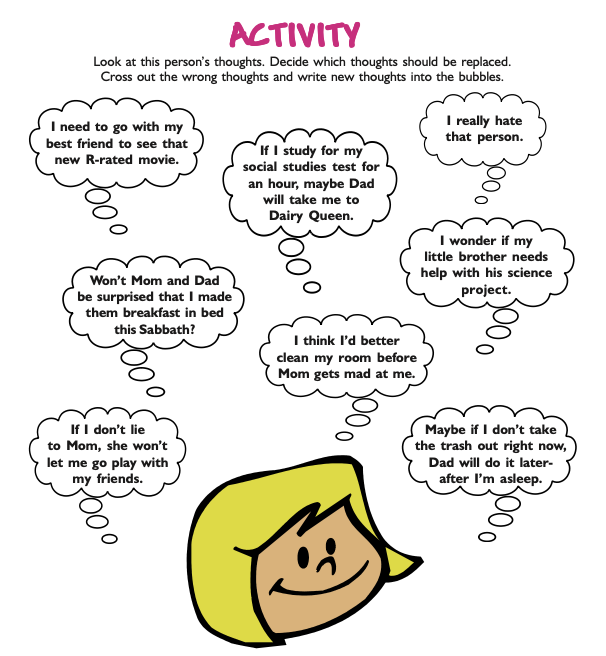
Before class, draw a person on a six-foot piece of butcher paper, draw thought bubbles around the person. Leave them blank for the kids.
How to Teach This Lesson
REAL LIFE APPLICABILITY - Ask the students to give examples of destructive or disrespectful behavior toward property or other peoples’ belongings. Make sure you write these down on poster paper. You can use them during the activity as a springboard.
JESUS’ ACTIONS - Ask the students to retell what happened in the Jerusalem Temple when Jesus saw the sellers and moneychangers. Contrast His actions in the Temple with the personality and character that Jesus demonstrated in the Triumphal Entry. Ask the students to give reasons why Jesus acted so strongly.
TEMPLE OF THE LIVING GOD - Ask the students what and who Paul identifies as the Temple of the Living God (1Corinthians 3: 16; 2 Corinthians 6:16). Ask how Christians can be a temple of God. Discuss how God gives the Holy Spirit to each person at baptism and what it can do for them.
UNCLEANNESS IN THE TEMPLE - Discuss the kinds of things that make our bodies unclean before God. Examples: lying, cheating, swearing, foul language, stealing, anger, hatred, envying (Colossians 3:8-9; Galatians 5:19-21). Leviticus 11 discusses unclean meat, if the students ask.
CLEANSING THE TEMPLE - Ask the students how they can get rid of the wrong thoughts and actions from their lives. Assure the students that as long as we are human beings, we will always have to work replacing wrong thoughts and actions with good ones. Romans 7 describes the battle that all Christians have with their carnal nature. Paul sums up the only way to become clean – that is, through Jesus Christ (Romans 7:25; I John 1:7, 9; Titus 2:12-14).
Review Questions
1. What did Jesus do when he saw the sellers and the moneychangers in the Temple of God in Jerusalem?
2. Why did Jesus react so strongly against them being there?
3. What does Paul tell us about the Temple of God today?
4. How does a Christian become a temple of God? (When God gives them His Holy Spirit at baptism.)
5. What are actions and thoughts that make our bodies unclean before God?
Teacher-Directed Activity
Use the six-foot drawing of the person that you prepared before class. Have the students discuss what clean thoughts might include. Refer back to the list of disrespectful and destructive behaviors.
Ask for the opposite of those negative thoughts and behaviors. Write their brainstorming suggestions on a separate sheet of paper. Remind them that actions usually come after thoughts. If your thoughts are clean, your actions will likely be clean too. Once you’ve exhausted their suggestions, decide which suggestions they’d like to write in the thought bubbles next to the person. Allow them to use different colors, if they wish.
Again, plan to display what they’ve learned for the rest of the church to see – but only with the student’s permission.
REACH Activity
Word Study: Katharizo (kath-ar-id’-zo)
The Greek word for “purify” in 2 Corinthians 7:1 is katharizo. It means to cleanse, clean, make pure. Paul tells the Corinthians (and us) to clean everything out of our lives that is unclean and ungodly. Do you resist cleaning your room? Some of us also resist cleaning bad habits and carnal nature out of our lives. It’s work! Sometimes it’s uncomfortable. Sometimes it seems like we’re never going to get it done. You clean your room because your parents tell you to. In the same way, Paul tells us to clean our lives out of reverence for God. Better get started. I suspect there’s a lot of work to do in there.
Did You Know?
The buying and selling of animals (at exorbitant prices) took place in the large outer court of the Gentiles [in the Temple], which covered several acres. (Source: NIV Archaeological Study Bible, p. 1598.)
Music Notes: Cleanse Me
“Cleanse Me” is on page 76 of the CEM Hymnal. The text was written by J. Edwin Orr (1912- 1988) in 1936 after a “stirring Easter convention in Ngaruawahia, New Zealand. Fervent meetings sprang up throughout the city. Inspired by this, . . . Dr. Orr took time as he left New Zealand to write the verses of ‘Cleanse Me’ on the back of an envelope in the post office. The tune he used was the lovely Maori Song of Farewell, sung to him by four Aborigine girls as he was leaving.”
Taken from Psalm 139, the hymn starts with a prayer that revival begin personally first. “Revival begins only after God’s people recognize their sin, receive cleansing from it and surrender their ‘will, passion, self and pride.’ The hymn ends. . . with the assurance of knowing that God will hear and supply our needs.” (Source: Amazing Grace, Osbeck, K., p. 251.)
In your Bible notebook, make two columns. In the left column, write the words from this hymn. In the right column, write the Scripture reference where these words are found. Start with Psalm 139:23-24.
Journal Jot
The Jewish authorities typically restricted the lame, blind, deaf, or mute from full temple access to symbolize the purity expected in those approaching God. (Source: NIV Archaeological Study Bible, p. 1599.) The Pharisees are such good examples of what our carnal nature does! We want to give the appearance of cleaning up our lives, but we resist truly submitting our wills to God. Can you think of something that you’ve done that looks good, but really wasn’t so good in your heart? Think about it. Write about it in your Bible notebook. Then pray about it.
Back to the Bible
Although a king, David did not always make the best decisions. Yes, he was guilty of sin in his life, as we are in our own. David wrote Psalm 51 because he wanted God to know that he was very repentant or sorry for sinning. Through the writing of this Psalm (and many others as well) David poured his “heart” out to God in sorrow for his sin.
Read Psalm 51. Did you notice how David very carefully outlines his repentance? In verse 7 David says: “Cleanse me with hyssop, and I will be clean; wash me, and I will be whiter than snow” (NIV). Can you think of anything whiter than snow? In verse 10 David requests: “Create in me a pure heart, O God. . .” (NIV). Can you see how this lesson’s memory verse relates to these verses in Psalm 51?
Discuss this topic with your family and write your thoughts about it in your Bible notebook. As you develop your prayer life, remember to ask God to give you an obedient heart that will follow only His ways, and not your own. When you do sin, remember David’s words in Psalm 51.
Just Toolin’ Around
Use Bible tools to discover what daily life was like in the Temple. Then draw and label a picture of it in your Bible notebook. Write a paragraph describing what took place at specific locations in the Temple.
Stretch It Out
Write in your Bible notebook, as a moneychanger, before and after Jesus cleansed the Temple. Be specific as to what the moneychanger would have seen, heard, and felt as he saw the action taking place around him. Draw pictures in your notebook if you would like. Add this event to your timeline.
Questions?
Remember to write any questions in your notebook. That way you will remember to ask your parents, teacher, or minister.
Song
“One Door, And Only One” page 44 in Kids Classics Collection.
Closing Prayer
Encourage the students to thank God for showing us that His Temple needs to be clean, and to ask Him for guidance and wisdom to purify ourselves from all unrighteousness.
Printable Pages