YEA Lesson Library
Lost and Found
About This Lesson
Using Jesus’ parables of the lost sheep and the prodigal son, this lesson teaches that each person is important to God and He rejoices when each one repents of their sin.
Scriptures
Psalm 103:1-5
Psalm 119:176
Isaiah 1:16-20
Ezekiel 34:15-16
Jonah 3:1-10
Matthew 7:1-5
Matthew 18:12-14
Matthew 18:21-22
Luke 15:1-32
Luke 15:7
Luke 19:10
Words to Know
AGITATED - excited or upset feelings
ESTATE - possessions passed from father to son
FAMINE - a severe lack of food
PUBLICAN - tax collector
WHIMPERING - a low, whining cry
The Lesson
One morning Mark heard a sound like someone whimpering. He stepped outside and the sound got louder. Under the bushes was his dog Cocoa. She had given birth to seven puppies! Excited, Mark ran to the shed and made a soft bed for them. He carefully picked the seven little fur balls and carried then to the shed. Cocoa followed, making sure they were all safe.
Every day there were changes in the puppies. First their eyes started to open. Then they wandered a little farther from their momma every day. Soon they were rolling and playing in the yard. The puppies greeted Mark with little barks and licks when he came home from school.
One day one of the puppies was missing. Mark searched the shed. He looked all over the yard. Cocoa was agitated. She paced back and forth in a corner of the yard. Then Mark spotted it – a hole under the fence! The puppy must have crawled under the fence and wandered away.
What would you do if this happened to you? Would you look for the lost puppy. Or, would you be content with the six puppies you still had? Would you forget about the lost puppy. And, if the puppy came back in a few days, would you welcome him back? Would you be happy and celebrate? Does that mean you love that puppy more than the others? Of course not!
God feels the same way about people. He is sad when one of His children wanders away from following Him. But, He is happy and celebrates when the lost child comes back to Him. To help the Pharisees understand how much He loves people, Jesus taught the following parable.
“Suppose one of you has a hundred sheep and loses one of them. Does he not leave the ninety-nine in the open country and go after the lost sheep until he finds it? And when he finds it, he joyfully puts it on his shoulders and goes home. Then he calls his friends and neighbors together and says, ‘Rejoice with me; I have found my lost sheep.’ I tell you that in the same way there will be more rejoicing in heaven over one sinner who repents than over ninety-nine righteous persons who do not need to repent.”
Why would Jesus tell this parable to the Pharisees? After all, they were religious people. They seemed to strictly keep God’s laws. Didn’t they already know how God felt about people who repent? But they didn’t understand. They didn’t like Jesus to spend time with publicans and sinners. They didn’t like people who didn’t act and believe like they did.
Jesus wanted to help them understand how God feels about sinners repenting. He told a parable about a man with two sons. The younger wanted his share of his father’s estate. The father gave him his share of the money. Then the younger son left home. He went to a country far away. He wasted all his money there on foolish things. He did things he shouldn’t do. Soon he had nothing left. He couldn’t even buy food to eat.
The young man went to work on a farm, feeding pigs. He got so hungry he even wanted to eat the pigs’ food! Then he thought, “My father’s servants have plenty to eat and I’m starving. I will go back and tell my father I’m sorry.” The boy was even willing to become one of his father’s servants. He didn’t think he was worthy to be his son.
The young son headed for home. Then his father saw him coming down the road. He had been watching for a long time hoping he would return. The father ran out and hugged and kissed his son.
The boy tried to say how sorry he was for what he did. But his father told the servants to put the best robe on him. He put a ring on his finger and sandals on his feet. He said, “Let’s have a feast and celebrate! My son was lost but now is found.” His father was very happy.
But, the older brother wasn’t happy at all! He said he wouldn’t go to the celebration. He had always obeyed his father and worked hard. His father had never given him a party. Instead, he was having a party for his good-for-nothing brother! The father thought he would never see his young son. Now that he was home it was time to celebrate.
God is always joyful when you are truly sorry for the bad things you do. He wants you to try hard not to repeat your mistakes. Our Heavenly Father is merciful – He will forgive you when you ask Him.
Student Prayer
Dear Heavenly Father, Thank you for giving these parables so that I might know just how very special each person is to you. Thank you for your mercy in forgiving me when I ask. Please teach me how to stay close to you.
In Jesus’ name. Amen.
Daily Devotions
Sunday - Luke 15:1-32
Monday - Matthew 18:21-22
Tuesday - Ezekiel 34:15-16
Wednesday - Matthew 7:1-5
Thursday - Jonah 3:1-10
Friday - Isaiah 1:16-20
Saturday - Psalm 103:1-5
Objectives
At the end of this lesson, the students will be able to:
1. Tell why Jesus taught these two parables.
2. State that God rejoices over sinners who repent.
3. Use the parables to tell how important each one of us is to God.
Topics & Themes
God’s Law
Jesus, His Ministry
Mercy
Parables
Lost Sheep
Prodigal Son
Pharisees
Repentance
Shepherd
Sin
Materials Needed
Bible, YEA students’ and teacher’s books, attendance and memory verse chart, stickers, cassette or CD and music player, awards, refreshments (optional), paper bags, toy sheep and pig, confetti, ring, party hats, play money
Preparation
Since this is the last lesson in this book, the students should recite 1 Corinthians 13 today. Depending on time and facilities, you may want to have a small party and give awards to those students able to recite the chapter.
Juniors are moving into the age where they tend to be very possessive. When they lose something, it can be devastating to them. Less mature students may have trouble keeping track of their belongings. This can cause some conflicts between the students in class. By understanding the maturity level of your students when starting this lesson you will be able to gauge how relevant the idea of Lost and Found will be to them.
You will need two paper bags. In one place a small stuffed lamb and some confetti, in the other place a toy pig, party hat, a ring and some play money.
How to Teach This Lesson
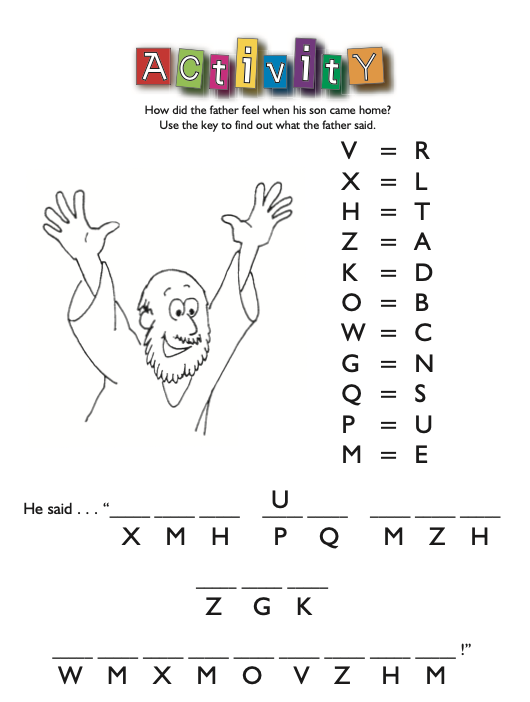
Begin with the Activity - Divide the class into two groups. Give each group one of the paper bags. Tell them to take the items out of their bags and see how they relate to one of the parables in today’s lesson. Have the groups act out each parable using the items in their bag as props.
Lost and Found - Ask the children if they have ever lost anything. (You will find out who is very concerned about keeping track of their belongings.) Ask them how long they searched and if they eventually found the object. What kind of feelings did they have if they didn’t find the object? If the lost object showed up a couple of days later, ask them what their reaction was.
Our Relationship to God - When we decide to follow God with our whole heart, we begin walking on the path towards God’s Kingdom. Sometimes God’s people make wrong decisions which are detours off the path towards God. Some people never come back. But, some people realize they’ve taken a wrong turn – that they have been doing wrong things – and they repent. Explain that to repent means to feel so sorry for your actions that you change your mind and actions. When God’s children repent, He is like the father in the parable – waiting to welcome us home.
The Lost Son - Discuss the wrong actions of the younger son. Ask: What was his first mistake? How did he feel when he realized what a mess his life was in? Sometimes when we make a mistake, we feel like it would be better to keep going in the direction we’re going. It takes a lot of courage to go back to God and admit that you have done something wrong. The younger son was ashamed and fearful that his father wouldn’t accept him back and forgive him. Ask: How did the father react? In the same way, God will forgive us when we repent and return to Him.
The Older Brother - Ask: Was the older brother happy that his brother had come home? Why or why not? Explain that we should not be angry or jealous over someone who has been forgiven. God is the Judge – it is up to Him to punish or forgive sin.
The Shepherd and the Father - Depending on the maturity of the students, you may also want to explore the differences between the shepherd and the father. The shepherd went looking for his lost sheep. The father stayed at home. There may be times in our Christian walk when God will come after us and lead us home again. Then again, there may be times when He waits for us to realize that we have made a mistake and return to Him. There’s a difference between going astray and rejecting God. It’s not safe to assume that if we reject God He will show us our errors and put us back on the right track.
Review Questions
1. Why did Jesus use the parables of the lost sheep and the lost son to teach the Pharisees?
2. Why do you think the younger son didn’t want to wait to receive his inheritance?
3. What did he do when he realized he had made a mistake?
4. How did his father treat him when he came home?
5. How does God treat us when we acknowledge our sins, and ask for His forgiveness?
6. Why is God so merciful to us?
Teacher-Directed Activity
This lesson’s activity is completed in How to Teach This Lesson.
REACH Activity
Word Study: Chara (khar-ah’)
In Luke 15:7 the word “rejoicing” comes from the Greek word “chara.” It comes from another word meaning “cheerfulness.” But the word itself shows that there is a cause for joy or rejoicing. The synonyms are exultation, exuberant joy, or gladness of heart. This word implies there is a reason for great joy.
Think about this meaning as you read the YEA lesson memory verse again. There is more “chara”—exultation—in heaven—by the angels!—when a sinner repents. Doesn’t it make you smile to know that God’s angels are cheering when you repent, when you tell God you are sorry and change the way you have been living your life?
* Word Study notes are taken from Spiros Zodhiates’ Hebrew-Greek KJV Key Word Study Bible and Lexicon.
Did You Know?
The father, in the parable of the prodigal son, may have divided the inheritance (with a double portion to the older son) but retained the income from it until his death. To give a younger son his portion of the inheritance upon request was highly unusual. (Source: NIV Archaeological Study Bible, p. 1698.)
Music Notes: The King of Love My Shepherd Is
This hymn is found on page 89 of the CEM Hymnal. The words were written by Sir Henry William Baker (1821-1877), an English musician most remembered as being the editor-in-chief of an extremely popular hymnal, Hymns, Ancient and Modern, which was published in 1861 and which sold more than 60 million copies.
Many hymns have been written based on Psalm 23, but Henry Baker wove the ideas of Psalm 23 with themes from the New Testament: the parable of the lost sheep from Luke 15:5 and the cross to guide.
Read the words to the hymn. Then read Psalm 23, John 10:1-18, and 1 Peter 2:25. In your Bible notebook, note the similarities you find. (Source: Amazing Grace, Osbeck, K., p. 26.)
Journal Jot
Have you ever lost something and then spent quite a while looking for it? Write about what you lost, where you looked, where you finally found it, and your feelings while you were looking and after it was found. Then compare your experience to what it would be like if you were talking about a person who was lost. Write a thank you note to God for being our Shepherd who looks for us when we are lost.
Back to the Bible
The Lord’s forgiveness is very evident to the writer of Psalm 130. The point of this Psalm is confession and forgiveness. Confessing is admitting that you did something wrong. Maybe you had a harsh word for someone, or cheated on a test. Deep down inside you knew it was wrong, but you did it anyway. How did your actions make you feel later, though? Did you know, like the lost son, that you needed to confess your sin? Read Psalm 130:1-2. Can you relate to these words? When you confessed your sin, did you want mercy from someone? Did you pray and ask God to forgive you for your sins? Did you know that He would be merciful and forgive you? Have confidence in approaching our Heavenly Father with a sorrowful heart. God knows your heart and the depths of your repentance. The lost son went to his father with confession on his lips, yet the father could only rejoice in his son’s return. Likewise when you go to your Father with confession, He, too, will find reason for rejoicing!
Just Toolin’ Around
Use your Bible and Bible reference books to find at least three Scriptures on “confession.” Use a Bible dictionary to find the meaning of the word “confess.” Write the definition and Scriptures in your Bible notebook. Share with your family or Sabbath School class.
Stretch It Out
Do you have a difficult time offering others mercy and compassion? Pray that God will open your eyes to the wonderful gift of mercy and compassion towards others. As a family or Sabbath School class, begin a Bible study of one Psalm a day. The writers of the Book of Psalms express praise and worship of God the Father for His forgiveness, mercy, love, and faithfulness to us. Learning about God’s way will help you know more about how He wants you to treat others. As you read and study, write your thoughts in your Bible notebook. Take time one day a week to write your own personal psalm. You do not need to share it with others.
Questions?
Remember to write any questions that you have in your notebook. That way you will remember to ask your parents, teacher, or minister.
Song
“Thy Word Have I Hid in My Heart” is on page 75 of Kids Classics Collection.
Closing Prayer
Encourage the students to thank God for giving us these parables so we might know just how very special each person is to Him. Thank Him, also, for His mercy and forgiving us when we ask.
Printable Pages