YEA Lesson Library
The Golden Rule
About This Lesson
This lesson uses a true story to teach how to apply the Golden Rule in your life.
Scriptures
Deuteronomy 28:1-14
Psalm 73:3-5
Micah 6:8
Matthew 5:45
Matthew 7:11-12
Luke 6:27-31
Luke 6:35
2 Peter 3:9
Words to Know
COMMOTION - loud noise, chaos, lots of movement
HARSH - extremely severe, unkind, strict
TORMENTING - intentionally causing pain
The Lesson
One day Anne heard a terrible commotion from the neighbor’s geese. She looked out her bedroom window to see what was going on. Anne saw her little brother chasing the geese and kicking their tails to see how far they would fly. This made Anne very upset. She marched through the house, ready to go outside and put a stop to the tormenting. Anne’s dad asked her where she was going in such a huff. She told him what was happening. She said she was going to kick her little brother to see if he liked it!
Anne intended to demonstrate to her little brother what we call The Golden Rule. It says you should “Do to others what you want them to do to you” (Luke 6:31 NIrV). Unfortunately, Anne didn’t understand the Golden Rule very well herself. She really shouldn’t have planned to kick her brother. She surely wouldn’t want someone to kick her! Also, her idea didn’t go over too well with her dad!
Why was it wrong for Anne to kick her brother? After all, he was kicking the geese. Jesus told His disciples, “If you don’t want people to hate you, don’t hate them. If you don’t want people to curse and treat you badly, don’t be mean to them. In the same way, don’t hit others and don’t steal from others.”
Sometimes it’s difficult to know what the right action is. But Jesus explains what we should do when He says to, “Do to others what you want them to do to you.” When someone is mean to you, think about The Golden Rule. If you were the one who treated someone else badly, would you want that person to retaliate or get even? Of course not! You would want him or her to be kind, generous and forgiving. This isn’t always easy, but it’s what a Christian should do.
What if the person who harms you is an enemy and not a friend? Jesus taught that if you love someone who loves you, you are no different than sinners. They are good to people who love them. But, Jesus says that you should love your enemies and be good to them with- out expecting anything back. That is really hard! Sometimes it is even hard to love your brothers and sisters and be nice to them!
Why would Jesus want us to be nice to people who are so mean to us? Think about how God, our Heavenly Father, treats us. He sent His only Son to earth to die for us – and Jesus didn’t deserve to die. God sends rain to water the gardens of both the good and bad people. God is kind to people who do bad things and don’t even care are about Him. That’s the kind of Heavenly Father we have.
Why is God kind to people who do bad things? He wants to give everyone a chance to turn away from doing evil. He is very patient. He doesn’t want anyone to suffer eternal death. He wants them to turn away from their bad actions. He wants them to accept Jesus and live because He truly loves us all.
Jesus Christ wants us to be like that! He wants us to treat other people with the same kind of love and goodness that God treats all people. And, He says that if you treat people the way you want to be treated you will have a great reward. He is kind and shows mercy. If you are His child, you should try to be like our Heavenly Father.
Now, think back. Anne was angry because her brother was treating the geese badly. She knew her brother wouldn’t want to be kicked in his tail feathers. If he wouldn’t like it, he certainly shouldn’t be doing it to the geese! But Anne forgot that The Golden Rule applied to her too! She would make mistakes in her life. She certainly wouldn’t want her parents to be as harsh in correcting her as she wanted to be with her brother. If Anne wants her parents to be kind to her when she does wrong, she needs to show the same kindness to her brother. Yes, she should have stopped him from kicking the geese. But, her desire to kick him was wrong! Anne should have remembered The Golden Rule. Her Heavenly Father would have corrected her brother in kindness and gentleness.
Do you think Anne’s brother could learn how to be kind (even to animals) if Anne had been kind to him? When you stop to think about it, The Golden Rule is a great rule by which to live!
Student Prayer
Dear Heavenly Father,
Thank you that you are kind and loving to me when I don’t deserve it. Please teach me how to show the same kindness to others that I want to receive from them and from you.
In Jesus’ name.
Amen.
Daily Devotions
Sunday - Luke 6:27-31
Monday - Matthew 7:12
Tuesday - Matthew 5:45
Wednesday - Matthew 7:11
Thursday - Deuteronomy 28:1-14
Friday - Micah 6:8
Saturday - Psalm 73:3-5
Objectives
At the end of this lesson, the students will be able to:
1. Recite The Golden Rule.
2. List some characteristics that they would like to find in a friend.
3. Explain that God the Father, shows mercy, kindness and love even to the ungrateful and wicked.
4. State that as children of God we must learn to be like Him.
Topics & Themes
God’s Love
God’s Provision
God’s Will
Golden Rule
Holy Conduct
Jesus Sets Example
Kindness
Loving Others
Mercy
Obedience
Materials Needed
Bible, YEA students’ and teacher’s books, attendance and memory verse chart, stickers, cassette or CD and music player, newsprint pad, marker, paper and pencils
Preparation
Preteens quickly notice people who aren’t living according to The Golden Rule, but they have trouble seeing it in themselves. The story in the student’s book about Anne is true, but for many years she didn’t see that kicking her little brother certainly wasn’t living The Golden Rule. That’s typical of Juniors. Once they see their own sin, they are usually very chagrined about their hypocrisy.
Loving your enemies may not mean as much to preteens as loving your brothers and sisters. It’s harder to get along with people who live in the same house than with someone you see occasionally at school. This age stays away from the kids who are mean to them. They will respond positively to the idea of being nice to them because it’s finite. After a short time, they can get away from them. It’s much more difficult to convince them to be nice to siblings who have built a history of injustices against them.
How to Teach This Lesson
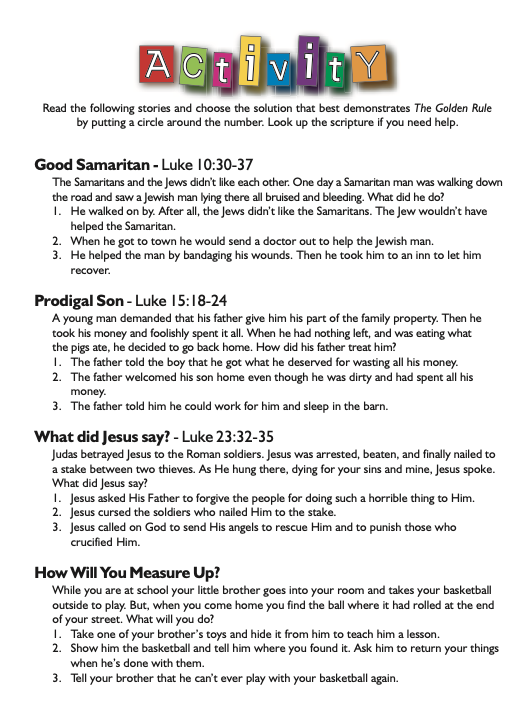
Begin by reading some ads from the classified section of the newspaper (want ads). Now do the Activity.
Do Unto Me - Ask: How many of the characteristics of your friend are related to how you want them to treat you? (Look at the list on the newsprint pad and discuss.) We all want people to treat us kindly and to do nice things for us. But do we deserve to be treated kindly?
Do Unto Others - Ask: In the story in the student book, how was Anne’s little brother treating the geese? Do you think this was a good thing to do? Anne decided to teach him a lesson about The Golden Rule. How was she going to teach him? Was Anne following the Golden Rule? Being mean to her little brother wouldn’t teach him to be kind to animals.
The Golden Rule - Have someone read Luke 6:31. Ask: Think about the story of Anne – how could she teach her little brother how to treat the geese and still follow the Golden Rule? (Allow the students time to come up with their own solutions.)
Our Example - Read Micah 6:8. God has shown us how He wants us to live. He gives us instructions in His Word on how we should treat others. He sent Jesus to show us by His life (John 3:16, 15:12-13). Our Father doesn’t want anyone to perish. His love is so great that His Son paid the penalty for our sins. If He feels that way about all people, maybe we should stop and think before we treat anyone badly!
Do You Measure Up? - Discuss how children inherit certain characteristics from their parents – eye color, hair color, height, etc. Relate this to the fact that God’s children are like God. God always treats us with mercy, kindness, patience, goodness, gentleness and love. Think about it – do you measure up to His example? Vengeance - There is a difference between taking vengeance and defending yourself. Ask: When someone picks on you or bullies you, how do you react? (Discuss) Address the scripture about turning the other cheek. Differentiate between turning the other cheek and self-defense. Distinguish between abuse and revenge. There is a balance between righting a wrong, taking your own vengeance and having mercy because of circumstances. The cycle of retaliation leads a person farther from Christian actions and the Golden Rule. Lead the students to understand that God will settle the accounts.
Review Questions
1. How do we want other people to treat us?
2. Name some ways that Jesus expects us to treat our enemies (even brothers and sisters).
3. How does God treat the entire world – regardless of wickedness or ingratitude?
4. In what way did Jesus set an example for us to follow?
Teacher-Directed Activity
Divide the class into groups of three or four. Give each group a sheet of paper and tell them to brainstorm and write out a want ad for a best friend. Ask them to include qualities in their ad that make a good friend. Give them about five minutes in the groups then ask each group to read their want ad. List the qualities on a newsprint pad.
REACH Activity
Word Study: Agathopoieo (ag-ath-op-oy-eh’-o)
“Do good” (in Luke 6:35) comes from the Greek word “agathopoieo.” This Greek word comes from the word which means to be a well-doer, as a favor or a duty. In Luke 6:35, how do you think Jesus used this word? Did He mean that we should do good as a favor to others? Or did He mean that it is our duty to do good to other people? This is not a suggestion from Jesus. This is direction in how to live your life all the time.
* Word Study notes are taken from Spiros Zodhiates’ Hebrew-Greek KJV Key Word Study Bible and Lexicon.
Did You Know?
The so-called Golden Rule is found in negative form in Rabbinic Judaism, Hinduism, Buddhism and Confucianism. It also occurred in various forms in Greek and Roman ethical teaching. That means these cultures said, “Don’t do to other people what you don’t want them to do to you.” Jesus, in contrast, stated it in positive form. Jesus said, “So in everything, do to others what you would have them do to you . . .” (Matthew 7:12). (Source: NIV Archaeological Study Bible, p. 1570.)
Music Notes: A Beautiful Life
This hymn is found on page 206 of the CEM Hymnal. The words and music were written in 1918 by William Matthew Golden (1878-1934). It is said that most of his songs were written while he was serving an eight-year sentence in the state penitentiary. His only child reportedly died young. He died in a traffic accident in Mississippi. (Source: www.cyberhymnal.org.)
The inspiration for this song comes from Luke 10:30-37, the parable of the Good Samaritan. Read the words of the hymn and list in your Bible notebook the ways William Golden says he’ll live a beautiful life.
Journal Jot
The situation with Anne and her little brother actually did happen. (The names have been changed to protect the guilty.) Annie was so angry with her brother. Then she was so angry with her dad for getting upset with her, instead of being upset at her brother. Oh, her dad was probably upset with her brother too, but first he had to deal with Annie assuming authority she didn’t have.
In the same way, we can look at other people’s actions and decide whether they are right or wrong, but we don’t have the right or authority to administer discipline, punishment, or consequences. Read Romans 12:9-21. Then write in your Bible notebook how these verses compare to The Golden Rule. Write about how these apply to your life. Can you think of a situation like Anne’s? Write about it.
Back to the Bible
Jesus Christ had many lessons to teach to large crowds of people that He met and those who followed Him. One day He found Himself with a very large audience on a mountainside. He sat down and began to teach them. (Read Matthew 5.) Teachers plan lessons according to what they believe their students need to hear or learn. So it was with Jesus. The lessons for His students then are the same ones for you today. You will meet people who will make fun of you for helping and listening to others. Your friends may not understand why you want peace over anger when someone hurts you or says bad things about you. They will not understand why you show mercy. The world can be a very unfriendly place, but as a child of God, you are not a part of this world. You follow Jesus Christ and His example. It will not be easy. But Jesus said that you would have a great reward in heaven. Let Jesus Christ be your Teacher of how to live a blessed life.
Just Toolin’ Around
Read James 1:19. Write this verse in your Bible notebook and circle the words that come before listen, speak, and angry. How does this verse relate to this YEA lesson? Discuss this Scripture and explain it to your family or Sabbath School class.
Use your Bible and a concordance to find at least two Scriptures for listen, speak, and angry. What Scripture do you think will help you most in a difficult situation, and why? Explain your answer in your Bible notebook.
Stretch It Out
Write an acrostic poem in your Bible notebook from the title of this YEA lesson (omit “The”): G-O-L-D-E-N R-U-L-E. From the letters, write what you have learned from the YEA lesson, and then share/teach it with/to family or Sabbath School class.
Questions?
Remember to write any questions that you have in your notebook. That way you will remember to ask your parents, teacher, or minister.
Song
“O Be Careful Little Eyes” is on page 39 of Kids Classics Collection.
Closing Prayer
Lead the students in thanking God that He is merciful and kind to us, despite what we deserve. Then ask Him for strength and guidance in learning to be kind and loving to others.
Printable Pages