YEA Lesson Library
Weeds in the Garden
About This Lesson
Using the parable of the weeds, this lesson explains that you can’t always tell who is a Christian from the outside, but God knows. It also encourages the student to seek God to produce fruit for the kingdom.
Scriptures
Psalm 91:14-15
Matthew 13:24-30
Matthew 13:36-43
Ephesians 6:10-18
1 Thes 5:21-22
1 Peter 5:8-9
Words to Know
CLUSTERED - a number of things grouped together
DISTINGUISH - able to tell the difference
EVIDENT - clear, easy to see
REPRESENTED - to stand for
The Lesson
Josh and Jennie walked through the woods looking for wild berries. They caught sight of something bright red. Was it a berry patch? No. There were no berries to be found. Instead they saw a vine with some red leaves. Just then Josh remembered a rhyme his science teacher taught the class: Leaves of three, let it be! Yes, there were three leaves clustered together. This was poison ivy! It looked good at first, but it was a weed, not berries.
Jesus told a story about Weeds In The Garden in Matthew 13:24-30. He said the Kingdom of Heaven is like a farmer sowing choice seeds in his garden. But one night his enemy came in while the farmer was asleep. He sowed weeds along the same row where the farmer had sowed wheat seeds. In a few days little shoots of wheat poked through the ground. But guess what. Weeds grew in the rows along with the wheat. Just like the poison ivy would never produce blackberries, the weeds would never produce grain.
The farmer’s workmen told him about the weeds. They explained an enemy had planted them. “Should we pull up all the Weeds In The Garden?” they asked. The farmer knew that the roots of the wheat and weeds would be tangled together. If they pulled up weeds, the wheat would also be pulled up. He told the workers, “Let them grow together until harvest time.” They could tell the difference then. The wheat could be picked and put in the barn. The weeds would be burnt in a fire.
Jesus wanted us to know that there are two kinds of people in the world. Christians are like wheat. People who don’t obey and follow God are like weeds. Sometimes its hard to tell the difference just by looking. Jesus wants us to understand that looking like a Christian, and even going to church every Sabbath, isn’t what makes us God’s children. He looks at what’s in our hearts!
Here again, Jesus wasn’t just giving a farming lesson. He wanted us to learn some- thing more. He said the garden represents the world. The one who planted the choice wheat seeds was Jesus. These seeds are like God’s children. They grow to love and serve Him. They tell others about Christ and God’s Kingdom. But, the weeds are like those who won’t obey God. Satan put them here to choke out the good seeds. He doesn’t want you to become a child of God. He doesn’t want you to follow Jesus.
But, like the poison ivy, it may be hard to tell by looking if these people are good or bad. They may grow right alongside Christians without anyone knowing the difference. But God knows! How do you think He can tell?
Wheat produces grain – the weeds can’t. As Christians grow, they produce grain or fruit. You follow Jesus. You love Him. You have faith in Him. You want to do His will and obey His commands. You find ways to help others.
When Christ returns, it will be harvest time. Angels will reap the harvest for Christ. He will know who the real Christians are. Angels will harvest Christians, not grain. And, the Christians will be put into God’s Kingdom, not a barn. The weeds will be burned up. This is another reason Jesus told us this story. He wants us to know what the consequences are for people who don’t follow Him and don’t bear fruit.
What happened to the weeds? They were burned up. Jesus wants us to know there are consequences for people who don’t follow Him and bear fruit. Jesus says, “By their fruits you will recognize them. . . . Every tree that does not bear good fruit is cut down and thrown into the fire” (Matthew 7:16, 19).
What kind of fruit or grain will Christ look for in His garden? Galatians 5:22 says the fruit of a true Christian are: love, joy, peace, patience, kindness, goodness, faithfulness, gentleness, and self-control. God can’t be deceived. He knows the difference between weeds and good fruit. And, He knows the difference between a real and a fake Christian.
Pay close attention to this story. It says the “godly shall shine as the sun in their Father’s Kingdom.” Don’t you want to shine in God’s Kingdom?
Student Prayer
Dear Heavenly Father,
Thank you for Jesus Christ who will help me produce fruit in my life. I want to be like the wheat and not Weeds In The Garden.
In Jesus’ name.
Amen.
Daily Devotions
Sunday - Matthew 13:24-30
Monday - Matthew 13:36-43
Tuesday - 1 Thessalonians 5:21-22
Wednesday - 1 Peter 5:8-9
Thursday - Ephesians 6:10-18
Friday - Psalm 91:14-15
Saturday - 1 Corinthians 4:5
Objectives
At the end of this lesson, the students will be able to:
1. Tell the two different kinds of people God put in this world and explain which one represents heat and which one represents weeds.
2. Retell the parable in their own words.
3. Explain that Satan puts evil people in the world to divert us from following Christ.
4. Give examples of what kinds of fruits Jesus will be looking for in their lives.
Topics & Themes
Angels
Fruit of the Spirit
God’s Kingdom
God’s Will
Harvest
Helping Others
Holy Conduct
Jesus, His Ministry
Loving God
Obedience
Parables
Weeds
Relationship With God
Seeking God
Materials Needed
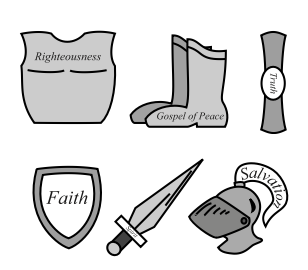
Bible, YEA students’ and teacher’s books, attendance and memory verse chart, stickers, cassette tape or CD and music player, poster of person, pieces of armor of God, dry-erase markers, eraser, double stick tape, pictures of the following things: garden, wheat, reaper, weeds, enemy, picture of a man
Preparation
We spend a great deal of time talking with our children about how they can be safe from evil people who are in the world. It’s important to let them know that the Bible also addresses this. Be very sensitive to the students’ reactions.
We don’t want to alarm them, but we do want to make them cautious. We also want them to learn to trust Jesus Christ, even when they have taken all reasonable precautions.
Before you come to class, find a photo of a man standing, to wear the pieces of the armor (from a catalog or magazine). Have the picture laminated or cover with clear contact paper. Cut out the individual pieces of armor.
How to Teach This Lesson
What Does all of this Mean? - Begin the discussion by showing what each part in the parable represents. Pass around a picture representing one of the parts in this parable and let the students look at it. As you do this, ask the students to give the Bible definition for each part. The garden in this story is the world. The wheat seeds represent Christians or people in the Kingdom. Weeds are people who belong to Satan. The harvest is the end of the world when Christ returns. Reapers are angels. The enemy who sowed the weeds in the garden is Satan.
Leave Them Alone - When the workers found weeds growing in the farmer’s field, they wanted to pull them up. But, the farmer told them to leave them alone. Ask: Why did he leave them to grow alongside the wheat? (In the process of pulling up a weed, a little wheat plant might be pulled up too.) God isn’t going to get rid of all of the evil people who live in our world either. Explain to them that God is merciful. He allows everyone an opportunity to turn from evil and seek Him. That’s one of the reasons He leaves evil people in our world.
Talk about appearances – it isn’t always possible to tell by looking at a person whether they are a Christian or not. It’s not always easy to tell if Satan has planted them in the world just like it was hard at first to tell the difference between the weeds and the wheat
Real or Fake Christians - What makes the difference in a person who is a Christian and one who is not? Have the students give one fruit Christ is looking for in a Christian life along with an example of how it would show in a Christian’s life. (Love, joy, patience, kindness, goodness, faithfulness, gentleness, and self- control).
Our Protection - It is important that you always be alert and careful. Lead students to understand that Jesus Christ is our ultimate protection from Satan and evil. Have them open their Bibles to Ephesians 6:10-18. As you come to each piece of the armor, have the students tape the pieces on the picture of the man that you cut out of a magazine. Discuss each piece. Ask: Why do you need the helmet of salvation? Tell that each piece of the armor is used for defense except one. Ask: With which piece of equipment would you use to fight? (Sword of the Spirit, God’s Word) As you read your Bible each day, you will be equipped to fight against Satan’s temptations.
Power in Prayer - Especially focus on verse 18 that tells them to pray. Help them understand that having faith in Jesus Christ is very important. Our security is in Him. Help them understand that they have no need to be fearful of Satan as long as they stay close to the Protector, Jesus Christ. When the angels reap the harvest at the end of this world, Jesus wants you to be in His Kingdom. He will do every- thing He can to ensure that you are. But you must live the Christian life and do your part.
Review Questions
1. Why did Jesus give this parable to His disciples?
2. Why does Satan put evil people into the world?
3. What are the fruits that Jesus will be looking for in His harvest?
4. Why did the farmer tell the workmen to leave the weeds alone?
5. Name the parts of the armor of God.
6. What should every Christian do every day?
Teacher-Directed Activity
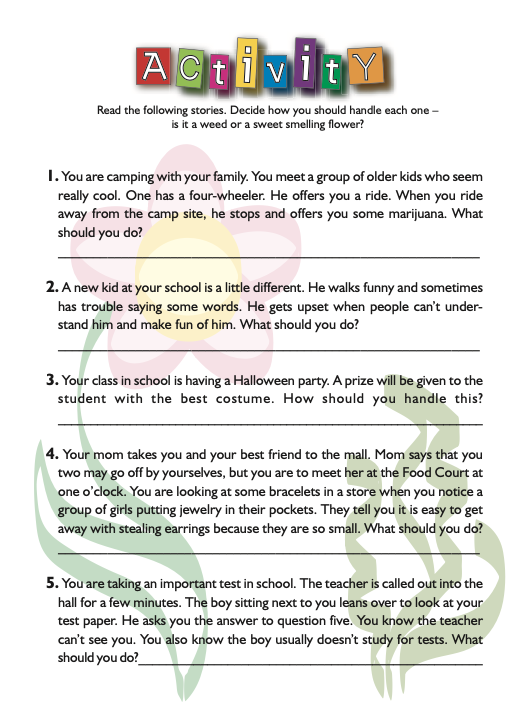
Ask for volunteers to share their solutions to the stories in the student’s books. Discuss the solutions and come up with the best one for each story.
REACH Activity
Word Study: Katecho (kat-ehk’-o)
In 1 Thessalonians 5:21-22, Paul encourages his readers to “hold on to what is good.” This phrase “hold on to” is from the same Greek word, meaning “keep,” that we saw in the last lesson—”kathecho.” It means to hold down or to hold fast.
Think about the contrast: Grab hold of the things of God with all of your might. Stay away from every kind of evil with the same degree of determination.
*Word Study notes are taken from Spiros Zodhiates’ Hebrew-Greek KJV Key Word Study Bible and Lexicon.
Did You Know?
The weed referred to as “darnel” or “tares” in Matthew 13:24-30 is Zizanion. It has poisonous seeds but looks like wheat in its early stages of growth. It is easily distinguished from wheat at harvest time. (Source: NIV Archaeological Study Bible, p. 1583.)
Music Notes: Bringing In The Sheaves
This hymn is found on page 35 of the CEM Hymnal. The text for this hymn was written by Knowles Shaw (1834-1878) in 1874. Shaw wrote music for these lyrics, but George Minor’s tune is universally used today.
Knowles Shaw was a well-known evangelist who was very successful. Just before the train wreck which took his life, Mr. Malloy (a traveler who just happened to be on the train at the same time with Knowles Shaw) asked him to tell the secret of his success in protracted meetings. Knowles Shaw said, very earnestly, that “he depended much on the power of song, preached Christ, always kept Jesus before the people, made them feel that they were sinners, and needed just such a Savior as he preached, that he never became discouraged, had confidence in the gospel truth as the power of God, that he loved his work, and became wholly absorbed in it; and added: ‘Oh, it is a grand thing to rally people to the Cross of Christ.’” Just having said this, the train went over an embankment. Knowles Shaw was thrown from the train after pushing Mr. Malloy out of danger. Subsequently, Shaw was pinned under the train in the water. He died there on June 7, 1878, in McKinney, Texas (near Dallas). (Source: www.cyberhymnal.org.)
Journal Jot
What if you really want to be a choice Christian plant in God’s garden, instead of a weed? How do you do that? Write your thoughts in your Bible notebook. Be sure to share your ideas and questions with your parents. This is too important to take lightly.
Back to the Bible
As a real Christian you will want others to see and know you as wheat, not weeds. Your life, then, must be walked in the footsteps of Jesus Christ. There will be days when you are tempted to give in and let the weeds take over. One day you may look around and see there are more weeds than wheat! They want to take you over and choke you out! Satan would be very happy harvesting weeds, not wheat. This enemy of yours prowls around like a roaring lion looking for someone (you) to devour (1 Peter 5:8). Following in obedience to God and the teachings of Jesus Christ every day will help in building a strong defense against temptation of weed growth. Micah 6:8 says: “He has told you what he requires of you. You must treat people fairly. You must love others faithfully. And you must be very careful to live the way your God wants you to” (NIrV). Are you fair with people? Do you love others with mercy and grace? Do you live your life in obedience to God? People will know you are a Christian, a follower of Jesus Christ, when they see wheat growing tall, straight, and strong. Keep a defense against weed growth by obeying God and following Jesus Christ.
Just Toolin’ Around
The memory verse for this YEA lesson is from the New International Reader’s Version. The Bible is written in many different versions, for example the King James Version, New King James Version, and New International Version. What version of the Bible do you usually read? Use at least two other versions of the Bible and find the memory verse. Write the memory verse from each Bible in your Bible notebook. Compare and contrast each verse. Write in your Bible notebook how they are alike and how they are different. Share with family or Sabbath School class.
Stretch It Out
In your Bible notebook make two columns. Label one column “weeds” and the other “wheat.” For the next week, listen and watch for examples of “weeds” in your life. Write them in the “weeds” column. In the “wheat” column write down what you would do to make them “wheat” examples. You do not need to share with anyone what you wrote in your notebook.
Questions?
Remember to write any questions that you have in your notebook. That way you will remember to ask your parents, teacher, or minister.
Song
“I Am A C-H-R-I-S-T-I-A-N” is on page 52 of Kids Classics Collection.
Closing Prayer
Lead the children in thanking God for providing safety from Satan and his temptations. Encourage them to ask God to help them bear the kinds of fruit in the life to show Him they are a Christian.
Printable Pages