YEA Lesson Library
Growing God’s Way
About This Lesson
Using the Parable of the Seeds, this lesson teaches that we need to keep seeking God to grow as Christians and navigate the troubles in this life.
Scriptures
Proverbs 3:5-6
Matthew 13:1-23
Matthew 17:20-21
Mark 4:1-9, 26-29
Luke 8:4-15
Luke 8:15
Galatians 6:7-9
1 Peter 1:13-23
1 Peter 5:8-9
Words to Know
EXHILARATING - to make cheerful and lively
NURTURED - fed and cared for
NUTRIENTS - food essential for life
PHOTOSYNTHESIS - production of nutrients in the cells of a plant, using light, water, and carbon dioxide
The Lesson
Don’t you just love the springtime? Its exhilarating! Fields are green with growing things. Flowers open their colorful petals and decorate the landscape. Tiny leaves and blossoms pop out on the trees. But all this doesn’t happen by accident. Many things are necessary for things to grow healthy and beautiful.
Seeds must have good soil to grow into healthy plants. The soil must be healthy – it must have nutrients. It must be prepared for planting the tiny seeds. Seeds planted in bad soil might sprout, but they will soon die.
What about water? That is another necessary ingredient. But, you must be careful to give just the right amount – not too much or too little.
What else does the seed need? Sunlight is essential to grow healthy plants. The sun warms the ground and encourages the seeds to sprout. Through photosynthesis, leaves transform water and gasses into nutrients to feed the plant.
But that’s not all! Plants must be nurtured – cared for. They must be protected from things that might hurt them. Weeds must be pulled so they will not take all the moisture from the tiny plant and block out the sunlight. Think about it! It is amazing that the seeds we plant actually survive and become sturdy plants.
Jesus taught a parable about a farmer who went out to plant His garden. He scattered the seeds. Some seeds fell on a hard path instead of the soft soil. Birds saw the seeds and came and ate them. Those seeds didn’t have a chance to grow.
Some of the seeds fell on rocky places where there wasn’t much soil. They sprouted, but they didn’t have enough soil to grow strong. The sun came out and burned the tiny plants. They had no roots. Other seeds fell where there were thorny weeds. The weeds blocked the sun and chocked the tiny plants so they died.
But some of the seeds fell in the rich soil. The soil had been prepared for planting. As the sun warmed the soil the seeds sprouted and grew. There were no weeds to choke them. The roots made their way deep into the soil and the plants were nourished. When the farmer went out to gather his crops there were many times more than what he planted!
The disciples knew Jesus wasn’t just giving them a lesson in farming. They asked Him what He meant by this story. Jesus told them, “The seed is God’s message” (Luke 8:11). He explained that when God’s Word falls on the hard path, or hard heart, the devil comes and takes it away.
Jesus said that the seeds that fell on the rocks are like people who listen to God’s Word and think it is great. They read their Bibles and believe what God says is true. But when hard times come they don’t depend on God. Their faith is like the roots that couldn’t go deep enough. Hard times cause their faith to wither and die.
The seeds among the thorns are like people who let the things of this world choke out God’s Word. Oh, they hear and believe that God is Supreme. They believe He has a plan, salvation, and His Kingdom for them. But, they are more interested making money or having fun than doing God’s will. Things take their attention away from God. They don’t grow into the person God wants them to be.
The seeds that fell on the good soil are like people who hear God’s Word and believe. They are good people who hold onto God’s truth. They put Him first in their lives. They don’t let anything come between themselves and God.
To Grow God’s Way your faith must be strong. You must trust God to lead you through hard times. Watch out for the choking weeds of money, pleasure, or worries. Trust God to give you the things you need, like food, clothes, or shelter. Worries can choke out hope and joy from your life.
Don’t give up! Just as the farmer cares for the tiny seeds, God cares for you. He has something special planned for you. Make sure your soil is rich with nutrients from God’s Word, and keep Growing God’s Way!
Student Prayer
Dear Heavenly Father,
Make me like the good soil. May the seeds of your Word be planted in my heart, may it grow and produce a bountiful harvest. Thank you for your understanding and guidance in my life.
In Jesus’ name.men.
Daily Devotions
Sunday - Mark 4:1-9
Monday - Matthew 13:1-17
Tuesday - Mark 4:26-29
Wednesday - Luke 8:4-15
Thursday - 1 Peter 1:13-23
Friday - Matthew 13:18-23
Saturday - Galatians 6:7-9
Objectives
At the end of this lesson, the students will be able to:
1. Retell the parable of the sower.
2. Explain the analogy used in each scenario.
3. Discuss the importance of persevering in gardening and in the Christian life.
Topics & Themes
Bible Study
Faith
God’s Love
Jesus, His Ministry
Parables
Seeds
Perseverance
Relationship With God
Seeking God
Trusting God
Materials Needed
Bible, YEA students’ and teacher’s books, attendance and memory verse chart, stickers, cassette tape or CD and music player, Styrofoam cups, gravel, potting soil, bean seeds, plastic wrap, rubber bands
Preparation
Juniors typically love gardening. They enjoy taking a tiny seed, planting it and watching it grow. Build on their exuberance of seeing the miracle of germination take place with this lesson. Take the time prior to this lesson to germinate a seed so that the class can dissect it and see how roots start to grow (Bean seeds work very well for this.). In the middle of the week put a seed on a damp paper towel. Place the towel into a sealable Ziploc bag and set it in a sunny window. Within a few days the bean will start to sprout.
Before you come to class, place gravel in the bottom of small Styrofoam cups (one for each student) and fill 3/4 full of potting soil.
How to Teach This Lesson
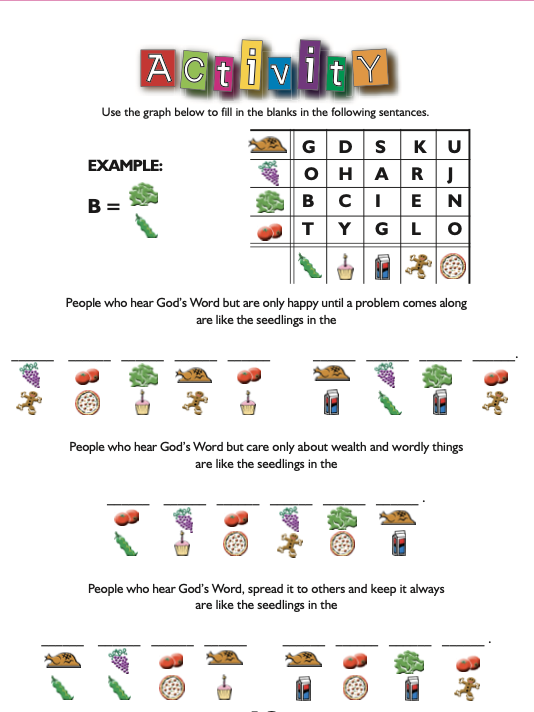
Capture the attention of the class and make the lesson extremely relevant by starting with the Activity.
Necessary Ingredients - Once the seeds are planted, talk about what is necessary to help them germinate and grow. List the necessary ingredients on a chalkboard or newsprint pad. Try to arrange their suggestions so that you can easily show the four different categories that Jesus talked about in the parable. (If the students have read the lesson in their student book, this should go quickly.)
Gardening Tips? The disciples realized that Jesus was not just giving them tips to help their gardens grow. A parable is a story that teaches a specific moral lesson. Jesus always began His parables by talking about something with which the people were familiar – like gardening. There were no grocery stores, so people grew their own food. Everyone knew how to plant and tend a garden. This parable had a much deeper meaning.
The Seed - Have one of the students read Luke 8:11 aloud. This parable is an analogy – a comparison of similar qualities. Here the seed is compared to the Word of God. It is God’s Word that teaches us that God is Supreme (above all). In God’s Word we are shown the way of salvation and to the Kingdom. God’s Word shows us how to live a life pleasing to God and full of joy. It is God’s Word that must germinate and grow within us.
Seeds On Hard Ground - The seeds that fell on the hard path were easy picking for the birds. They didn’t have a chance! Similarly, when God’s Word is heard by someone with a hard heart, it is easy picking for Satan. Proverbs 28:14 states people with hard, stubborn hearts will get into trouble. God’s Word doesn’t have a chance to take root! Satan is just waiting for a chance to snatch the seed away and destroy that life (1 Peter 5:8).
Rocky Ground - The seeds that fell on the rocky ground were warmed by the sun and sprouted quickly (Show the germinated seed. Discuss how this seed is not in soil. So, when the nutrients inside the seed are gone the plant will die.) Because the soil is shallow, the roots cannot develop like they should. There is no protection from the drying heat of the sun. Compare this to people who don’t have a faith strong in the Lord. They do not trust God when bad things happen in their lives.
Choking Weeds - Discuss how weeds in a garden are stronger than the young plants. They take in the moisture vital to the plants. Their roots intertwine around the roots of the tiny plant, literally choking it. The leaves of the weed block the sun and the poor plant can’t grow. Compare this to the relationship that we have with God. If we are so concerned about having a good time, making money, or worrying about our daily lives, then our relationship with God can’t grow – it is choked out!
Good Soil - Ask: What is essential to make soil good for planting seeds? Discuss how the soil must be prepared to receive the seed: softened (plowed), rocks removed, weeds pulled, watered, fed. When God’s Word enters a heart that has been prepared: softened and tender toward God, the cares of the world have been removed, and that heart daily feeds on God’s Word, it will take root and grow!
Persevere - A gardener cannot plant seeds one day and go out the next expecting to reap a harvest. He must have patience – he must persevere! If you are faithful in following God and His Word, you will be like a strong plant in God’s Kingdom as His child.
Review Questions
1. What does the seed in this parable represent?
2. What happened to the seed that was sown along the hard path?
3. What happens when God’s Word falls on a hard heart?
4. What happened to the seed that fell on the rocky soil? Why?
5. When God’s Word is not allowed to take root in your life what will happen?
6. Name some thorny weeds that can choke out God’s Word from your life.
7. What kind of heart should you have for God’s Word to grow in you?
Teacher-Directed Activity
Do the Activity at the beginning of the lesson.
Give each student a Styrofoam cup that has been prepared and two or three seeds to plant. Instruct them in the proper depth for planting (see seed packet). Show them how to sprinkle a little water in the cup with their fingers. Explain that the soil should be damp, do not over-water and drown the seed. Cover the cup with plastic wrap and secure with a rubber band to speed the germination process. Place the seeds in a warm spot. After the seed breaks through the ground, the plastic wrap can stay for a few days to provide a greenhouse effect.
REACH Activity
Word Study: Katecho (kat-ehk’-o)
In Luke 8:15 Jesus talks about the people who are the good seed. They keep the message they hear in their hearts—and produce a good harvest. This word “keep” is from the Greek “katecho,” meaning to hold down or hold fast.
Do you have a determination to grab hold of God and His ways and not let go for anything? Make it your goal to “katecho” God’s word in your heart!
*Word Study notes are taken from Spiros Zodhiates’ Hebrew-Greek KJV Key Word Study Bible and Lexicon.
Did You Know?
The mustard seed is not the smallest seed known today, but it was the smallest used by farmers and gardeners in the Holy Land at that time. Under favorable conditions, the mature plant could reach about ten feet in height. (Source: NIV Archaeological Study Bible, p. 1583.)
Music Notes: Higher Ground
This hymn is found on page 148 of the CEM Hymnal. The words were written by Johnson Oatman, Jr. (1856-1922). The music was composed by Charles H. Gabriel. The hymn “Higher Ground” was first published in 1898.
Johnson Oatman, Jr., was a businessman who wrote 3000 Gospel songs in his spare time. He was ordained by the Methodist Episcopal church, but was never a pastor. Although his hymns were well-liked, he was never paid more than a dollar for any of the texts!
Charles H. Gabriel was the music editor of the Rodeheaver Publishing Company. He wrote the music (and sometimes the texts) for more than 8000 Gospel songs. Many of these were especially popular in the Billy Sunday-Homer Rodeheaver campaigns from 1910-1920. “Higher Ground” was used often in the camp meetings during this time, and the singing of it would often be followed by shouts of “Glory, hallelujah!” (Source: Amazing Grace, Osbeck, K., p. 91.)
Journal Jot
The activity in the YEA book on page 18 helps you remember the different kinds of soil and what happens in each. As you are studying the YEA lesson, think about what kind of soil you are. Talk about the parable of the sower and the seed (Matthew 13:1-23) with your family. You may be surprised at which soil your parents feel they are most like. Write your ideas and conclusions in your Bible notebook.
Back to the Bible
Once a seed is planted in good soil, it takes time for it to take root and grow. Remember, it must have just the right amount of sun, water, and nutrients. A master gardener does not leave his garden untended to be ravaged by heat and drought. He does not let his growing plants go hungry. As your Master Gardener, God the Creator will not let you go untended or unwatched either. He wants a bountiful harvest at the end of the growing season. He needs you to be “rooted,” healthy, and strong. His word, the Bible, will give you just the right amount of what you need each day. Read, learn about, and know about His Son, Jesus Christ. When you are “thirsty” for help and don’t know what to do, Jesus will provide you with a drink of Living Water. When you are “hungry” and need food for strength to overcome a bad decision or sinful choice, the Bread of Life will feed you. The Son, the Water, and the Bread are in the Bible, the Word of God. While you are growing in your Christian life, learning the Bible by reading through it will keep you spiritually healthy and strong. The Bible has just the right amount of everything that you need to grow as a child of God. Growing a productive garden is a process that involves many steps and careful tending over time, but the result is a bountiful harvest for the Master Gardener. At the end of the growing season, you will be a part of the harvest: a child of the King, a part of God’s family.
Just Toolin’ Around
Using your Bible and Bible reference books, research what kind of garden tools were used in Bible times. In your Bible notebook, draw and label pictures of the tools. Are similar tools used in gardening today? Write the research information in your Bible notebook. Share with family or Sabbath School class.
Stretch It Out
Bible reading each day is important to your growth as a Christian. From this YEA lesson, choose at least seven words to get you started on a Bible study for the next week. To get you started, here are two: message and salvation. Use a Bible and a concordance to find and read Scriptures where these words are found. In your Bible notebook write the word and corresponding Scripture, as well as what you learned or thought of the Scriptures you read. Remember to pray each day that you will grow healthy and strong in God’s Word. And pray that these seven days of study will help you continue a daily Bible reading plan.
Questions?
Remember to write any questions that you have in your notebook. That way you will remember to ask your parents, teacher, or minister.
Song
“Let The Sunshine In” is on page 70 of the Kids Classics Collection.
Closing Prayer
Lead the students to ask that God make their hearts like the good soil and produce a bountiful harvest for Him. Encourage them to thank Him for His daily guidance.
Printable Pages