YE3B.1 · Activity Page
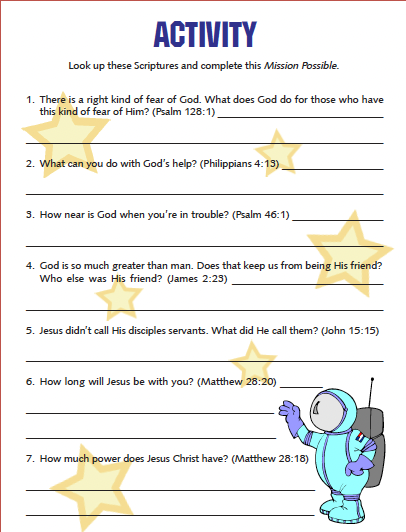
1 Samuel 18:1-5
Proverbs 18:24
Isaiah 41:10-13
Matthew 5:23-26
Matthew 8:23-27
Matthew 28:18-20
Mark 4:35-41
Luke 8:22-25
Hebrews 2:11
1 John 4:21
SEISMOLOGIST - a scientist who studies earthquakes
ACCESSIBLE - can be easily approached or obtained
Dark clouds roll in, turning the sky black enough for streetlights to come on in the middle of the day. Storm spotters are called out to watch for tornados. The winds become increasingly stronger and small craft on a lake are dangerously tossed about. Warnings go out for these boats to get off the lake. People in certain parts of the
country head for storm shelters. Times like this can get downright scary! You need to know God is near.
Storms are not uncommon on the Sea of Galilee. It is surrounded by hills. The wind currents rise up over the tops and down the sides of the hills, whipping up waves and thunderstorms. They appear suddenly and without warning. Jesus’ disciples experienced a storm such as this one day as they tried to cross the Sea of Galilee. They couldn’t watch the Weather Channel to see that a storm was approaching. But Jesus told them to go across the lake and they did what He said.
Jesus put His head on a cushion and fell asleep as the terrible storm came up. The waves got higher and higher, splashing water into the boat. The disciples became increasingly concerned the boat would sink. By this time they were frantic, but Jesus slept on.
As they reached the point of desperation they awakened Jesus saying, “Teacher, don’t you even care that we are all about to drown?”
Jesus answered, “O you men of little faith! Why are you so frightened?” He rebuked the wind and said, “Quiet down.” Everything became very calm as the winds quieted down.
Since Jesus was in the boat with His disciples, He must have been a little disappointed with their lack of faith. Didn’t they know that He made the winds and the rain? He asked them why they were so afraid when He was right there in the boat with them. Do you think they looked a little sheepish? How would you have felt?
Though they may have been embarrassed, they were still filled with awe at Jesus’ power. They privately began to ask each other, “Who is this Man, that even the winds and seas obey Him?” These men had been with Jesus for some time now. Didn’t they know who He was? Had they forgotten about His miracle-working power? They didn’t seem to recognize that this Man was their Messiah. He created the world and certainly had the power to calm a storm. He has all power!
An earthquake can destroy an entire city. Hurricanes or tornados can pick up houses and smash them. News programs can warn you of approaching storms because they have equipment and experts to detect what kind of weather is coming. Sirens may sound in your town to warn that a tornado has been spotted. If this happens, you should take shelter immediately. But, a weather man can only give you information about the weather, he is powerless to change it. In the same way, a seismologist can’t stop an earthquake from happening.
Just as Jesus calmed the storm and saved the disciples when they were endangered, He is there to protect you as well. He loves you and wants what is best for you. Even though you can’t see Him in the boat with you or beside you, He is there with you wherever you may be. His power is just as great today as when He calmed the storm on the Sea of Galilee. He’s just as accessible for you as He was for the disciples in the boat.
Jesus wants to be your Friend. And like a friend, He is willing to help you when you are in need. He will not make fun of you or scold you. You can count on Him! Just as the disciples had to ask for His help, you, too, should take your problems to Him in prayer. Does knowing that Jesus has the power to quiet any storm make you feel safer?
Jesus lived in a very natural world, as you do. He has power over nature. God gave it to Him. He is a Friend that sticks closer than a brother. Whether you’re in a storm, an earthquake, or just in trouble, Jesus is your Friend and He is there to help you.
Dear loving Father,
Thank you for reassuring me that you are always here when I am afraid. You are with me just as you were with the disciples in the storm on the Sea of Galilee. Help me remember to always ask for your help and protection. Knowing you are near makes me feel so much better.
It’s in Jesus’ name I pray.
Amen.
Sunday - Matthew 8:23-27
Monday - 1 John 4:21
Tuesday - Hebrews 2:11
Wednesday - Matthew 5:23-26
Thursday - 1 Samuel 18:1-5
Friday - Matthew 28:18-20
Saturday - Isaiah 41:10-13
Matthew 7:7-11
Matthew 14:15-21
Matthew 15:32-39
Mark 6:34-44
Mark 8:1-9
Luke 9:11-17
John 6:1-13
John 6:35
PHYSICAL - something you can touch or see
SPIRITUAL - having to do with the spirit world; i.e., God, the things of God
NECESSITY - something we need to survive
Have you ever been really hungry? Not the kind of hunger when it’s ten minutes before lunch time and you would really like the math lesson to be over. Or when you’ve just seen a candy bar commercial on TV. The hunger that comes when you’ve worked hard and missed a couple of meals. If you’ve fasted on the Day of Atonement, you know what I mean. It’s the hunger you get about 3:00 in the afternoon, when there are several hours of fasting left. This kind of hunger shows how important food is to keep your body going. We call food a necessity.
One day Jesus performed a miracle because people were hungry. A large crowd came to hear Him teaching. When it was time to eat, Jesus asked His disciples where they could get enough bread. To buy enough for everyone to have just one bite would cost more than eight months wages, Philip said. There were about 5000 men, plus women and children. Then Andrew said something that sounded pretty silly, since many people needed to eat. He said, “Here is a boy with five small barley loaves and two small fish, but how far will they go among so many?” At least Andrew knew that normally this small amount wouldn’t feed many people. But Jesus took the loaves, gave thanks to God, and gave each person as much as he or she wanted. He did the same thing with the fish. When everyone had eaten, the disciples gathered enough leftover pieces to fill 12 baskets. It was truly a miracle!
We don’t know why all those people were there. Maybe they wanted Jesus to heal them. Perhaps they wanted to hear what He had to say, or were just curious about who He was. For whatever reason they were there, Jesus had compassion on them. They needed something to eat and Jesus performed a miracle to feed them. We know that our God is merciful and loving. Does that mean He always provides food for people to eat? There are famines. Why?
There’s a clue to the answer in Matthew 6:33. “But seek first his kingdom and his righteousness, and all these things will be given to you as well.” What was Christ talking about in this Scripture? Matthew 6:25 says, “Therefore I tell you, do not worry about your life, what you will eat or drink; or about your body, what you will wear.” Food is one of the things referred to in Matthew 6:33. We need to learn to do God’s will and to behave as His children should, and then He will provide everything we need.
In Matthew 7:9-11, Jesus says, “Which of you, if his son asks for bread, will give him a stone? Or if he asks for a fish, will give him a snake? If you, then, though you are evil, know how to give good gifts to your children, how much more will your Father in heaven give good gifts to those who ask him!” Our God is loving and merciful. He knows we need food, something to drink, clothes, and other necessities.
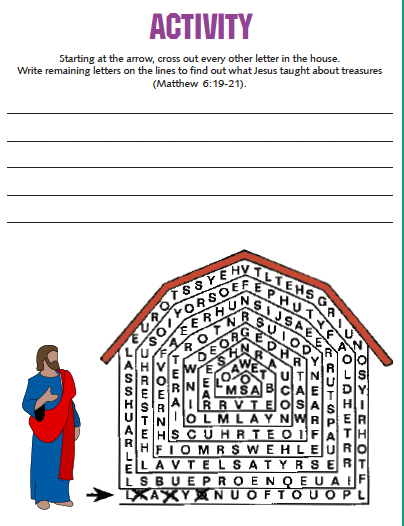
Another time, Jesus told a large crowd to look at how God provides for the birds. They don’t plant gardens or store things in barns, but He feeds them. As long as we are seeking God and trying to do His will, He will take care of us. He really is interested in getting each of us into His Kingdom. Our spiritual well-being is much more important to Him than our physical well-being. That’s exactly what Jesus was talking about when He said, “Do not store up for yourselves treasures on earth. . . but store up for yourselves treasures in heaven. . . For where your treasure is, there your heart will be also” (Matthew 6:19-21).
What kind of treasures was Christ talking about? Think of something you really, really want. Maybe an Xbox game or an iPod. Things we want, but don’t really need, can focus our attention on earthly, physical things. Toys, games, clothes, and other things are not very important compared to what God wants for us. He wants us to spend eternity with Him. To do that, we need to be concerned with things that matter to God. The physical things that concern us aren’t nearly as important as we think.
Don’t think food isn’t important to God. Jesus told His disciples to gather up all the leftover pieces. The food shouldn’t be taken for granted or wasted even if it was created by a miracle. How we take care of physical things shows God what we’ll do with more important things.
So, the next time you want something, ask yourself if it’s really that important. Ask yourself if Jesus thought it was important when He was your age. And, the next time you really need something, don’t waste your time worrying about whether you’ll get it. Just ask your Heavenly Father for whatever it is you need. In the meantime, read your Bible and take time to pray. Remember, as much as God cares about your physical needs, He cares about your spiritual needs even more. He really wants to spend eternity with you!
Dear Heavenly Father,
Please help me to know the difference between what I want and what I need. Help me to truly understand that what you have planned for me is much better than I can ever imagine. I want to seek you, but I need your help.
In the name of your Son, Jesus Christ.
Amen.
Sunday - Luke 9:11-17
Monday - Matthew 14:15-21
Tuesday - Mark 6:34-39
Wednesday - John 6:5-14
Thursday - Matthew 15:32-39
Friday - Mark 8:1-9
Saturday - Mark 6:40-44

Matthew 4:23
Matthew 4:23-25
Matthew 8:14-17
Matthew 9:20-22
Matthew 9:27-31
Matthew 12:9-14
Mark 1:34
Mark 7:31-37
Luke 5:17-26
John 5:1-9
2 Corinthians 12:7-10
LEUKEMIA - cancer of the bone marrow characterized by an abnormal increase in white blood cells
ASTHMA - disease of the respiratory system, resulting in difficulty breathing
SYNAGOGUE - Jewish place of worship
PARALYZED - unable to move some or all of the body because of spinal injury
LEPROSY - severe disease of the skin
Have you ever noticed how much pain and suffering there is in this world? Perhaps you have had more than your share of bruises and scrapes. Maybe you’ve sprained an ankle or broken a bone. These are usually pretty small injuries compared to the pain some people have. Many children have cancer, leukemia, or asthma. Some of them probably won’t live very long. There really is a great deal of pain in this world.
When Jesus walked the earth, He saw much pain and suffering too. But He could do something about it. Matthew 4:23-24 tells us that as Jesus went throughout Galilee, He taught in the synagogues, preaching the good news of the Kingdom. He also could be found healing people of sickness and disease. News about Him spread all over Syria. People began bringing those who had various diseases. Because Jesus felt compassion for the sick, He healed them.
Matthew, Mark, Luke, and John all tell about the wonderful miracles of healing that Jesus performed. Matthew 20:29-34 tells about two blind men who received their sight. Mark 1:40-42 tells about a man being healed of leprosy. Luke 22:49-51 tells about Jesus healing the ear of the servant of the High Priest when the soldiers came to arrest Jesus. John 11:38-44 tells about Jesus healing Lazarus. He had been dead for three days!
In most cases, Jesus said something about faith. It was important for the person to believe Jesus could heal them. A woman had been bleeding for 12 years. She believed if she could just touch the hem of Jesus’ robe, she would be healed. When she touched it, she was! Jesus told her, “Your faith has healed you” (Matthew 9:20-22).
Sometimes it may not be God’s will to heal a person in this life. The Apostle Paul wrote, “To keep me from becoming conceited because of these surpassingly great revelations, there was given me a thorn in my flesh, a messenger of Satan, to torment me. Three times I pleaded with the Lord to take it away from me. But He said to me, ‘My grace is sufficient for you, for my power is made perfect in weakness’” (2 Corinthians 12:7-10). No one could accuse Paul of not believing God could heal him. Paul knew God was more concerned about spiritual health than physical health. Physical health only lasts as long as we live in these bodies. Spiritual health is vital if we are going to spend eternity with God—to live forever.
God always keeps His promises, but may not do it when we expect. The Book of James says, “. . . the prayer of faith shall save the sick, and the Lord shall raise him up.” Many faithful people who did not receive their promise in this life are listed in the Book of Hebrews. These people of God were more concerned with their spiritual health than receiving a temporary reward.
The story of the paralyzed man shows God is concerned about spiritual health. This man couldn’t walk and had to be carried to Jesus on a mat. Jesus didn’t say he was healed. Jesus said his sins were forgiven. That’s a very strange thing to say. The man wanted physical healing. The man could walk, but Jesus did something much more important. Jesus healed the man spiritually, by forgiving his sins (Luke 5:17-26).
Sins make people sick spiritually. This world does not choose God’s way of living. People do not follow God’s Laws. They are spiritually sick. Jesus told the Pharisees that He had come to heal the spiritually sick, the sinners. Spiritual healing is so important because without it no one will be allowed to enter God’s Kingdom. And we certainly want to live in God’s Kingdom with Jesus Christ.
So, the next time you ask God to heal you, remember these three things: 1) You must believe that God has the power to heal you. 2) You must truly want God’s will to be done, even if it means you aren’t healed in this life. 3) Even though our bodies only last for this life, God heals our physical illnesses. And He heals us of spiritual illnesses so that we can live for all eternity with Him. Our God is truly an awesome God!
Dear Heavenly Father,
I know that you love and care about me. You want me to be well and happy. Father, please show me your ways and heal me spiritually that I may always dwell with you.
In Jesus’ name I pray.
Amen.
Sunday - Matthew 8:14-17
Monday - Matthew 4:23-25
Tuesday - Mark 1:34
Wednesday - John 5:1-9
Thursday - Matthew 12:9-14
Friday - Matthew 9:27-31
Saturday - Mark 7:31-37
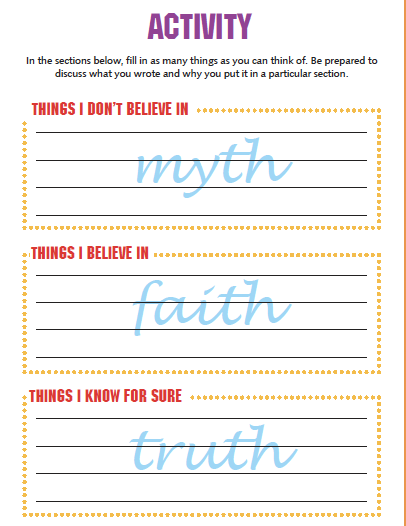
Isaiah 40:1-8
Matthew 3:1-17
Matthew 14:1-12
Mark 1:1-4
Luke 1:5-17
Luke 3:1-20
Luke 9:7-9
John 1:19-28
John 7:6-10
1 Peter 3:15-16
CREDENTIALS - certificate showing one’s right to a certain position or authority
EXTORT - pressure people into giving money, usually with threats
THE GREAT COMMISSION - to preach the Gospel throughout the world
TUNIC - shirt
Before a president, king, or queen comes into a room for a public appearance, they are announced. Even speakers at conventions have someone to announce them. The person making the introduction may give information about the speaker. He may tell about his credentials, education, experience, or perhaps books he has written. All these things prepare the way for the important person or speaker to do his job.
John the Baptist was born for a very special purpose. The angel, Gabriel, told John’s father that John would bring him much joy. Many people would be blessed through John. He would cause many to come back to serving the Lord. John would be a great man in God’s sight. He would have power like Elijah, and would turn many hearts back to doing what was right. (Luke 1:14-17). It was John’s responsibility to prepare the way for Jesus Christ. He had the awesome job of declaring that Jesus Christ, the Son of God, came into the world to save it!
John carried out his mission. Luke 3 says John preached a baptism of repentance for the forgiveness of sins. He baptized people in the Jordan River. He told the people that being Abraham’s descendants didn’t mean they could ignore the ways of God. Then he gave some examples. He told the man who had two tunics that he should share with a man who didn’t have any. He told a man who had plenty of food that he should share with those who didn’t have anything to eat (Luke 3:11). He told the tax collectors not to collect more money than they were required. He told the soldiers not to falsely accuse people or extort money from them. He also told Herod, the ruler of the country, that he was wrong for living with his brother’s wife, Herodias. So Herod put John into prison.
Most of us don’t like to be told we are wrong. Herod didn’t like John telling him he was wrong either. In fact, he wanted to kill John, but was afraid of what people would think. So John stayed in prison. On Herod’s birthday, Herodias’ daughter danced so well for him that he promised to give her anything she asked. She asked for the head of John the Baptist on a platter. Because Herod had promised, he had John’s head cut off!
God gave John the Baptist a very important job. John knew his job was so important that he was willing to die for it. God has given us a job to do, too—to be a light and an example to those we see each day. We’re also supposed to tell the world the truth about Jesus and the ways of God. It’s called “The Great Commission.”
Speaking the truth, especially the truth of God, may not be very popular with people around you. In fact, some may not take it very well when told about God’s way. People don’t like to hear they are wrong. They especially don’t like to be told they are wrong if it is not done with a respectful and gentle attitude. So whatever truth God has given to you needs to be shared in a positive, respectful way—when someone asks. Peter tells us, “Always be prepared to give an answer to everyone who asks you to give the reason for the hope that you have. But do this with gentleness and respect” (1 Peter 3:15-16a).
One of the best ways to share the truth of God is through your actions. What you do says more about what you believe. Your example can cause people to ask you questions, those questions that Peter tells us to be prepared to answer.
Another way you can share the truth of God is by inviting your friends to Sabbath School and to Sabbath services. You may want to start by inviting them to a lock-in for kids or to another church activity. Sabbath School classes are a fun way to learn about God. So, by inviting your friends, you can share the fun with them.
John the Baptist came to prepare the way for Christ’s first coming. Another prophet will come before His second coming. Jesus went to heaven to prepare a place for us. He promises to come again for those who are ready. Every day we must share God’s truths with others and prepare ourselves for Christ to return.
John the Baptist had a very important job to do—to proclaim that Jesus Christ was coming. And we each have an important job to do as well—to tell people about Jesus Christ, God’s way, and Jesus’ return. May we “dare to be a Daniel, dare to stand alone; dare to have a purpose firm, dare to make it known.” When someone asks you about your Christian beliefs, don’t worry about not knowing what to say at the right time. Jesus told His disciples that they were not to worry about what to say—the Holy Spirit would give them the right words.
Dear Heavenly Father,
Thank you for opening our eyes to see the truth that you’ve shown us. Help us to share that truth with others in a respectful and gentle way, according to your will. Please give us the right words to say so that others will come to know you.
In the name of your Son, Jesus Christ.
Amen.
Sunday - Luke 9:7-9
Monday - Matthew 3:1-6
Tuesday - Matthew 3:7-17
Wednesday - Mark 1:1-4
Thursday - John 7:6-10
Friday - John 1:19-28
Saturday - Isaiah 40:1-8
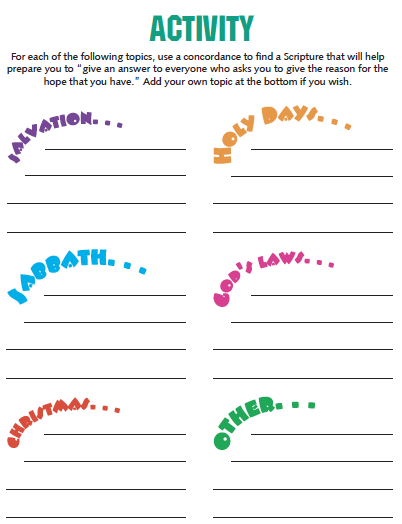
Matthew 6:12
Luke 6:35-38
Luke 7:36-50
Luke 7:47
Luke 18:9-14
Ephesians 4:23-32
Colossians 3:12-13
1 John 1:8-9
DENARII - a coin worth about a day’s wages
HUMBLE - not being proud or confident and cocky before God
REMORSEFUL - being sorry for what you’ve done
REPENTANT - being sorry for doing wrong and changing the behavior
Last week in school, one teacher assigned a rather large project. It was due on Friday. When Friday came, two girls were not finished. One had a tiny thing left to do. The other had not completed much of it. Yet both students were truly sorry they had not done the project. Seeing how badly they felt about the project, their teacher forgave them and didn’t call their parents as she had planned. Which of the two students was more grateful?
Allen and John were supposed to come straight home from school. They had chores to do before company came that evening. Allen diligently accomplished everything he was supposed to—except to change the water in the dog’s dish. John was distracted by his friends after school. He completely forgot all the chores he was supposed to do and got home just as company arrived. He was very sorry that he forgot. He felt badly for not helping the family prepare for visitors. When his parents saw John’s attitude, they forgave him and didn’t ground him as they had planned.
Jesus also encountered some people who followed the commandments better than others. One day Jesus went to eat at Simon’s house. He was a Pharisee. The Pharisees were known for their extreme care in following the Oral Law. They were very proud of how well they kept the law. So when a sinful woman came in, Simon felt he was better than she. The woman began washing Jesus’ feet with her tears. She dried His feet with her hair, and poured perfume on His feet. Simon couldn’t stand it! He couldn’t understand why Jesus would allow such a woman to touch Him. Jesus told Simon a parable: Two men owed money to a certain moneylender. One owed him 500 denarii, and the other 50. Neither had money to pay him back, so he canceled both debts. Which of them would love him more? Simon understood that the person who had the bigger debt canceled would love the moneylender more. Jesus let Simon know it is the same with sins and God’s attitude toward sinners.
Remember our stories earlier in this lesson? Both girls were sorry for not completing the project and both were forgiven by their teacher. Both Allen and John neglected something. John forgot all of his chores; Allen only forgot a minor chore. John deserved to be punished, but he showed a very repentant attitude. His parents forgave him and didn’t ground him. Do you think John will forget next time? His parents’ decision not to ground him demonstrated their love for him. And, because he saw their love, he loves them back even more.
Imagine this happened: Allen’s parents reminded him about the water dish and he responded, “At least I did most of my chores.” He wasn’t sorry he’d forgotten. He felt it wasn’t nearly as important as all the things John had forgotten. Can you imagine what his parents would say to him?
It’s the same with Jesus and God. We have all sinned. We all fail to completely and perfectly do God’s will. But when we come before God with a humble, remorseful heart, He has promised to forgive us. We must never come before God with the wrong attitude, thinking what we’ve done isn’t as bad as what someone else has done.
Look at Jesus’ parable in Luke 18:9-14 for people who compare themselves with others. A tax collector and a Pharisee were praying in the Temple. The Pharisee was very thankful he wasn’t a sinner like the tax collector. Jesus certainly wasn’t pleased with the Pharisee comparing himself to the tax collector. What did please Jesus was the repentant attitude of the tax collector. He humbly prayed, “God have mercy on me, a sinner.”
The next time you do something wrong, or just don’t do what you should, confess it to God. Don’t worry, if you are truly sorry, God will know and He will forgive you. God really, truly loves you. Just knowing that God loves you and has forgiven you will help you love God more. Then, the next time you are tempted to do wrong, your love for God will help you make a better decision.
Dear Heavenly Father,
I know I don’t always make the best choices . Help me to understand why I should choose your way. Give me the strength and courage to choose your way even when it’s hard. Thank you for promising to forgive me when I am truly sorry and ask for your forgiveness. And most of all, thank you for your love for me.
In the name of your Son, Jesus Christ.
Amen.
Sunday - 1 John 1:9
Monday - Luke 7:36-42
Tuesday - Luke 7:43-50
Wednesday - Luke 6:35-38
Thursday - Matthew 6:12
Friday - Colossians 3:12-13
Saturday - Ephesians 4:23-32

Leviticus 19:15-18
Matthew 10:16, 40-42
Mark 12:28-31
Luke 6:30-36
Luke 10:25-37
Luke 10:27
James 1:21-27
James 2:19-26
1 Peter 3:15
SAMARITAN - person from Samaria; there was open hostility between Jews and Samaritans at the time of Jesus’ parable
DESCENT - going downhill; moving to a lower elevation
MALICIOUS - intending harm
When you think about your neighbors, who do you include? The kids who get on the school bus with you each day? Or, are the people who live on your block your only neighbors? Maybe you think the kids you attend church with and enjoy sharing fun activities with at a lock-in are your neighbors. If you live in the country, you may think all the people who live within a mile or two of your house are your neighbors. Do you think of people who are a different race, color, or religion as your neighbors? The Bible has something to say about who your neighbors are. An expert in the law asked Jesus a question that leads us to the answer.
One day, an expert in the law asked Jesus what he had to do to inherit eternal life. Jesus asked him what the law said. He answered, “Love the Lord your God with all your heart and with all your soul and with all your strength and with all your mind, and love your neighbor as yourself.” Jesus told him that was exactly what the law said. Jesus told the man to Just Do It! Jesus wanted to see by his actions that he loved Jesus as his neighbor. He was telling the man he should love God first, but he should also love his neighbor as much as he loved himself. The law expert asked the question, “Who is my neighbor?” Jesus answered by telling this story. We know it as the parable of the Good Samaritan.
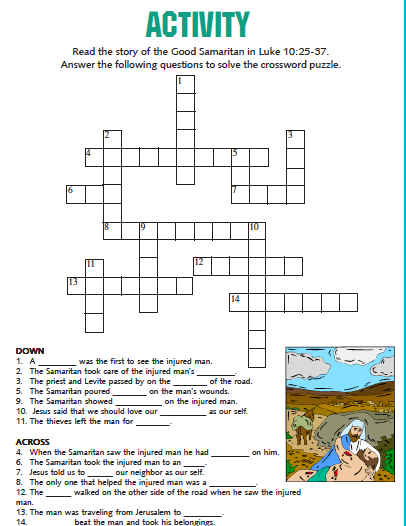
A man traveled from Jerusalem to Jericho. Jerusalem sits in the hills and Jericho is on the plains. It is quite a descent through rocky, dangerous territory. There are many places for ban- dits and thieves to hide, waiting to ambush whoever comes along. That is what happened to this man. Thieves beat him up, took his belongings, and left him for dead. Soon a priest came along. When he saw the man, he walked on the other side of the road to avoid him. Next, a Levite came by—he did the same thing.
You would expect a priest and a Levite who work in the Temple to help a man who has been injured. But they didn’t want to get involved. Thankfully, a Samaritan also traveled down the same road on that day. When he saw the injured man, he felt sorry for him. He bandaged the man’s wounds as best he could out on the road. He took the man to an inn and cared for him. When the Samaritan left, he paid the innkeeper to care for him until the man could care for himself. Also, the Samaritan told the innkeeper that if the money wasn’t enough, he would pay the rest of the bill when he came back.
The law expert understood that the Samaritan was the man’s neighbor. That doesn’t mean much today unless we understand that Samaritans were not well-liked by Jews because they were a different race. Jesus told this parable to make it clear that your neighbor isn’t just the person next door, or someone of the same race, or someone you like. Our neighbors include all people who need our help when we can give it.
Helping people today can be a scary thing. Many evil and malicious people wouldn’t think twice about hurting children or adults. You have probably heard about people being killed or beaten when they only stopped to help. You know your parents don’t pick up hitchhikers. You know not to talk to strangers and, when you answer the phone, you shouldn’t tell people you’re home alone. In your world, there are many things that can hurt you. So, how do you “love your neighbor as yourself,” as Jesus says?
Jesus told His disciples, “I am sending you out like sheep among wolves. Therefore be as shrewd as snakes and as innocent as doves” (Matthew 10:16). Jesus knew this world was a dangerous place for His disciples. He cautions us to think before we act. Thankfully, we have God’s Holy Spirit to help guide us. We can always pray for God’s help and protection.
But, what does all this mean to you in the situations you encounter? What happens if you see someone who really needs help? What if you see a person who is obviously injured? How are you a neighbor to people around you? First, don’t put yourself in a position where you could be in danger. You can help in other ways. Tell a parent or teacher. Call an adult friend of the family. If you feel it’s necessary, call the police.
Think of an important way you can help others. How many people around you don’t know Jesus as they should? They need some spiritual help. How can you be a neighbor? First, pray for them. Then, “always be prepared to give an answer to everyone who asks you to give the reason for the hope that you have” (1Peter 3:15). That means to study your Bible, listen to sermons, and ask questions. Make sure you know why you believe what you believe. Be prepared to share your love for God with others. Also, be ready to answer anyone who asks why you worship God as you do—not celebrating Christmas or Easter, but keeping God’s holy days.
Remember that more people will see how you live your life than will ever listen to your reasons for keeping the Sabbath and holy days. You’ve heard, “Actions speak louder than words.” If you are patient, kind, and caring, others will see Jesus in you. If someone on your block is sick, bake some cookies for them. If you don’t know them well, get your mom or dad to go with you. Send a card or note to kids in your Sabbath School class who are sick. Use your head and you can think of many ways to be a good Samaritan. This is what Jesus meant when He told the expert in the law to Just Do It! If you do help someone spiritually or physically, you are undoubtedly a good Samaritan.
Sunday - Luke 10:25-37
Monday - Leviticus 19:15-18
Tuesday - Matthew 10:40-42
Wednesday - Luke 6:30-36
Thursday - James 2:19-26
Friday - Mark 12:28-31
Saturday - James 1:21-27
Matthew 6:19-24
Matthew 6:20-21
Matthew 6:33-34
Matthew 13:44-52
Matthew 19:16-21
Mark 10:17-23
Luke 12:13-34
Luke 14:14
1 Corinthians 2:9-16
1 John 5:3
GREEDY - having an excessive desire for wealth, profit, or something that is wrong
INHERITANCE - come into legal possession of something upon the death of another
CONSEQUENCES - results of your actions
SOPHISTICATED - more mature, more complex
POSSESSION - something that you own or have
Do you have a younger brother or sister, or have you done some babysitting? Have you noticed that a three-year-old child lives only for right now? When a three-year-old is hungry, he wants to be fed right now! When he has to go to the bathroom, look for one immediately. And a three-year-old wants all the toys. Perhaps you’ve heard a child loudly pronounce, “Mine!” when someone picked up his toy. When the child wants candy or cookies, he doesn’t just want one. Older folks know that you can’t just hand him the bag of candy or the cookie jar. He’ll eat them all—not thinking of the consequences to his stomach later.
But, don’t make fun, because you do the same thing, you’re just more sophisticated in your wants and desires. New clothes, a CD player, a new bike, maybe a cell phone—the list can be quite long. But you’re not the only one who wants physical possessions. Think of all the car commercials. Who buys cars? Not kids! Adults have lists of wants like everyone else. And it’s been this way for a very long time.
One day someone in the crowd said to Jesus, “Tell my brother to divide the inheritance with me”(Luke 12:13). Here was a person very concerned about getting money! It wasn’t necessarily money that he had done anything to earn; it was an inheritance because someone had died. He was concerned about getting his fair share.
Jesus told him to be careful of being too greedy and told the parable of the rich man. He grew such large crops his barns couldn’t hold them. So he built bigger barns to store up all his wealth so he could take it easy. But God told him he would die that very night. All the wealth he had stored wouldn’t help him at all. He certainly wouldn’t care about it once he was dead. Then Christ said, “This is how it will be with anyone who stores up things for himself but is not rich toward God.”
Think about that! Nothing on earth is more important than our relationship with God. That’s why Christ said, “Do not store up for yourselves treasures on earth, where moth and rust destroy, and where thieves break in and steal” (Matthew 6:19). Can you think of a possession that can’t be destroyed or stolen? All of the ones that we are able to touch can be broken or stolen.
Remember the three-year-old who would eat all the cookies or candy? Sometimes the things we think we want can really hurt us. We don’t know they will hurt us; we just want them. But God knows. He has much better things for us. He has our best interests at heart.
Don’t misunderstand. God doesn’t say you can’t have nice things or want possessions. He is saying it’s easy to get caught up in money or possessions. If our whole focus is on getting, then we’re just like the rich man who had so much, but died that very night. Don’t spend all of your time trying to get more things. Christ tells us that there’s something better to work for.
“But store up for yourselves treasures in heaven, where moth and rust do not destroy, and where thieves do not break in and steal. For where your treasure is, there your heart will be also” (Matthew 6:20-21). How do you store up for yourself treasures in heaven? Start by loving God. Paul tells us that our eyes have not seen, nor can we even imagine what God is preparing for the people who love Him. And, we can show God that we love Him by giving to Him and keeping His commandments.
Read your Bible. Find out how God wants you to act. Listen to the sermons and ask questions of your parents, Sabbath School teacher, and pastor. Ask God to show you what He wants you to do. Do your very best to please God—because you love Him. That’s storing up treasures in heaven!
One thing that pleases God is to give back to Him a tenth of our increase. This means that we give God back a dime out of every dollar we earn or get as allowance. Malachi 3:19 says, “Bring all the tithes into the storehouse so that there will be food enough in my Temple; if you do, I will open up the windows of heaven for you and pour out a blessing so great you won’t have room enough to take it in!”
When we seek God first, He blesses us. He promises to take care of those who love Him and do His will. He will make sure you have what you need. But remember, what you need isn’t necessarily what you want.
The choice is yours. You can work for treasures on this earth, but they are like clumps of dirt. The treasures God has for us are like diamonds. Which are you going to choose? Clumps of dirt or diamonds? Choose wisely. Choose life. Choose diamonds. Choose God!
Dear Heavenly Father,
There are many treasures in this world that look desirable to me. Help me see that they are only temporary. They won’t last. Help me learn to seek you and to build a relationship with you that will last forever.
In Jesus’ name I pray.
Amen.
Sunday - Matthew 6:19-21
Monday - Matthew 19:16-21
Tuesday - Luke 14:14
Wednesday - 1 Corinthians 2:9-16
Thursday - Luke 12:31-34
Friday - Matthew 13:44-52
Saturday - Mark 10:17-23
Deuteronomy 32:4
Psalm 19:7
Matthew 5:48
Matthew 7:1-5
Mark 12:41-44
Luke 6:37
Luke 6:37-38
Luke 18:9-14
Romans 14:4
1 Corinthians 6:1-10
CONDEMN - to disapprove of someone as unfit or guilty
JUSTIFIED - having been made right with God
PHARISEE - someone outwardly diligent in keeping the Oral Law
POVERTY - very poor
TAX COLLECTOR - looked on in Jesus’ day as a sinful person
One day Jesus entered the Temple and sat opposite from where people placed offerings. He watched the people putting money into the Temple treasury. Some rich people called attention to themselves and threw in large amounts of money. One poor widow humbly put in two very small copper coins. They were worth only a fraction of a penny. Jesus called His disciples to him and said, “I tell you the truth, this poor widow has put more into the treasury than all the others. They all gave out of their wealth; but she, out of her poverty, putting in everything— all she had to live on” (Mark 12:43-44).
Can you imagine the disciples watching the people with Jesus? All anyone could see were the amounts people gave. Do you think some- one watching might have thought that the widow’s offering was too small to notice? Jesus very clearly tells us that she put in more than anyone because she gave all of her money! Knowing that detail helps us understand. It probably helped Christ’s disciples to also think more highly of that poor widow.
That should make you think. How often do you judge someone only by what you can see? Think about the noisy boy who is always in trouble at school. Do you ever wonder why he behaves that way? Think about the student in class who is really smart. He or she always gets an A on the test. Do you ever wonder if he or she works as hard as you do on assignments?
The truth is that God created people to be different from one another. Each person is unique and special in God’s sight. We are all different because of our ages, our abilities, and the things we are struggling to learn.
Have you ever been around when a child ties his shoe for the first time? Adults go crazy praising him! Would they praise you for tying your shoe? Of course not! They know you’re way beyond that. You struggle with much more difficult things. If you have trouble learning multiplication and you finally remember that 7x7 is 49, your teacher and parents will praise you for getting it. But will anyone praise the principal of your school for knowing what 7x7 is? Of course not! Your principal learned that many years ago. There are much more difficult things for your principal to know.
Because God has made us all different, we should never compare ourselves to others. You wouldn’t compare your abilities to those of your teacher. And you shouldn’t compare your abilities to anyone else’s—no matter if you think you’re better or worse. You don’t know how difficult it may be for that person to learn. And you don’t know all the facts (remember the widow?). It’s not fair to compare.
Jesus was adamant about not comparing. He tells us that we should not judge other people. Because if we do, we will be judged in the same way. Often when you compare yourself to others you end up looking down on someone because they’re doing something wrong. Sometimes you look down on them because you think you can do it better. But you don’t know all the facts. It’s not fair to judge, or compare, and it’s not fair to look down on someone else.
Jesus gave the following parable to some people who thought they were better than everyone else: “Two men went up to the temple to pray, one a Pharisee and the other a tax collector. The Pharisee stood up and prayed about himself: ‘God, I thank you that I am not like other men—robbers, evildoers, adulterers—or even like this tax collector. I fast twice a week and give a tenth of all I get.’ But the tax collector stood at a distance. He would not even look up to heaven, but beat his breast and said, ‘God, have mercy on me, a sinner.’ I tell you that this man, rather than the other, went home justified before God.”
Jesus was showing them it is not fair to com- pare ourselves to others. We can’t judge other people. No one is perfect, including you! There is a problem with comparing yourself to someone else and looking down on them. It’s your attitude. The Pharisee forgot the things he did wrong because he was so busy comparing himself to the tax collector. When we go before God we have to realize that we don’t always do the things that we should. There is no room for us to judge anyone else. None of us is perfect yet. God is the only one qualified to judge. God alone is perfect!
So, does that mean you shouldn’t judge actions? No, not at all. Stealing is wrong, and it’s good for you to say that it is wrong. Lying, cheat- ing, hurting people—all those actions are wrong. God gave us His Law. Breaking God’s Law is sin. It is wrong. So condemn the action, but don’t look down on the person. God isn’t finished with him yet. And, thankfully, God isn’t finished with you or me yet either! We are Not Yet Perfect.
Dear Heavenly Father,
I know I don’t always do the things I should. Help me remember not to look down on or compare myself to others. Help me remember that you created us to be different and special to you. Thank you for your love and mercy for me.
In Jesus’ name I pray.
Amen.
Sunday - Matthew 7:1-5
Monday - Luke 6:37,38
Tuesday - 1 Corinthians 6:1-10
Wednesday - Romans 14:4
Thursday - Matthew 5:48
Friday - Psalm 19:7
Saturday - Deuteronomy 32:4

Deuteronomy 4:29
Psalm 5:1-8
Proverbs 14:7-12
Isaiah 35:8-10
Matthew 7:13-14
Luke 13:24-30
John 10:9-11
John 14:6
1 Timothy 2:4
James 1:12
2 Peter 3:9
Revelation 3:20-22
Revelation 7:9
Revelation 21:3-4
DESTRUCTION - in this usage, eternal death
REPENTANT - sorry for sinful actions or thoughts, and willing to change to follow God’s way
SACRIFICE - Christ’s death for each of us in payment for our sins
SALVATION - redemption from death, eternally living with God in His Kingdom
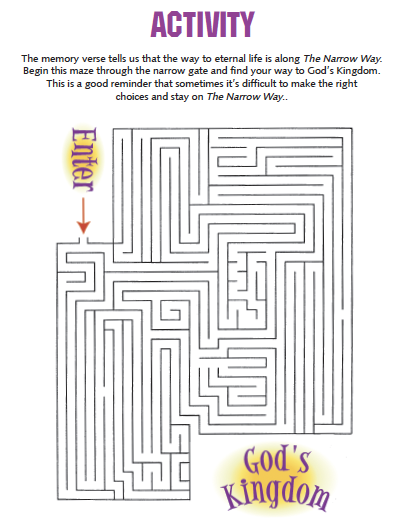
Most people enjoy mazes. A maze seems to draw us in. We want to figure them out. Mazes were popular in Europe in the 1700s. Some people even made formal gardens into mazes created out of shrubs and bushes. When those shrubs and bushes got big, it was easy to get lost in the maze. And it’s easy to get lost in this world without Jesus Christ.
You are used to your teachers and parents encouraging you to work on your own. So you become really independent. You can do much on your own. Unfortunately, adults sometimes forget to tell you that you need Jesus Christ. If you don’t live your life with Jesus, it’s like driv- ing a car the wrong way down a highway. You may travel along at a high rate of speed for a while. But sooner or later, an obstacle, such as another car, is going to stop you!
Jesus tells us, “I am the way and the truth and the life.” He wasn’t just talking about this life, and making our way through it. Jesus was also talking about eternal life in the Kingdom of God. In the New Jerusalem, God will dwell with His people. This sounds like a place we all want to be. Most people are tired of living in a world where friends and pets die, where there is so much disease, hurting, and crime. We want a place where there will be no more suffering. So how do we get to this wonderful place? We have to live this life with Jesus Christ.
In John 10:9, Jesus tells us, “I am the gate; whoever enters through me will be saved.” Accepting Jesus Christ, believing that He is the Son of God, and knowing that He died for your sins is the only way to get eternal life. It is a free and wonderful gift from our Heavenly Father. God knew that we were not going to be able to earn eternal life. It’s too easy to get lost in sins. So God sacrificed His own Son for you and for me. Eternal life is a gift from God!
So, why did Christ say, “Enter through the narrow gate. For wide is the gate and broad is the road that leads to destruction, and many enter through it. But small is the gate and narrow the road that leads to life, and only a few find it”? Christ said that it’s very difficult to find that narrow way because we are too independent. We want to do our own will. We don’t want to follow Jesus. We don’t want to enter into the gate that is Jesus Christ. We’d rather try to go down the street the wrong way!
Yes, salvation is a free gift from God—it is eternal life! But once on that narrow road to eternal life, you have to stay there. At times we find it hard to follow God and keep His commandments. We fail. We sin. Does that mean that we’re lost forever? No, it means that we need to confess our sins to God and get back on the road. He will forgive our sins if we ask with a repentant heart. If we try to keep God’s commandments and follow His way, we are on that narrow road. God will know that we love Him through the things we do. God blesses the person who does the right thing, even when it’s difficult to do. In the end, He will give them eternal life.
The godly road is narrow. The gate is Jesus Christ. There is no other way to make it into God’s Kingdom except through Jesus Christ. Our Heavenly Father wants all of us to have eternal life. Peter tells us God does not want anyone to die and be separated from Him forever. He wants everyone to repent and have eternal life. The Apostle Paul writes that God, our Savior, “wants all men to be saved and come to the knowledge of the truth” (1 Timothy 2:4).
John gives us hope that God will give eternal life to a huge number of people. He saw in a vision more people than he could count standing before the throne of God. There were people from every nation, speaking many different languages. These people had accepted Jesus as their Savior. Jesus Christ’s death was the payment for their sins. And they were given eternal life.
Jesus is creating a wonderful place for His people. It is where you want to be. So, accept Jesus Christ’s sacrifice for you. Keep God’s commandments as well as you can. Then ask God’s forgiveness when you fail. Go through the gate that is Jesus Christ. Make every effort to stay on the narrow road. Find your way through this maze called life by walking with Jesus Christ.
Dear Heavenly Father,
Thank you for the gift of your Son, Jesus Christ. I know He has made it possible for me to live with you. There will be no pain or tears. Help me, Father, to stay on that narrow road. Help me when I make a decision to always choose your way. Thank you for your love for me.
In the name of your Son, Jesus Christ.
Amen.
Sunday - Matthew 7:13-14
Monday - Luke 13:24-30
Tuesday - Deuteronomy 4:29
Wednesday - Revelation 3:20-22
Thursday - Isaiah 35:8-10
Friday - Psalm 5:1-8
Saturday - Proverbs 14:7-12
Matthew 8:5-13
Matthew 9:1-8
Matthew 9:2
Matthew 14:13-14
Mark 2:1-12
Luke 5:18-26
Luke 6:17-19
Luke 7:2-10
Hebrews 11:1, 13-14
James 5:16
BLASPHEMY - to insult or show contempt for God
ILLUSION - making the eyes think they saw some- thing they really didn’t
MIRACLE - the power of God, something that usually cannot happen
PARALYTIC - someone who is unable to move S
COURGE - to whip or lash
What is your favorite magic trick? Do you like the never-ending scarf? Are you amazed when the rabbit comes out of the magician’s hat? Do you clap when the lady is sawn in two, then steps out of the box? Magic appeals to most people. They like to be amazed at people floating in the air. They think magic is kind of neat! But magic is something that is done just to fool the audience into believing in something they know really can’t happen. But there are things that our God has the power to do that have nothing to do with magic. God performs these miracles because He has the power to do whatever He wants to do. It’s not a trick to fool you. God’s power is real!
Jesus performed many miracles when He walked this earth 2000 years ago. One of them involved a man who was paralyzed. If you’ve ever broken a leg, sprained an ankle, or injured your foot, you know that it’s not much fun being unable to walk around. This paralyzed man wanted very much to be able to walk. He knew that Jesus had been healing people. So several of his friends carried him to the house where Jesus was teaching. But the crowds were very large. There were so many people that his friends couldn’t get him into the house where Jesus was. At that point many would have given up. Perhaps they would just have waited for Jesus to come out. But not the friends of the paralyzed man! They hoisted him up on the roof. Then they made a hole in the roof so they could lower him through it right in front of Jesus!
Can you imagine being in the house when they started digging a hole in the roof? Their persistence showed a great deal of faith. Going to this much trouble showed they really had faith that Jesus could heal their friend. And they were right. When Jesus saw their faith, He said, “‘My friend, your sins are forgiven!’
“Who does this fellow think he is?” the Pharisees and teachers of the Law exclaimed among themselves. “This is blasphemy! Who but God can forgive sins?” Jesus knew what they were thinking, and he replied, “‘Why is it blasphemy? I the Messiah, have the authority on earth to forgive sins. . .”
This is very interesting! Jesus had been healing many people. The Pharisees and teach- ers of the Law really got excited when they heard Jesus say, “Your sins are forgiven!” Jesus knew talk is cheap—anyone could say that. So He proved that He had power to forgive sins by healing the paralytic. He told the paralyzed man to pick up his mat and go home, because he was healed! While everyone watched, the man picked up the mat he had been lying on and went home praising God. What a great miracle! It was obvious this man had been healed.
Our injuries and diseases are usually very obvious too. There’s a saying: “They stick out like a sore thumb.” Our health problems get our attention because we don’t like pain. It’s easier for us to ignore such sins in our lives as lying, bad attitudes, bad language, or disrespect for our parents, than to ignore pain. When we break God’s commandments we do harm to ourselves and to others. God gave us His commandments for our good and to show us how to treat other people. When we break one of His Laws, it affects us physically, spiritually, and emotionally—even though we may not immediately see or feel it.
Eventually, we will all die if Christ does not return before we do. If we ask God to forgive us of our sins, we can live forever with Him in His Kingdom. Jesus Christ came to this earth to pay the penalty for our sins. His was not an easy death. He was beaten and scourged so that we might be healed. He died that we might have forgiveness of our sins. We cannot take our sins lightly. They are very serious business. If you ask God to forgive you He will.
Jesus performed this incredible miracle of healing the paralytic to show us that He can for- give sins. Think what it must have meant to that man to be able to walk! When you get down on your knees and ask God to forgive you of your sins, don’t you feel free and happy? Don’t you want to praise God as the healed man did?
Our God is truly an awesome God! He has power that we cannot even begin to understand. So even though magic shows may be interesting, they are just tricks. You have a chance to come to know the power of God. He can forgive your sins and heal you. And that’s not a trick or an illusion. It’s real!
Dear Heavenly Father,
Thank you for showing us glimpses of your greatness and power. We want to come to know you. Please heal us of our physical and spiritual illnesses and bring us into your Kingdom.
In Jesus’ name I pray.
Amen.
Sunday - Matthew 9:1-8
Monday - Hebrews 11:1, 13-14
Tuesday - James 5:16
Wednesday - Matthew 8:5-13
Thursday - Matthew 14:13-14
Friday - Luke 6:17-19
Saturday - Luke 7:2-10