YEA Lesson Library
Not Yet Perfect
About This Lesson
Using the episode with the widow’s mite and the parable of the Pharisee and the tax collector, this lesson teaches that we should not judge others or compare ourselves with others. We should, however, judge actions.
Scriptures
Deuteronomy 32:4
Psalm 19:7
Matthew 5:48
Matthew 7:1-5
Mark 12:41-44
Luke 6:37
Luke 6:37-38
Luke 18:9-14
Romans 14:4
1 Corinthians 6:1-10
Words to Know
CONDEMN - to disapprove of someone as unfit or guilty
JUSTIFIED - having been made right with God
PHARISEE - someone outwardly diligent in keeping the Oral Law
POVERTY - very poor
TAX COLLECTOR - looked on in Jesus’ day as a sinful person
The Lesson
One day Jesus entered the Temple and sat opposite from where people placed offerings. He watched the people putting money into the Temple treasury. Some rich people called attention to themselves and threw in large amounts of money. One poor widow humbly put in two very small copper coins. They were worth only a fraction of a penny. Jesus called His disciples to him and said, “I tell you the truth, this poor widow has put more into the treasury than all the others. They all gave out of their wealth; but she, out of her poverty, putting in everything— all she had to live on” (Mark 12:43-44).
Can you imagine the disciples watching the people with Jesus? All anyone could see were the amounts people gave. Do you think some- one watching might have thought that the widow’s offering was too small to notice? Jesus very clearly tells us that she put in more than anyone because she gave all of her money! Knowing that detail helps us understand. It probably helped Christ’s disciples to also think more highly of that poor widow.
That should make you think. How often do you judge someone only by what you can see? Think about the noisy boy who is always in trouble at school. Do you ever wonder why he behaves that way? Think about the student in class who is really smart. He or she always gets an A on the test. Do you ever wonder if he or she works as hard as you do on assignments?
The truth is that God created people to be different from one another. Each person is unique and special in God’s sight. We are all different because of our ages, our abilities, and the things we are struggling to learn.
Have you ever been around when a child ties his shoe for the first time? Adults go crazy praising him! Would they praise you for tying your shoe? Of course not! They know you’re way beyond that. You struggle with much more difficult things. If you have trouble learning multiplication and you finally remember that 7x7 is 49, your teacher and parents will praise you for getting it. But will anyone praise the principal of your school for knowing what 7x7 is? Of course not! Your principal learned that many years ago. There are much more difficult things for your principal to know.
Because God has made us all different, we should never compare ourselves to others. You wouldn’t compare your abilities to those of your teacher. And you shouldn’t compare your abilities to anyone else’s—no matter if you think you’re better or worse. You don’t know how difficult it may be for that person to learn. And you don’t know all the facts (remember the widow?). It’s not fair to compare.
Jesus was adamant about not comparing. He tells us that we should not judge other people. Because if we do, we will be judged in the same way. Often when you compare yourself to others you end up looking down on someone because they’re doing something wrong. Sometimes you look down on them because you think you can do it better. But you don’t know all the facts. It’s not fair to judge, or compare, and it’s not fair to look down on someone else.
Jesus gave the following parable to some people who thought they were better than everyone else: “Two men went up to the temple to pray, one a Pharisee and the other a tax collector. The Pharisee stood up and prayed about himself: ‘God, I thank you that I am not like other men—robbers, evildoers, adulterers—or even like this tax collector. I fast twice a week and give a tenth of all I get.’ But the tax collector stood at a distance. He would not even look up to heaven, but beat his breast and said, ‘God, have mercy on me, a sinner.’ I tell you that this man, rather than the other, went home justified before God.”
Jesus was showing them it is not fair to com- pare ourselves to others. We can’t judge other people. No one is perfect, including you! There is a problem with comparing yourself to someone else and looking down on them. It’s your attitude. The Pharisee forgot the things he did wrong because he was so busy comparing himself to the tax collector. When we go before God we have to realize that we don’t always do the things that we should. There is no room for us to judge anyone else. None of us is perfect yet. God is the only one qualified to judge. God alone is perfect!
So, does that mean you shouldn’t judge actions? No, not at all. Stealing is wrong, and it’s good for you to say that it is wrong. Lying, cheat- ing, hurting people—all those actions are wrong. God gave us His Law. Breaking God’s Law is sin. It is wrong. So condemn the action, but don’t look down on the person. God isn’t finished with him yet. And, thankfully, God isn’t finished with you or me yet either! We are Not Yet Perfect.
Student Prayer
Dear Heavenly Father,
I know I don’t always do the things I should. Help me remember not to look down on or compare myself to others. Help me remember that you created us to be different and special to you. Thank you for your love and mercy for me.
In Jesus’ name I pray.
Amen.
Daily Devotions
Sunday - Matthew 7:1-5
Monday - Luke 6:37,38
Tuesday - 1 Corinthians 6:1-10
Wednesday - Romans 14:4
Thursday - Matthew 5:48
Friday - Psalm 19:7
Saturday - Deuteronomy 32:4
Objectives
At the end of this lesson, students will be able to:
1. Explain what Jesus meant when He said the widow had given more than anyone.
2. Tell why Jesus was not pleased with the Pharisee, despite his actions when compared to the tax collector.
3. State that God created each person to be different and special and deals with us individually.
4. State that judging people is reserved for God.
5. Explain the difference between judging people and judging actions.
Topics & Themes
Attitude
Judging Others
Parable
Pharisee/Tax Collector
Temple
Widow’s Mite
Materials Needed
Bible, YEA Students’ and Teacher’s books, attendance and memory verse charts, stars, songbook, CD, CD player, large craft sticks, glue, yarn, alpha- bet noodles, ziplock bags, tablespoon measure, rubbing alcohol, food coloring, paper towels, various sports balls
Preparation
Before class, read the Students’ lesson and the Scriptures. Keep in mind this age group sees things in black and white. They feel that what’s okay for one should be okay for someone else, so this lesson may be a little tricky. Your students are constantly being compared to other children. Grades are a poor reflection of intelligence and ability, but they leave a lasting impression with our children. Spelling bees, karate lessons, piano lessons, Little League, soccer and hockey teams, and scouts all tend to emphasize competition rather than cooperation. We compare them with- out even being aware of it.
Road rage has received a lot of attention. It happens partially from judging other drivers’ actions without having all the facts. Children need to learn they will be judged by the same standards with which they judge others. We are all God’s children and He alone has the authority to judge us. Thankfully, He judges with mercy and love. He knows our beginning, our heart and attitude, and our willingness to submit to His will. It’s imperative that our preteens understand these concepts. At the same time, He wants us to make the right choices to avoid wrong actions. Emphasize that Jesus allows us to judge actions.
As the children talk about God’s judgment, reinforce the reality of God’s love to them. Help students realize that, although we all try to do God’s will, we all fail. Our attitude of repentance and willingness to submit to His will allows Christ’s sacrifice to pay for our sins. Help them to see that, just as their parents love them, our Heavenly Father loves them and will forgive.
Each child will need six large craft sticks for the activity. Two of the sticks will need a hole drilled in one end. Place two tablespoons of rubbing alcohol into a plastic ziplock bag along with several drops of food coloring. Put in the alphabet noodles and shake until all the noodles are colored. Spread out on paper towels and allow to dry thoroughly.
How to Teach This Lesson
After opening with prayer, follow the lesson plan.
Different Purposes - Bring various sports balls to class: basketball, football, tennis ball, soccer ball, softball, etc. Lead students in comparing the balls. Then make a very judgmental statement about one of the balls; i.e., “This football is worthless; it won’t bounce straight.” Students will quickly understand the point and tell you that the balls were made for different purposes. You can’t compare and judge them equally because they were not made the same. Use this analysis to lead into a discussion on comparing oneself to others— and looking down on them. It is the most human thing to want to appear in the best light. We want to stand out, to shine. The students may surprise you. Once you begin the discussion, they may be able to give you examples of people they know who are shining.
Comparing Is Not Wise - 2 Corinthians 10:12 warns about people who compare themselves to others. They commend themselves for their good works and look down their noses at others. Paul tells us these people are not wise. Each of us is different. We were created for different purposes. It is like comparing apples to oranges—they are not the same!
Know the Facts - Talk about the widow’s offering, and about comparing without having all of the facts. Then talk about the Pharisee and the tax collector. Emphasize the importance of the attitude of each. Pride is listed in Proverbs 6:16-17 as one of the things that the Lord hates. (Remind them of lesson five, The Sinful Woman.)
Judging Actions vs. Judging People - Stress the difference between judging actions and judging people. God loves people—all people—but He doesn’t always love their actions. He sent His only Son, Jesus, to die for the sinful actions of people. He is the only one qualified to judge what is in the hearts of people. He is the only one who knows why we do the things we do. He has all the facts!
Review Questions
1. Why did Jesus say the widow had given more than anyone?
2. What was the Pharisee doing wrong? What was the tax collector doing right?
3. Why shouldn’t we compare ourselves to others?
4. Why shouldn’t we judge other people?
5. Who is our Judge and why do you think it’s that way?
6. Should we judge actions? How is judging actions different from judging people?
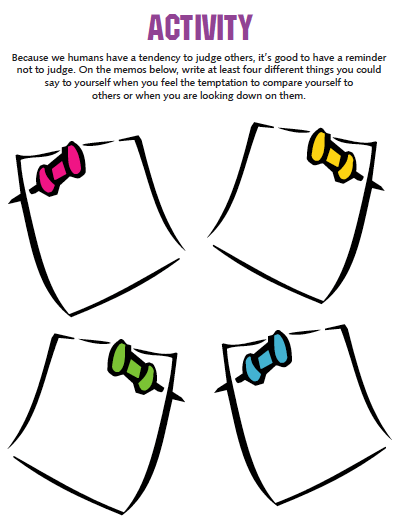
7. How can we remember not to judge others or compare ourselves to others?
Teacher-Directed Activity
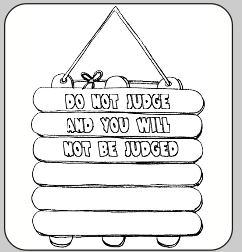
Give each child six large craft sticks (two with holes in one end). Glue four sticks horizontally to two vertical sticks with the holes at the top. Carefully glue on alphabet noodles to spell out Luke 6:37: “Do not judge, and you will not be judged.” Thread yarn through holes and tie to form a hanger.
REACH Activity
Word Study: Krino and Katadikazo
In Luke 6:37, Jesus says, “Do not judge,” and “Do not condemn.” The Greek word for“judge” is “krino.” It means to judge, pass sentence, or give one’s opinion in a private matter.The Greek word for “condemn” is “katadikazo,” which means to give a judgment against someone.The opposite is to declare innocent or to justify. In your Bible journal, write three sentences about each word and why Jesus said not to judge or to condemn. Read Luke 6:37-42 again to find the context.
Did You Know?
In Mark 12:43-44, Jesus calls His disciples’ attention to the offering made by the widow. She put in two very small copper coins. These copper coins were the smallest coins in circulation at that time. (Source: NIV Archaeological Study Bible, p. 1652.)
The widow’s mite was probably a tiny coin called a lepta. “On the front and back they may have had pictures of open flowers, anchors, grape clusters, helmets, fringed umbrellas, ears of corn, a wine jug, or a palm tree with two date clusters. Most had inscriptions referring to the emperor or some other ruler.” (Source: The Victor Journey Through the Bible, Beers, V.G., p. 309).
Music Notes: Come Thou Fount of Every Blessing
This hymn is found on page 8 of the CEM Hymnal. The words to this hymn were written by Robert Robinson, who was a hoodlum in London in his early teens. At 17, he decided to attend a meeting where a famous evangelist was speaking. His sole purpose was to scoff at the “poor, deluded Methodists.” Instead, he felt convicted and accepted Jesus Christ as his Savior. He was so moved, he became a Baptist minister in Cambridge, England. He wrote the words to “Come, Thou Fount of Every Blessing” when he was only 23. (Source: Amazing Grace, Osbeck, K., p. 343).
What is the fount in the first line? (Zechariah 13:1) Jesus Christ. We are directed to sing praise to God (Psalm 147:1-2) and when we do we’re in excellent company (Revelation 5:11-12). Wouldn’t we all like to be able to sing the songs the angels sing!
The Ebenezer (1 Samuel 7:10-12) is the memorial to God’s help. It’s interesting that Samuel chose a rock, because Jesus Christ is our Rock of help (Deuteronomy 32:3-4). Christ has gotten us this far, and we trust that He will take us home, to His Kingdom (Hebrews 9:14). The symbolism of the rock, the foundation, and the sacrifice are portrayed in Moses striking the rock to bring forth water for the people (Exodus 17:6). Through the sacrifice of Christ are we able to look forward to living in God’s Kingdom.
Thus, it is through grace we are saved (Acts 15:11). We pray that God will “fetter” our hearts to Him through His grace. We want our hearts sealed for His Kingdom (Revelation 7:14). Therefore, let’s make a reminder (an Ebenezer) to what God has done for us. Our Ebenezer can be understanding the words of the song. Our memorial can be our actions. But let’s raise our Ebenezer to God.
Journal Jot
Becoming more like Jesus Christ is a process, one choice at a time. As God works in your heart, He changes you to make you more like Him. Think of something that you used to do—a sin that you struggled with—that is no longer a temptation. If you can’t think of anything, make a list of things you know are wrong in your life, things that God needs to change. Take this list with you when you pray. Ask God to change your heart so these things are no longer a temptation for you. Then think of ways to help make a change: reading the Bible, telling your parents so they can help hold you accountable and encourage you, singing songs like “Come Thou Fount of Every Blessing.”
Back to the Bible
In the YEA lesson you learned that you should not judge or look down on others, and you should not compare yourself to others. It may be very difficult at times for you not to compare your abilities or looks with someone else’s, but Jesus taught firmly against it. How do you feel when you find that you do not measure up to a friend’s intelligence or physical ability? Do you know that you are wonderfully and fearfully made? God “knit” you together in your mother’s womb (Psalm 139:13-16). God knew what He was doing when you were created. He does not want you to be like everyone else. Avoid comparison with others. Do you know that even identical twins are not exactly alike? Now read the first and second chapters of Genesis and familiarize yourself with His amazing creation. You are one of them! Offer your Creator praise and thanksgiving for making you special and unique.
Just Toolin’ Around
Research how widows were cared for in Jesus’ time. (You may want to begin in James 1:27.) Choose a creative way to present the information to your Sabbath School class or family.
Stretch It Out
Using the information from Just Toolin’ Around above, research a widow that is named in the Scriptures and write her life story. Consider presenting her biography as a play or skit.
Questions?
Remember to write any questions that you have in your journal. That way, you will remember to ask your parents, teacher, or minister.
Song
“Jesus Loves Me” is on page 6 of the Kids Classics Collection.
Closing Prayer
Ask a student to lead in prayer thanking God for making each person special and different.
Printable Pages