YEA Lesson Library
Treasures in Heaven
About This Lesson
Using the parable of the rich fool, this lesson teaches the importance of seeking God first and storing up treasure in heaven.
Scriptures
Matthew 6:19-24
Matthew 6:20-21
Matthew 6:33-34
Matthew 13:44-52
Matthew 19:16-21
Mark 10:17-23
Luke 12:13-34
Luke 14:14
1 Corinthians 2:9-16
1 John 5:3
Words to Know
GREEDY - having an excessive desire for wealth, profit, or something that is wrong
INHERITANCE - come into legal possession of something upon the death of another
CONSEQUENCES - results of your actions
SOPHISTICATED - more mature, more complex
POSSESSION - something that you own or have
The Lesson
Do you have a younger brother or sister, or have you done some babysitting? Have you noticed that a three-year-old child lives only for right now? When a three-year-old is hungry, he wants to be fed right now! When he has to go to the bathroom, look for one immediately. And a three-year-old wants all the toys. Perhaps you’ve heard a child loudly pronounce, “Mine!” when someone picked up his toy. When the child wants candy or cookies, he doesn’t just want one. Older folks know that you can’t just hand him the bag of candy or the cookie jar. He’ll eat them all—not thinking of the consequences to his stomach later.
But, don’t make fun, because you do the same thing, you’re just more sophisticated in your wants and desires. New clothes, a CD player, a new bike, maybe a cell phone—the list can be quite long. But you’re not the only one who wants physical possessions. Think of all the car commercials. Who buys cars? Not kids! Adults have lists of wants like everyone else. And it’s been this way for a very long time.
One day someone in the crowd said to Jesus, “Tell my brother to divide the inheritance with me”(Luke 12:13). Here was a person very concerned about getting money! It wasn’t necessarily money that he had done anything to earn; it was an inheritance because someone had died. He was concerned about getting his fair share.
Jesus told him to be careful of being too greedy and told the parable of the rich man. He grew such large crops his barns couldn’t hold them. So he built bigger barns to store up all his wealth so he could take it easy. But God told him he would die that very night. All the wealth he had stored wouldn’t help him at all. He certainly wouldn’t care about it once he was dead. Then Christ said, “This is how it will be with anyone who stores up things for himself but is not rich toward God.”
Think about that! Nothing on earth is more important than our relationship with God. That’s why Christ said, “Do not store up for yourselves treasures on earth, where moth and rust destroy, and where thieves break in and steal” (Matthew 6:19). Can you think of a possession that can’t be destroyed or stolen? All of the ones that we are able to touch can be broken or stolen.
Remember the three-year-old who would eat all the cookies or candy? Sometimes the things we think we want can really hurt us. We don’t know they will hurt us; we just want them. But God knows. He has much better things for us. He has our best interests at heart.
Don’t misunderstand. God doesn’t say you can’t have nice things or want possessions. He is saying it’s easy to get caught up in money or possessions. If our whole focus is on getting, then we’re just like the rich man who had so much, but died that very night. Don’t spend all of your time trying to get more things. Christ tells us that there’s something better to work for.
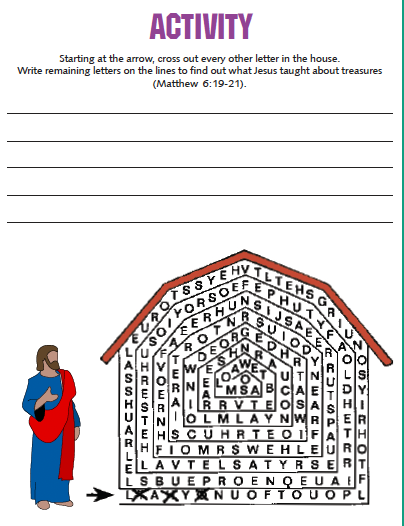
“But store up for yourselves treasures in heaven, where moth and rust do not destroy, and where thieves do not break in and steal. For where your treasure is, there your heart will be also” (Matthew 6:20-21). How do you store up for yourself treasures in heaven? Start by loving God. Paul tells us that our eyes have not seen, nor can we even imagine what God is preparing for the people who love Him. And, we can show God that we love Him by giving to Him and keeping His commandments.
Read your Bible. Find out how God wants you to act. Listen to the sermons and ask questions of your parents, Sabbath School teacher, and pastor. Ask God to show you what He wants you to do. Do your very best to please God—because you love Him. That’s storing up treasures in heaven!
One thing that pleases God is to give back to Him a tenth of our increase. This means that we give God back a dime out of every dollar we earn or get as allowance. Malachi 3:19 says, “Bring all the tithes into the storehouse so that there will be food enough in my Temple; if you do, I will open up the windows of heaven for you and pour out a blessing so great you won’t have room enough to take it in!”
When we seek God first, He blesses us. He promises to take care of those who love Him and do His will. He will make sure you have what you need. But remember, what you need isn’t necessarily what you want.
The choice is yours. You can work for treasures on this earth, but they are like clumps of dirt. The treasures God has for us are like diamonds. Which are you going to choose? Clumps of dirt or diamonds? Choose wisely. Choose life. Choose diamonds. Choose God!
Student Prayer
Dear Heavenly Father,
There are many treasures in this world that look desirable to me. Help me see that they are only temporary. They won’t last. Help me learn to seek you and to build a relationship with you that will last forever.
In Jesus’ name I pray.
Amen.
Daily Devotions
Sunday - Matthew 6:19-21
Monday - Matthew 19:16-21
Tuesday - Luke 14:14
Wednesday - 1 Corinthians 2:9-16
Thursday - Luke 12:31-34
Friday - Matthew 13:44-52
Saturday - Mark 10:17-23
Objectives
At the end of this lesson, students will be able to:
1. Explain the difference between treasures on earth and treasures in heaven.
2. State that God has things in store for us that are much more wonderful than we can imagine.
3. State that God has our best interests at heart.
4. Tell that God requires us to tithe on our increase.
Topics & Themes
God’s Will
Greed
Loving God
Obedience
Parables
Rich Fool
Relationship With God
Seeking God
Tithes
Treasure
Materials Needed
Bible, YEA Students’ and Teacher’s books, attendance and memory verse charts, stars, songbook, CD, CD player, dry erase board and marker
Preparation
Before class, do the teacher-directed activity. Make your own list of things you want. Next to each item, list the things God has promised to those who love Him. Look up the Scriptures that contain these promises and keep them for class. (Here are several to get you started: Psalm 32:8; Psalm 91:1-16; John 14:27; Romans 8:28-29; 1 Corinthians 2:9; John 14:2-3; Acts 2:38-39; Ephesians 1:3; Deuteronomy 28:1-14; Revelation 21:4, 6-7) You will want to be very familiar with these Scriptures. The things of this world are very enticing to our children. This age group is making the transition from wanting to please parents, teachers, and adults, to wanting to fit in with their peers. It’s important to strongly make the case for choosing God’s way. Preteens need to know that the Bible contains these promises from God. They can read them and understand that the promises are for them; the promises are not limited to their parents and other baptized members of God’s church. Our children are holy! (1 Corinthians 7:14). And they need to be told they are holy. They need to know and fully comprehend that they are extremely important to God and this carries a responsibility!
How to Teach This Lesson
Temporary Possessions - After opening the class with prayer, begin by listing on the board things the students want. Spend a little time talking about why they want each thing. Then talk about the parable of the rich man who stored great wealth, but died that very night (Luke 12:13). Discuss the temporariness of possessions. Talk about how our possessions can sometimes be harmful to us—both physically and spiritually; i.e., a new boat may keep a family from attending church.
Read Matthew 6:19-24 from a modern translation of the Bible. Ask: What is the difference between treasures on earth and treasures in heaven? Then read 1 Corinthians 2:9 and discuss some of the wonderful things that God may have in store, and the things He has promised us.
God Knows the Heart - Read 1 Samuel 16:7. Make sure students realize that God knows the heart. If they are not sincere in their love for God, He will know. We may be able to fool people, but we can’t fool God. We demonstrate our love for God through our willingness to submit to His will, to choose His way, and to follow His commands (1 John 5:3). Emphasize that we are not keeping God’s Laws to gain salvation—God’s greatest gift. There’s no way we can earn salvation. Keeping God’s Law is for our own good. If we love God, we will keep His commands.
God’s Promises - Emphasize that God’s promises are not temporary treasures; they will endure!
Make a Choice - Ask each student to take some time this week to think about the treasures most people work for. Ask them to compare earthly treasures with the promises of God. Then they need to make a choice. Let them know that the choice isn’t always easy. Sometimes it is difficult. Remind them of Paul’s statement in Philippians 3:14: “I press on toward the goal to win the prize for which God has called me heavenward in Christ Jesus.” Encourage students to ask God for guidance in helping them choose the right treasure!
Review Questions
1. What is the difference between earthly treasures and heavenly treasures?
2. Why does Jesus tell us not to store up earthly treasures? (Give at least two reasons.)
3. Does God really not want us to have any earthly treasures? Explain.
4. Why do we want to store up heavenly treasures?
5. How do we store up heavenly treasures?
6. What kinds of promises has God made to us?
Teacher-Directed Activity
Ask students to list the things they want— write these on the board. Next to this list of “wants,” guide them in listing the promises of God, reading the Scriptures where these promises can be found. When they have finished with both lists label the two lists “Clumps of Dirt” and “Diamonds,” explaining that dirt is plentiful and is easily blown away by the wind; diamonds, on the other hand, are very valuable and will endure.
REACH Activity
Word Study: Kardia
In the memory verse, Matthew 6:20-21, the word for “heart” is “kardia.” This Greek word comes from a more primitive root for heart. It is used in a figurative sense, meaning the thoughts or feelings. Does this Greek word make you think of any words that we have in English?
Did You Know?
Matthew 6:19 says, “Do not store up for yourselves treasures on earth, where moth and rust destroy, and where thieves break in and steal.” The people who heard Jesus say this probably understood all too well how easily a thief could break in and steal anything valuable. The houses at the time of Jesus were made of mud bricks and could be broken into very easily. (Source: NIV Archaeological Study Bible, p. 1568.)
Music Notes: Turn Your Eyes Upon Jesus
This hymn is found on page 181 of the CEM Hymnal. The words and music were both written by Helen Howarth Lemmel in 1918. It is probably the best-known of the 500 hymns written by Helen Lemmel. She had been given a missionary tract by a friend. Inside the tract was the line: “So then, turn your eyes upon Him, look full into His face, and you will find that the things of earth will acquire a strange new dimness.” So struck was Helen Lemmel by this idea, the hymn was born. She relates:
“Suddenly, as if commanded to stop and listen, I stood still, and singing in my soul and spirit was the chorus of the hymn with not one conscious moment of putting word to word to make rhyme, or note to note to make melody. The verses were written the same week, after the usual manner of composition, but nonetheless dictated by the Holy Spirit.” (Source: Amazing Grace, Osbeck, K., p. 183.)
This is exactly what Jesus is talking about in the memory verse this week. Keep your eyes focused on what is really important—Jesus Christ and the things of God.
Journal Jot
Make a list of the most important things in your life. Be completely honest with yourself. Ask yourself: What would I not be willing to share with someone else? What would make me really sad to lose? When you have finished your list, highlight those things which are of lasting value, the ones you’ll be very glad you have in 20 years or in God’s Kingdom. Then write a prayer asking God to help you determine what really has value and deserves your attention and focus.
Back to the Bible
In the YEA lesson you read of the rich man that built bigger barns to store all of his wealth. As he was building his barns he was probably thinking about all the money he could get from what the barn could hold. When do you think he thought of someone else? Do you think he had the time to help others? Do you think he had any friends? Do you think he knew to love others as he loved himself? This parable, or story with a lesson, is one of many that Jesus told to help teach people about loving God and others. Sometimes Jesus taught in parables because it was easier for the people to understand what He was teaching. He did not keep people guessing as to how they could love God. Jesus said that the greatest commandment is to “Love the Lord your God with all your heart and with all your soul and with all your mind” (Matthew 22:37-39). If you are too focused on yourself, the way the rich man was, you will not have room in your heart to love others, much less God. Wouldn’t that be a terrible way to live the precious life God has given you? Remember that God knows what is in your heart. What treasures fill your heart today? Here are three permanent treasures to fill your heart: Mercy, love, and humility. These are worthy treasures for your life today and in God’s Kingdom!
Just Toolin’ Around
Jesus told many parables. Find and read at least two others. Share the parables and their meanings to the Sabbath School class or your family.
Stretch It Out
Draw a picture that illustrates the memory verse. Use the drawing to explain the YEA lesson. Share with the Sabbath School class or family.
Questions?
Remember to write any questions that you have in your journal. That way you will remember to ask your parents, teacher, or minister.
Song
“I Have Decided to Follow Jesus” is on page 23 of the Kids Classics Collection.
Closing Prayer
Ask for a volunteer to give the prayer. Encourage students to pray for God’s guidance and wisdom in their daily choices.
Printable Pages