YEA Lesson Library
Just Do It!
About This Lesson
Using the parable of the Good Samaritan, this lesson teaches the students to be ready to wisely help people who are in need.
Scriptures
Leviticus 19:15-18
Matthew 10:16, 40-42
Mark 12:28-31
Luke 6:30-36
Luke 10:25-37
Luke 10:27
James 1:21-27
James 2:19-26
1 Peter 3:15
Words to Know
SAMARITAN - person from Samaria; there was open hostility between Jews and Samaritans at the time of Jesus’ parable
DESCENT - going downhill; moving to a lower elevation
MALICIOUS - intending harm
The Lesson
When you think about your neighbors, who do you include? The kids who get on the school bus with you each day? Or, are the people who live on your block your only neighbors? Maybe you think the kids you attend church with and enjoy sharing fun activities with at a lock-in are your neighbors. If you live in the country, you may think all the people who live within a mile or two of your house are your neighbors. Do you think of people who are a different race, color, or religion as your neighbors? The Bible has something to say about who your neighbors are. An expert in the law asked Jesus a question that leads us to the answer.
One day, an expert in the law asked Jesus what he had to do to inherit eternal life. Jesus asked him what the law said. He answered, “Love the Lord your God with all your heart and with all your soul and with all your strength and with all your mind, and love your neighbor as yourself.” Jesus told him that was exactly what the law said. Jesus told the man to Just Do It! Jesus wanted to see by his actions that he loved Jesus as his neighbor. He was telling the man he should love God first, but he should also love his neighbor as much as he loved himself. The law expert asked the question, “Who is my neighbor?” Jesus answered by telling this story. We know it as the parable of the Good Samaritan.
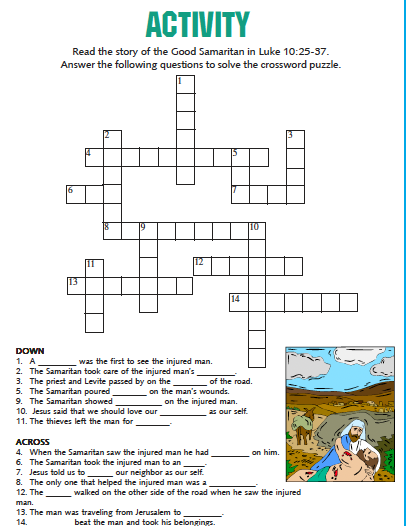
A man traveled from Jerusalem to Jericho. Jerusalem sits in the hills and Jericho is on the plains. It is quite a descent through rocky, dangerous territory. There are many places for ban- dits and thieves to hide, waiting to ambush whoever comes along. That is what happened to this man. Thieves beat him up, took his belongings, and left him for dead. Soon a priest came along. When he saw the man, he walked on the other side of the road to avoid him. Next, a Levite came by—he did the same thing.
You would expect a priest and a Levite who work in the Temple to help a man who has been injured. But they didn’t want to get involved. Thankfully, a Samaritan also traveled down the same road on that day. When he saw the injured man, he felt sorry for him. He bandaged the man’s wounds as best he could out on the road. He took the man to an inn and cared for him. When the Samaritan left, he paid the innkeeper to care for him until the man could care for himself. Also, the Samaritan told the innkeeper that if the money wasn’t enough, he would pay the rest of the bill when he came back.
The law expert understood that the Samaritan was the man’s neighbor. That doesn’t mean much today unless we understand that Samaritans were not well-liked by Jews because they were a different race. Jesus told this parable to make it clear that your neighbor isn’t just the person next door, or someone of the same race, or someone you like. Our neighbors include all people who need our help when we can give it.
Helping people today can be a scary thing. Many evil and malicious people wouldn’t think twice about hurting children or adults. You have probably heard about people being killed or beaten when they only stopped to help. You know your parents don’t pick up hitchhikers. You know not to talk to strangers and, when you answer the phone, you shouldn’t tell people you’re home alone. In your world, there are many things that can hurt you. So, how do you “love your neighbor as yourself,” as Jesus says?
Jesus told His disciples, “I am sending you out like sheep among wolves. Therefore be as shrewd as snakes and as innocent as doves” (Matthew 10:16). Jesus knew this world was a dangerous place for His disciples. He cautions us to think before we act. Thankfully, we have God’s Holy Spirit to help guide us. We can always pray for God’s help and protection.
But, what does all this mean to you in the situations you encounter? What happens if you see someone who really needs help? What if you see a person who is obviously injured? How are you a neighbor to people around you? First, don’t put yourself in a position where you could be in danger. You can help in other ways. Tell a parent or teacher. Call an adult friend of the family. If you feel it’s necessary, call the police.
Think of an important way you can help others. How many people around you don’t know Jesus as they should? They need some spiritual help. How can you be a neighbor? First, pray for them. Then, “always be prepared to give an answer to everyone who asks you to give the reason for the hope that you have” (1Peter 3:15). That means to study your Bible, listen to sermons, and ask questions. Make sure you know why you believe what you believe. Be prepared to share your love for God with others. Also, be ready to answer anyone who asks why you worship God as you do—not celebrating Christmas or Easter, but keeping God’s holy days.
Remember that more people will see how you live your life than will ever listen to your reasons for keeping the Sabbath and holy days. You’ve heard, “Actions speak louder than words.” If you are patient, kind, and caring, others will see Jesus in you. If someone on your block is sick, bake some cookies for them. If you don’t know them well, get your mom or dad to go with you. Send a card or note to kids in your Sabbath School class who are sick. Use your head and you can think of many ways to be a good Samaritan. This is what Jesus meant when He told the expert in the law to Just Do It! If you do help someone spiritually or physically, you are undoubtedly a good Samaritan.
Daily Devotions
Sunday - Luke 10:25-37
Monday - Leviticus 19:15-18
Tuesday - Matthew 10:40-42
Wednesday - Luke 6:30-36
Thursday - James 2:19-26
Friday - Mark 12:28-31
Saturday - James 1:21-27
Objectives
At the end of this lesson, students will be able to: 1
1. Retell the parable of the Good Samaritan.
2. Tell why Jesus used a Samaritan as the hero of the story instead of the priest or Levite.
3. Explain what it means to be a good neighbor.
4. Explain the difference between helping physically and spiritually.
5. State that they understand they are not to put themselves in danger.
Topics & Themes
Eternal Life
God’s Protection
Good Samaritan
Helping Others
Holy Conduct
Holy Spirit
Loving God
Loving Others
Parables
Good Samaritan
Prayer
Samaritans
Sharing the Gospel
Materials Needed
Bible, YEA Students’ and Teacher’s books, attendance and memory verse charts, stars, songbook, CD, CD player, paper, pencils
Preparation
Before class, read through the entire account (Luke 10:25-37). Then spend some time listing concrete ways children this age can truly be neighbors to those around them. Our children are very precious to us; we would never want to put them in any danger. But, children tend to be trusting and compassionate at this age. They are old enough to have grown out of the self-absorption stage and into the crusader stage where everything has to be fair and right.
Knowing this, prior thought and planning can provide some practical ways for the students to do good to those around them. Your community and the maturity of your preteens will be major factors in deciding what is practical for them at this point.
Jericho is 17 miles from Jerusalem. The elevation difference makes it a treacherous trip. Jerusalem sits 2,500 feet above sea level. Jericho sits about 800 feet below sea level. Additionally, the road runs through rocky, desert country.
How to Teach This Lesson
After opening with prayer, follow the lesson plan.
Who is your neighbor? - Begin the lesson by asking students: Who is your neighbor? (Being very literal, they’ll probably tell you it’s the person who lives next door. Be prepared for them to be familiar with the story of the Good Samaritan. They could say anything.)
Expand upon the neighbor theme by asking: Are the people in the house across the road from you your neighbors? Keep expanding the boundaries. Point out that our neighbors are not always people we like or enjoy being around.
The Parable - Read Luke 10:25. Tell students that Jesus gave an expert in the law a parable about his neighbor. Tell the story, pointing out that the ones you would expect to help—the priest and Levite—ignored the man in need.
Discuss how the story relates to students and what their responsibility is in loving their neighbor as themselves. Make sure to discuss the physical and spiritual aspects of being a good neighbor. This may take some time, depending upon the maturity of the students. Some of them may have never considered that spreading the truth about God is a helpful thing to the person who receives it and accepts it.
CAUTION! - There are many people and things in our world today that can harm children. Many unscrupulous perpetrators will play on the tender emotions of children to lure them into dangerous situations. Remember to caution students about doing anything that would endanger themselves when they are helping others. Discuss Jesus’ warn- ing to the disciples in Matthew 10:16.
Review Questions
1. What did the expert in the law want to know?
2. What did Christ tell him he should do to inherit eternal life?
3. Why do you think Jesus used a Samaritan as the good guy in this parable?
4. How do you think this parable relates to your life?
5. How can you be a good neighbor?
6. What does your memory verse say?
7. Can you think of other ways to help people?
Teacher-Directed Activity
Divide your class into groups of three or four (smaller classes can work individually). One at a time, read the following scenarios. Allow them time to brainstorm, chose one or two ways they could help the people, and write their answers on a sheet of paper. Discuss their answers in class and have the class decide which might be the best and wisest solution.
1. As you’re walking home from school, you see someone driving a car recklessly. You’re afraid they will hurt themselves or someone else. What do you do?
2. You’re playing basketball with your friends when you see a little girl on roller blades wipe out. Her knees are bleeding and she is crying. What do you do?
3. A homeless man is hunting through trash cans in the alley. He’s very thin and dirty. You feel sorry for him. What do you do?
4. A friend invites you to spend the night. That evening your friend’s parents ask you why you don’t celebrate Christmas. What do you tell them?
5. Think of a situation where you could be a good neighbor to someone. Write it on another sheet of paper and be ready to share it with the class.
REACH Activity
Word Study: Agapao
This is the same Greek word we learned in Lesson 5! Look at how it is used in this week’s memory verse: “Love the Lord your God with all your heart with all your soul and with all your strength and with all your mind. . .” (Luke 10:27). Again agapao indicates a direction of the will and finding one’s joy in something. Here Jesus tells us to love God, as a matter of our will, with all of our heart, soul, strength, and mind—and to find our joy in God.
This quote is from Deuteronomy 6:5 where the Hebrew word for this kind of love is ahav, like we saw in Lesson 1.
Did You Know?
The distance from Jerusalem to Jericho was a distance of 17 miles and a descent from about 2500 feet above sea level to some 800 feet below sea level. The road ran through rocky, desert terrain, which provided natural hiding places for lurking robbers to waylay defenseless travelers. (Source: NIV Archaeological Study Bible, p. 1691.)
Music Notes: Help Somebody Today
This hymn is found on page 177 of the CEM Hymnal. The words were written by Carrie Elizabeth Ellis Breck (1855-1934).
Carrie’s family moved from Vermont to Vineland, New Jersey, and she spent most of her life in southern New Jersey. She married Frank Breck, and they moved to Oregon between 1910 and 1920. A devout Christian, she was devoted to her husband and five daughters. She had no sense of pitch, and could not carry a tune, but she had the gift of poetic rhythm, and wrote more than 2,000 poems. She was not particularly robust in health, and had to take frequent rests while doing chores. At such times, she would sit in her favorite rocking chair, take up a notebook, and write poetry—often with a baby on her knee, or playing at her feet. She also wrote “Face to Face With Christ My Savior.”
The words for “Help Somebody Today” were inspired by the story of the Good Samaritan in Luke 10:25-37. (Source: www.cyberhymnal.org.)
Journal Jot
Read through Luke 10:25-37. Put Jesus Christ in the place of the Good Samaritan. How does Jesus fit the role of the Good Samaritan? Write your thoughts in your Bible journal.
Back to the Bible
The injured man by the side of the road needed help, yet a Levite and priest passed by. A Samaritan man stopped, checked, and bandaged his wounds, and then made sure he had a place to recover. There is a word that describes the Samaritan’s actions: Mercy. Webster’s II Dictionary defines mercy as “kind and compassionate treatment.” This is what Jesus had to say about mercy, “Blessed are the merciful, for they will be shown mercy” (Matthew 5:7 NIV). Because the Samaritan showed mercy to the injured man, he will be shown mercy, too. We do not know when or where or even why the Samaritan will someday need mercy. But because he showed mercy to the man who had been robbed and beaten, Jesus says someone will be merciful to him. It is important to realize that kindness to others should not be based on what we hope to get out of it. In other words, we should want to help and be kind to others because that is what Jesus preached and taught. Jesus Himself is a perfect example of mercy. He died for our sins so that we can have eternal life with Him. Be an example of Jesus Christ and find ways to serve and be merciful to others. That is real love! Put aside time to read and study the Bible so that you can learn more about repentance, forgiveness, and mercy.
Just Toolin’ around
Who were the Levites? Use a Bible and other Bible reference to find out more about this group of people. Write the information in your journal and share it with the Sabbath School class or your family.
Stretch It Out
Sometimes it’s hard to relate to certain parts of a story because we are unfamiliar with the people or place. Write a new, modern version of the Good Samaritan. For instance, maybe the story could take place in your home town. Perhaps the injured man could be your father, or another male relative or friend. Present your story to the Sabbath School class or family and friends.
Questions
Remember to write any questions that you have in your journal. That way you will remember to ask your parents, teacher, or minister.
Song
“Jesus Bids Us Shine” is on page 37 of the Kids Classics Collection.
Closing Prayer
Lead the children in praying for God’s guidance as they become good neighbors. Pray for God’s wisdom in making decisions and for His protection every day.
Printable Pages