YEA Lesson Library
Prepare the Way
About This Lesson
This lesson teaches that John the Baptist continued to preach about Jesus and obedience to God, even though it meant his death; students are exhorted to be willing to share the gospel as well.
Scriptures
Isaiah 40:1-8
Matthew 3:1-17
Matthew 14:1-12
Mark 1:1-4
Luke 1:5-17
Luke 3:1-20
Luke 9:7-9
John 1:19-28
John 7:6-10
1 Peter 3:15-16
Words to Know
CREDENTIALS - certificate showing one’s right to a certain position or authority
EXTORT - pressure people into giving money, usually with threats
THE GREAT COMMISSION - to preach the Gospel throughout the world
TUNIC - shirt
The Lesson
Before a president, king, or queen comes into a room for a public appearance, they are announced. Even speakers at conventions have someone to announce them. The person making the introduction may give information about the speaker. He may tell about his credentials, education, experience, or perhaps books he has written. All these things prepare the way for the important person or speaker to do his job.
John the Baptist was born for a very special purpose. The angel, Gabriel, told John’s father that John would bring him much joy. Many people would be blessed through John. He would cause many to come back to serving the Lord. John would be a great man in God’s sight. He would have power like Elijah, and would turn many hearts back to doing what was right. (Luke 1:14-17). It was John’s responsibility to prepare the way for Jesus Christ. He had the awesome job of declaring that Jesus Christ, the Son of God, came into the world to save it!
John carried out his mission. Luke 3 says John preached a baptism of repentance for the forgiveness of sins. He baptized people in the Jordan River. He told the people that being Abraham’s descendants didn’t mean they could ignore the ways of God. Then he gave some examples. He told the man who had two tunics that he should share with a man who didn’t have any. He told a man who had plenty of food that he should share with those who didn’t have anything to eat (Luke 3:11). He told the tax collectors not to collect more money than they were required. He told the soldiers not to falsely accuse people or extort money from them. He also told Herod, the ruler of the country, that he was wrong for living with his brother’s wife, Herodias. So Herod put John into prison.
Most of us don’t like to be told we are wrong. Herod didn’t like John telling him he was wrong either. In fact, he wanted to kill John, but was afraid of what people would think. So John stayed in prison. On Herod’s birthday, Herodias’ daughter danced so well for him that he promised to give her anything she asked. She asked for the head of John the Baptist on a platter. Because Herod had promised, he had John’s head cut off!
God gave John the Baptist a very important job. John knew his job was so important that he was willing to die for it. God has given us a job to do, too—to be a light and an example to those we see each day. We’re also supposed to tell the world the truth about Jesus and the ways of God. It’s called “The Great Commission.”
Speaking the truth, especially the truth of God, may not be very popular with people around you. In fact, some may not take it very well when told about God’s way. People don’t like to hear they are wrong. They especially don’t like to be told they are wrong if it is not done with a respectful and gentle attitude. So whatever truth God has given to you needs to be shared in a positive, respectful way—when someone asks. Peter tells us, “Always be prepared to give an answer to everyone who asks you to give the reason for the hope that you have. But do this with gentleness and respect” (1 Peter 3:15-16a).
One of the best ways to share the truth of God is through your actions. What you do says more about what you believe. Your example can cause people to ask you questions, those questions that Peter tells us to be prepared to answer.
Another way you can share the truth of God is by inviting your friends to Sabbath School and to Sabbath services. You may want to start by inviting them to a lock-in for kids or to another church activity. Sabbath School classes are a fun way to learn about God. So, by inviting your friends, you can share the fun with them.
John the Baptist came to prepare the way for Christ’s first coming. Another prophet will come before His second coming. Jesus went to heaven to prepare a place for us. He promises to come again for those who are ready. Every day we must share God’s truths with others and prepare ourselves for Christ to return.
John the Baptist had a very important job to do—to proclaim that Jesus Christ was coming. And we each have an important job to do as well—to tell people about Jesus Christ, God’s way, and Jesus’ return. May we “dare to be a Daniel, dare to stand alone; dare to have a purpose firm, dare to make it known.” When someone asks you about your Christian beliefs, don’t worry about not knowing what to say at the right time. Jesus told His disciples that they were not to worry about what to say—the Holy Spirit would give them the right words.
Student Prayer
Dear Heavenly Father,
Thank you for opening our eyes to see the truth that you’ve shown us. Help us to share that truth with others in a respectful and gentle way, according to your will. Please give us the right words to say so that others will come to know you.
In the name of your Son, Jesus Christ.
Amen.
Daily Devotions
Sunday - Luke 9:7-9
Monday - Matthew 3:1-6
Tuesday - Matthew 3:7-17
Wednesday - Mark 1:1-4
Thursday - John 7:6-10
Friday - John 1:19-28
Saturday - Isaiah 40:1-8
Objectives
At the end of this lesson, students will be able to:
1. Give three facts of the life of John the Baptist.
2. Relate how John the Baptist died.
3. State that actions sometimes speak louder than words—use that cliche to explain 1 Peter 2:12.
4. Tell that they also have the job of spreading the Gospel of Jesus Christ.
Topics & Themes
Angel
Attitude
Baptism
Forgiveness
God’s Laws
God’s Promises
Great Commission
Holy Conduct
Jesus, Return of
John the Baptist
Jordan River
Jesus, God the Son
Obedience
Repentance
Share the Gospel
Truth
Materials Needed
Bible, YEA Students’ and Teacher’s books, attendance and memory verse charts, songbook, CD, CD player, stars, construction paper, color markers, concordances (one per student, if possible)
Preparation
Children this age have the wonderful opportunity to witness to a group of people who have not yet become cynical about this world’s religions. They are constantly with classmates, friends, other children in the neighborhood, and relatives. Children are very open, both about their curiosities and their beliefs. It’s important that we give them the tools that may plant seeds in these fertile minds.
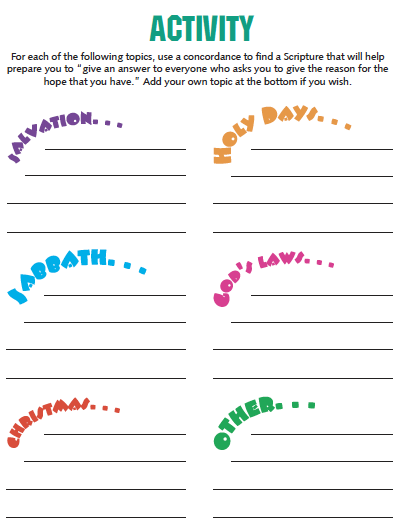
Make sure to do the Activity in the Students’ book for yourself before class. Find Scriptures to support your beliefs. Here are a few references. You may wish to find others:
God’s Holy Days - John 7:8-10; Acts 2:1, 12:3, 20:6,16, 27:9; 1 Corinthians 5:8, 16:8; Leviticus 23; Zechariah 14:16.
Sabbath - Exodus 16, 20:8-11, 31:12-17; Genesis 2:2-3; Mark 2:27-28; Luke 4:16
Salvation - John 3:16-17; Hebrews 6:1-2; Romans 6:23; Ephesians 2:8-9; Matthew 16:27
Keeping God’s Laws - Exodus 20; Deuteronomy 5; Matthew 5:17-19; 1 Corinthians 7:19; Romans 7:12, 13:10; Revelation 12:17, 10:10; 1 John 5:2-3; John 14:15, 21
Christmas - Jeremiah 10:1-5
How to Teach This Lesson
After opening with prayer, follow the lesson plan.
Possible Persecution - John the Baptist was given an extraordinary job. We, too, have been given a job—to be a light and to preach the Gospel to the world. Those who preach God’s truth may encounter opposition and some will be persecuted. We don’t want to scare our children by making them think that all of God’s people will be persecuted. We don’t want our children to think that Christians will be arrested, put into prison, tortured and/or killed for their beliefs. Help them realize that some of God’s people have felt so strongly about God’s truth that they were willing to die.
Encourage to share faith - Some Juniors aren’t mature enough to do full-blown personal evangelism, but should be learning how it is done so they will be ready when the opportunity presents itself. However, there are things they can do now. They are perfectly capable of being an example and a light to others. Also, encourage your students to invite friends to attend Sabbath School with them.
Christ-like traits - Involve the class in a discus- sion about being a light to the people they see each day. Read Matthew 5:15-16, and ask what happens when a light is put under a bushel. Talk about Christ-like traits they should have. Get them to tell you what traits they like in their friends. Encourage them to include such things as honesty, courage, kindness, fairness, caring, friendliness, patience, and dependability. Help them to understand these are traits they should have to reflect Christ in their lives. When they reflect these godly traits, they are being a light to the world. This is what it means to put your light or candle on a candlestick. To be a light to the world, they should pray that God will help them to be kind, friendly, honest, and caring. Having these traits will make it much harder for other kids to give them a hard time about their religious beliefs.
Have an answer - As you work through the lesson, make students aware that God expects them to be prepared to give an answer to people who ask them questions. That can be intimidating, so teach them how to use a concordance. Encourage them to take notes or to keep a notebook of their favorite Scriptures. If they don’t already have a Bible of their own, plan with them how to earn one in Sabbath School. (These can be purchased inexpensively at a Christian bookstore or some dollar stores.) Show them how to mark key Scriptures in their Bible. It’s important that we each be able to support what we say we believe.
God is with us - Reassure students that God will never leave nor forsake us. Mark 13:11 tells us that the Holy Spirit will speak through us when we need the appropriate words. Share whatever personal experiences you may have had—those in which you know that the Holy Spirit helped you with the words to say.
Work through the review questions before and after you do the Activity; the repetition is good for the students.
Review Questions
1. What was the job of John the Baptist?
2. What kinds of things did he tell people they should and shouldn’t do?
3. How did John the Baptist die?
4. How is the job that God has given us similar to the job that John the Baptist had?
5. What should our attitude be when sharing truth that God has given to us?
6. How can you find Scriptures to support what you believe?
7. How can we be a light to those around us?
Teacher-Directed Activity
Tell students to fold an 81⁄2" x 11" sheet of construction paper into three sections to make a “Prepare the Way” pamphlet. Have them design words and pictures for the cover that depict something they believe in (from the Student’s book). Inside, they should write one or more of the Scriptures they looked up. They can share this pamphlet with anyone who might ask about their beliefs.
REACH Activity
Word Study: Prautes
The word “gentleness” in the memory verse (1 Peter 3:15-16) is translated “meekness” in the KJV. It is the Greek word prautes. It is not easily explained in English since many associate meekness with weakness. It is, rather, a condition of the mind and heart which demonstrates gentleness not in weakness but in power. It is a virtue born in strength of character. For example, according to Aristotle, prautes is the middle road in being angry, standing between two extremes—getting angry without reason and not getting angry at all. Therefore, prautes is getting angry at the right time, in the right measure, and for the right reason.
Did You Know?
Herodias was one of the evil women of the Bible. She was first married to Herod Philip I, who was also her uncle. When Herod Philip I’s half-brother, Herod Antipas, wanted her, she divorced her first husband to marry his brother. It was this Herod (Herod Antipas) who beheaded John the Baptist. Later, Herodias’ brother, Herod Agrippa I, became king. So Herodias persuaded her husband, Herod Antipas, to go to Rome and ask for the title of king as well. Agrippa quickly brought charges against Antipas and had him exiled to what is now France. (Source: The Victor Journey Through the Bible, Beers, V.G., p. 260-261.)
Music Notes: Let Others See Jesus in You
This hymn is found on page 178 of the CEM Hymnal. It is one of about 150 hymns (both words and music) written by Baylus Benjamin McKinney (1886-1952). He also composed the music to 115 additional hymns. Among the hymns written by McKinney are “The Nail Scarred Hands,” “Breathe on Me,” and “Wherever He Leads I’ll Go.”
As you read the words, think about how others view your life. McKinney compares our lives to an open book that people are reading “through and through.” People see everything you do. Your actions speak louder than words, especially when you are trying to share Jesus Christ. The exhortation to “be faithful and true” about showing Jesus in the things we do reminds us that it only takes one bad choice to give someone a wrong impression about what it means to be a follower of Jesus. We certainly don’t want to hear someone tell us, like Nathan told David (2 Samuel 12:14), that we’ve given the enemies of God reason to blaspheme or show contempt for God.
Journal Jot
This week’s memory verse is 1 Peter 3:15-16: “Aways be prepared to give an answer to everyone who asks you to give the reason for the hope that you have. But do this with gentleness and respect, keeping a clear conscience. . .” Think about what doing the opposite of this verse would be: Not being prepared to talk about Jesus, not showing Jesus to others through your actions, not being respectful or gentle with others. You can live just in this life for this life. But someday it will be gone. Or, you could work for the great God of the universe for something that will last forever. Write about this topic in your Bible journal.
Back to the Bible
Among the men taken captive from Judah by King Nebuchadnezzar of Babylon were Daniel, Hananiah, Mishael and Azariah. These four young men were chosen to be trained for three years; after that they were to enter the king’s service (Daniel 1:1-6). Daniel had been taught to live according to God’s ways. He worshiped and served the Creator God, but the Babylonians worshiped and served foreign gods. The king was hoping that Daniel and his friends would change and live like the Babylonians. He even changed their names so that they would feel more like Babylonians. When Daniel and his friends were offered royal food and wine, he “. . . resolved not to defile himself.” (The meat was probably pork, or an unclean food that we read about in Leviticus 11.) The word “resolve” means to be devoted to principle and to be committed to a course of action. Daniel was not going to change who he worshiped just because he lived in Babylon. Even with the threat of death, the Hebrew children “resolved,” or stood up for, who and what they believed. By resolving to live God’s way they put their lives in danger. One course of action they took was to go to God in prayer. Through their faith and by His power, they survived orders of death. Imagine what the king and people of Babylon thought when they saw Daniel and his friends living what they believed! They stood up to the king! Can you resolve to be a Daniel?
Just Toolin’ Around
Use your Bible and reference books to find the Hebrew and Babylonian meanings of the names of Daniel and his three friends. Write them in your journal and explain how their meanings tie in to the YEA lesson.
Stretch It Out
Talk to your Sabbath School class or family and consider planning a special youth event at Sabbath School or church. Ask the Intermediate and Senior Teen classes to lend a hand, if needed. Brainstorm ideas together. Some event examples: A mini-Olympics day with volleyball, basketball, and/or other team sports, with a barbeque to follow; a car wash, with pizza afterwards; or potluck and a movie. Send invitations out well in advance to ensure a good crowd!
Questions?
Remember to write any questions that you have in your journal. That way you will remember to ask your parents, teacher, or minister.
Song
“Dare to Be A Daniel” is on page 9 of the Kids Classics Collection.
Closing Prayer
Lead students in prayer asking for God’s assistance as they witness about Jesus Christ to those around them.
Printable Pages