YEA Lesson Library
The Power to Heal
About This Lesson
This lesson surveys many of Jesus’ miracles of healing and teaches the student that God is more concerned with our spiritual health than our physical condition. We should pray for God’s will in our lives.
Scriptures
Matthew 4:23
Matthew 4:23-25
Matthew 8:14-17
Matthew 9:20-22
Matthew 9:27-31
Matthew 12:9-14
Mark 1:34
Mark 7:31-37
Luke 5:17-26
John 5:1-9
2 Corinthians 12:7-10
Words to Know
LEUKEMIA - cancer of the bone marrow characterized by an abnormal increase in white blood cells
ASTHMA - disease of the respiratory system, resulting in difficulty breathing
SYNAGOGUE - Jewish place of worship
PARALYZED - unable to move some or all of the body because of spinal injury
LEPROSY - severe disease of the skin
The Lesson
Have you ever noticed how much pain and suffering there is in this world? Perhaps you have had more than your share of bruises and scrapes. Maybe you’ve sprained an ankle or broken a bone. These are usually pretty small injuries compared to the pain some people have. Many children have cancer, leukemia, or asthma. Some of them probably won’t live very long. There really is a great deal of pain in this world.
When Jesus walked the earth, He saw much pain and suffering too. But He could do something about it. Matthew 4:23-24 tells us that as Jesus went throughout Galilee, He taught in the synagogues, preaching the good news of the Kingdom. He also could be found healing people of sickness and disease. News about Him spread all over Syria. People began bringing those who had various diseases. Because Jesus felt compassion for the sick, He healed them.
Matthew, Mark, Luke, and John all tell about the wonderful miracles of healing that Jesus performed. Matthew 20:29-34 tells about two blind men who received their sight. Mark 1:40-42 tells about a man being healed of leprosy. Luke 22:49-51 tells about Jesus healing the ear of the servant of the High Priest when the soldiers came to arrest Jesus. John 11:38-44 tells about Jesus healing Lazarus. He had been dead for three days!
In most cases, Jesus said something about faith. It was important for the person to believe Jesus could heal them. A woman had been bleeding for 12 years. She believed if she could just touch the hem of Jesus’ robe, she would be healed. When she touched it, she was! Jesus told her, “Your faith has healed you” (Matthew 9:20-22).
Sometimes it may not be God’s will to heal a person in this life. The Apostle Paul wrote, “To keep me from becoming conceited because of these surpassingly great revelations, there was given me a thorn in my flesh, a messenger of Satan, to torment me. Three times I pleaded with the Lord to take it away from me. But He said to me, ‘My grace is sufficient for you, for my power is made perfect in weakness’” (2 Corinthians 12:7-10). No one could accuse Paul of not believing God could heal him. Paul knew God was more concerned about spiritual health than physical health. Physical health only lasts as long as we live in these bodies. Spiritual health is vital if we are going to spend eternity with God—to live forever.
God always keeps His promises, but may not do it when we expect. The Book of James says, “. . . the prayer of faith shall save the sick, and the Lord shall raise him up.” Many faithful people who did not receive their promise in this life are listed in the Book of Hebrews. These people of God were more concerned with their spiritual health than receiving a temporary reward.
The story of the paralyzed man shows God is concerned about spiritual health. This man couldn’t walk and had to be carried to Jesus on a mat. Jesus didn’t say he was healed. Jesus said his sins were forgiven. That’s a very strange thing to say. The man wanted physical healing. The man could walk, but Jesus did something much more important. Jesus healed the man spiritually, by forgiving his sins (Luke 5:17-26).
Sins make people sick spiritually. This world does not choose God’s way of living. People do not follow God’s Laws. They are spiritually sick. Jesus told the Pharisees that He had come to heal the spiritually sick, the sinners. Spiritual healing is so important because without it no one will be allowed to enter God’s Kingdom. And we certainly want to live in God’s Kingdom with Jesus Christ.
So, the next time you ask God to heal you, remember these three things: 1) You must believe that God has the power to heal you. 2) You must truly want God’s will to be done, even if it means you aren’t healed in this life. 3) Even though our bodies only last for this life, God heals our physical illnesses. And He heals us of spiritual illnesses so that we can live for all eternity with Him. Our God is truly an awesome God!
Student Prayer
Dear Heavenly Father,
I know that you love and care about me. You want me to be well and happy. Father, please show me your ways and heal me spiritually that I may always dwell with you.
In Jesus’ name I pray.
Amen.
Daily Devotions
Sunday - Matthew 8:14-17
Monday - Matthew 4:23-25
Tuesday - Mark 1:34
Wednesday - John 5:1-9
Thursday - Matthew 12:9-14
Friday - Matthew 9:27-31
Saturday - Mark 7:31-37
Objectives
At the end of this lesson, students will be able to:
1. Give examples of the miracles Jesus performed in healing people.
2. State that a person must have faith to be healed, but it doesn’t always ensure healing in this life.
3. Tell why spiritual healing is so important.
4. Explain that our loving Heavenly Father doesn’t want us to suffer, but He does want us in His Kingdom.
Topics & Themes
Crippled
Blindness
Eternity
Faith
Forgiveness
God’s Love
God’s Promises
God’s Will
Healing
Jesus, His Ministry
Jesus, His Miracles
Healing
Resurrection
Jesus, Savior
Lazarus
Pain
Physical Infirmities -
Blindness
Physical Infirmities -
Crippled
Resurrection
Sin
Trusting God
Materials Needed
Bible, YEA Students’ and Teacher’s books, attendance and memory verse chart, stars, CD, CD player, songbook, chair, blindfold, dry erase board and marker
Preparation
Before class, read the various accounts of Jesus’ healing to refresh your memory about the kinds of diseases He healed, and His attitude toward the various people. It would also be good to do some research into leprosy, asthma, and leukemia.
God is working from eternity for eternity in each of us. He wants us in His Kingdom. Our illnesses can be very hard to bear, and the illnesses of our loved ones tear us apart. But we have to learn to trust God. God is not going to give us more than we can bear (1 Corinthians 10:13).
There is a reason why people who love God and follow His ways suffer. God may use an illness to make us stronger. If physical illness is something that will build character in us, if we are strong enough to strive and overcome the disability, we are stronger for having fought against the illness. We just don’t understand everything about God and His plan. But we do know that He loves us so much that He sent His own Son to suffer and die for each of us.
It’s important to remind children that this life is a preparation for life with Christ in His Kingdom for eternity. That’s the goal. Here’s where Scriptures such as Romans 5:2-4, Hebrews 13, and the following passage provide encouragement: “There- fore we do not lose heart. Though outwardly we are wasting away, yet inwardly we are being renewed day by day. For our light and momentary troubles are achieving for us an eternal glory that far outweighs them all” (2 Corinthians 4:16-17).
How to Teach This Lesson
After opening with prayer, follow the lesson plan.
God’s Power To Heal - Let students discuss illnesses they or their friends may have had. Ask: Did you ever ask for God’s healing? Encourage them to relate instances when they know they were healed by God through prayer, and perhaps anointing. Then lead into discussing the kinds of healings Jesus performed and why. In many cases, the Gospel writers relate that Jesus had compassion on those He healed. In almost every case, faith is also mentioned. Discuss faith and its role in heal- ing. In Matthew 9:29 Christ told the two blind men, “According to your faith will it be done to you.”
Faith - Children have been told that Jesus loves them, that our loving Heavenly Father cares about their every need, that if we believe, our prayers will be answered. But it’s more complicated than that. And children this age realize there’s something else in the equation. Many children believe that God will heal them because Mom and Dad said He would. Their prayers are touching in their candor and faith. Yet some of those children aren’t healed. We have to explain why this is—before they lose their childlike faith in their parents and in God.
God’s Bigger Purpose - Juniors are too old to be told that God has always healed people. They’ve heard of Christians dying. Emphasize that God keeps His promises, but sometimes He says “wait.” Abraham and many great people of God had to wait to receive their promises. But they will receive them in the life to come. There is tremendous power in prayer and faith. Sometimes persistence is rewarded with healing. We need to en- courage our children to realize that God has a bigger purpose—not because He wants us to suffer, but because He loves us so much.
Discuss why God may not heal someone in this life. Qualify the discussion with Isaiah 55:8-9. “‘For my thoughts are not your thoughts, neither are your ways my ways, declares the Lord. ‘As the heavens are higher than the earth, so are my ways higher than your ways and my thoughts than your thoughts.’” We don’t always know why God delays answering our prayers, but we have to trust Him.
Review Questions
1. What were some of the illnesses that Jesus healed?
2. Jesus often told people that they would be healed according to what? (Their faith.)
3. Does having faith that God will heal you always mean that God will heal you? (Yes, but maybe not now.)
4. Why is it so important to be healed spiritually?
5. Why do we experience so many painful things in this life? (Very open-ended question!)
Teacher-Directed Activity
The discussion of faith is a good place to do an activity demonstrating the difference between knowledge, faith, and disbelief. For example, ask the students to tell you one thing they know, something they can prove. (There is a chair in the room. They can see it.) Then blindfold a student and ask if she knows there is a chair in the room. If she says yes, ask why she believes it. If she’s not allowed to move around, can she prove there is a chair there? Then have another student, as silently as possible, take the chair out of the room. Then ask the still blindfolded student if she believes there is a chair in the room. Discuss what happened. Turn to Hebrews 11:1 and read, “Now faith is being sure of what we hope for and certain of what we do not see.”
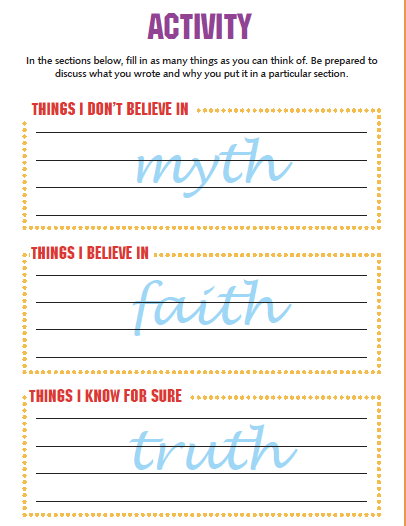
On the board, compile three lists: Things I Don’t Believe In, Things I Believe In (faith), and Things I Know For Sure (can prove). Ask students to make entries from the lists in their Students’ books. Discuss what has been placed in each column. Ask what could cause an item to move from one column to another.
REACH Activity
Word Study: Therapeuo
The word “healing” in this week’s memory verse is the Greek word “therapeuo.” It means to heal miraculously, not effectively heal. That is, the healing happens right then, not as a matter of a cure, and not spiritually, but physically. It is similar to, but not exactly, the Greek word from which we derive our English word “therapeutic.”
Did You Know?
In Matthew 4:23-24 there is a list of the kinds of healings Jesus did. One of these is “those having seizures.“ The Greek word that was translated for this phrase originally meant “moonstruck” and reflects the ancient superstition that seizures were caused by changes of the moon. (Source: NIV Archaeological Study Bible, p. 1564.)
Music Notes: Rescue the Perishing
This hymn is found on page 156 of the CEM Hymnal. The words to this hymn were written by Fanny Crosby (1820-1915), often called the “queen of Gospel music.” This is her account of how she wrote this hymn:
“I remember writing that hymn in the year 1869. Like many of my hymns, it was written following a personal experience at the New York City Bowery Mission. I usually tried to get to the mission at least one night a week to talk to ‘my boys.’ I was addressing a large company of working men one hot summer evening, when the thought kept forcing itself on my mind that some mother’s boy must be rescued that night or he might be eternally lost. So I made a pressing plea that if there was a boy present who had wandered from his mother’s home and teaching, he should come to me at the end of the service. A young man of 18 came forward—‘Did you mean me, Miss Crosby? I promised my mother to meet her in heaven, but as I am now living, that will be impossible.’ We prayed for him and suddenly he arose with a new light in his eyes—‘Now I am ready to meet my mother in heaven, for I found God.’”
A few days before, William Doane, the composer of the melody had sent Fanny Crosby the music to be titled “Rescue the Perishing.” It was to be based on the text “Go out into the highways and hedges, and compel them to come in, that my house may be filled” (Luke 14:21). (Source: Amazing Grace, Osbeck, K., p. 297.)
Journal Jot
Many people believe that if they ask God to heal them of a physical condition, He will do it. Then when they are not healed, they lose their faith in God and His power to heal. God is not a genie who lives to grant our wishes. He is the great God of the universe who loves us more than our own parents do. He wants the very best in our lives. And He wants us in His Kingdom. If that means not healing someone, then that’s what He will do. Write about this in your Bible journal. Write about why God might not heal someone. Write about how you might feel if God didn’t heal you. Then write what you believe about God and His power to heal.
Back to the Bible
The Psalms express praise, worship, and confession to God. They were written in a poetic style and so are grouped with the other books of poetry, including Job, Proverbs, Ecclesiastes, and Song of Songs. David was one of the writers of the Psalms. During his life, David was a shepherd, a warrior, and a king. David wrote Psalm 29, which speaks of God’s power in nature, “. . . the Lord thunders over the mighty waters. The voice of the Lord is powerful. . . majestic. . . breaks the cedars. . . in pieces. . . shakes the desert. The Lord gives strength to his people; the Lord blesses his people with peace” (NIV). Even though David was writing about God’s power within nature, think about how His power can overcome illness, disease, and other ailments. Read Psalm 29 carefully and notice the details of His power. No power equals His. No one but God can provide you with the strength and courage to walk through any of life’s sicknesses, whether physical or spiritual. His power does not involve trickery or magic. He has the power to heal. Pray with faith, live according to God’s way, and look forward to living in God’s Kingdom with Him!
Just Toolin’ Around
The YEA lesson mentions many of the healing miracles that Jesus performed. Who were the people and what were their illnesses or handicaps? Where did the healings take place? Read the Scriptures to find out more about the people and their healings by Jesus. Write about each miracle in your journal. You might want to have a section just for the miracles of Jesus. Share your information with others.
Stretch It Out
Write and perform a play or skit of Jesus’ miracles. (If you have a large class or family, do more than one.) Gather necessary props and supplies. Choose a song or songs that the actors, and perhaps audience can sing along with before, during, and after the performance. Serve easy refreshments, perhaps popcorn and/or lemonade (during cooler weather, hot chocolate). Design invitations with the theme of the play/skit and invite friends and family to a night of miracles!
Questions?
Remember to write any questions that you have in your journal. That way you will remember to ask your parents, teacher, or minister.
Song
“Oh, How I love Jesus” is on page 66 in the Kids Classics Collection.
Closing Prayer
Lead students in asking God for spiritual healing, that all of us may be in God’s Kingdom with Him forever.
Printable Pages