YEA Lesson Library
Bread and Fish
About This Lesson
Using the miracle of feeding the 5000, this lesson teaches that we need to seek God and His will always, asking Him to provide for our needs.
Scriptures
Matthew 7:7-11
Matthew 14:15-21
Matthew 15:32-39
Mark 6:34-44
Mark 8:1-9
Luke 9:11-17
John 6:1-13
John 6:35
Words to Know
PHYSICAL - something you can touch or see
SPIRITUAL - having to do with the spirit world; i.e., God, the things of God
NECESSITY - something we need to survive
The Lesson
Have you ever been really hungry? Not the kind of hunger when it’s ten minutes before lunch time and you would really like the math lesson to be over. Or when you’ve just seen a candy bar commercial on TV. The hunger that comes when you’ve worked hard and missed a couple of meals. If you’ve fasted on the Day of Atonement, you know what I mean. It’s the hunger you get about 3:00 in the afternoon, when there are several hours of fasting left. This kind of hunger shows how important food is to keep your body going. We call food a necessity.
One day Jesus performed a miracle because people were hungry. A large crowd came to hear Him teaching. When it was time to eat, Jesus asked His disciples where they could get enough bread. To buy enough for everyone to have just one bite would cost more than eight months wages, Philip said. There were about 5000 men, plus women and children. Then Andrew said something that sounded pretty silly, since many people needed to eat. He said, “Here is a boy with five small barley loaves and two small fish, but how far will they go among so many?” At least Andrew knew that normally this small amount wouldn’t feed many people. But Jesus took the loaves, gave thanks to God, and gave each person as much as he or she wanted. He did the same thing with the fish. When everyone had eaten, the disciples gathered enough leftover pieces to fill 12 baskets. It was truly a miracle!
We don’t know why all those people were there. Maybe they wanted Jesus to heal them. Perhaps they wanted to hear what He had to say, or were just curious about who He was. For whatever reason they were there, Jesus had compassion on them. They needed something to eat and Jesus performed a miracle to feed them. We know that our God is merciful and loving. Does that mean He always provides food for people to eat? There are famines. Why?
There’s a clue to the answer in Matthew 6:33. “But seek first his kingdom and his righteousness, and all these things will be given to you as well.” What was Christ talking about in this Scripture? Matthew 6:25 says, “Therefore I tell you, do not worry about your life, what you will eat or drink; or about your body, what you will wear.” Food is one of the things referred to in Matthew 6:33. We need to learn to do God’s will and to behave as His children should, and then He will provide everything we need.
In Matthew 7:9-11, Jesus says, “Which of you, if his son asks for bread, will give him a stone? Or if he asks for a fish, will give him a snake? If you, then, though you are evil, know how to give good gifts to your children, how much more will your Father in heaven give good gifts to those who ask him!” Our God is loving and merciful. He knows we need food, something to drink, clothes, and other necessities.
Another time, Jesus told a large crowd to look at how God provides for the birds. They don’t plant gardens or store things in barns, but He feeds them. As long as we are seeking God and trying to do His will, He will take care of us. He really is interested in getting each of us into His Kingdom. Our spiritual well-being is much more important to Him than our physical well-being. That’s exactly what Jesus was talking about when He said, “Do not store up for yourselves treasures on earth. . . but store up for yourselves treasures in heaven. . . For where your treasure is, there your heart will be also” (Matthew 6:19-21).
What kind of treasures was Christ talking about? Think of something you really, really want. Maybe an Xbox game or an iPod. Things we want, but don’t really need, can focus our attention on earthly, physical things. Toys, games, clothes, and other things are not very important compared to what God wants for us. He wants us to spend eternity with Him. To do that, we need to be concerned with things that matter to God. The physical things that concern us aren’t nearly as important as we think.
Don’t think food isn’t important to God. Jesus told His disciples to gather up all the leftover pieces. The food shouldn’t be taken for granted or wasted even if it was created by a miracle. How we take care of physical things shows God what we’ll do with more important things.
So, the next time you want something, ask yourself if it’s really that important. Ask yourself if Jesus thought it was important when He was your age. And, the next time you really need something, don’t waste your time worrying about whether you’ll get it. Just ask your Heavenly Father for whatever it is you need. In the meantime, read your Bible and take time to pray. Remember, as much as God cares about your physical needs, He cares about your spiritual needs even more. He really wants to spend eternity with you!
Student Prayer
Dear Heavenly Father,
Please help me to know the difference between what I want and what I need. Help me to truly understand that what you have planned for me is much better than I can ever imagine. I want to seek you, but I need your help.
In the name of your Son, Jesus Christ.
Amen.
Daily Devotions
Sunday - Luke 9:11-17
Monday - Matthew 14:15-21
Tuesday - Mark 6:34-39
Wednesday - John 6:5-14
Thursday - Matthew 15:32-39
Friday - Mark 8:1-9
Saturday - Mark 6:40-44
Objectives
At the end of this lesson, students will be able to:
1. Retell the miracle of Jesus feeding the 5000.
2. Explain that God cares about our physical needs.
3. State that there is a difference between needs and wants.
4. Tell why Jesus wants us to seek God’s Kingdom first.
Topics & Themes
Bread/loaves
Bread of Life
Disciples
Andrew
Philip
Eternity
Fasting
Fish
God’s Gifts
God’s Love
God’s Provision
God’s Will
Jesus, His Ministry
Jesus, His Miracles
Feeding of 5000
Hungry
Seeking God
Stewardship
Treasure
Materials Needed
Bible, YEA Students’ and Teacher’s books, attendance and memory verse charts, stars, songbook, CD, CD player
Preparation
Prior to class, familiarize yourself with the four parallel accounts of the feeding of the 5000 (Matthew 14:13-21; Mark 6:32-44; Luke 9:10- 17; John 6:1-13). Because this miracle is in all four Gospel accounts, we have a clue to its significance in our lives as Christians. There are some interest- ing aspects. First, Matthew and Mark relate that Jesus and His disciples tried to find a solitary place, but that Jesus felt compassion for the crowds who followed them. It is only John who tells where the bread and the fish came from: a little boy. Another interesting fact is that John includes the detail that the loaves were made of barley.
Before class, read Matthew 7:7-11, 6:19-21, 25-34. These Scriptures show what Christ considered to be human needs and what is really important. A companion Scripture to these thoughts is Matthew 16:26: “What good will it be for a man if he gains the whole world, yet forfeits his soul?”
How to Teach This Lesson
After opening with prayer, follow the lesson plan.
Temporary Things - Students in this age group are very much into new clothes, computer games, shoes, jeans, hairstyles, cell phones, etc. This lesson, then, may meet with some resistance. Peer pressure is very much a force. Being accepted by their peers can be a strong motivator for Juniors. Therefore, lead students through the lesson carefully. Help them to buy into the concepts by encouraging them to read the Scriptures aloud, and to retell the events in their own words. Encourage them to put themselves in the place of the disciples and of the people who were fed. Let them draw their own conclusions about the miracle’s significance—especially when coupled with Jesus’ teaching on the temporary nature of earthly things (Matthew 6-7). Try not to be preachy; rather, let the students know that all people have to eventually make the choice to follow God, to seek His Kingdom first. It can be very powerful for the teacher to relate a personal incident in which the choice to follow God was made, no matter what the consequences might have been.
He Knows What’s Best - Emphasize that our Heavenly Father is a loving God who does not want to deprive us of what we need; rather, He is working from eternity for eternity. He wants us all to be in His Kingdom and knows what we need to get there. We must believe, and act as though we believe, that He knows what is best for each of us.
Seek First - Spend some time discussing what it means to “seek first His Kingdom and His righteousness.” Help students plan some concrete activities they can do at home during the week that will draw them closer to God, such as: daily Bible reading, reading their daily devotionals, praying for others, confession of sins, making wise choices. They can also log on to our website at www.borntowin.net and download FREE activities— just click on YEA! Let’s R.E.A.C.H.
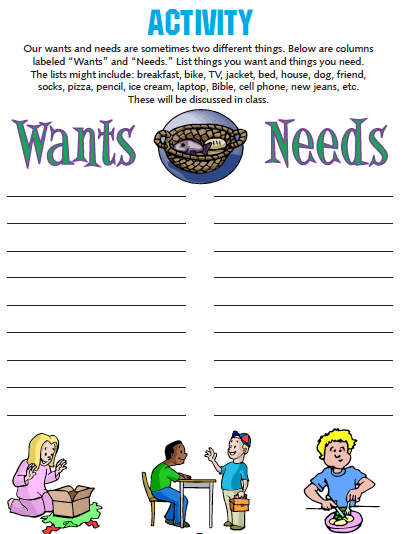
The activity below is designed to foster a discussion about “needs” and “wants” not necessarily being black and white terms. Therefore, do the Activity before asking the review questions.
Review Questions
1. Why did Jesus feed 5000 men (and who knows how many women and children) with five loaves and two fish?
2. Why were they so far away from where food could be purchased?
3. What did Christ tell His disciples to do when everyone had enough?
4. What was the point of picking up the leftovers? Why do you think Christ told them to do that?
5. What does Christ say about God the Father giving us food, drink, clothing, shelter—the necessities?
6. What should we seek first? Why?
7. What’s the difference between a “need” and a “want”?
Teacher-Directed Activity
Divide your room in half, either visually or merely verbally. One side represents the “wants” and the other side the “needs.” Instruct students to move to the appropriate side of the room as you read off the items listed in the Student book Activity. Try to remain neutral and allow students to discuss why they chose a particular side. Then give the option of changing sides if anyone has changed his mind. Spend some time on each item because the status of many of the items is contingent upon the situation. Let students discover that. Let them discuss various situations and how they can change an item from a “want” to a “need,” or vice versa.
REACH Activity
Word Study: Erchomai
In John 6:35, Jesus says “he that cometh” (KJV). The Greek word for “cometh” is “erchomai” which simply means “to come,” the opposite of “to go.” It is important to know that Jesus wants us to come to Him. He doesn’t come to us; we have to desire Him and a relationship with Him enough to move in His direction. We can’t wait for Him to come to us.
Did You Know?
The barley loaves the boy had in John 6:1-13 would have been very unlike our loaves of bread today. They were made of barley, a cheap bread that was a staple for the poor. And they were small and flat—several could easily be eaten by a person in a single meal. (Source: NIV Archaeological Study Bible, p. 1638.)
Music Notes: Guide Me, O Thou Great Eternal
This hymn is found on page 14 of the CEM Hymnal. The words were written by William Williams. Revival swept through Wales in the 18th century, led by a 24-year-old Welsh preacher, Howell Harris. Harris’ evangelistic preaching and congregational singing touched William Williams when he was 20 years old. Williams was the son of a wealthy Welsh farmer and was preparing to become a medical doctor. But when challenged by Harris, Williams decided to dedicate his life to God and the Christian ministry. For the next 43 years, William Williams traveled 100,000 miles across Wales on horseback preaching and singing the Gospel. He became known as the “sweet singer of Wales.”
The words for this hymn are drawn wholly from the Bible, generally focusing on the march of the Israelites from Egypt to Canaan. Traveling in the wilderness for 40 years, God provided for their physical needs, including a fresh supply of manna daily. Similarly, God provided water. And God led His people with a cloud by day and a pillar of fire by night. (Source: Amazing Grace, Osbeck, K., p. 13.)
Journal Jot
Read the Music Notes section on the previous page. Then spend a few minutes thinking about the true needs of William Williams as he wandered around Wales, and of the Israelites as they wandered in the wilderness. Knowing that these people had to carry their possessions as they traveled, you can well imagine their want for unnecessary items was very limited. Similarly, as you complete the list in your YEA book, think about traveling on horseback or even in a minivan. Does that help you define needs and wants?
Now spend a few minutes writing in your Bible journal about the blessings of God, how He has given you so much more than you need, granting many of your wants. What then should your response be?
Back to the Bible
The Bible has many references to bread and manna. In the YEA lesson Scriptures we read that the Passover Feast was near, or “nigh.” During this festival all leavened bread is to be removed from our households (Leviticus 23:6). Leavened bread rises due to an ingredient called yeast. Before this Feast begins we remove all leavened products from our homes because during these days, leavening pictures sin and unrighteousness. Sin causes us to be “puffed up” (like leavened bread) or full of pride and arrogance (1 Corinthians 5:6-8 ). Unleavened bread does not have yeast as one of its ingredients. This bread is flat; it does not rise or puff up. This unleavened bread pictures Jesus Christ who was without sin. During the Days of Unleavened Bread, we eat bread without yeast because pure Jesus is the Bread of Life without sin (yeast). As we eat unleavened bread for seven days during the Passover Feast, we should remember that Jesus is the Bread of Life. We remember symbolically by eating unleavened bread, and we also do it by reading and studying the Bible and spending time in prayer with Christ because He is the Bread of Life and our provider (Matthew 6:11).
Just Toolin’ Around
Use a Bible and concordance to find at least two other Scriptures that refer to Jesus as the “Bread of Life.” Write them in your journal and compare them to the YEA lesson memory verse.
Stretch It Out
There are many songs of praise and worship that use the YEA lesson Scripture as their focus. Use a CEM Hymnal or other source to find a song that you believe fits the YEA lesson well. Try to find someone to play it for you on the piano for class or bring a CD or tape with the music on it. Teach the song to the Sabbath School class, or your family. Research the story behind the song and explain why you chose it.
Questions?
Remember to write any questions that you have in your journal. That way you will remember to ask your parents, teacher, or minister.
Song
“His Banner Over Me Is Love” is on page 36 of the Kids Classics Collection.
Closing Prayer
Have one of the students lead in prayer thanking God for providing for all of our needs.
Printable Pages