YE3A.1 · Activity Page
Isaiah 7:10-16
Isaiah 9:6
Matthew 1:20-23
Matthew 2:1-12
Luke 1:26-38
Luke 2:1-20
Luke 2:11
John 7:42
EMPEROR - a male ruler or sovereign
HUMBLE - low in importance or stature
SWADDLING - cloths used to wrap a newborn baby
Most children love to celebrate their birthdays. Cake with candles, gifts, and special treatment are really fun. It’s neat to hear everyone sing “Happy Birthday to You.” You get the attention and feel very special that one day of the year. You have something to celebrate – you’re one year older!
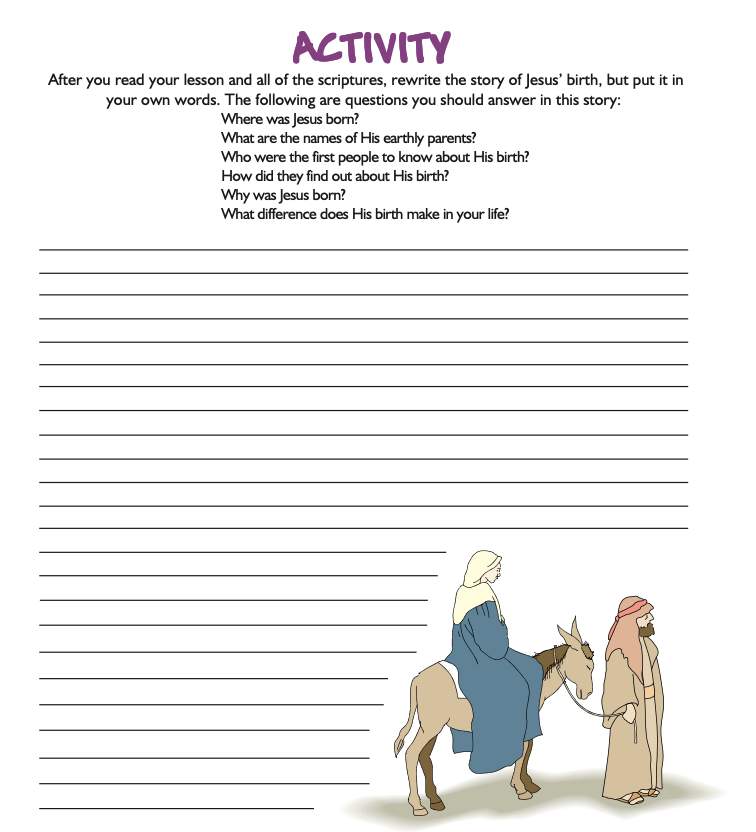
Something very special took place many years ago, about the time of the Feast of Tabernacles. This event was worthy of the entire world celebrating. Yet God chose not to reveal this event to kings, emperors, or even the religious leaders that night. He chose humble shepherds to be the first to know about the birth of Jesus. News traveled, and kings, emperors, and religious leaders learned about the birth of Jesus later.
That crisp autumn night an angel suddenly appeared to shepherds who were watching their flocks on the hills near Bethlehem. The glory of God brightly lit up the sky. It was a most unusual occurrence and frightened the shepherds.
An angel said to them, “Don’t be afraid because I’m here to give you good news of great joy! It is for everyone. Today in the town of Bethlehem a Savior has been born for you. He is Christ the Lord. Here is how you will know that I am telling you the truth. You will find the baby wrapped in swaddling clothes lying in a manger.”
A large group of angels suddenly appeared to the shepherds. They celebrated by singing praises to God. You’ve never heard such beautiful music as the heavenly choir sang:
“Glory to God in the highest and may peace be to men on Earth that He is pleased with.”
What a celebration! We’ve never seen anything like it. The angels returned to heaven. But the shepherds were never quite the same.
This was wonderful news! The shepherds wanted to see their Savior with their very own eyes. So they hurried off to Bethlehem. And, just as the angel said, they found baby Jesus lying in a manger. He was wrapped in swaddling clothes. His mother, Mary, and Joseph were in the stable with Him.
Why was the birth of Jesus so important? Jesus Christ was the one who created the heavens, the earth, and all that is in them. He was very God! He came to earth as a baby because Adam and Eve, and every person after them have sinned. A Savior was needed to pay the penalty for our sins, or we would all die and never live again.
You know, it was much, much better being God than giving up all that glory and becoming a mere human being. But Jesus was willing to do it. He knew He had to come as a flesh and blood man to be our Savior. Jesus was willing to be born in a stable and lie in a manger where cattle are usually fed. He lived a perfect life and died in your place, for your sins. He deserved much better than to be deprived of His glory and die for you. But He did it because He loves you so much. Talk about celebrating – this is really something worth celebrating!
The way Jesus wants you to celebrate His birth is by showing you love Him. How can you do that? By obeying His Word and by treating others the way you want to be treated.
The shepherds knew Jesus came to be our Savior. They saw Him lying in the lowly manger. They were thankful He was willing to give up living in heaven to be born in a stable. They couldn’t keep this good news to themselves. They went everywhere praising God and telling everyone what they saw.
Christmas, with all of its false representation of Santa Claus, overlooks the real point of Jesus’ birth. He came to be our King and our Savior. Praise God and be thankful every day of the year, not just on one day. We have Something Worth Celebrating because Jesus Christ was born to be our Savior!
Dear Heavenly Father,
The birth of your Son was such a wonderful event. Thank you that Jesus was willing to give up His glory and come in the flesh to be my Savior.
In Jesus’ name I pray.
Amen.
Sunday - Isaiah 9:6
Monday - Isaiah 7:10-16
Tuesday - Matthew 1:20-23
Wednesday - Luke 1:26-27
Thursday - Luke 2:8-11
Friday - Luke 2:14
Saturday - John 7:42
1. Role-Playing with Puppets: Using craft sticks, markers, paper, scissors, and glue, make puppets to retell the story of Jesus’ birth. If you have several students, have them each make one of the characters. If you only have a couple of students, you can work with them to make the puppets, or you may wish to have constructed several prior to class.
2. Mapwork: Using the REACH activity (Word Meanings: Bethlehem) as a springboard, find out more about where Jesus was born. Locate Israel and Bethlehem on a map. Determine where Israel is in relation to you. Figure out how big Israel is and compare its size to your present location.
3. Music Extension: What songs do you associate with Jesus’ birth? Which ones are totally Christmas songs (i.e. “Grandma Got Ran Over By a Reindeer”)? Some people associate some songs with Christmas when they are winter songs, i.e. “Jingle Bells” or “Winter Wonderland” or “Frosty the Snowman.” Other songs are completely about the birth of Jesus and there is nothing in them we would disagree with. What is not accurate in some of the songs which seem to be just about Jesus’ birth? Hint: Look for words like “snow” or “winter.” Challenge: look up the history of “Joy to the World.” Was it written as a Christmas song? Sing, play, share your favorite song from your research.
4. Birth Prophecies: Use the REACH activity (Did You Know?) as a springboard (the prophecy of Jesus’ birth in Micah 5:2-5). Find other Bible prophecies about Jesus’ birth. Have the students make a list. This can be laminated and turned into a bookmark. (Clear contact paper makes a quick and easy laminate.)
5. Celebration: The title of this lesson is “Something Worth Celebrating.” Brainstorm with the students why it’s called this. Do the students feel Jesus’ birth is worth celebrating? Do they feel guilty celebrating Jesus’ birth because of the world’s association with Christmas? What can they do as a family to celebrate Jesus’ birth in a God-honoring way? Why is it important to them? Brainstorm celebration ideas for this life-changing event.
Zechariah 9:9
Matthew 2:1-23
Matthew 13:55
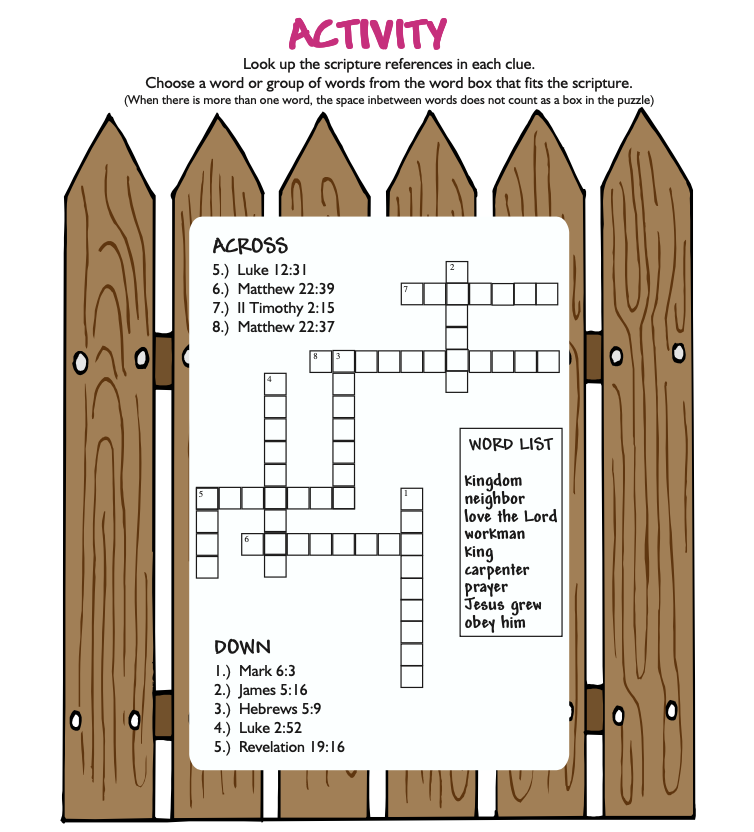
Mark 6:3
Luke 1:31-33
Luke 2:1-52
Luke 2:52
Luke 19:38
John 19:14
I Timothy 6:15
Revelation 11:15
Revelation 17:14
Revelation 19:16
CUSTOMARY - habit or usual events
CONSTRUCT - to build by putting parts together
DESTINY - predetermined course of events
How far back can you remember? Are your earliest memories about your family?Do you remember the good times and the bad times? Do you ever remember being lost from your parents? What’s the first trip you remember taking with your family? Where were your parents born? How many brothers and sisters do they have? Where did they grow up and go to school? Do you know what your dad does for a living? Can you remember helping your dad paint the house, build a dog house, or work on the car?
We learned that Jesus was born in Bethlehem. His mother, Mary, used a manger for His baby bed. His earthly father was named Joseph. Jesus was the oldest Son in the family with at least four brothers and two sisters (Mark 6:3). Family was very important to Jesus. They had good times and bad times, much like you have.
Jesus was still a baby when an angel appeared to Joseph in a dream. The angel told Joseph to flee to Egypt with the baby and His mother because King Herod wanted to kill the child. Joseph left for Egypt with Mary and Jesus that very night. They stayed there until Herod’s death. Again, the angel appeared to Joseph in a dream and told him to take his family back to Judea. But things weren’t as safe as they first seemed because Herod’s son was now king. So the angel told Joseph to go to Galilee instead. They returned to Galilee and made their home there.
Joseph was a carpenter. It was customary for the father to teach his son a worthwhile trade. Young boys learned at the feet of their fathers by watching, helping, and running errands. Joseph must have taught Jesus how to be a carpenter as well. Carpenters constructed homes, but they also made wooden ox carts, plows, tables, chairs, and doors.
When Jesus was 12 years old, He went with His family to celebrate the Passover in Jerusalem. After the celebration was over, they started back home to Nazareth. But Mary and Joseph noticed that Jesus wasn’t with them. They must have thought He was lost, so they started looking for Him. He was nowhere to be found. Returning to Jerusalem to find Him seemed to be the only answer.
Three days later, Mary and Joseph found Jesus in the Temple “sitting with the teachers of the law, discussing deep questions with them.” His teachers were really amazed that He knew so much about the Scriptures. It was really important to Jesus to be in His Father’s house. He wanted to learn everything He could about His Father and His Word. This was a time of physical and spiritual growth for Him. “Jesus grew both tall and wise, and was loved by God and man.”
How did Jesus know the Scriptures so well that He could answer questions of the law teachers? He spent a lot of time studying God’s Word. Even though Jesus looked and played like a 12 year old boy, He knew His destiny was to be our Savior and King. While He was on earth He would not be crowned King, but someday He will return as King of kings and Lord of lords.
Why will Jesus return to this earth? He will come back not only to be our King, but to bring our reward with Him. He wants us to be a part of His family. But not just anyone can be in His family. We can start by working on being wise and being loved by God and man, like Jesus was.
To be a part of God’s family we must believe in Him, love Him, obey Him, and put Him first in our lives. Where do you start to put Jesus first in your life? Do the things He did. Jesus had to study the Bible to know the Scriptures well. You can begin with studying your Sabbath School lessons and reading your Daily Devotionals each day. Then you must practice what you learn. The reward He’ll bring for you will be worth every effort. Your Bible study, obedience, and love for God will make you wise and will cause you to be loved by God and man.
Dear Heavenly Father,
Thank you so much for Jesus being our perfect example. Thank you that He will return as King of Kings and Lord of Lords. Help me to always believe your every word and love you enough to put you first in my life.
In Jesus’ name.
Amen.
Sunday - John 19:14
Monday - Luke 1:31-33
Tuesday - Luke 19:38
Wednesday - I Timothy 6:15
Thursday - Revelation 11:15
Friday - Revelation 17:14
Saturday - Zechariah 9:9
(Youth Educational Adventures Helps)
(alternative approaches to teaching the lesson)
1. Quiz Time. If the students haven’t read the lesson, read it first. If they have read the lesson, review it with them. Ask them what impacted them most or what sticks out in their memory as very significant. Then ask them to create a quiz to give to you (their teacher) or to their parents. Encourage them to use the quarterly and their Bible with the specific verses covered.
2. What Are Your Goals? If the students haven’t read the lesson, read it first. If the students have read the lesson, discuss the main points with them. Then focus on Jesus’ development: Because He knew who He was and what His purpose on earth was, He kept that focus. Even though He likely was trained as a carpenter by His earthly father, He had a hunger for the things of God (as evidenced by Him going to the temple to talk with the teachers of the law for three days). In a similar way, discuss with the students what their long-term goals are and how they are going to achieve them. Remind them that God has designed them as they are for a purpose; they will be much happier if they seek God’s guidance for their future. Sometimes that requires starting small, but we know that God is planning a future in His kingdom with His people as a kingdom of priests, or another analogy, as the Bride of Christ. We must keep that goal in mind regardless of what we’re doing now. Assign the REACH activity “Journal Jot” as homework for this week.
3. Twenty Questions: If the students haven’t read the lesson, read it first. If the students have all read the lesson, discuss the events of Jesus’ life, using the verses from the lesson. Then compile a list with them of the main events (flight to Egypt; return to Galilee; Jesus in the temple as a 12 year old; probable training as carpenter; destiny as King of kings) Write these events on separate pieces of paper. Give one to each student. Then play twenty questions. For instance, one student might say, “I’m thinking of a place.” It could be the temple, Egypt, Nazareth, Galilee. Answering yes/no questions, let the students try to figure out the place. The students may choose places, occupations, characters, timing in the life of Christ, etc. as the Thing they’re thinking of. This reinforces the details of the lesson.
4.Timeline. If the students haven’t read the lesson, read it first. If they have read it, talk about what they learned. Then, using the lesson and the accompanying scriptures, make a timeline of Jesus’ life. For the timeline, cut 11 x 17 sheets of paper in half the long way and glue them together. The students may wish to start with Jesus’ birth. They may choose to write the events or they may choose to draw little pictures with captions to record the events of Jesus’ life. Be sure to leave enough space on the timeline to add more events as you continue to work through the next lessons.
5. Jeopardy. If the students haven’t read the lesson, read it first. If they have read it, write down the significant points from the lesson that they remember. See if they can arrange the events into categories. Using these categories, have the students begin creating a Jeopardy game. This can be added to each successive lesson in this quarterly. Then when the student feels the game is large enough, or when the quarterly is finished, play the games in class, play them with their families, or have a church game night and incorporate the games into the evening’s fun.
Matthew 3:13-17
Matthew 3:16
Matthew 28:19-20
Mark 16:16
Luke 3:21-22
Acts 2:38
Romans 6:4
Colossians 2:12
ARRAY - a large and impressive grouping
RELENT - to soften in feeling or determination
FORGIVE - to pardon
Isn’t it fun to watch birds build their nests? They need a place to lay their eggs. The mother bird sits on the nest to keep the eggs warm until the babies hatch. She searches for a juicy worm and puts it in the baby’s open beak. Then the day comes when it’s time for these little birds to spread their wings and fly. Isn’t it amazing how young they are when they fly?
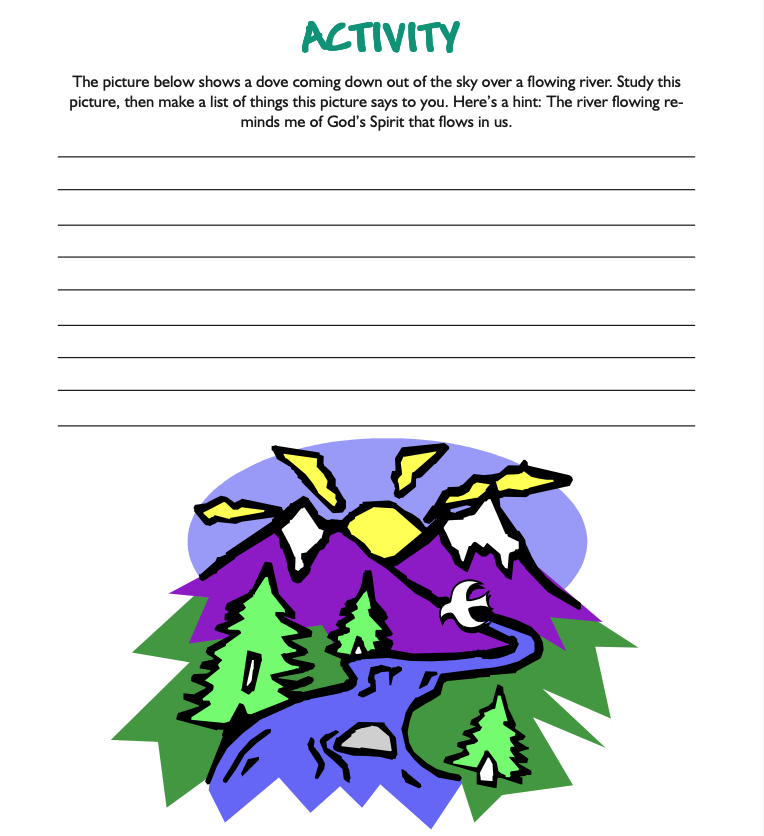
There are many kinds of birds in a beautiful array of colors. Doves are just one of the many varieties. Even within the dove family there are so many different kinds: pigeon dove, Inca dove, ground dove, rock dove, ringed turtle dove, white winged dove, etc. God must have especially liked the dove. It is mentioned several times in the Bible. But this time, God used a dove to represent His Holy Spirit.
One day Jesus went from Galilee to the Jordan River. He saw His cousin, John the Baptist, baptizing people in the river. Jesus asked John to baptize Him. John didn’t think that he was good enough to baptize Jesus, who was the Son of God.
Jesus insisted by saying, “Please do it, for I must do all that is right.” John relented and went with Jesus into the Jordan River. He put Jesus completely under the water. As He came up out of the water “the heavens were opened and Jesus saw the Spirit of God coming down in the form of a dove. And a voice from heaven said, ‘This is my beloved Son, and I am wonderfully pleased with him.’” What a stamp of approval on what Jesus had just done! God was so pleased with His Son that His Spirit came from heaven as a dove and landed upon Jesus.
But why was this such a special event? Why did Jesus need to be baptized? Acts 2:38 says: “Each one of you must turn from sin; return to God, and be baptized in the name of Jesus Christ for the forgiveness of your sins, then you also shall receive this gift, the Holy Spirit.” But Jesus never sinned. He never did anything wrong. Then why did He need to be baptized? Jesus wanted to do everything to please His Father. It is right for everyone to be baptized. Even though Jesus never sinned, He still wanted to obey His Father and do every right thing.
You may ask, what is sin? You sin any time you break one of God’s commandments. Any time you make anyone or anything more important than God, that is breaking the first commandment. God says we shouldn’t work on the Sabbath day. It is to be kept holy. If we do what we want instead of keeping the Sabbath like God wants us to, then we sin. If we don’t honor and respect our parents, we are sinning. If we steal or kill, we are sinning.
Why do you have to be put completely under water when you are baptized? Because God washes all your sins away when you repent. Baptism also pictures the burial of your old sinful self and becoming a new Christian who will follow God.
Anytime you sin, God wants you to repent of the wrong you have done. He wants you to be very sorry for doing it. Then He is quick to forgive you. Sinning is a very serious thing that you can’t take lightly. You must really mean the prayer you pray when you repent.
There comes a time in everyone’s life when he should be baptized. But before you can be baptized, you need to be old enough to understand what sin is and how bad it is. You must be really sorry for all of your sins and try hard to never do them again. Then Jesus will forgive you. He will give His stamp of approval on what you have done. He will also give you His Holy Spirit.
The Holy Spirit can help you resist sin and to do what is right. It can help you understand God’s way better. God wants us to learn to obey Him and not sin. Pray that God will help you repent. Tell Him that you want to be baptized. Every time you see or think of a dove, remember that God used it to picture His Holy Spirit.
Dear Heavenly Father,
Thank you that Jesus set me such a perfect example. Help me to really understand what sin is and how bad it is. Help me to understand when I am ready to be baptized.
In Jesus’ name.
Amen.
Sunday - Matthew 3:16
Monday - Luke 3:21
Tuesday - Mark 16:16
Wednesday - Matthew 28:19-20
Thursday - Acts 2:38
Friday - Romans 6:4
Saturday - Colossians 2:12
Junior YEAH (Youth Educational Adventures Helps)
(alternative approaches to teaching the lesson)
1. Role Play: If the students haven’t read the lesson, read it first. If they have read the lesson, review it with them. Using the review questions in the teacher’s quarterly is a good way to ascertain that they’ve read and understood the lesson. Then assign parts to role play: John the Baptist, soldiers, tax collectors, people, Jesus. Talk about where John was, what he said to the people listening to him, what he said to Jesus and Jesus’ response.
2. Retelling - Spreading the News: If the students haven’t read the lesson, read it first. If they have read the lesson, review it with them. Discuss with the students how this event would have spread like wildfire! God the Father declaring that He was well-pleased with His Son! John baptizing Jesus in the Jordan! The Holy Spirit coming down like a dove in bodily form! You know that the people who viewed all of this would have shared it. Assignment for students: Pretend you were an observer. Practice retelling the story from that point of view to each other.
3. A Picture’s Worth a Thousand Words: If the students haven’t read the lesson, read it first. If they have read the lesson, review it with them. Ask them to make a pictorial presentation of the assignment. They may choose to draw a cartoon strip. They may choose to make a trifold pamphlet. They may choose a bird’s eye view of the whole event. Encourage them to use their favorite color tools (crayons, markers, colored pencils, tempera paint) to bring it to life.
4. Baptism Essay: If the students haven’t read the lesson, read it first. If they have read the lesson, review it with them. Some students would be very uncomfortable role-playing, drawing, or retelling the story. But they would feel right at home writing down the events in a descriptive essay. This can be in letter format - as if they were telling a friend what happened. It can also be a descriptive essay with a title like “A Significant Event in Jesus’ Life.” They should remember to include the answers to who?, What?. When?. Where? and Why?
5. Making It Personal: If the students haven’t read the lesson, read it first. If they have read the lesson, review it with them. Have the students write an essay explaining what baptism is, when it is done, why someone would want to be baptized, and what the benefits of baptism are. Include in the essay the things that are not reasons to be baptized, i.e. my friend is getting baptized, my parents really want me to, it looks like fun, etc. Encourage them to include Bible scriptures in their essay.
Matthew 4:18-22
Matthew 9:9-13
Matthew 28:19-20
Mark 2:13-17
Mark 3:13-19
Mark 6:7-13
Luke 6:12-19
Luke 9:1-6
John 1:29-51
John 5:1-11
James 1:22
DISCIPLE - student, follower of Christ
TRAITS - qualities of one’s nature
APOSTLE - any of the original 12 disciples called of God to preach the gospel
Have you ever thought about why you go to school every day? Why do you do your homework each night? School trains you to be a successful, independent person. You learn how to read, write, count, add, subtract, multiply, and divide at school. You also learn to use the computer. Having computer skills can make learning even more fun.
The things you learn in school give you skills and knowledge that you will need to make a living someday. How well you learn will make a difference in whether you are poor or rich when you get older. It will have a lot to do with how well you and your family will live. A good education is very important for everyone.
Jesus had a job that needed to be done. He knew that He needed helpers to get that job done. That job was letting the entire world know that He came to be their Friend and Savior. Jesus knew His helpers would need training. They needed to be taught how to make friends out of enemies.
Before Jesus picked His first 12 helpers, He spent all night praying to God. He wanted God to help Him make the right choices. He probably discussed each man’s natural traits and talents with His Father. He may have asked God to show Him what each man needed to know and how to teach them.
At daybreak, Jesus called all 12 men up onto a mountain: Peter, Andrew, James, John, Philip, Bartholomew, Matthew, Thomas, James, Simon, Judas, and Judas Iscariot. These 12 men were disciples who became apostles. A disciple is a student, follower, and a believer. Apostles are special representatives. Don’t you think Jesus taught His disciples a lot of things up on that mountain?
When they came down, there were many people who wanted to hear Jesus, and many wanted to be healed. People came from all over Judea, Jerusalem, and as far north as the seacoast of Tyre and Sidon.
Jesus continued teaching His disciples. He said that the needy person should be happy because the Kingdom of God belongs to him. Hungry people should be happy because they will be satisfied. Those who are now sad will become happy and laugh. “Be happy when people hate you and have nothing to do with you and even treat your name like it is evil. They do all this because you follow me,” Jesus said. “Just remember they treated God’s prophets the same way. When these things happen, be glad and jump for joy because God will give you many blessings.”
Do you see what Jesus was teaching His disciples? He told them that bad times would come. No one likes to have enemies. It hurts when people say bad things about us. But how can we ever learn how to treat our enemies if everyone treats us nicely? Jesus knows when others wrong us. And, He will reward us if we follow Him.
We’re being trained just like Jesus’ disciples were. Jesus still needs helpers to tell others what He came to do. He wants everyone to know about the daily help Jesus can give. But Jesus has even greater things to give us than help today. He wants us to be part of His family and live with Him forever.
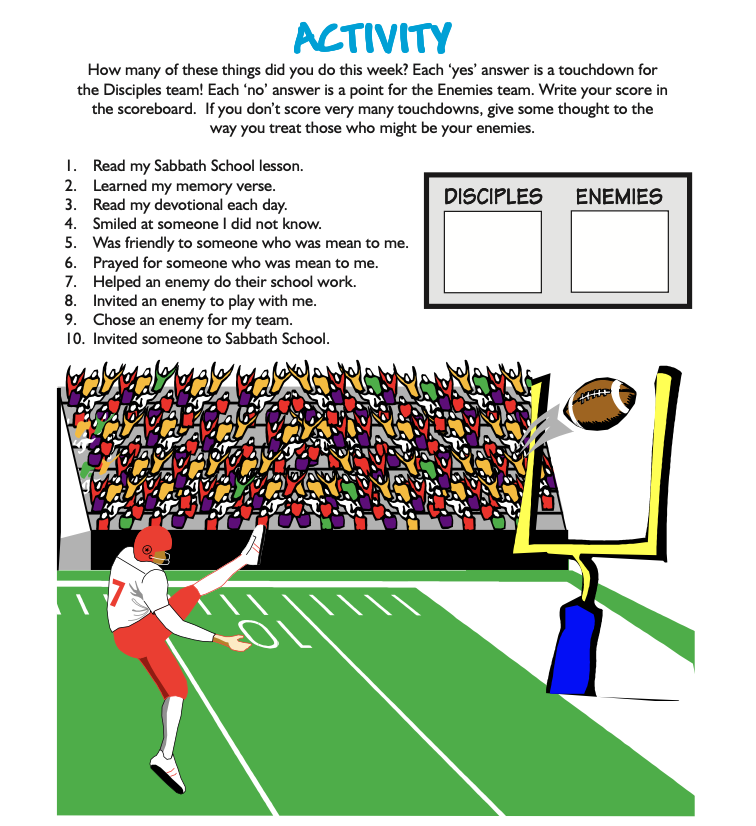
To be part of His family, you must learn His way and live it. Read your YEA lessons, Daily Devotionals, and your Bible each day. Attend Sabbath School every week. Show love to your enemies. See how many times this week you can do good for your enemies. Smile, help them with their homework, say nice things about them, invite them to do something with you.
Remember, Jesus prayed all night before He chose His disciples. Prayer is the most important thing we can do for our enemies. It is a good way to show love for them. God may even turn your enemies into good friends. You can be one of Jesus’ helpers by making friends, not enemies.
Dear Father,
Thank you for choosing me to be one of your disciples. Help me to love you so much that I will want to learn everything I can. Help me to show love to my enemies.
In Jesus’ name.
Amen.
Sunday - John 1:35-42
Monday - Matthew 9:9-13
Tuesday - Mark 2:13-17
Wednesday - Mark 3:13-19
Thursday - Mark 6:7-13
Friday - John 1:43-51
Saturday - Luke 9:1-6
(Youth Educational Adventures Helps)
(alternative approaches to teaching the lesson)
1. Chosen - If you were going to choose twelve people to help you, what characteristics would you look for? For example, would integrity or slothful be high on the list? As a class, brainstorm as many characteristics as possible in five minutes. (Setting a timer lets the students know this won’t take up the whole class time.) Include in the list the characteristics you definitely wouldn’t want. Then go back to the lesson and re-read the lesson together. Complete the activities in the student quarterly and teacher’s guide.
2. What’s His Name? Sometimes it’s very confusing to try to memorize the twelve disciples because a couple of them have alternate names. Using the scriptures (Matthew 10:2-4; Mark 3:16-19; Luke 6:14-16; John 1:45-49; John 14:22; Acts 1:13), make a chart, listing the disciples and their alternate names. Then re-read the lesson together, discussing as you go. Assign the students to memorize the twelve disciples.
3. Teaching. Define the word disciple. Because disciple means learner, you would expect Jesus to teach. Talk about one of Jesus’ most famous teachings, the Sermon on the Mount, which includes the Beatitudes. Ask the students how many of them they can name. What other topics were in the sermon? Then re-read the lesson together, discussing it as you go.
4. Disciple vs. Apostle. Define both terms. A disciple is a student or learner; an apostle is one who is sent. But apostle has come to mean one of the disciples who was chosen by Jesus and sent to spread the gospel. Dig into the definitions further with the students: Why would someone become a disciple? To learn from the teacher. If they are not willing to put the teaching into practice, then what’s the point of learning? A disciple who learns, and is willing to be used, can be sent to teach others. When the twelve disciples were sent out by Jesus, they are referred to as apostles. It can be very confusing for children when adults use the two terms interchangeably. Once they understand the definitions, ask them if an apostle can still be a disciple. Yes; they are two different roles. Just because a disciple became an apostle doesn’t mean he stopped learning from the Master. With this introduction, if the students haven’t read the lesson, read the lesson together and discuss it.
5. D-I-S-C-I-P-L-E acrostic. Read and discuss the lesson together before doing this activity. (This activity is found in the REACH activities for this lesson.) Use the letters from “disciple” to create an acrostic poem. (Remember that an acrostic poem doesn’t have to rhyme - and usually doesn’t. Acrostics can be one word on each line or an entire sentence. What makes it acrostic is the beginner letter of each line.) Each letter starts a sentence or description of something the students learned from the lesson or an important point from the lesson. Here’s an example, in case you get stuck.
Disciples were chosen by Jesus; they didn’t chose Him.
Instead of catching fish, Jesus told them He would make them fishers of men.
Simon, the brother of Andrew, was also called Peter.
Calling the disciples meant that they would leave everything to follow Jesus.
It was a very diverse group - tax collectors, fishermen, and zealots.
Pursuing God’s purpose for each of their lives was their goal.
Learning to share the gospel and to heal was part of their training.
Experiencing miracles became part of their daily lives.
2 Chronicles 7:14
Matthew 6:5-15
Luke 11:2-4
Romans 12:12
Colossians 4:2
I Thessalonians 5:17
James 4:3
James 5:16
ETIQUETTE - requirements for good social behavior
GREETING - an expression of friendly or respectful regard
SLATE - a record of conduct
As a preteen, the telephone plays a very important part in your life. Eighty years ago a lot of families didn’t even have a telephone. But over the years, it has become a very important tool. It helps you stay in contact with your friends. Have you wished to have your own phone?
It is important to practice certain telephone etiquette. When someone answers the number you dialed, identify yourself and politely ask for the person you wish to speak to. Greet each caller and allow him or her to express their opinions. Close your conversations in a friendly way. Try to be considerate and not bore your friends with calls that are too long. After all, friends are friends, and we want them to like us. So, show them respect.
When you’re on the phone with a friend, how long do you talk before you run out of things to say? What do you talk about all that time? Do you do all of the talking? Do you drag out a “give me” list and spend most of your time asking him for something. If you do this very many times, your friend may stop calling!
Did you know that praying is much like talking with a friend? As good as our friends are, they are limited in what they can do. But God isn’t! You can spend as much time as you like talking to Him and He’ll never tire of hearing your voice. He has plenty of time to listen to you. He loves you and is interested in what you are doing. He is really happy to hear from you. God is the best of all friends.
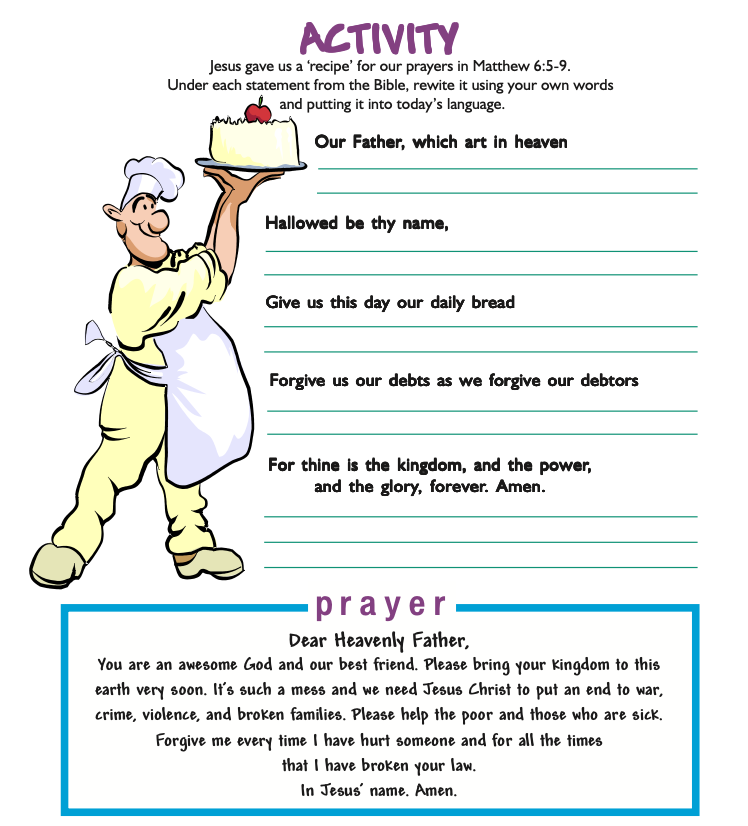
Jesus knew that we might not know how to talk with God so He made it a point to teach us. When we bake cookies or make fudge, we get out a recipe. We follow it to make sure we include all of the ingredients. Jesus gave us a recipe for prayer so we will know what ingredients we should include. Sometimes it is called “The Lord’s Prayer,” but it is really the model prayer. Jesus laid it out in outline form with instructions as to how to approach His Father with respect and the proper etiquette.
First, Jesus says to go to a private place to pray. He doesn’t want you to try to impress other people with how great your prayers are. He wants a private conversation with you. You should talk to God much like you would talk with a friend. You don’t say the same things to your friends each time you call. God doesn’t want to hear the same things each time you pray, either. God knows exactly what you need even before you ask Him. But, remember, God won’t be impressed if you drag out your “give me” list and spend all your time asking for things. He wants you to really get to know Him.
The first ingredient in Jesus’ recipe for prayer is greeting God. There are several ways to begin prayer, but Matthew 6:9 says “Our Father in heaven.” He is not only a Friend, but He is our Father.
Then it says, “we honor your holy name.” Don’t take God for granted or put Him on the level of any human being. He is the Great God of the universe. He is awesome!
The next ingredient we should include in prayer is to ask that His Kingdom will come soon on this earth. When that happens, Jesus will return as our King. He’ll immediately start making this earth a beautiful, wonderful, and peaceful place. What Jesus wants will finally be done, and not what evil, greedy men want. This world will be far better than anything we can imagine. That is why we should ask for God’s Kingdom to come soon!
Spend time talking with God about how wonderful He is and what great things He does.
Then Jesus tells us that we can ask for something. Ask for your food for today. God loves you so much that He cares about your needs. Don’t be selfish and just pray about your own needs. Your family has needs. Friends may have problems and need God’s help. People in the church may be sick and hurting. They need you to pray for them too.
We all do a lot of dumb things and mess up. We need God to forgive us and put things right. So the next ingredient in our prayers is asking God to forgive us when we have sinned. But you know what, you can’t expect God to forgive you of your sins if you don’t forgive others. Jesus says that God simply won’t do it! That’s really something to think about. We’ve got to wipe the slate clean and not hold grudges. It’s just that simple!
Being able to talk with God is one of the most wonderful ways we can spend our time. God wants to hear from you very often. He wants to know you very well. He wants to help you every day of your life. And He wants you to know Him as your best Friend. Take advantage of such a wonderful opportunity and pray every day. Use the recipe given to us in the Bible to help you get started and learn how to include all the ingredients!
Dear Heavenly Father,
You are an awesome God and our best friend. Please bring your kingdom to this earth very soon. It’s such a mess and we need Jesus Christ to put an end to war, crime, violence, and broken families. Please help the poor and those who are sick. Forgive me every time I have hurt someone and for all the times that I have broken your law.
In Jesus’ name.
Amen.
Sunday - Matthew 6:5-15
Monday - Luke 11:2-4
Tuesday - 2 Chronicles 7:14
Wednesday - I Thessalonians 5:17
Thursday - Romans 12:12
Friday - Colossians 4:2
Saturday - James 4:3
Youth Educational Adventures Helps)
(alternative approaches to teaching the lesson)
1. Role Play. You may actually want to have a real phone for the students to hold (You’ll need two.) or you can just pretend. Do some phone conversations. At the start, you need to be the one who makes the call. Model calling without identifying yourself, talking without listening, and making demands. Then model the proper way to call: greeting, identifying yourself, followed by a two-way conversations. Then follow this introduction by teaching the lesson. Have the students go through the quarterly with you, stopping to discuss each paragraph. End by asking them what they learned.
2. Side by Side. If the students haven’t read the lesson, read it with them. If they have read it, ask them what they remember. You can use the review questions in the teacher’s edition. Then, do this activity: Fold a piece of paper in half. On the left side, write the Lord’s Prayer. On the right side, write one or two words to describe each piece. For instance, Our Father (on right) - Greeting (on left); Hallowed be Thy Name (on right) - Acknowledgment of His greatness (on left). Work your way through each piece of the Lord’s Prayer. Our laundry list of wants is not the first thing that should come out of our mouths when we’re praying to our Heavenly Father! Send the completed activity home with the students as a help for them when they pray.
3. Write it out. If the students haven’t read the lesson, read it with them. If they have read it, talk about it. Then have the following discussion: Sometimes it’s hard to know what to say to God. Other times when you are praying, you find your mind wandering away from what you’re saying to God. Writing out your prayer to God can be an effective tool in getting the words down just as you want to say them, to remember to praise Him for who He is first, and to keep your mind focused on a reverent prayer. The benefit, too, of writing out your prayers is that you can go back later and see how God has answered them. You may want to give each student a journal that they can use specifically for prayer. If you do, have them write the Lord’s Prayer on the first page (or inside cover) as a reminder of the recipe Jesus gave His disciples.
4. Frame It. Read and/or review the lesson. Then show the students how to use a ruler to lightly make lines for a framed print. Using their best handwriting, lightly write out the Lord’s Prayer with a pencil. Go over the wiring with a sharpie. There are lots of colors to choose from. Then decorate the background. Or choose to write on a piece of colored paper and mat it with scrapbook materials. There are lots of options!! Then frame it.
5. Picture This. Read and/or review the lesson. Then help the students begin this follow-up activity. Make a coffee table picture book using pieces of construction paper, scrapbook paper, wall calendar photos, glue, sharpies, and clear contact paper. Divide up the Lord’s Prayer into sections. For instance, the first page might be “Our Father, which art in heaven.” Choose a calendar picture which emphasizes the sky or clouds or something majestic. After gluing that onto the scrapbook paper or construction paper (or both), use a sharpie to write the phrase at the bottom, along the side, or in the clouds where it catches the reader’s eye. When the page is complete, cover it with clear contact paper to protect it. Follow this procedure with each page. Either take the final project to a print shop and have it professionally spiral bound or use a hole punch and bind with ribbon.
Genesis 2:1-3
Exodus 16:29
Exodus 20:8-11
Deuteronomy 5:12-15
Isaiah 58:13-14
Matthew 12:1-14
Mark 2:27-28
Mark 3:1-5
Luke 13:10-17
John 5:17-20
COMPARISON - capable of being compared; similarity
PROTEST - objection, disapproval or dissent
BONDAGE - slavery or involuntary servitude
Have you ever seen it snow so much that school was canceled for the day? The snow can be so deep that a blanket of white covers everything. Tree limbs are weighted down with the white stuff. Icicles glisten as the sun comes out. It makes a perfect day to rest. It’s good to pull the covers up and go back to sleep with only your nose peaking out. It’s fun to rest and enjoy the beauty God graciously gives. It’s fun to get out in the snow and feel it, smell it, and touch it with your own hands.
God knows that we need a day of rest. Even animals need to rest. The staff at the Grand Canyon learned this lesson from the donkeys people ride down to visit its lower levels. They found that if they rest the donkeys one day out of seven they live longer. Don’t you think it’s equally important that we rest one day out of seven? Do you think we might live longer if we do?
You know, there are some comparisons to be made with the day school was canceled because of snow and the Sabbath day. You slowed down and thought about what God created. The beautiful white blanket of snow gave you a chance to appreciate one of God’s gifts to us. You enjoyed the snow. God wants us to delight in the Sabbath day. We can do this by spending time appreciating His creation.
Matthew 12:1-14 tells us about Jesus walking through a grainfield with His disciples. They were hungry, so they broke off a few stalks of fresh grain and ate them. But the Pharisees protested. They claimed that Jesus and His disciples were breaking the Sabbath. People, like the Pharisees, are so picky about things that they miss the big picture. They always judge people instead of seeing to it that their own lives please God.
Jesus created the Sabbath for our good. He realized that human needs are important. Simply breaking off a few stalks of grain and eating them when you are hungry doesn’t break the Sabbath. Jesus would never break the Sabbath. He is Lord and Master of the Sabbath.
Jesus told the Pharisees that King David and his men went into the very Temple of God and ate the special bread that only the priests were to eat. David and his men were hungry. Even though they broke the law, Jesus points out that being merciful is more important than condemning the guilty.
On another Sabbath Jesus was teaching in a synagogue. He saw a seriously handicapped woman who had been bent over for years. He called her to Him and touched her. He said, “Woman, you are healed of your sickness.” Immediately she stood up straight and praised God (Luke 13:10-17).
The Pharisees didn’t like that Jesus healed this woman on the Sabbath. They lacked mercy and love to sympathize with hurting or hungry people. Jesus said, “You hypocrites! You work on the Sabbath! Don’t you untie your cattle from their stalls on the Sabbath and lead them out for water? And is it wrong for me, just because it is the Sabbath day, to free this Jewish woman from the bondage in which Satan has held her for eighteen years?” This must have embarrassed and shamed the Pharisees.
Exodus 20:8 clearly teaches that we have “six days a week to do our daily duties and regular work, but the seventh day of the week is a day of Sabbath rest” (TLB). This is not something we can change or mess with. Jesus adds understanding to that scripture by showing us that we can do good on the Sabbath. Taking care of human needs by relieving suffering or hunger is good to do on the Sabbath.
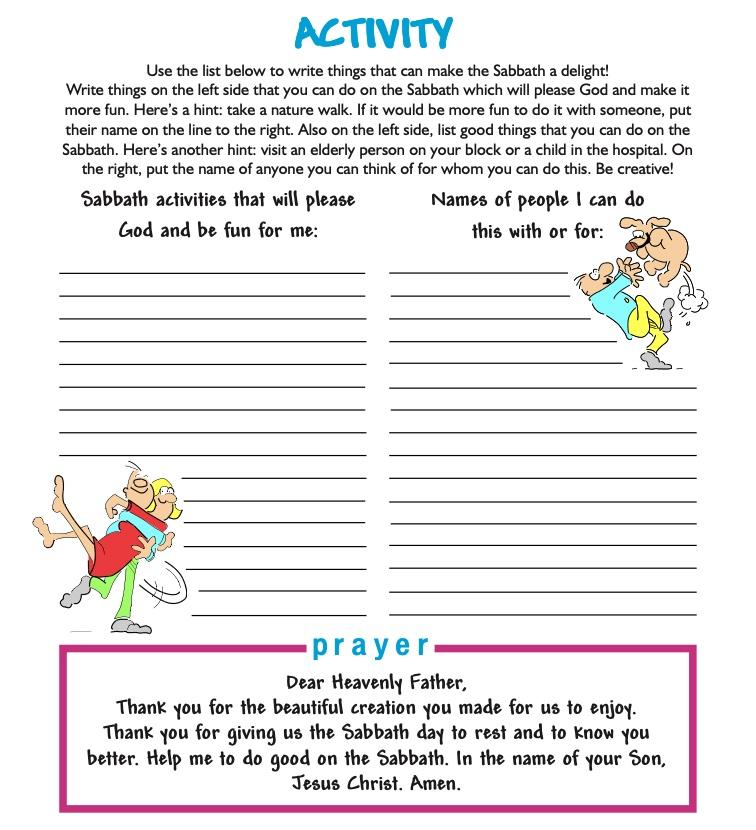
Then how should you keep the Sabbath? We know that we’re not to do our daily duties and regular work on the Sabbath. We learned that it is all right to do good for others. So, what are some things we can do to make the Sabbath a joy and delight? You don’t have your regular work to do so you can get extra sleep and rest. Your greatest desire should be to know God better. Attend Sabbath School and worship services. Hang your “Time-out with God” sign on your door and spend extra time praying and reading your Bible.
There are many things in nature to help you understand and appreciate God. Spend some time looking at creation and thinking about how good and great God is. He made it all for you! Keep God’s Sabbath holy!
Dear Heavenly Father,
Thank you for the beautiful creation you made for us to enjoy. Thank you for giving us the Sabbath day to rest and to know you better. Help me to do good on the Sabbath.
In the name of your Son, Jesus Christ.
Amen.
Sunday - Exodus 20:8-11
Monday - Genesis 2:3
Tuesday - Mark 2:27-28
Wednesday - Deuteronomy 5:12-15
Thursday - Exodus 16:29
Friday - John 5:17-20
Saturday - Mark 3:1-5
(Youth Educational Adventures Helps)
(alternative approaches to teaching the lesson)
Students this age should have read the lesson prior to class. Regardless, make sure to weave the lesson into the following activities.
1. Perspective. Set something on the table. Have the students do a quick drawing of it from four different perspectives: straight on, high, low, and from the side. Discuss how a different viewpoint changes how you see something. And this applies to keeping the Sabbath holy. We as adults who work 40 hours/week long for the sabbath as a day of rest. But children (This group is ages 9 - 11) don’t have this perspective. They usually have lots of energy, their minds are sharp, they sleep well at night and feel good. These two perspectives can clash when it comes to Sabbath observance. The kids want to do something God-honoring and fun (read: active). Their parents want to do something God-honoring which also involves resting and re-cooperating from the work week. Combine the activity in the student’s quarterly and the REACH activity: Journal Jot! It’s very important that we communicate why we do what we do so that our children grow up learning to value the Sabbath.
2. Sabbath Placemats. Families often come up with Sabbath activities to emphasize how special the Sabbath is. Many times it’s a special Sabbath meal Friday evening to bring in the Sabbath. Have the students create special Sabbath placemats using 11 x 17 construction paper, markers, crayons, colored pencils, stamps, ink stamps, stickers, paper punches, etc. Once the placemat is finished, cover it with clear contact paper to keep it nice (and reusable) for Sabbath meals. Instruct the students to make enough placemats for each member in their family - and a couple of extra ones for guests.
3. Create a Flow Chart. It can be difficult to figure out what constitutes an appropriate Sabbath activity. Help the students create a flow chart to help them make evaluations of various activities. It could look something like this:
4. Defining Rest. Discuss the Biblical command to rest. It does mean to cease from your normal labors (to earn money, to go to school). You are to set the Sabbath apart, to make it special, to make sure you’re treating it as holy. But that doesn’t mean you can’t DO anything. It does not mean you have to stay in bed all day - Hebrews 10:25 says that you are not to forsake the assembling of yourselves together. So there is a difference between physical rest and spiritual rest. We need to do both! What does it mean to rest in Christ? What activities are appropriate for Sabbath? (Be wary here; there is a wide range of ideas of what is/is not appropriate for Sabbath.) Encourage the students to have a calm, non-argumentative discussion with their parents.
5. SABBATH acrostic. Write an acrostic poem of good things to do on the sabbath. The students can each make their own, work in pairs, or work together as a large group. Here’s a suggestion, if you get stuck.
S - Sing praises to God.
A - Act justly.
B - Be faithful in church attendance.
B - Be ready to help others
A - Ask God for direction in all that you do.
T - Thank God for His blessings
H - Honor God in all that you do.
Jeremiah 29:13
Matthew 9:28-29
Matthew 13:58
Matthew 21:21
Matthew 24:13
Mark 5:34
Luke 11:5-13
Luke 18:1-8
John 11:41-42
Acts 12:5
James 4:3
I John 3:22
I John 5:14
PERSISTENT - to continue steadily or firmly in some purpose or action, in spite of opposition
GODLESS - evil, sinful
Maggie is a pretty brown and white Springer Spaniel with long curly ears. Her fur is soft and she’s a very lovable dog. But that’s not all, she is very persistent. When she is let out of the house, she’ll come to the breakfast room window and let us know she wants back in.
At first, she makes her wants known very quietly. But if nothing happens, she whacks the window with her paw. Being persistent, she whacks the window again and again until she is let back into the house. She seems to understand that persistence pays off. She hangs in there until she gets an answer.
Jesus used a similar illustration to teach His disciples a principle about praying. “Let’s just suppose you went to a friend’s house to borrow a loaf of bread,” He said. That’s not a terribly unusual request. But it was midnight and his friends were asleep in bed. The man shouted up to his friend that guests had just arrived and he needed to serve them a meal. The friend he had awakened shouted back at him, “Please don’t ask me to get up. The door is locked for the night and we are all in bed. I just can’t help you this time” (Luke 11:5-13 TLB). The man didn’t want to get up out of his warm bed simply for a friend. But the persistent knocking eventually got the man his loaf of bread!
A similar story about a widow lady illustrates the need for constant, persistent prayer. A poor widow lady had been harmed by a man. She went to the judge to appeal for justice. The judge was difficult to get along with and didn’t obey God. Just as Maggie’s owner sometimes ignores her, the judge ignored the lady’s com- plaint.
The poor widow didn’t have a husband to help her when she had problems. But she was very persistent. She wasn’t about to give up until justice was done against the man who harmed her. She came back again and again and made her appeal to the judge. This must have been very difficult for her to do. She could have let this very unpleasant judge intimidate or frighten her. But she hung in there and kept on coming back.
The judge ignored her complaints for awhile. He must have thought she would eventually just go away. But she didn’t! Then she began to get on the judges nerves. He said, “I fear neither God nor man, but this woman bothers me. I’m going to see that she gets justice, because she is wearing me out with her constant coming.”
If Maggie’s owner, a friend all warm in bed, and an evil judge can be reached with persistence, what about God? Don’t you think God, who is all loving and merciful, will surely give you justice if you don’t give up praying? The Bible tells us, “Yes! He will answer them quickly!”
Prayer is like medicine. When the doctor gives you a prescription for medicine, he expects you to follow his instructions and take all of the medicine. Even if you start feeling better, you still have to take all of the medicine to get the full benefit. Perhaps one reason your prayers aren’t answered is because you give up too quickly. Jeremiah 29:13 says, “You will seek me and find me when you seek me with all your heart.” That means you have to continue to pray and be persistent, even if you feel like you have done enough already. If you don’t, you will not get the full benefit of your prayers!
The widow didn’t give up easily when the mean, godless judge ignored her. The man didn’t quit knocking until he got bread to feed his guests. If you want your prayers answered, hang in there. God wants you to be persistent until you get an answer. God honors patient, persistent prayer!
Dear Heavenly Father,
Thank you for showing me that I should hang in there with my prayer request. Help me to remember that I have to be persistent like the widow lady and the man who needed a loaf of bread.
In the name of Jesus Christ.
Amen.
Sunday - I John 5:14
Monday - James 4:3
Tuesday - I John 3:22
Wednesday - Acts 12:5
Thursday - Luke 18:1-8
Friday - John 11:41-42
Saturday - Luke 11:5-13
(Youth Educational Adventures Helps)
(alternative approaches to teaching the lesson)
Review the lesson with the students before doing one (or more) of these activities. Remember, modify these to fit your needs and particular teaching situation and circumstances.
1. Write it Down. 1 Thessalonians 5:17 pairs well with this lesson. Discuss how you can be constant in prayer. Encourage the students to start a prayer journal and be diligent to use it until it’s a habit. See REACH activity: Journal Jot.
2. Famous Prayers: Research some famous Biblical prayers: Jehoshaphat, Daniel, Solomon, (2 Chronicles 20:6-12; Daniel 9:3-19; 2 Chronicles 6:14-22; Nehemiah 9:6-38) Each one acknowledges God’s greatness and provision; each one acknowledges man’s sinfulness and our need for God.
3. God Answers Prayers: Read these four passages and reconcile them to each other: Isaiah 59:2; Proverbs 28:9; 1 John 5:14-15; John 14:13. God’s answer is no. Sometimes it is yes, but not immediately; you have to wait. Sometimes it is yes - but in a much different way than you had imagined. And sometimes God answers our prayers immediately with a resounding yes.
4. Persistence. Consider several examples of not giving up: 1 Samuel 1 (See REACH activities: Back to the Bible); 2 Corinthians 12:8-10; Revelation 2:7; 2:11; 2:17; 2:26-28; 3:5; 3:12; 3:21. Overcoming, enduring to the end, hanging in there, persevering - these are all synonyms for a character trait that God wants us to have. Discuss how you can strengthen your persistence in following God. Discuss an instance when God told Jeremiah not to persist in praying: Jeremiah 7:16; 11:24; 14:11.
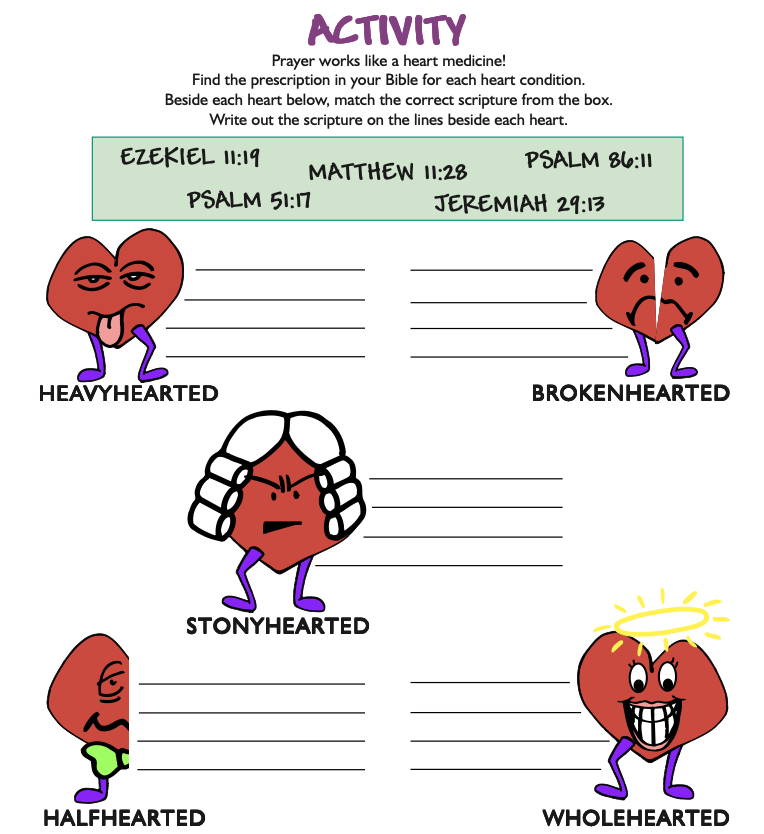
5. Your Heart Condition. Take the five depictions of heart condition from the student quarterly. Write down a time when you fit each of these descriptions. Alternately, role play what it would look like to approach God when you are hard-hearted; broken-hearted; half-hearted; heavy-hearted; whole-hearted.
Matthew 6:33
Matthew 18:4
Matthew 19:16-30
Mark 10:17-31
Luke 18:18-30
Luke 18:27
MONARCH - king, queen, or emperor
FAME - widespread reputation of favorable character
Kings, queens, princes, and princesses capture our imagination. We visualize royalty living in magnificent, huge castles. Servants take care of their every need. These royal people have more money than they know what to do with. Huge precious stones are in their crowns. We think of them being dressed in expensive clothes that often look uncomfortable. We may picture a royal monarch being much older than we are. But that isn’t necessarily true.
Prince William and Prince Harry are heirs to the British throne. Yet we have watched them grow up on television and in the newspaper. Their clothes look much like the clothes you wear. They attended school with other boys their age. But when they were not in boarding school, they lived in lavish palaces. And yes, they are rich!
You may think if you were only wealthy you would never have any problems. Unfortunately that is not true. Princes William and Harry lost their mother in a horrible car crash. Their lives are always in the spotlight. And they are faced with many of the same problems and temptations that you are.
Jesus told us a story in Luke 18:18-30 about a rich young ruler. We don’t know how old he was. He may have been a teenager. But he was old enough to be concerned about what he had to do to have eternal life. He asked Jesus what would be required of him to receive it.
Jesus told the young man, “You know what the Ten Commandments say – don’t commit adultery, don’t murder, don’t steal, don’t lie, honor your parents, and so on.”
The rich young ruler replied, “I’ve obeyed every one of these laws since I was a small child.”
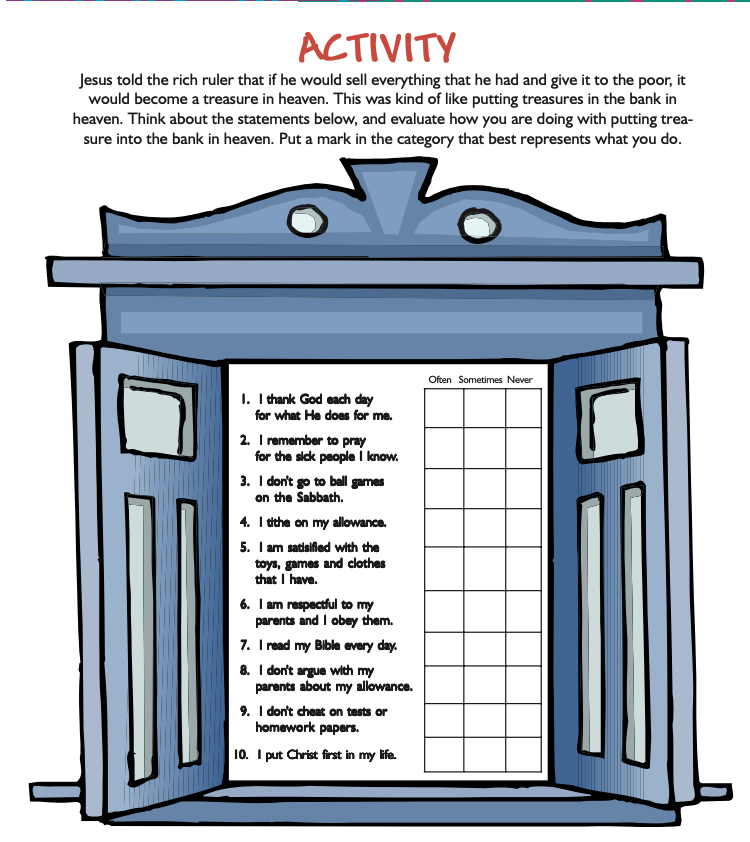
Keeping the commandments is something we do for our own good, and we should keep them. But, keeping the commandments will never gain us eternal life. Jesus said the young man was missing one important thing. He told him to, “Sell all you have and give the money to the poor – it will become treasure for you in heaven – and come, follow me.”
To truly follow Christ, we can’t have anything that we value more than Him. We can’t love money, a car, a career, being on a ball team at school, another person, or even ourselves more than Christ. Jesus knew that the young ruler’s riches were more important to him than God was. He was very sad at what Jesus told him because he was very rich.
Jesus watched as the rich man walked away. He said to His disciples, “How hard it is for the rich to enter the Kingdom of God! It is easier for a camel to go through the eye of a needle than for a rich man to enter the Kingdom of God.”
Have you ever had to thread a needle to sew on a button? It isn’t easy. You’ve seen camels at the zoo. There is no way that a camel can go through the eye of a needle. That is utterly impossible! The disciples must have been amazed that Jesus made this statement. They asked, “How can anyone have eternal life?”
Jesus told them that they can’t earn eternal life. It is a gift that only He can give. All things are possible with Christ, even having eternal life. But He won’t give us that gift if we love money, fame, things, or ourselves more than we love Him. We must love Jesus more than anything else.
Peter, one of Jesus’ disciples, pointed out that they left their homes to follow Him. Jesus promised that everyone who gives up their home, wife, brothers, parents, or children for the sake of God’s Kingdom will be repaid many times over. If you do this, He will not only repay you in this life, but in the world to come. The treasures you have in heaven are greater than anything on earth!
Wealth, fame, and pleasure don’t last forever. But what God promises does. It’s worth it to give up whatever it takes for God. He promises that He will repay you. You’ll have far more than Prince William and all the royal family put together. It’s worth it to live for Christ.
Dear Heavenly Father,
Thank you for showing me that I must put you first in my life. I know that I have put other things before you, and I am really sorry. Thank you that you have promised to reward me if I give anything up for you.
In His name I pray.
Amen.
Sunday - Luke 18:18-27
Monday - Matthew 19:16-22
Tuesday - Mark 10:17-22
Wednesday - Matthew 19:23-30
Thursday - Mark 10:23-27
Friday - Matthew 6:33
Saturday - Matthew 18:4
(Youth Educational Adventures Helps)
(alternative approaches to teaching the lesson)
1. In the Cards. Give a set of eight cards to each student. Each card will have a different word already printed on it: money, family, God, friends, leisure, possessions, pets. Include one blank one for the students to add something else. Have them lay them out in front of them and prioritize them in order of importance in their lives. Then discuss the lesson with the students. Sometimes it’s difficult to figure out what it actually looks like to put God first. Does that mean you can’t have fun with your friends? Does that mean possessions can’t be important to you any more? It’s really important to wrestle with these questions with the students. Then let them re-prioritize the cards if they wish. You might also ask them if they have a certain priority list now, but know that it needs to be different. What would they like it to be? How would they get to that mindset?
2. Giving Everything Up For God. Currently in some places in our world, Muslims will go to Christian homes and demand that they pay a huge fine or convert to Islam or be faced with death. These Christians are fleeing their homes with whatever they can carry - and they feel blessed to be counted worthy to suffer for the name of Christ. Talk about this situation as you’re discussing the lesson with the students. Help them to think about what it means to be willing to give up everything for Jesus Christ.
3. Put God First. Give each student a jar. Have the following items for each student: rock - represents Jesus; marbles - family; beans - represents friends; rice - represents possessions. Have them put in the items according to what is most important. What goes in first? If they put anything in first before the rock, they won’t be able to fit the rock in. It’s a good reminder that God has to be our first choice. Then review the lesson with the students.
4. Role Play. Take turns role playing this story. Actually acting out the part of the rich young ruler can be very impactful to the students. Do it several times until everyone gets to play the role of the rich young ruler. It’s important to point out that Jesus looked at him and loved him (Mark 10:21). Discuss how that changes our perspective of how Jesus interacted with him.
5. God First. Review the lesson with the students. Then follow up with this visual craft. With a sharpie, have the students write all of the important things in their lives on a piece of white cardstock. Then color a design until the entire page is filled with color. (Alternately, the students may choose to divide the cardstock into different colored sections, each section representing what is important in their lives.) When the page is completely colored, take a black crayon and color over the entire page until the black is fairly thick. Then using a paper clip, scrape off the black crayon to form the words “God First.” Tell the students how what’s important to us in our lives forms the foundation for our actions. What we want people to see is that God is first.
Leviticus 27:32
Malachi 3:8-10
Mark 12:38-44
Luke 6:38
Luke 21:1-4
I Corinthians 2:12
2 Corinthians 9:7
TITHE - returning to God one tenth of what He gives you
MEASURE - a unit or standard of measurement, the extent, dimensions, quantity, etc.
GENUINE - free from pretense or hypocrisy, sincere
Do your friends and family give you gifts at the Feast of Tabernacles or on your birthday?
These gifts make those days even more special. But if no one gave, you wouldn’t have any gifts. It is especially nice of your friends and family to be so generous with their gifts. It makes life better.
There were some religious teachers in Jesus’ day who weren’t genuine in their belief. Jesus warned the people in the Temple to watch out for these men. They loved to wear the clothes of the rich and educated. They wanted everyone to pay special attention to them as they gave their offerings. They wanted the best seats and to sit in the place of honor at the table. They shamelessly cheated widows out of their homes. Oh yes, they prayed long prayers in public. But they loved themselves more than God.
Jesus went over to the box where offerings were given in the Temple. He watched as people dropped their money in. Some of the rich people put in large offerings. But a poor widow lady came by. She put in only two pennies. Jesus took notice of what she had done. He remarked to His disciples that she gave more than all the rich men put together. They only gave what they didn’t need – it wasn’t a sacrifice. But the widow gave all that she had.
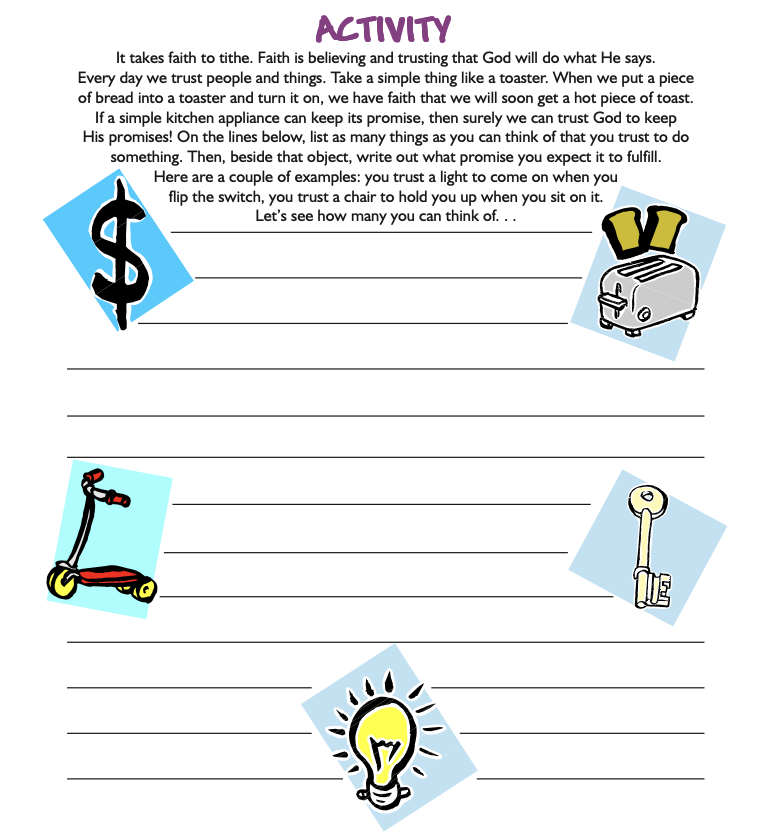
How much should we give to God? The Bible says that ten percent of all we receive, our increase, belongs to God. This is called a tithe. It is not a gift because it is not ours. Anything we give over the ten percent is a gift to God. When we give an offering on the Holy Days, that is a gift.
Ten percent of everything you receive may seem like a lot to you. But what does the Bible say about it? Malachi 3:8-12 says you are robbing God if you don’t give Him back a tenth of what you receive. God says if you will tithe to Him, He will “open up the windows of heaven for you and pour out a blessing so great you won’t have room enough to take it in!” What a fantastic promise!
The Bible goes on to say that you will be so blessed that all nations will call you blessed. Your land will sparkle with happiness! This seems to say that you’ll be much better off with nine-tenths of what you receive than with everything. God will give you wonderful blessings. Just think how blessed the poor widow was for giving everything she had. She knew that Giving is Good.
Would you ever think of robbing a bank or another person? God is the one who gives us everything that we have. It would certainly be wrong of us to rob God. So remember, every time you get a dollar, ten cents belongs to God. You’ll be left with ninety cents that God can make go further than the dollar will go if you robbed God of the tithe.
Just remember: Giving Is Good!
Dear Heavenly Father,
Thank you for everything you give us. Everything we have comes from you and one tenth of that is yours. Help me never to rob you and to always be generous with my gifts.
In His name we pray.
Amen.
Sunday - 2 Corinthians 9:7
Monday - Luke 21:1-4
Tuesday - Mark 12:41-44
Wednesday - I Corinthians 2:12
Thursday - Leviticus 27:32
Friday - Luke 6:38
Saturday - Malachi 3:10
(Youth Educational Adventures Helps)
(alternative approaches to teaching the lesson)
Check with students to make sure they’ve read the lesson. If they haven’t, take turns reading from the student quarterly. If they have, review the key points, asking questions like “What stood out about today’s lesson?” or “What would you say is a key point from today’s lesson?”
1. Tithe or Offering. Discuss the difference between a tithe and an offering. Find scriptural support for each. The tithe belongs to God. Offering are expressions of your thankfulness. See REACH activity “Did You Know” for more commentary on Deuteronomy 16:17 - to bring an offering in proportion to the way God has blessed you.
2. What Do You Have? Most nine to eleven year-olds don’t have a full-time paying job. Their tithe comes probably from an allowance, odd jobs around the house/neighborhood, and birthday/Feast gifts. The resource they do have is time. Discuss how they can give of their time to glorify and honor God. See REACH activity “Back to the Bible” for more discussion.
3. A Widow’s Mite. Role play the scene of Jesus and the disciples watching in the temple and seeing the widow put in an offering. Take turns being the widow, a Pharisee, and a disciple. Talk about perspective: only Jesus knew exactly what the widow’s offering meant.
4. More Than Going Through the Motions. Model giving a tithe to God, but then acting in an unchristian manner. For example, tell the student that you just earned $100. So you’re giving $10 to the church. But you use inappropriate language, shoplift, or work on the sabbath. Ask the students what’s wrong with this. God doesn’t need our money. God doesn’t want an action that is only for show or done because it’s expected. God wants a relationship with you. Your giving of tithes and offerings should not merely be a religious obligation, but also an expression of gratitude to God. Give from the heart, because of your thankful acknowledgment of God’s gracious provision and because of your love for Him.
5. Calculating a Tithe. Some students will not understand how to figure a tithe. Explain that “tithe” means “tenth.” That’s easy when counting objects, i.e. for every ten Hershey’s kisses, one is a tithe. Demonstrate this. Then demonstrate using ten $1-dollar bills. Then show how to move the decimal point to figure the tithe: $10.00 → $1.00; $25.00 → $2.50; $600.00 → $60.00; $432.16 → $43.22. Show how to round. Let the students come up with examples for the class to work.
Proverbs 20:1
Proverbs 23:19-21
Isaiah 5:22-24
Isaiah 28:7
Matthew 24:45-51
I Corinthians 5:11
I Corinthians 6:9-10
ADDICTED - to be dependent upon a substance such as drugs or alcohol
Gary, Tommy and Matt spent every spare minute working on their tree house. They used some old lumber at a building site. Tommy’s father gave them nails and hammers. They built the house in a large tree behind Gary’s house. Matt made a sign for the doorway that read, “Members Only.” The boys were excited to finally have their tree house finished.
The big weekend finally came. The boys were having their first sleep-over. They invited two other boys who lived on their street. They also invited a new boy who just moved into the neighborhood. Each boy brought something to eat or drink. They had some games to play. It would be great fun!
Saturday evening six boys eagerly climbed up to the tree house. They unrolled their sleeping bags and put sacks of food over in the corner. Matt brought a card game. They all sat around a lantern playing and laughing. It was great!
As typical with boys, they were soon hungry. Gary had a big bag of chips, Tommy had some candy bars, and one boy brought cookies. They had cans of Coke and Pepsi. The new boy had a can that looked a little different. He sipped it and offered it to Matt. Matt took a whiff of the can. He realized it was beer. What should Matt do? Should he take a drink so the new boy wouldn’t think he was a wimp? Should he refuse? What would happen if Gary’s dad found them drinking beer?
Jesus talked to His disciples about the time He would return to earth. He said no one knows the exact day or hour when He will come back. Some people will be working in their gardens. Women will do their housework. Jesus’ return will come as a surprise to every- one. He warned them not to be doing anything they shouldn’t do when He returns.
There was a servant who was in charge of a large household. His job was to take care of feeding the children and make sure all the work was done properly. This man had a very responsible position.
One day the servant didn’t feel like doing his work. He said, “My master won’t be home for a while. I can do whatever I want.” He decided to have a party. Everyone was drinking and soon the servant was drunk. He started abusing the other servants. The master came home and found the man in this condition. He punished him immediately. Jesus told the disciples, “Don’t be like that servant” (Matthew 24:45-50).
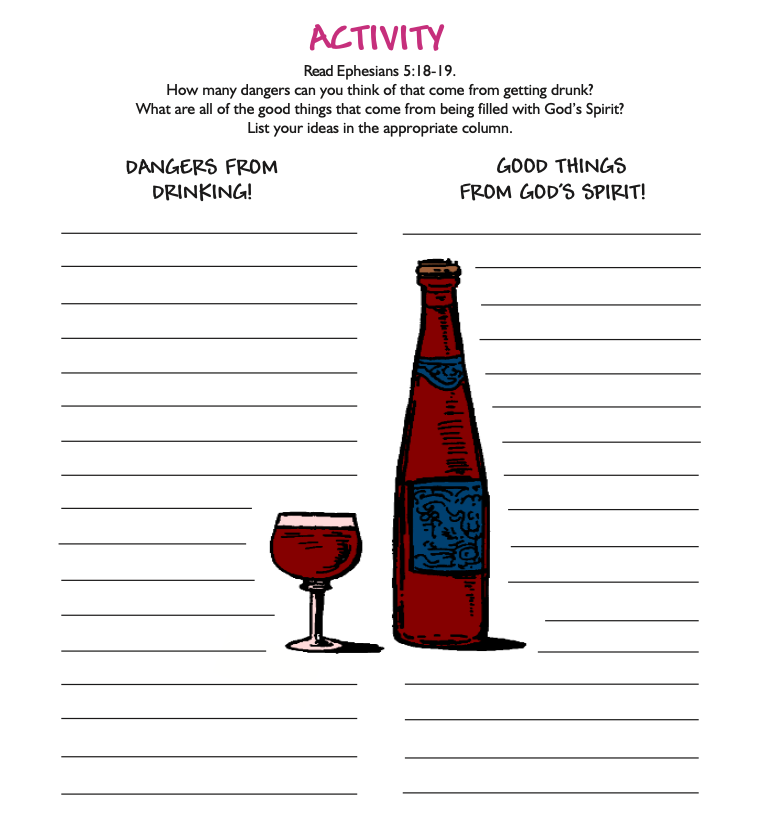
Alcohol gives people false courage. False courage can lead you to do things that you will regret. It can make you angrier than you should be. It can lead you to do foolish things, like fighting. Your memory verse says, “Wine gives false courage; hard liquor leads to brawls; what fools men are to let it master them. . .” When a person becomes a drunkard, alcohol has mastered him. God says that neither thieves or greedy people, drunkards, slanderers, or robbers will be in God’s Kingdom (1 Corinthians 6:9-10).
Alcohol is addictive and can control and ruin your life. Your judgement is hindered, your reflexes are slower, and often your personality is changed. Many violent acts have been committed by people who were under the influence of alcohol.
Lawmakers understand that young bodies can’t handle alcoholic beverages, such as wine or beer. The earlier a person starts drinking, the more likely he is to become dependent upon it. It is unlawful for children to drink alcohol. If you are caught drinking you will be in trouble with the police. You may have a large fine to pay. You may even have trouble getting a driver’s license later on.
Do you know kids at school who are already drinking? Look at their lives. Are they really happy? How are their grades? Are they doing other bad things? There are so many better things to do that are fun and legal. Make many friends. Participate in sports. Learn to play a musical instrument. Study to make good grades.
No one knows when the Lord will return. Would you want Him to find you doing something you shouldn’t when He comes back? You should obey God because you love Him and want to please Him. If someone tries to get you to drink alcohol remember – it is illegal! Don’t mess up your life with alcohol. God has many good things in store for you, so Don’t Be A Fool!
Dear Heavenly Father,
Thank you for teaching us in your Word about the dangers of young people drinking alcohol. Help me to learn to resist temptation, and just say no!
In Jesus’ name I pray.
Amen.
Sunday - Matthew 24:45-50
Monday - Proverbs 23:19-21
Tuesday - Isaiah 5:22-24
Wednesday - Proverbs 20:1
Thursday - I Corinthians 6:9-10
Friday - Isaiah 28:7
Saturday - I Corinthians 5:11
(Youth Educational Adventures Helps)
(alternative approaches to teaching the lesson)
Check with students to make sure they’ve read the lesson. If they haven’t, take turns reading from the student quarterly. If they have, review the key points. Regardless of which of the following options you choose (or all of them), you may wish to have the students design a pledge saying they will honor God with their bodies (similar to the pledge in the movie Courageous).
1. Temple of the Living God. These students are not too young to begin using a concordance. Help them work through a study about the temple of God. One avenue might go like this: There are specific warnings about defiling the temple. Find some of these verses. Then find verses which specifically talk about us being the temple of God. Are there verses which talk about not defiling yourself? Write a conclusion about your findings.
Note: the REACH activity “Word Study: Soma” gives some additional thoughts/direction about defiling our bodies.
2. Fool! Define foolish and fool. Brainstorm things/activities/thoughts which are foolish. Then talk about why people do foolish things. Follow this with a discussion of ways to prevent becoming a fool, i.e. choosing your friends wisely, reading the Bible, asking God for help to avoid bad situations, listening to your conscience when it warns you, finding an accountability partner, etc.
3. Poster. Brainstorm possible PSAs (public service announcements) which warn about the dangers of drugs, alcohol, defiling the temple, becoming a fool, etc. Have the students each design a poster with their favorite slogan. Make available art tools such as glitter, glue, construction paper, stickers, markers, tempera paint, etc. for them to use on the poster.
4. The Wise Man and the Foolish Man Demonstration. Before reviewing the lesson, begin with a very visual object lesson. In a wash basin or large aluminum pan put a little house (like from Monopoly) on a pile of sand and a house on a rock. (Prior to class prepare a third option by gluing with school glue one of the houses to a rock.) Take a water bottle that has a pop top so that you can squirt the water out. Demonstrate what happens when the bottle “rains” on each house. The sand may hold as long as it’s a gentle rain, but a stronger “rain” causes the sand to be washed away. Similarly, just setting a house on a rock, unattached, is not going to provide security. This is akin to someone claiming to be a Christian without actually devoting their life to following His ways. The house which is glued to the rock is like a Christian who holds firmly to Christ and His ways. The storms of life will not sweep him away. After doing this visual demonstration, turn to the lesson and develop the tie between honoring God with our bodies in all ways and being a wise man who builds his house on the Rock.
5. Doing the Research. After reviewing the lesson, discuss with the students the affects drugs and alcohol have on their bodies. Besides damaging your body, they can also impair your thought processes, causing you to do things you wouldn’t normally do. Research the statistics on crimes related to alcohol and drug use. Here is one interesting link: https://www.verywellmind.com/crime-and-alcohol-statistics-from-1998-62821 On this site, they attribute one death every 48 minutes to alcohol in 2017. Since almost every student will have a smart phone, give them about ten minutes to see what they can find and then report back to the whole group about their findings.