YEA Lesson Library
Giving is Good!
About This Lesson
Using the widow’s mite, this lesson teaches the difference between tithes and offerings and emphasizes their importance.
Scriptures
Leviticus 27:32
Malachi 3:8-10
Mark 12:38-44
Luke 6:38
Luke 21:1-4
I Corinthians 2:12
2 Corinthians 9:7
Words to Know
TITHE - returning to God one tenth of what He gives you
MEASURE - a unit or standard of measurement, the extent, dimensions, quantity, etc.
GENUINE - free from pretense or hypocrisy, sincere
The Lesson
Do your friends and family give you gifts at the Feast of Tabernacles or on your birthday?
These gifts make those days even more special. But if no one gave, you wouldn’t have any gifts. It is especially nice of your friends and family to be so generous with their gifts. It makes life better.
There were some religious teachers in Jesus’ day who weren’t genuine in their belief. Jesus warned the people in the Temple to watch out for these men. They loved to wear the clothes of the rich and educated. They wanted everyone to pay special attention to them as they gave their offerings. They wanted the best seats and to sit in the place of honor at the table. They shamelessly cheated widows out of their homes. Oh yes, they prayed long prayers in public. But they loved themselves more than God.
Jesus went over to the box where offerings were given in the Temple. He watched as people dropped their money in. Some of the rich people put in large offerings. But a poor widow lady came by. She put in only two pennies. Jesus took notice of what she had done. He remarked to His disciples that she gave more than all the rich men put together. They only gave what they didn’t need – it wasn’t a sacrifice. But the widow gave all that she had.
How much should we give to God? The Bible says that ten percent of all we receive, our increase, belongs to God. This is called a tithe. It is not a gift because it is not ours. Anything we give over the ten percent is a gift to God. When we give an offering on the Holy Days, that is a gift.
Ten percent of everything you receive may seem like a lot to you. But what does the Bible say about it? Malachi 3:8-12 says you are robbing God if you don’t give Him back a tenth of what you receive. God says if you will tithe to Him, He will “open up the windows of heaven for you and pour out a blessing so great you won’t have room enough to take it in!” What a fantastic promise!
The Bible goes on to say that you will be so blessed that all nations will call you blessed. Your land will sparkle with happiness! This seems to say that you’ll be much better off with nine-tenths of what you receive than with everything. God will give you wonderful blessings. Just think how blessed the poor widow was for giving everything she had. She knew that Giving is Good.
Would you ever think of robbing a bank or another person? God is the one who gives us everything that we have. It would certainly be wrong of us to rob God. So remember, every time you get a dollar, ten cents belongs to God. You’ll be left with ninety cents that God can make go further than the dollar will go if you robbed God of the tithe.
Just remember: Giving Is Good!
Student Prayer
Dear Heavenly Father,
Thank you for everything you give us. Everything we have comes from you and one tenth of that is yours. Help me never to rob you and to always be generous with my gifts.
In His name we pray.
Amen.
Daily Devotions
Sunday - 2 Corinthians 9:7
Monday - Luke 21:1-4
Tuesday - Mark 12:41-44
Wednesday - I Corinthians 2:12
Thursday - Leviticus 27:32
Friday - Luke 6:38
Saturday - Malachi 3:10
YEAH — At-Home Activity
(Youth Educational Adventures Helps)
(alternative approaches to teaching the lesson)
Check with students to make sure they’ve read the lesson. If they haven’t, take turns reading from the student quarterly. If they have, review the key points, asking questions like “What stood out about today’s lesson?” or “What would you say is a key point from today’s lesson?”
1. Tithe or Offering. Discuss the difference between a tithe and an offering. Find scriptural support for each. The tithe belongs to God. Offering are expressions of your thankfulness. See REACH activity “Did You Know” for more commentary on Deuteronomy 16:17 - to bring an offering in proportion to the way God has blessed you.
2. What Do You Have? Most nine to eleven year-olds don’t have a full-time paying job. Their tithe comes probably from an allowance, odd jobs around the house/neighborhood, and birthday/Feast gifts. The resource they do have is time. Discuss how they can give of their time to glorify and honor God. See REACH activity “Back to the Bible” for more discussion.
3. A Widow’s Mite. Role play the scene of Jesus and the disciples watching in the temple and seeing the widow put in an offering. Take turns being the widow, a Pharisee, and a disciple. Talk about perspective: only Jesus knew exactly what the widow’s offering meant.
4. More Than Going Through the Motions. Model giving a tithe to God, but then acting in an unchristian manner. For example, tell the student that you just earned $100. So you’re giving $10 to the church. But you use inappropriate language, shoplift, or work on the sabbath. Ask the students what’s wrong with this. God doesn’t need our money. God doesn’t want an action that is only for show or done because it’s expected. God wants a relationship with you. Your giving of tithes and offerings should not merely be a religious obligation, but also an expression of gratitude to God. Give from the heart, because of your thankful acknowledgment of God’s gracious provision and because of your love for Him.
5. Calculating a Tithe. Some students will not understand how to figure a tithe. Explain that “tithe” means “tenth.” That’s easy when counting objects, i.e. for every ten Hershey’s kisses, one is a tithe. Demonstrate this. Then demonstrate using ten $1-dollar bills. Then show how to move the decimal point to figure the tithe: $10.00 → $1.00; $25.00 → $2.50; $600.00 → $60.00; $432.16 → $43.22. Show how to round. Let the students come up with examples for the class to work.
Objectives
At the end of this lesson, students will be able to:
1. Explain that the first tenth of what they receive (their increase) belongs to God.
2. Tell that an offering is over and above a tithe.
3. State that they are robbing God when they do not tithe.
4. Explain that God blesses the tither and giver bountifully.
Topics & Themes
Attitude
Generosity
God’s Gifts
Jesus, His Ministry
Offerings
Pharisees
Pride
Stealing (aka Robbing)
Temple
Ten Commandments
Stealing
Tithes
Widow’s Mite
Materials Needed
Bibles, YEA Students’ and Teacher’s books, attendance, memory verse and daily devotional charts, marker pens, songbook, award, cassette or CD and music player, chocolate hugs and kisses and a basket.
Preparation
Because so many people today are self-centered and only out for themselves, giving and especially tithing are not popular subjects. You can check through stacks of religious books for children and find such subjects as outreach, service, sharing, faith, etc. but it is nearly impossible to find one that discusses the biblical principle of tithing. Even in the churches in our tradition today, more and more people either don’t understand the importance of tithing or lack the faith to do it. Could this be the reason for rampant financial problems, bankruptcies and marriage problems? Could this be why it requires both parents working today to make a living? By neglecting to obey this eternal spiritual principle, a vicious cycle sets in and it becomes increasingly more difficult to dig ones self out of financial problems.
It is important that God’s children learn and appreciate the blessings of tithing and giving at an early age while faith is yet easy. Unfortunately, money, instead of God is often a family’s security. The more they have or earn, the more difficult it often becomes to give back to God His tenth and then to give an offering. The students should understand that the first tenth is God’s, not just what is left over.
This lesson calls on Juniors to do something very different from what the world around them says. It says money equals happiness and they are to look out for themselves. Jesus’ teaching says for us to deny ourselves and follow God.
How to Teach This Lesson
Prayerfully read the student’s entire lesson and everything in the Parent and Teacher’s guide as well. Other scriptures which will tie in with this lesson are Matthew 6:1; 2 Corinthians 9:6-7; Genesis 14:20 (the first place tithing is mentioned in the Bible) and Leviticus 27:30-33.
Start the lesson by helping Juniors to understand that without giving we would have nothing. Their mother and dad gave them life. They wouldn’t have a home, food, clothes, school supplies, transportation, an allowance, etc. if someone didn’t give it to them. God gives the earth we live on. He gives us the sun for light, warmth and energy. He gives rain that makes crops grow for us to have food. He gave us His Son that we might have eternal life. Giving is God’s way. Giving is good!
Talk openly about the fact that it may be difficult to live with a different set of values from many of their friends. Encourage the kids to share the struggles they face as they try to live up to God’s standards.
Tithing and giving are such positive things because the benefits are so abundant. But it does take faith. As you go through their lesson remind the students of the benefits promised in their memory verse and in Malachi 3:8-12. Point out that holding on to everything God gives them only brings short term happiness. Ask them if they think a robber can be really happy. Isn’t he always wondering when his lifestyle is going to catch up with him? Choosing to tithe may mean giving up a little to begin with. God’s blessings aren’t always immediate. But the long-term benefits will come and they can live with full assurance that Giving is Good.
Review Questions
Do a “sword drill.” Have the children take their Bibles and form a line facing you. You say “attention” and the kids stand at attention with their Bibles in their left hand beside them. Then you say “draw swords” and the children bring their Bibles in front of them at their waist with the left hand under it and the right hand on top. You give them a scripture to find and then say “charge.” The first person who finds it takes one step in front of the others and reads the verse you gave. Have them look up the following scriptures and ask them to answer the question beside these scriptures.
Mark 12:38-44 - How much did the widow give?
Malachi 3:8-10 - How can you rob God?
Luke 21:1-4 - How did the widow’s offering compare with the other givers?
Luke 6:38 - What determines what you will get back?
Leviticus 27:30-34 - Who does the tithe belong to?
2 Corinthians 9:6-7 - What kind of a giver does God want us to be?
Matthew 6:1-2 - If you give for man to see it, what happens?
Give an award to the student who wins the sword drill.
Teacher-Directed Activity
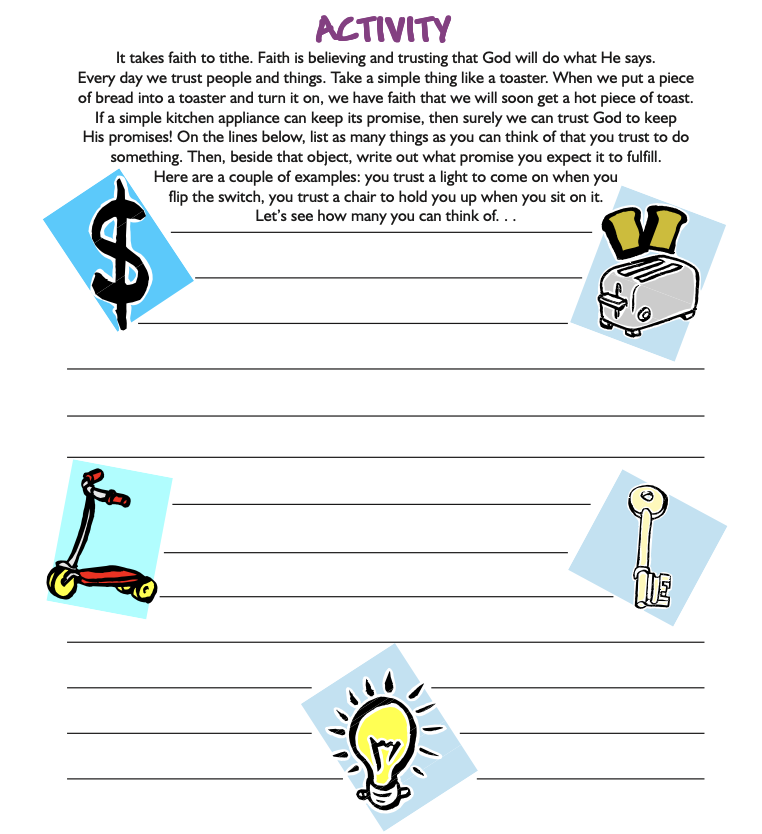
Go over the Activity in the student’s book. Get each one to read their list of the things they trust to do something, and what it does for them. Then give each student nine Hershey kisses and a Hershey hug.Tell them that the hug represents the tithe.Tell them that you are going to pass the offering basket and they are to put their hug in it. Then tell them, “Look, God has given you nine kisses that you can have. You can eat them or give them to someone else. It is entirely up to you. But the hug is God’s. Then pass the offering basket.Tell the kids that the minister will get their tithe like the priest got it in the Bible. After the class is over, have the students go with you and give the minister all of the hugs and let the class explain that it is their tithe.
REACH Activity
Word Study: Doron
The word “offering” in Luke 21:4 is talking about the offerings made to God. It is the Greek word “doron,” which means a present, specifically a sacrifice. Look at the offerings made to God in Luke 21:1-4. The rich men were casting their gifts (same Greek word) into the treasury. But Jesus said they were giving out of their abundance. It definitely wasn’t much of a sacrifice. A sacrifice is something that will cost you something in order that it will be meaningful to you. To give money when you have a lot means very little. Its absence is hardly noticed. To give money when you have very little means so much more—that you have to go without something the money would have bought. This principle is found in 2 Samuel 24:24. King David would not offer a sacrifice to God that had cost him nothing.
Did You Know?
You have probably heard Deuteronomy 16:16 read on Holy Days: “Three times a year all your men must appear before the LORD your God at the place he will choose: at the Feast of Unleavened Bread, the Feast of Weeks and the Feast of Tabernacles. No man should appear before the LORD empty-handed.” Have you also thought about Deuteronomy 16:17? “Each of you must bring a gift in proportion to the way the LORD your God has blessed you.”
What does “in proportion to the way God has blessed me” mean? Where shall I start? God has given me life. He takes care of my needs. He calls me His child. He has promised me eternal life in His Son. He gave me His own Son. The list is endless! So what kind of gift could I possibly give that would be enough? Just all of me, my love, my adoration, all that I am!
Music Notes: Give of Your Best to the Master
This hymn is found on page 147 of the CEM Hymnal. The words for this hymn were written by Howard Benjamin Grose (1851-1939). He spent part of his life serving God as a minister and as editor for a mission journal.
Grose exhorts the singer to “give of your best to the Master.” This echoes the requirements for sacrifices to God. No blemished sacrifice was acceptable. In the same way, why would we give less than our best to God today? Here is the list Grose composed for us to consider:
Give the strength of your youth (Ecclesiastes 12:1)
Throw yourself into the battle for truth (1 Timothy 1:18)
Follow Christ’s example (1 Corinthians 11:1)
Give Him your loyal devotion (Titus 3:14)
Give Him first place in your heart (Deuteronomy 6:4, 5)
Give Him first place in your service (Joshua 24:15)
Consecrate every part of your life (Leviticus 20:7)
Seek to serve Him (Matthew 4:10)
Give Him your heart’s adoration (Matthew 22:37)
Give Him the best that you have (Numbers 18:29).
The third verse tells us why we should give Him the very best. It is because Jesus gave Himself for us without complaint, so that we can be saved (Source: www.cyberhymnal.org).
Journal Jot
What are you willing to give to God? What are you not willing to give to God? Write these questions down as column headings in your Bible journal. When you see what you put in the “not willing” column, think of what God has given to you. Then pray about it.
Back to the Bible
A special kind of giving requires sacrifice of your time and energy. When you give of your time to serve or care for someone, you are giving to them and also giving to Jesus Christ (Matthew 25:40). You may find an opportunity to visit an elderly person and read to them or take them cookies. You may have a relative whose husband or wife has died and they are lonely for company. When you take time to call or talk with them, you’ll see how much they appreciate it. Television is a poor substitute for human company. James 1:27 teaches that “. . .God our Father accepts as pure and faultless . . . this: to look after orphans and widows in their distress. . .” Is there someone at school or church who has a parent serving in the military? Invite them over to share family time. This is a selfless way to serve Jesus. When you become a servant, you give without caring whether you will receive anything in return. This is the best kind of giving. Giving and serving from the heart are the ways Jesus wants us to care for others (1 John 3:11).
Besides loving God, the second greatest commandment is to love your neighbor as yourself (Matthew 19:19). James 2:8 says, “If you really keep the royal law found in Scripture, ‘Love your neighbor as yourself,’ You are doing right.” To sacrifice playing video games, watching television, or going to a movie to bake cookies for the elderly or a widowed relative shows you have a servant’s heart. The greatest Servant of all is Jesus Christ who sacrificed His life for us in order that we can be redeemed from our sins. How much more should we give of ourselves for others because we love Jesus? “In the same way, let your light shine before men, that they may see your good deeds and praise your Father in heaven” (Matthew 5:16).
Just Toolin’ Around
What kind of coins did the widow put into the Temple treasury? How was the money in the Temple treasury used? Find out more from your Bible, a Bible dictionary, and a Bible encyclopedia.
Stretch It Out
Is there a way for you to serve someone in your family, church, or community? Talk it over with your family. Volunteering as a family can be great fun and a very rewarding way to give to others.
Questions?
Remember to write any questions that you have in your journal. That way you will remember to ask your parents, teacher, or minister.
Song
“Every Promise In The Book Is Mine” is on page 15 of the Kids Classics Collection.
Closing Prayer
Ask for a volunteer to lead in prayer and thank God for the blessing of giving.
Printable Pages