YEA Lesson Library
A Rich Young Ruler
About This Lesson
Using Jesus’ encounter with the rich young ruler, this lesson teaches the importance of putting God first in our lives - above all else.
Scriptures
Matthew 6:33
Matthew 18:4
Matthew 19:16-30
Mark 10:17-31
Luke 18:18-30
Luke 18:27
Words to Know
MONARCH - king, queen, or emperor
FAME - widespread reputation of favorable character
The Lesson
Kings, queens, princes, and princesses capture our imagination. We visualize royalty living in magnificent, huge castles. Servants take care of their every need. These royal people have more money than they know what to do with. Huge precious stones are in their crowns. We think of them being dressed in expensive clothes that often look uncomfortable. We may picture a royal monarch being much older than we are. But that isn’t necessarily true.
Prince William and Prince Harry are heirs to the British throne. Yet we have watched them grow up on television and in the newspaper. Their clothes look much like the clothes you wear. They attended school with other boys their age. But when they were not in boarding school, they lived in lavish palaces. And yes, they are rich!
You may think if you were only wealthy you would never have any problems. Unfortunately that is not true. Princes William and Harry lost their mother in a horrible car crash. Their lives are always in the spotlight. And they are faced with many of the same problems and temptations that you are.
Jesus told us a story in Luke 18:18-30 about a rich young ruler. We don’t know how old he was. He may have been a teenager. But he was old enough to be concerned about what he had to do to have eternal life. He asked Jesus what would be required of him to receive it.
Jesus told the young man, “You know what the Ten Commandments say – don’t commit adultery, don’t murder, don’t steal, don’t lie, honor your parents, and so on.”
The rich young ruler replied, “I’ve obeyed every one of these laws since I was a small child.”
Keeping the commandments is something we do for our own good, and we should keep them. But, keeping the commandments will never gain us eternal life. Jesus said the young man was missing one important thing. He told him to, “Sell all you have and give the money to the poor – it will become treasure for you in heaven – and come, follow me.”
To truly follow Christ, we can’t have anything that we value more than Him. We can’t love money, a car, a career, being on a ball team at school, another person, or even ourselves more than Christ. Jesus knew that the young ruler’s riches were more important to him than God was. He was very sad at what Jesus told him because he was very rich.
Jesus watched as the rich man walked away. He said to His disciples, “How hard it is for the rich to enter the Kingdom of God! It is easier for a camel to go through the eye of a needle than for a rich man to enter the Kingdom of God.”
Have you ever had to thread a needle to sew on a button? It isn’t easy. You’ve seen camels at the zoo. There is no way that a camel can go through the eye of a needle. That is utterly impossible! The disciples must have been amazed that Jesus made this statement. They asked, “How can anyone have eternal life?”
Jesus told them that they can’t earn eternal life. It is a gift that only He can give. All things are possible with Christ, even having eternal life. But He won’t give us that gift if we love money, fame, things, or ourselves more than we love Him. We must love Jesus more than anything else.
Peter, one of Jesus’ disciples, pointed out that they left their homes to follow Him. Jesus promised that everyone who gives up their home, wife, brothers, parents, or children for the sake of God’s Kingdom will be repaid many times over. If you do this, He will not only repay you in this life, but in the world to come. The treasures you have in heaven are greater than anything on earth!
Wealth, fame, and pleasure don’t last forever. But what God promises does. It’s worth it to give up whatever it takes for God. He promises that He will repay you. You’ll have far more than Prince William and all the royal family put together. It’s worth it to live for Christ.
Student Prayer
Dear Heavenly Father,
Thank you for showing me that I must put you first in my life. I know that I have put other things before you, and I am really sorry. Thank you that you have promised to reward me if I give anything up for you.
In His name I pray.
Amen.
Daily Devotions
Sunday - Luke 18:18-27
Monday - Matthew 19:16-22
Tuesday - Mark 10:17-22
Wednesday - Matthew 19:23-30
Thursday - Mark 10:23-27
Friday - Matthew 6:33
Saturday - Matthew 18:4
YEAH — At-Home Activity
(Youth Educational Adventures Helps)
(alternative approaches to teaching the lesson)
1. In the Cards. Give a set of eight cards to each student. Each card will have a different word already printed on it: money, family, God, friends, leisure, possessions, pets. Include one blank one for the students to add something else. Have them lay them out in front of them and prioritize them in order of importance in their lives. Then discuss the lesson with the students. Sometimes it’s difficult to figure out what it actually looks like to put God first. Does that mean you can’t have fun with your friends? Does that mean possessions can’t be important to you any more? It’s really important to wrestle with these questions with the students. Then let them re-prioritize the cards if they wish. You might also ask them if they have a certain priority list now, but know that it needs to be different. What would they like it to be? How would they get to that mindset?
2. Giving Everything Up For God. Currently in some places in our world, Muslims will go to Christian homes and demand that they pay a huge fine or convert to Islam or be faced with death. These Christians are fleeing their homes with whatever they can carry - and they feel blessed to be counted worthy to suffer for the name of Christ. Talk about this situation as you’re discussing the lesson with the students. Help them to think about what it means to be willing to give up everything for Jesus Christ.
3. Put God First. Give each student a jar. Have the following items for each student: rock - represents Jesus; marbles - family; beans - represents friends; rice - represents possessions. Have them put in the items according to what is most important. What goes in first? If they put anything in first before the rock, they won’t be able to fit the rock in. It’s a good reminder that God has to be our first choice. Then review the lesson with the students.
4. Role Play. Take turns role playing this story. Actually acting out the part of the rich young ruler can be very impactful to the students. Do it several times until everyone gets to play the role of the rich young ruler. It’s important to point out that Jesus looked at him and loved him (Mark 10:21). Discuss how that changes our perspective of how Jesus interacted with him.
5. God First. Review the lesson with the students. Then follow up with this visual craft. With a sharpie, have the students write all of the important things in their lives on a piece of white cardstock. Then color a design until the entire page is filled with color. (Alternately, the students may choose to divide the cardstock into different colored sections, each section representing what is important in their lives.) When the page is completely colored, take a black crayon and color over the entire page until the black is fairly thick. Then using a paper clip, scrape off the black crayon to form the words “God First.” Tell the students how what’s important to us in our lives forms the foundation for our actions. What we want people to see is that God is first.
Objectives
At the end of this lesson, students will be able to:
1. Explain that to follow God we can’t value anything more than Him.
2. Tell that eternal life is a gift that only Christ can give.
3. State that God rewards those who give up home or family for His sake.
Topics & Themes
Camel
Eternal Life
God’s Gifts
Jesus, His Ministry
Kingdom of God
Loving God
Obedience
Peter
Putting God First
Rich Young Ruler
Ten Commandments
Putting God First
Treasure
Materials Needed
Bibles, YEA Students’ and Teacher’s books, attendance, memory verse and devotional charts, newsprint, poster board, marker pens, pencils, slips of paper, paper, songbook, pictures from magazines, glue, cassette or CD and music player.
Preparation
Your approval is important to Juniors. But for them to really value it and be concerned when you are disappointed in them, you must first have a relationship of love. Every child will need some of your time and individual attention to create this relationship. For them to really be drawn to Sabbath School every week, they must feel a part of the group. No one likes to feel excluded, especially kids. Try to make everyone feel equally important.
Children can learn love from the way you model it. Extend love beyond the classroom. Bring a birthday or get well card to class for someone in your church or community and have everyone write a note and sign it. Pray for peace in the world. Collect food or clothing for a needy person in the church or community. Teach religious values that stress love. These things will help the students see that Christ is first in your life.
Before class, cut out many pictures from magazines portraying wealth (money, jewelry, banks, high life styles, expensive cars, etc.), royalty, children their age, school activities such as ballgames, etc. As the kids arrive, have them start making a collage from these pictures. Ask questions that will encourage them to talk about wealth, fame and physical things that are important to them. Let one of the better printers write above the pictures making the collage, “Jesus is Number 1.”
How to Teach This Lesson
After opening the class with prayer, start the class by asking if anyone has ever seen a king, queen, prince or princess? If they have, give them time to share this experience with the class. Ask: Do you think this royal personage has more love for Jesus than his or her love for being part of a royal family? How do you feel about royalty or rich people? Include the students in a discussion as you go through their lesson and add details that aren’t in it.
Rich Young Ruler - Ask: How did you feel about Jesus telling the young ruler to sell all that he had and give it to the poor? Ask: How would you feel if this were required of you? Encourage everyone to tell how they would feel.
There are those who think the needle’s eye that Jesus mentioned was a small gate for foot passengers close to the large city gate in Jerusalem. Camels could kneel and go through this gate with great difficulty. It seems more likely that Jesus is saying that it is a real needle. This would show that it is impossible for a camel to go through it and that salvation is only possible with God.
Before you finish telling the lesson, go back to the answers you got when you asked “How would you feel if this were required of you?” Point out that everyone of us has to be willing to give up everything. We can’t have anything in our lives that is more important than Christ if we hope to receive salvation. Have the class turn in their Bibles to Mark 10:28-31. Ask one of the better readers to read this aloud to the class. Ask: What kind of reward is that for giving up going to a ballgame on the Sabbath, not keeping Christmas or giving up any other physical things for Christ?
Review Questions
1. What was the important question asked by the rich young ruler?
2. What part of Jesus’ answer was troubling to the young man?
3. Why do you think Jesus told him to sell every- thing he had and give it to the poor?
4. Do you think a rich man has a better chance at eternal life than a poor man? Why or why not?
5. How would you compare wealth and riches to the things God promises?
Teacher-Directed Activity
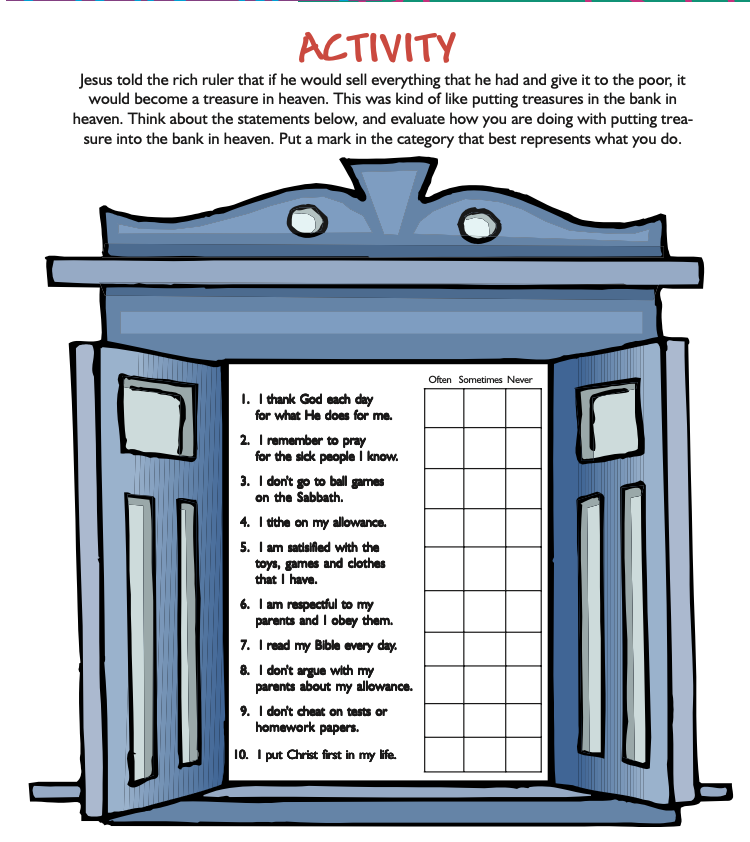
Give each student nine slips of paper and a pencil. Ask them to number their slips of paper one through nine and don’t put their names on them. Have them turn to the activity in their lesson. If they have marked “often” for number one, write that on the slip they numbered one. If they have marked “never” on number two, write that on the slip they numbered two and so on. Give them a few minutes to complete this. Then pass a basket for each one to put their nine slips of paper.
Separate the slips of paper into nine stacks by numbers. Say: Let’s see how much treasure we have put in the bank in heaven. Number a newsprint pad one to nine and put “often,” “sometimes,” and “never” to the right and just above the numbers. Now read the statement and write on the newsprint pad how many “oftens,” “sometimes,” and “nevers” are on the slips. Be sure to commend them if they do well. If they do poorly ask what they think about the treasure they have laid up. Then ask: What can we do about it?
REACH Activity
Word Study: Chrema
Luke 18:24 says, “And when Jesus saw that he was very sorrowful, he said, How hardly shall they that have riches enter into the kingdom of God!” The word translated “riches” is the Greek word “chrema,” which means something useful or needed, like wealth, money, riches. It is the same word found in Acts 4:37 translated “money.” This tells us that money itself is not bad. It is what a person does with it and how important money is to that person. That is, does money and working to get money mean more to a person than pursuing a relationship with God and serving Him? If money is more important, it becomes a problem. It is the same for anything a person values more highly than God.
Did You Know?
“Jesus looked at him and said, “How hard it is for the rich to enter the kingdom of God! Indeed, it is easier for a camel to go through the eye of a needle than for a rich man to enter the kingdom of God’” (Luke 18:24, 25 NIV).
There is a Bible legend that there was a smaller gate within one of the main gates into Jaffa and Hebron which would allow a camel through—but only if it was unloaded and on its knees. Supposedly, this was the gate to which Jesus was referring in Luke 18. Legend says that a rich man would have to be stripped of his riches and be on his knees if he wanted to get into God’s kingdom. However, there is archaeological evidence to suggest that these legends began after this teaching from Jesus, not before. In fact, it is more likely that Jesus really did mean the largest animal in Palestine and the smallest of holes—to emphasize the point that salvation is not just difficult, but impossible without Jesus. (NIV Archeological Study Bible, p. 1594).
Music Notes: Take My Life and Let It Be
This hymn is found on page 129 of the CEM Hymnal. Frances Ridley Havergal wrote this poem in 1874 when she was thinking about how to completely give her life to the service of God. The words she penned were especially meaningful to her. She was naturally very musical and had been trained as a concert soloist. With her beautiful voice, she could have gained much worldly fame. But she determined to sing and work only for Jesus. Similarly, she gathered several expensive pieces of jewelry and family heirlooms. Nearly 50 items were given to the church missionary house for spreading the Gospel of Jesus Christ.
As you sing these words, think about each line. Spend some time thinking about how you can give everything you are to Jesus Christ, to His glory and service (Source: Amazing Grace, Osbeck, K., p. 256).
Journal Jot
Think of what things are most important to you. Make a list of them in your Bible journal. Which would you be willing to give to God? Which would you find very hard to give to God? Why? Write a prayer asking God to help you see the value of a relationship with Him in comparison to the value of everything else. It may take some time for your heart to know this—even if your head tells you it is true.
Back to the Bible
Has anyone ever asked you what you want to be when you grow up? Depending on your answer you may have to go to college or get some special training. You may want to be a veterinarian, a nurse, or an electrician. No matter what career you choose, it will require you to have a plan, set goals, and keep focused on the future. The Rich Young Ruler may have inherited his riches and his power. But that will probably not be true of you or anyone else you know. You will need to make some decisions and plan carefully for your future. Do you know that it is just as important to plan for a life with Jesus as it is to plan for your future career? In the same way that you prepare for your career, you prepare yourself to live according to God’s way. You will need to set goals, such as making time to study your Bible to learn what it says and means (Proverbs 1:1-7). When you have questions you need to ask them. Dig into such Bible reference books as a concordance and encyclopedias. Become familiar with Bible maps. It may seem like homework right now, but try to think of it as Kingdom work. You are preparing for a future with the King who surpasses all other royalty, even this Rich Young Ruler! Your goal is eternal life in the glorious Kingdom of God. He wants you to be with Him (John 14:2-4). This Rich Young Ruler in the YEA lesson did not prepare himself very well. He went away very sorrowful. That is very sad. His goals were not set on eternal life. That is why he had to ask Jesus about what he needed to do to have eternal life. He was not ready to give up his money. His heart was not prepared to sacrifice what he owned (1 Samuel 16:7). The ruler should have had a plan. He should have had the right goals. He allowed himself to get caught up in “things” of the world and not the things of God. To find out more about the Kingdom of God and eternal life, you will need to be a good student of the Bible. As you study you will need to learn more about Jesus Christ and how to follow Him, not your peers. Do not be sad or full of sorrow like the Rich Young Ruler. Prepare yourself now to follow Jesus!
Just Toolin’ Around
Use your Bible and a concordance to find five Scripture verses referring to Jesus as King. Share these verses with your family.
Stretch It Out
Now that you know a little more about planning and setting goals, think about writing a Bible study plan. For example, what do you already know? What would you like to know? Perhaps you could talk to your family for some suggestions. Set a goal to study one topic of the Bible at a time. Share what you learn with your family. Don’t give up! Prepare yourself for eternal life today!
Questions?
Remember to write any questions that you have in your journal. That way you will remember to ask your parents, teacher, or minister.
Song
“I Have Decided to Follow Jesus” is on page 23 of the Kids Classics Collection.
Closing Prayer
Ask one of the students to lead in prayer asking God to help them to always put Christ number one in their lives.
Printable Pages