YEA Lesson Library
Hang in There!
About This Lesson
Using the parable of the unjust judge and Luke 11:5-13, this lesson teaches the importance of being persistent in our prayers to God.
Scriptures
Jeremiah 29:13
Matthew 9:28-29
Matthew 13:58
Matthew 21:21
Matthew 24:13
Mark 5:34
Luke 11:5-13
Luke 18:1-8
John 11:41-42
Acts 12:5
James 4:3
I John 3:22
I John 5:14
Words to Know
PERSISTENT - to continue steadily or firmly in some purpose or action, in spite of opposition
GODLESS - evil, sinful
The Lesson
Maggie is a pretty brown and white Springer Spaniel with long curly ears. Her fur is soft and she’s a very lovable dog. But that’s not all, she is very persistent. When she is let out of the house, she’ll come to the breakfast room window and let us know she wants back in.
At first, she makes her wants known very quietly. But if nothing happens, she whacks the window with her paw. Being persistent, she whacks the window again and again until she is let back into the house. She seems to understand that persistence pays off. She hangs in there until she gets an answer.
Jesus used a similar illustration to teach His disciples a principle about praying. “Let’s just suppose you went to a friend’s house to borrow a loaf of bread,” He said. That’s not a terribly unusual request. But it was midnight and his friends were asleep in bed. The man shouted up to his friend that guests had just arrived and he needed to serve them a meal. The friend he had awakened shouted back at him, “Please don’t ask me to get up. The door is locked for the night and we are all in bed. I just can’t help you this time” (Luke 11:5-13 TLB). The man didn’t want to get up out of his warm bed simply for a friend. But the persistent knocking eventually got the man his loaf of bread!
A similar story about a widow lady illustrates the need for constant, persistent prayer. A poor widow lady had been harmed by a man. She went to the judge to appeal for justice. The judge was difficult to get along with and didn’t obey God. Just as Maggie’s owner sometimes ignores her, the judge ignored the lady’s com- plaint.
The poor widow didn’t have a husband to help her when she had problems. But she was very persistent. She wasn’t about to give up until justice was done against the man who harmed her. She came back again and again and made her appeal to the judge. This must have been very difficult for her to do. She could have let this very unpleasant judge intimidate or frighten her. But she hung in there and kept on coming back.
The judge ignored her complaints for awhile. He must have thought she would eventually just go away. But she didn’t! Then she began to get on the judges nerves. He said, “I fear neither God nor man, but this woman bothers me. I’m going to see that she gets justice, because she is wearing me out with her constant coming.”
If Maggie’s owner, a friend all warm in bed, and an evil judge can be reached with persistence, what about God? Don’t you think God, who is all loving and merciful, will surely give you justice if you don’t give up praying? The Bible tells us, “Yes! He will answer them quickly!”
Prayer is like medicine. When the doctor gives you a prescription for medicine, he expects you to follow his instructions and take all of the medicine. Even if you start feeling better, you still have to take all of the medicine to get the full benefit. Perhaps one reason your prayers aren’t answered is because you give up too quickly. Jeremiah 29:13 says, “You will seek me and find me when you seek me with all your heart.” That means you have to continue to pray and be persistent, even if you feel like you have done enough already. If you don’t, you will not get the full benefit of your prayers!
The widow didn’t give up easily when the mean, godless judge ignored her. The man didn’t quit knocking until he got bread to feed his guests. If you want your prayers answered, hang in there. God wants you to be persistent until you get an answer. God honors patient, persistent prayer!
Student Prayer
Dear Heavenly Father,
Thank you for showing me that I should hang in there with my prayer request. Help me to remember that I have to be persistent like the widow lady and the man who needed a loaf of bread.
In the name of Jesus Christ.
Amen.
Daily Devotions
Sunday - I John 5:14
Monday - James 4:3
Tuesday - I John 3:22
Wednesday - Acts 12:5
Thursday - Luke 18:1-8
Friday - John 11:41-42
Saturday - Luke 11:5-13
YEAH — At-Home Activity
(Youth Educational Adventures Helps)
(alternative approaches to teaching the lesson)
Review the lesson with the students before doing one (or more) of these activities. Remember, modify these to fit your needs and particular teaching situation and circumstances.
1. Write it Down. 1 Thessalonians 5:17 pairs well with this lesson. Discuss how you can be constant in prayer. Encourage the students to start a prayer journal and be diligent to use it until it’s a habit. See REACH activity: Journal Jot.
2. Famous Prayers: Research some famous Biblical prayers: Jehoshaphat, Daniel, Solomon, (2 Chronicles 20:6-12; Daniel 9:3-19; 2 Chronicles 6:14-22; Nehemiah 9:6-38) Each one acknowledges God’s greatness and provision; each one acknowledges man’s sinfulness and our need for God.
3. God Answers Prayers: Read these four passages and reconcile them to each other: Isaiah 59:2; Proverbs 28:9; 1 John 5:14-15; John 14:13. God’s answer is no. Sometimes it is yes, but not immediately; you have to wait. Sometimes it is yes - but in a much different way than you had imagined. And sometimes God answers our prayers immediately with a resounding yes.
4. Persistence. Consider several examples of not giving up: 1 Samuel 1 (See REACH activities: Back to the Bible); 2 Corinthians 12:8-10; Revelation 2:7; 2:11; 2:17; 2:26-28; 3:5; 3:12; 3:21. Overcoming, enduring to the end, hanging in there, persevering - these are all synonyms for a character trait that God wants us to have. Discuss how you can strengthen your persistence in following God. Discuss an instance when God told Jeremiah not to persist in praying: Jeremiah 7:16; 11:24; 14:11.
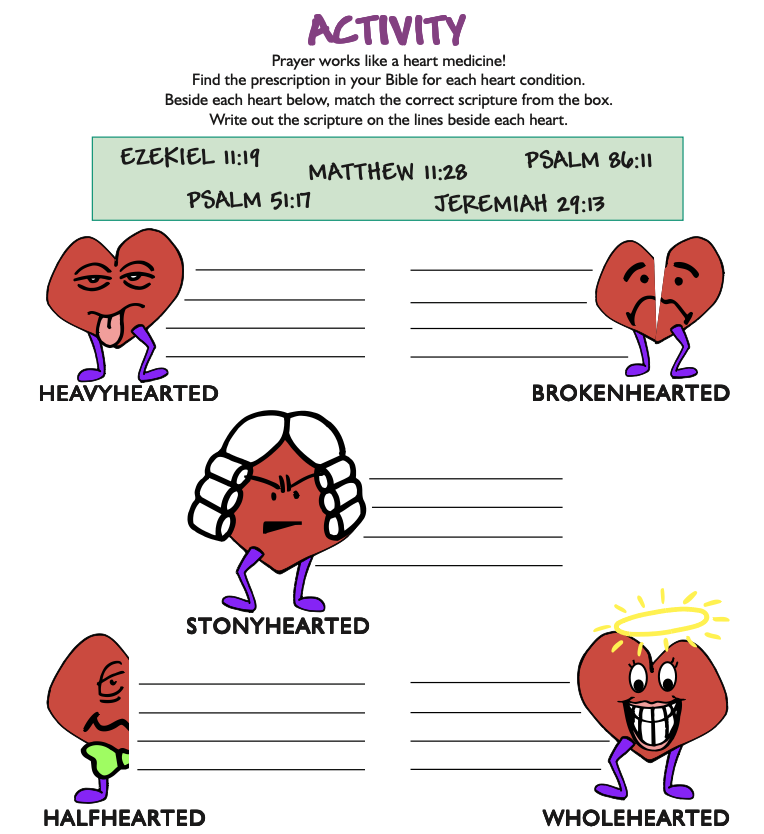
5. Your Heart Condition. Take the five depictions of heart condition from the student quarterly. Write down a time when you fit each of these descriptions. Alternately, role play what it would look like to approach God when you are hard-hearted; broken-hearted; half-hearted; heavy-hearted; whole-hearted.
Objectives
At the end of this lesson, students will be able to:
1. Explain that God doesn’t always answer their prayer on the first request.
2. Tell that God honors patient, persistent prayers.
Topics & Themes
Ask
Jesus, His Ministry
Perseverance
Prayer
Materials Needed
Bibles, YEA Students’ and Teacher’s books, attendance, memory verse and daily devotional charts, poster board, pictures, marker pens, songbook, construction paper, cassette or CD and music player.
Preparation
Before class, cut out pictures of a dog (preferably a Springer Spaniel), a judge and a man in bed asleep. Let the class make a poster with captions before the class begins. Across the top write “Hang in There!” Draw a bubble in front of the dog and write, “whack, whack” in it. In a bubble by the judge write, “Justice shall be done,” and by the man sleeping, write “Go away!” in a bubble. Have them tack this on the wall next to the attendance, memory verse and devotional charts.
Regardless of our age, we have times when it seems our lives are falling a part. Juniors are no exception to this. Lessons on prayer can be an enormous help for kids who feel defenseless and frightened when things go wrong. This lesson teaches a most encouraging and important principle. It gives them hope that God will hear their prayers if they won’t give up.
The stories in Luke 18:1-8 and Luke 11:5- 13 were told to teach that God will honor patient, persistent, persevering prayer. In Matthew 6:7 Jesus warned of “vain repetition,” and added, “Your Father knows what things you need before you ask Him.” How do you reconcile this with the persistence of the widow and the importunity of the friend at midnight which Jesus commended? Sometimes it is not easy to reconcile two sides of a truth. But our own desires must be tempered by the calm submission to the will of God. And, God wants us to present our desires to Him, without allowing ourselves to become discouraged when He delays the answer.
How to Teach This Lesson
All too often we squeeze out meaningful prayer in Sabbath School classes. We allow activities and discussions to crowd out prayer time. Make a deliberate effort towards heart-felt, purposeful prayer time. Show by your example that prayer is a priority. To demonstrate the importance of prayer in our lives, begin and end each class with prayer. Before you open with prayer tell the class that God is interested in the big and the small things in their lives. Ask the students if they have a problem or a need that they would like for you to talk over with God. Mention a need that you have and ask them to please remember to pray for you.
Open the class with meaningful prayer. Juniors are at a great age to appreciate the power of prayer. As you tell the lesson, you might include Matthew 13:58 to show that our unbelief hinders our prayers. Mark 5:34; Matthew 9:28,29, 2l:21 are good contrasts showing the importance of faith. We all want answers to our prayers so it is easy to emphasize the benefits of this lesson to your pre- teens. Help them to understand how persistence will benefit them in other areas of their lives, but it can be self-defeating if it is done in a wrong spirit and becomes obnoxious.
Review Questions
Write your review questions on the back of cutouts that look like a dog, a judge and a man sleeping. Let them select which one they want to answer.
1. Describe the judge that the widow came to.
2. Why did the widow need the judge’s help?
3. What attribute of Maggie should we imitate?
4. Why did the man who was asleep answer his friend?
5. What do you have to do to make sure God hears your prayer?
6. Name another way that persistence will pay off in your life.
Teacher-Directed Activity
Go over the activity in the student’s book with your class and let students check their answers. Then divide the class into two sections. Give them a few minutes to plan their drama. Let one group act out the judge and the widow story and the other half of the class act out the friend wanting a loaf of bread from the man who is in bed. Then get everyone to form a circle, give a thumbs up and say “Hang in there.” Give the reminders while they are still in the circle. Have them hold hands for the closing prayer.
REACH Activity
Word Study: Ekkakeo
Luke 18:1 says, “Then Jesus told his disciples a parable to show them that they should always pray and not give up.” The King James Version of the Bible translates “not give up” as “not to faint.” The word “ekkakeo” means “to be weak,” by implication, “to fail in heart, to faint or to be weary.” It denotes cowardice or faintheartedness, and is usually translated “to lose heart.” It is the same word found in 2 Corinthians 4:16; Galatians 6:9; Ephesians 3:13; and 2 Thessalonians 3:13.
Did You Know?
Widows were important to God. Psalm 68:5 describes God as a “father to the fatherless, a defender of widows.” Israelite farmers were instructed to leave some grain so the poor, orphans, widows, Levites, and foreigners could have something to eat (Deuteronomy 24:17-22). God’s people, who had been slaves in Egypt, were never to deny justice to widows, orphans, aliens, and priests (Deuteronomy 24:17-18). Part of the reason for God’s judgment against Israel was because they did not “plead the case of the widow” (Isaiah 1:17). Jesus upheld an impoverished widow as a model of generosity (Luke 21:2-4). James defines true worship as caring for widows and orphans in their need (James 1:27).
Music Notes: Did You Think to Pray?
This hymn is on page 170 of the CEM Hymnal. Born in Boston, Massachusetts in 1820, Mary Ann Kidder was blinded as a teenager. Fortunately, her sight was restored after a few years. She lived for 46 years in New York City and was a member of the Methodist Episcopal Church (Source: cyberhymnal.org).
Whether you are a blind person, a poor widow lady who wants justice, or someone who is hungry, you have a loving Heavenly Father who wants to hear from you. Mary Ann Kidder exhorts the singer to pray:
* Before you leave you room every morning—to ask for God’s protection on you throughout the day (Ezra 8:21-23).
* When you are faced with temptations (Matthew 26:41).
* For the Holy Spirit to guide you (John 16:13).
* For the ability to forgive when someone has wronged you (Colossians 3:13).
* For strength and comfort when things are rough (Luke 22:41-44; 1 Thessalonians 5:16-18).
Journal Jot
Praying, for most people, means kneeling down before God in a place where you can be alone. But 1 Thessalonians 5:17 says to be constant in prayer. You can pray to God as you’re walking to school or to a friend’s house. Your prayer doesn’t have to be spoken aloud or even silently to yourself. You can also write a prayer to God. Sometimes writing a prayer in your Bible journal helps you find the words you want to use, helps you stay on task, and gives you a record for when God answers your prayer. Try praying to God on paper today. You might find that you like praying this way.
Back to the Bible
Hannah was a woman who was barren. This means that she couldn’t have children. She was very upset and her husband, Elkanah, couldn’t comfort her. He had another wife who was able to have children and she kept ridiculing and irritating Hanaah. Even though Elkanah told Hannah that he loved her, she still wanted to give him a child. In Old Testament times, a barren woman was considered a failure as a wife. Hannah carried a personal burden of guilt and shame. On a yearly trip to Shiloh, by the doorpost of the Tabernacle, Hannah wept and prayed to the Lord that He would see her misery and give her a son. If the Lord gave her a son, she promised to give him “to the Lord for all of his days” (1 Samuel 1:11). Hannnah also told the Lord that no razor would ever touch her son’s head. She was so deep in prayer that her mouth was moving but no sound was coming from her mouth. Eli, the priest, saw Hannah praying and told her to stop drinking wine. Hannah told Eli that she had been pouring out her soul and was praying out of her great anguish and grief (1Samuel 1:15, 16). Eli told Hannah to go away in peace. He said, “May the God of Israel grant you what you have asked of him.” God did answer Hannah’s prayer and she gave birth to a son that she gave back to the Lord. His name was Samuel. After she had Samuel, Hannah prayed a prayer of thanksgiving, which is one of the most beautiful prayers in the Bible, recorded in 1 Samuel 2:1-10. Hannah was persistent and never gave up. Find words of strength and faith in God’s word. Read the Bible and study every day to be strong in the Lord and to stand firm against the temptation to give up.
Just Toolin’ Around
Elkanah and Hannah went up from Ramah to Shiloh each year. Israelite men were required to make a pilgrimage to the Tabernacle, or the Tent of Meeting. Use your Bible concordance and Bible map to find out why they had to make the yearly pilgrimage. Draw a map that shows the pilgrimage from Ramah to Shiloh.
Stretch It Out
Fold a sheet of 11 x 17 paper into thirds and illustrate the two examples of persistence from the lesson and the story of Hannah, Elkanah, and Samuel. Retell the lesson using these illustrations.
Questions?
Remember to write any questions that you have in your journal. That way you will remember to ask your parents, teacher, or minister.
Song
“Standin’ In The Need of Prayer” is on page 53 of the Kids Classics Collection.
Closing Prayer
After the activity and reminders, ask one of the students to lead in prayer. Have the group form a circle and hold hands for the prayer.
Printable Pages