YEA Lesson Library
The Best of Seven
About This Lesson
This lesson teaches that the Sabbath is to be a delight and talks about what is appropriate in a general sense.
Scriptures
Genesis 2:1-3
Exodus 16:29
Exodus 20:8-11
Deuteronomy 5:12-15
Isaiah 58:13-14
Matthew 12:1-14
Mark 2:27-28
Mark 3:1-5
Luke 13:10-17
John 5:17-20
Words to Know
COMPARISON - capable of being compared; similarity
PROTEST - objection, disapproval or dissent
BONDAGE - slavery or involuntary servitude
The Lesson
Have you ever seen it snow so much that school was canceled for the day? The snow can be so deep that a blanket of white covers everything. Tree limbs are weighted down with the white stuff. Icicles glisten as the sun comes out. It makes a perfect day to rest. It’s good to pull the covers up and go back to sleep with only your nose peaking out. It’s fun to rest and enjoy the beauty God graciously gives. It’s fun to get out in the snow and feel it, smell it, and touch it with your own hands.
God knows that we need a day of rest. Even animals need to rest. The staff at the Grand Canyon learned this lesson from the donkeys people ride down to visit its lower levels. They found that if they rest the donkeys one day out of seven they live longer. Don’t you think it’s equally important that we rest one day out of seven? Do you think we might live longer if we do?
You know, there are some comparisons to be made with the day school was canceled because of snow and the Sabbath day. You slowed down and thought about what God created. The beautiful white blanket of snow gave you a chance to appreciate one of God’s gifts to us. You enjoyed the snow. God wants us to delight in the Sabbath day. We can do this by spending time appreciating His creation.
Matthew 12:1-14 tells us about Jesus walking through a grainfield with His disciples. They were hungry, so they broke off a few stalks of fresh grain and ate them. But the Pharisees protested. They claimed that Jesus and His disciples were breaking the Sabbath. People, like the Pharisees, are so picky about things that they miss the big picture. They always judge people instead of seeing to it that their own lives please God.
Jesus created the Sabbath for our good. He realized that human needs are important. Simply breaking off a few stalks of grain and eating them when you are hungry doesn’t break the Sabbath. Jesus would never break the Sabbath. He is Lord and Master of the Sabbath.
Jesus told the Pharisees that King David and his men went into the very Temple of God and ate the special bread that only the priests were to eat. David and his men were hungry. Even though they broke the law, Jesus points out that being merciful is more important than condemning the guilty.
On another Sabbath Jesus was teaching in a synagogue. He saw a seriously handicapped woman who had been bent over for years. He called her to Him and touched her. He said, “Woman, you are healed of your sickness.” Immediately she stood up straight and praised God (Luke 13:10-17).
The Pharisees didn’t like that Jesus healed this woman on the Sabbath. They lacked mercy and love to sympathize with hurting or hungry people. Jesus said, “You hypocrites! You work on the Sabbath! Don’t you untie your cattle from their stalls on the Sabbath and lead them out for water? And is it wrong for me, just because it is the Sabbath day, to free this Jewish woman from the bondage in which Satan has held her for eighteen years?” This must have embarrassed and shamed the Pharisees.
Exodus 20:8 clearly teaches that we have “six days a week to do our daily duties and regular work, but the seventh day of the week is a day of Sabbath rest” (TLB). This is not something we can change or mess with. Jesus adds understanding to that scripture by showing us that we can do good on the Sabbath. Taking care of human needs by relieving suffering or hunger is good to do on the Sabbath.
Then how should you keep the Sabbath? We know that we’re not to do our daily duties and regular work on the Sabbath. We learned that it is all right to do good for others. So, what are some things we can do to make the Sabbath a joy and delight? You don’t have your regular work to do so you can get extra sleep and rest. Your greatest desire should be to know God better. Attend Sabbath School and worship services. Hang your “Time-out with God” sign on your door and spend extra time praying and reading your Bible.
There are many things in nature to help you understand and appreciate God. Spend some time looking at creation and thinking about how good and great God is. He made it all for you! Keep God’s Sabbath holy!
Student Prayer
Dear Heavenly Father,
Thank you for the beautiful creation you made for us to enjoy. Thank you for giving us the Sabbath day to rest and to know you better. Help me to do good on the Sabbath.
In the name of your Son, Jesus Christ.
Amen.
Daily Devotions
Sunday - Exodus 20:8-11
Monday - Genesis 2:3
Tuesday - Mark 2:27-28
Wednesday - Deuteronomy 5:12-15
Thursday - Exodus 16:29
Friday - John 5:17-20
Saturday - Mark 3:1-5
YEAH — At-Home Activity
(Youth Educational Adventures Helps)
(alternative approaches to teaching the lesson)
Students this age should have read the lesson prior to class. Regardless, make sure to weave the lesson into the following activities.
1. Perspective. Set something on the table. Have the students do a quick drawing of it from four different perspectives: straight on, high, low, and from the side. Discuss how a different viewpoint changes how you see something. And this applies to keeping the Sabbath holy. We as adults who work 40 hours/week long for the sabbath as a day of rest. But children (This group is ages 9 - 11) don’t have this perspective. They usually have lots of energy, their minds are sharp, they sleep well at night and feel good. These two perspectives can clash when it comes to Sabbath observance. The kids want to do something God-honoring and fun (read: active). Their parents want to do something God-honoring which also involves resting and re-cooperating from the work week. Combine the activity in the student’s quarterly and the REACH activity: Journal Jot! It’s very important that we communicate why we do what we do so that our children grow up learning to value the Sabbath.
2. Sabbath Placemats. Families often come up with Sabbath activities to emphasize how special the Sabbath is. Many times it’s a special Sabbath meal Friday evening to bring in the Sabbath. Have the students create special Sabbath placemats using 11 x 17 construction paper, markers, crayons, colored pencils, stamps, ink stamps, stickers, paper punches, etc. Once the placemat is finished, cover it with clear contact paper to keep it nice (and reusable) for Sabbath meals. Instruct the students to make enough placemats for each member in their family - and a couple of extra ones for guests.
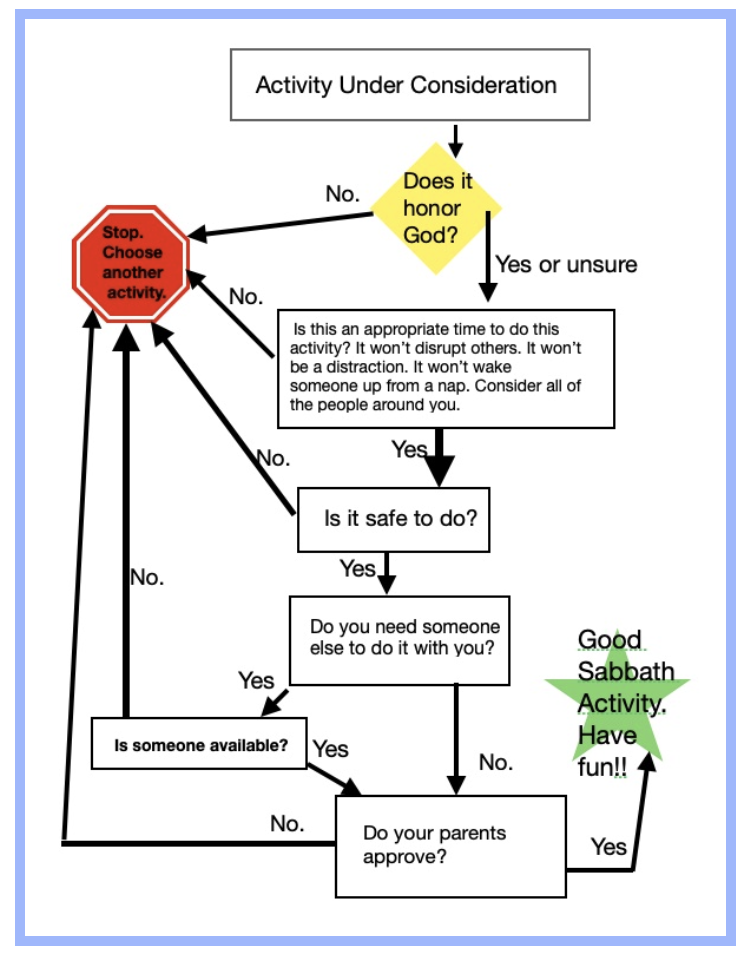
3. Create a Flow Chart. It can be difficult to figure out what constitutes an appropriate Sabbath activity. Help the students create a flow chart to help them make evaluations of various activities. It could look something like this:
4. Defining Rest. Discuss the Biblical command to rest. It does mean to cease from your normal labors (to earn money, to go to school). You are to set the Sabbath apart, to make it special, to make sure you’re treating it as holy. But that doesn’t mean you can’t DO anything. It does not mean you have to stay in bed all day - Hebrews 10:25 says that you are not to forsake the assembling of yourselves together. So there is a difference between physical rest and spiritual rest. We need to do both! What does it mean to rest in Christ? What activities are appropriate for Sabbath? (Be wary here; there is a wide range of ideas of what is/is not appropriate for Sabbath.) Encourage the students to have a calm, non-argumentative discussion with their parents.
5. SABBATH acrostic. Write an acrostic poem of good things to do on the sabbath. The students can each make their own, work in pairs, or work together as a large group. Here’s a suggestion, if you get stuck.
S - Sing praises to God.
A - Act justly.
B - Be faithful in church attendance.
B - Be ready to help others
A - Ask God for direction in all that you do.
T - Thank God for His blessings
H - Honor God in all that you do.
Objectives
At the end of this lesson, students will be able to:
1. Explain that you don’t mess around with the Sabbath. It is a day of rest that God created for man.
2. State that Jesus never broke the Sabbath.
3. Tell that it is good to take care of human needs and suffering on the Sabbath.
4. Explain that there are blessings for keeping the Sabbath.
Topics & Themes
Creation
David
Holy Conduct
Jesus, His Ministry
Jesus, His miracles
Healing
Jesus - Without Sin
Loving Others
Rest
Sabbath
Sabbath Conduct
Showbread
Temple
Worship God
Materials Needed
Bibles, YEA Students’ and Teacher’s books, attendance and memory verse and daily devotional charts, butcher’s paper, newsprint paper, wrapping paper, different color marker pens, songbook, cassette tape or CD and music player.
Preparation
The memory verse may be too long for the younger children. We recommend that you shorten it if needed.
Before class, use a long piece of butcher’s paper to make a seven day calendar. Write Sunday, Monday, Tuesday, etc. across the length of it. Put a big “one” under Sunday, “two” under Monday, etc. In a different color on another long piece of butcher’s paper, write, “God is So Good!” Tack this across the wall under the calendar.
After the students arrive, ask one of the students who prints well to go to the chalk- board or newsprint pad. Ask the students what things they can do the first six days of the week. Help them list everything they can think of that they can do on those days. The student at the chalkboard should write “work days” at the top and list each activity as the students give them. This list should include such things as going to school, doing their homework, attending ballgames, dance lessons, going to the movies, shopping, skating, swimming, other sports, etc. Now read Exodus 20: 8-11 or have one of the better readers do it. Then ask them what things they can do on the Sabbath. Ask the student at the chalkboard to write at the top of another sheet of newsprint “Sabbath” and list the things as the students give them. This list should include such things as rest, sleep in, attend Sabbath Service, attend Sabbath School, pray, read their Bibles, read their Sabbath School lesson, take a nature walk, visit friends, visit the elderly or sick, play such games as Bible trivia, check the YEA web site, write a note to a YEA pen pal, etc. Tack both of these lists under the calendar and the sign that says “God is So Good.”
Now ask the class how they feel about this. Ask them if they noticed that God gives them six days to do all of their work and the other things listed. Then, He is so good that He gives them a day to spend with Him. Get the entire class to say together, “God is So Good!”
How to Teach This Lesson
Self-centeredness is a problem with every age group and Juniors are no exception. Teaching religious values, such as keeping the Sabbath, calls for the children to reach beyond selfishness to a communion with something larger than themselves. Try to understand the students’ points of view and what they’re going through. Juniors are old enough to begin thinking less about rewards and punishments and more about living up to God’s expectations.
After opening the class with prayer, emphasize that we shouldn’t dread the Sabbath even though we can’t do some of the same things that we do the other six days of the week. Stress the benefits. Conclude by reading Isaiah 58:13-14 from the NIrV Kids Devotional Bible.
“Do not work on the Sabbath day.
Do not do just anything you want to on my holy day.
Make the Sabbath a day you can enjoy.
Honor my holy day.
Do not work on it.
Do not do just anything you want to.
Do not talk about things that are worthless.
Then you will find your joy in me.
I will give you control over the most
Important places in the land.
And you will enjoy all of the good things
In the land I gave your father Jacob.
The Lord has spoken.”
Review Questions
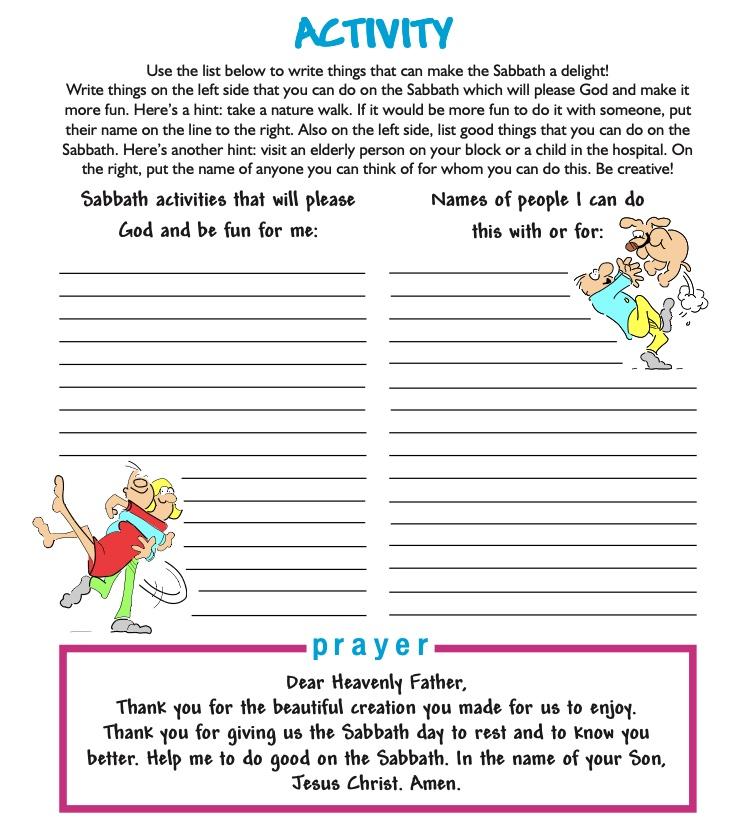
Ask the students to turn to the “Activity” in their book. Have one student read one of the things he listed that will please God and make the Sabbath more fun. The person next to him can tell who she would enjoy doing that activity with. Then let the next person give one good thing on their list that they can do on the Sabbath to help another person. Then let the next person tell who they would like to do that good deed for. Continue around the room until everyone’s list is finished. Then ask: What benefits will you gain from doing these things because you love God and the Sabbath so much?
Teacher-Directed Activity
Divide the class in thirds and assign each group one of the three different stories (Jesus and His disciples walking through the grain field, David and the special bread in the Temple and Jesus healing the handicapped woman) given in the lesson for them to act out. Give the groups two or three minutes for them to brainstorm how they will act it out before they perform. Then have each group act out their assigned skit.
REACH Activity
Word Study: Sabbaton and Sabbatismos
The word “Sabbaton” means “Sabbath,” the day of weekly rest from secular (non-religious) interests and work. This is the word used in Matthew 12:1 and Luke 13:10. The word “sabbatismos” comes from “Sabbaton” and means “the rest found in being a Christian and living in Christ.” It is this word which is used in Hebrews 4:9. That is what the Sabbath (Sabbaton) points us to—a true rest (sabbatismos) in Jesus Christ.
Did You Know?
“A common practice on the evening the Sabbath began was for the father to bless his children. He would also often say a hymn taken from the Book of Proverbs about a godly wife and mother. Women were more highly regarded by the Hebrews than by most other nations in those times” (Source: Children’s Book of the Bible, Metts and Causey, 2000, p. 99).
Music Notes: Safely Through Another Week
This hymn is on page 96 of the CEM Hymnal. It is one of the more than 280 hymns composed by John Newton. He is most remembered for his hymn, “Amazing Grace.”
John Newton was born in London, England in 1725. His mother was a devout Christian and taught John to pray and to memorize Scriptures. John’s father was a sea captain and not often home. When John’s mother died just before he turned seven, he stayed with relatives who mocked him for his belief in God. When he was 11, he ran off to join his father, sailing the seas. His father also made fun of him, so John sailed around the Mediterranean, getting into all kinds of trouble. He was often disrespectful to those in authority and even deserted from the British Navy. He eventually joined with a slave dealer. This was a bad decision! When the trader was gone, John was left in the care of the trader’s wife, who imprisoned John in her quarters, beat him, and made him eat food off the floor like a dog. John escaped and was later picked up by another ship. On this ship, the captain left John in charge one night. John got bored during a long watch, broke into the ship’s supply of rum, generously shared it with the crew, and drank enough rum himself to fall overboard. One of the ship’s officers saved John by spearing him in the thigh with a harpoon and reeling him back aboard ship. Now severely wounded and disciplined, John was put below the deck. He had lots of time to read Thomas à Kempis’ book, Imitation of Christ, and to think about his own mother’s instruction. When the ship hit a storm and was in danger of going down, John repented before God. Two years later, he married Mary Carlett, a Christian, and became a minister.
John Newton knew firsthand how God brings us safely through each week to share the Sabbath with Him (Source: Hymns of Faith and Inspiration, Kennedy, P., p. 80-81).
Journal Jot
Sometimes it is hard to appreciate the Sabbath. You can’t play sports or play with your friends. When you go to church, the sermon may be long. Sometimes your parents stay and talk. But your parents aren’t trying to make you hate the Sabbath. They really want you to come to love it as the best day of the week. Read your memory verse from Isaiah 58:13-14 again. Then write your frustrations about the Sabbath in your Bible journal. When your parents are ready, share your thoughts with them. Try to work out a plan together to make the Sabbath a delight.
Back to the Bible
What does the Lord require or need of you? Have you ever wondered about that? In Micah 6:8 you will find out what the Lord requires. “And what does the Lord require of you? To act justly and to love mercy and to walk humbly with your God.” When God made the Sabbath for man He gave us the opportunity to get to know Him better. We know God better each Sabbath when we study His word and learn more about Jesus Christ, His Son. When you celebrate the Sabbath you are humbling yourself before God. When you are humble you are not proud or full of yourself. You are acknowledging the special gift that He gave you, a day of rest. What better way to spend the Sabbath day than to walk humbly with God and experience His creation. God wants you to also act justly, or be fair, with others. In Matthew 12:1-4 you read that Jesus had to explain to the Pharisees that they were unfairly judging His disciples for picking grain on the Sabbath. Jesus gave you a good example of how to be fair to others. Look at the whole picture instead of just a part of it. Reading Luke 13:10-17 you will see where Jesus teaches a wonderful lesson of mercy. He healed a woman on the Sabbath. This woman had been suffering with a physical handicap. She had been stooped (bent over) for a very long time. Jesus was merciful and healed her. This woman praised Jesus for His mercy. The Pharisees did not understand humility, fairness, or mercy. But Jesus did and you can too. Keep studying God’s Word and rest on the Sabbath.
Just Toolin’ Around
Who were the Pharisees? Use your Bible, a concordance, and a Bible encyclopedia to find information about them.
Stretch It Out
Create a word search with at least 15 words from the lesson. Give it to someone to solve.
Questions?
Remember to write any questions that you have in your journal. That way you will remember to ask your parents, teacher, or minister.
Song
“My God is So Big” is on page 14 of the Kids Classics Collection.
Closing Prayer
Ask one of the students to say the closing prayer.
Printable Pages