YEA Lesson Library
A Recipe for Prayer
About This Lesson
This lesson teaches how to use the Lord’s Prayer as a model prayer.
Scriptures
2 Chronicles 7:14
Matthew 6:5-15
Luke 11:2-4
Romans 12:12
Colossians 4:2
I Thessalonians 5:17
James 4:3
James 5:16
Words to Know
ETIQUETTE - requirements for good social behavior
GREETING - an expression of friendly or respectful regard
SLATE - a record of conduct
The Lesson
As a preteen, the telephone plays a very important part in your life. Eighty years ago a lot of families didn’t even have a telephone. But over the years, it has become a very important tool. It helps you stay in contact with your friends. Have you wished to have your own phone?
It is important to practice certain telephone etiquette. When someone answers the number you dialed, identify yourself and politely ask for the person you wish to speak to. Greet each caller and allow him or her to express their opinions. Close your conversations in a friendly way. Try to be considerate and not bore your friends with calls that are too long. After all, friends are friends, and we want them to like us. So, show them respect.
When you’re on the phone with a friend, how long do you talk before you run out of things to say? What do you talk about all that time? Do you do all of the talking? Do you drag out a “give me” list and spend most of your time asking him for something. If you do this very many times, your friend may stop calling!
Did you know that praying is much like talking with a friend? As good as our friends are, they are limited in what they can do. But God isn’t! You can spend as much time as you like talking to Him and He’ll never tire of hearing your voice. He has plenty of time to listen to you. He loves you and is interested in what you are doing. He is really happy to hear from you. God is the best of all friends.
Jesus knew that we might not know how to talk with God so He made it a point to teach us. When we bake cookies or make fudge, we get out a recipe. We follow it to make sure we include all of the ingredients. Jesus gave us a recipe for prayer so we will know what ingredients we should include. Sometimes it is called “The Lord’s Prayer,” but it is really the model prayer. Jesus laid it out in outline form with instructions as to how to approach His Father with respect and the proper etiquette.
First, Jesus says to go to a private place to pray. He doesn’t want you to try to impress other people with how great your prayers are. He wants a private conversation with you. You should talk to God much like you would talk with a friend. You don’t say the same things to your friends each time you call. God doesn’t want to hear the same things each time you pray, either. God knows exactly what you need even before you ask Him. But, remember, God won’t be impressed if you drag out your “give me” list and spend all your time asking for things. He wants you to really get to know Him.
The first ingredient in Jesus’ recipe for prayer is greeting God. There are several ways to begin prayer, but Matthew 6:9 says “Our Father in heaven.” He is not only a Friend, but He is our Father.
Then it says, “we honor your holy name.” Don’t take God for granted or put Him on the level of any human being. He is the Great God of the universe. He is awesome!
The next ingredient we should include in prayer is to ask that His Kingdom will come soon on this earth. When that happens, Jesus will return as our King. He’ll immediately start making this earth a beautiful, wonderful, and peaceful place. What Jesus wants will finally be done, and not what evil, greedy men want. This world will be far better than anything we can imagine. That is why we should ask for God’s Kingdom to come soon!
Spend time talking with God about how wonderful He is and what great things He does.
Then Jesus tells us that we can ask for something. Ask for your food for today. God loves you so much that He cares about your needs. Don’t be selfish and just pray about your own needs. Your family has needs. Friends may have problems and need God’s help. People in the church may be sick and hurting. They need you to pray for them too.
We all do a lot of dumb things and mess up. We need God to forgive us and put things right. So the next ingredient in our prayers is asking God to forgive us when we have sinned. But you know what, you can’t expect God to forgive you of your sins if you don’t forgive others. Jesus says that God simply won’t do it! That’s really something to think about. We’ve got to wipe the slate clean and not hold grudges. It’s just that simple!
Being able to talk with God is one of the most wonderful ways we can spend our time. God wants to hear from you very often. He wants to know you very well. He wants to help you every day of your life. And He wants you to know Him as your best Friend. Take advantage of such a wonderful opportunity and pray every day. Use the recipe given to us in the Bible to help you get started and learn how to include all the ingredients!
Student Prayer
Dear Heavenly Father,
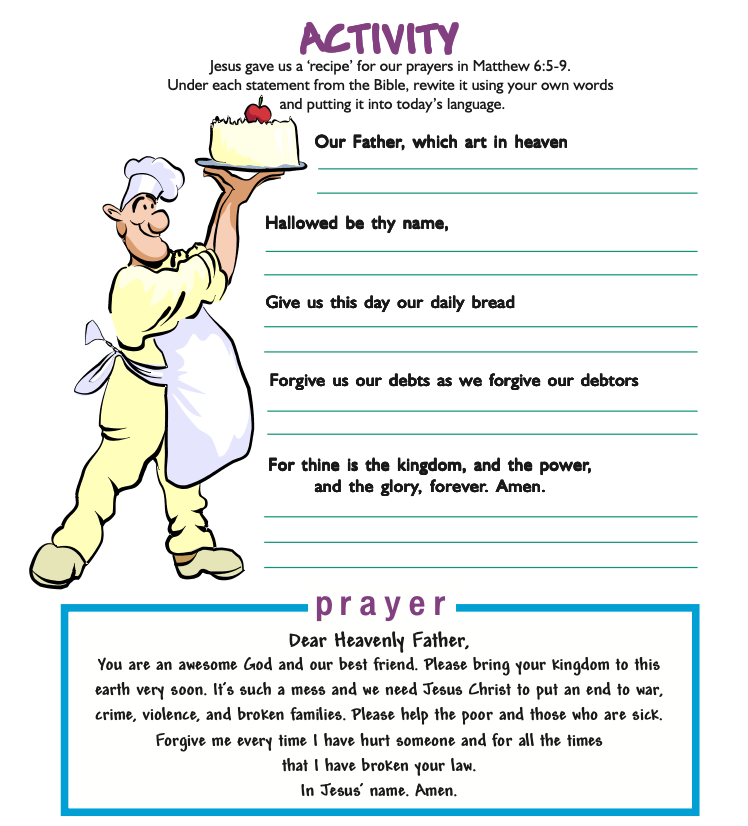
You are an awesome God and our best friend. Please bring your kingdom to this earth very soon. It’s such a mess and we need Jesus Christ to put an end to war, crime, violence, and broken families. Please help the poor and those who are sick. Forgive me every time I have hurt someone and for all the times that I have broken your law.
In Jesus’ name.
Amen.
Daily Devotions
Sunday - Matthew 6:5-15
Monday - Luke 11:2-4
Tuesday - 2 Chronicles 7:14
Wednesday - I Thessalonians 5:17
Thursday - Romans 12:12
Friday - Colossians 4:2
Saturday - James 4:3
YEAH — At-Home Activity
Youth Educational Adventures Helps)
(alternative approaches to teaching the lesson)
1. Role Play. You may actually want to have a real phone for the students to hold (You’ll need two.) or you can just pretend. Do some phone conversations. At the start, you need to be the one who makes the call. Model calling without identifying yourself, talking without listening, and making demands. Then model the proper way to call: greeting, identifying yourself, followed by a two-way conversations. Then follow this introduction by teaching the lesson. Have the students go through the quarterly with you, stopping to discuss each paragraph. End by asking them what they learned.
2. Side by Side. If the students haven’t read the lesson, read it with them. If they have read it, ask them what they remember. You can use the review questions in the teacher’s edition. Then, do this activity: Fold a piece of paper in half. On the left side, write the Lord’s Prayer. On the right side, write one or two words to describe each piece. For instance, Our Father (on right) - Greeting (on left); Hallowed be Thy Name (on right) - Acknowledgment of His greatness (on left). Work your way through each piece of the Lord’s Prayer. Our laundry list of wants is not the first thing that should come out of our mouths when we’re praying to our Heavenly Father! Send the completed activity home with the students as a help for them when they pray.
3. Write it out. If the students haven’t read the lesson, read it with them. If they have read it, talk about it. Then have the following discussion: Sometimes it’s hard to know what to say to God. Other times when you are praying, you find your mind wandering away from what you’re saying to God. Writing out your prayer to God can be an effective tool in getting the words down just as you want to say them, to remember to praise Him for who He is first, and to keep your mind focused on a reverent prayer. The benefit, too, of writing out your prayers is that you can go back later and see how God has answered them. You may want to give each student a journal that they can use specifically for prayer. If you do, have them write the Lord’s Prayer on the first page (or inside cover) as a reminder of the recipe Jesus gave His disciples.
4. Frame It. Read and/or review the lesson. Then show the students how to use a ruler to lightly make lines for a framed print. Using their best handwriting, lightly write out the Lord’s Prayer with a pencil. Go over the wiring with a sharpie. There are lots of colors to choose from. Then decorate the background. Or choose to write on a piece of colored paper and mat it with scrapbook materials. There are lots of options!! Then frame it.
5. Picture This. Read and/or review the lesson. Then help the students begin this follow-up activity. Make a coffee table picture book using pieces of construction paper, scrapbook paper, wall calendar photos, glue, sharpies, and clear contact paper. Divide up the Lord’s Prayer into sections. For instance, the first page might be “Our Father, which art in heaven.” Choose a calendar picture which emphasizes the sky or clouds or something majestic. After gluing that onto the scrapbook paper or construction paper (or both), use a sharpie to write the phrase at the bottom, along the side, or in the clouds where it catches the reader’s eye. When the page is complete, cover it with clear contact paper to protect it. Follow this procedure with each page. Either take the final project to a print shop and have it professionally spiral bound or use a hole punch and bind with ribbon.
Objectives
At the end of this lesson, students will be able to:
1. Explain that praying to God is very much like talking with a dear friend.
2. Recite the basic ingredients that go into a prayer.
3. Tell that they can’t be forgiven of their sins unless they forgive those who wrong them.
Topics & Themes
Forgiveness
God the Father
God’s Kingdom
God’s Love
God’s Provision
Prayer
Prayer, The Lord’s
Materials Needed
Bibles, Students’ and Teacher’s books, attendance, memory verse and daily devotional charts, marker pens, paper, pencils, pictures from magazines, construction paper, yarn, poster board, songbook, cassette or CD, and music player.
Preparation
Even though Juniors are concrete thinkers, research shows that this age group expects and appreciates certain qualities in their teacher. They want a teacher who listens to them. For them to really know you are listening, eye contact is important as preteens give their comments. Even though they like variety, they want a certain consistency with the routine in Sabbath School. They also expect you to be fair. They want everyone to be treated equally. Juniors thrive on encouragement and need wise council when they reveal their secrets to you. Making them feel special with a surprise or treat will go a long way in solidifying your relationship with them. Don’t forget positive reinforcement for jobs well done. A birthday card or personal notes will also be appreciated by Juniors in your class.
The YEA Sabbath School materials are designed to provide a curriculum that will develop in each student a strong spiritual foundation. Prayer, daily Bible study, obedience to God and His law, and giving should be expounded and encouraged at every opportune moment. Learning to pray is one of the most basic essentials for a Christian. The benefits derived from knowing God through daily contact are invaluable. Prayer can be an enormous help to Juniors when they face personal and family difficulties.
Before class, look through magazines and cut out such pictures as an etiquette book, a telephone, a recipe book, mixing bowl, mixer, measuring cup and spoons and a recipe. Make a poster using these pictures and caption it, “A Recipe for Prayer.” Tack it to the wall or bulletin board along with attendance, memory verse and daily devotional charts. Also, design and make door hangers for each student out of construction paper. Write on each one “Time- out for God.”
List these things on the newspaper pad: Greeting, praise, request, apology, closing remarks.
How to Teach This Lesson
After the students arrive, open the class with prayer. Divide the class into pairs. If you have an odd number, you can be a child’s partner. Give each pair a piece of paper and a pencil. Have each pair sit facing one another. Space the pairs far enough apart so that conversations can be carried on among each pair at the same time. Tell them to list on their papers the words that are on the newsprint pad. Ask them to pretend that one of the pair has telephoned the other person. You have given them a recipe to follow in their conversation. They are to greet one another, compliment or praise the other person, make a request or ask the other person for something, apologize or ask forgiveness for something, and then have a friendly closing to their conversation. Allow them four or five minutes to carry on a “phone” conversation and let them know when they only have 30 seconds left to complete their “phone” conversation.
Now have each pair write beside each category what they said to fulfill this part of the conversation.
Arrange your students in a semicircle and ask one pair to tell the class what kind of greeting they used to begin their “phone” conversation. Let another pair tell about any praise or compliment they gave to the person they were conversing with. Get another pair to tell what they asked the other person to do while they were talking. The next pair can tell about any apology that was made during their talk. Let another pair tell how they ended their conversation. If any pair is left without a comment for a category, ask if another pair can share what they said.
Prayer Recipe - Ask: Do you realize what you have just done? You’ve carried on a conversation with a friend, much like you do when you pray. There were certain ingredients that went into your conversation recipe. The recipe for prayer is just that simple.
Request - Ask: How did you feel when your partner asked you to do something for him or her? Do you think they asked for too much? How do you think God feels if your entire prayer is nothing but “give me”?
Students’ Activity - Tell students to open their books to this week’s Activity. Have one student read the Bible phrase and let another student tell how they rephrased it. After they finish, ask: How do you feel about God not being willing to forgive you of your sins if you can’t forgive another person who has wronged you? What does holding a grudge do to a friendship? Is it worth it to hold a grudge?
Review Questions
1. What is the prayer in Matthew 6:5-9 called?
2. Name the ingredients that went into this prayer.
3. What did Jesus tell us to ask for in this prayer?
4. What will keep you from being forgiven of your sins?
5. How does an unforgiving spirit affect friendships?
Teacher-Directed Activity
Give students another piece of paper and pencil and ask each one to write out a prayer using the recipe on the newsprint pad. Give each student one of the door hangers you made before class. Allow them to select pictures to decorate their door hangers from the ones you cut out of magazines. Remind them that prayer is a private time. They probably don’t want to be disturbed when they pray, so they can hang this on the door to let everyone know not to disturb them.
REACH Activity
Word Study: Pater
The model prayer in Matthew 6:9 begins: “Our Father.” The Greek word “pater” means “father” or “parent.” Jesus is telling us that we are praying to our Heavenly Father, who loves us very much. Yes, we are praying to the Great God of the Universe, but as His child, we can boldly approach the throne of grace (Hebrews 4:16).
Did You Know?
Matthew 6:6 says, “But when you pray, go into your room . . .” The Greek word translated “room” probably means “storeroom,” because unlike most rooms in the house, this one had a door that could be shut (NIV Archeological Study Bible, p. 1568).
Music Notes: Teach Me To Pray
This hymn is found on page 175 of the CEM Hymnal. Albert Reitz, who lived from 1879 to 1966, composed the words and the music for this hymn in 1925, the morning after a Day of Prayer organized by the Evangelical Prayer Union of Los Angeles. He was pastor of the Rosehill Baptist Church at the time (Source: Osbeck, Kenneth W., Amazing Grace (1990) Kregel Publications, p. 16).
Scripture Ties to Words: Read 1 Thessalonians 5:16 In the first verse, what is the composer’s desire? (For God to teach him to pray.) Matthew 6:5-7 tells us to pray unseen by men and not to babble. Our many words are not what causes God to hear us. Our attitude when praying to God is the key (1 Peter 4:7).
What is the composer’s stated reason for praying? (To know God’s will and His way.) We want to have God’s direction in our lives. But, you must ask Him (Philippians 4:6).
The chorus draws a picture of a close relationship with God. Even the Israelites knew that prayer drew them close to God (Deuteronomy 4:7). When you have a close relationship with the most powerful Being in the universe, you have access to incredible power.
Verse two asks for what? (Power from God.) Why does the composer ask for power—for himself? (No, power because there’s so much sin, sorrow, trouble, death, etc.—he’s asking for God’s help, James 5:13, 16.)
Jesus made a statement in Matthew 21:22. So, will all of our prayers be answered? You have to have the right attitude and you have to believe. But sometimes our prayers are not the will of God. Indeed, we truly don’t know what we’re asking for. So God gives us His Holy Spirit to help (Romans 8:26).
Verse three asks for what? (Help to overcome weaknesses, sins.) We know what we should do according to the Bible, but it’s very hard. It only comes through the power of God. But God will not force His power to change you if you don’t want it. Read Matthew 5:43-45 for an example. The change within each of us (to stop sinning) comes through humbling ourselves and praying to God. 2 Chronicles 7:14 sounds very much like repentance. When you have repented to God, there is no room to judge someone else (Mark 11:25).
Verse four asks God to teach the composer to pray again—why? (Because Jesus gave us an example to pray.) We know Jesus prayed a lot, but He also told His disciples to pray and to keep praying (Luke 18:1).
The summary is in Hebrews 4:16.
Journal Jot
Philippians 4:6 says, “Do not be anxious about anything, but in everything, by prayer and petition, with thanksgiving, present your requests to God.” Our prayers should never be a list of things we want from God. They should be conversations—expressing worship, thanksgiving, and requests. In your Bible journal, write at least three reasons why God is worthy of your worship, and three things for which you are thankful. Then write your requests.
Back to the Bible
The memory verse includes a very important phrase, “pray for one another.” Prayer requests may be a part of the worship service. People will ask for prayer when they or someone they know needs healing from a sickness or an accident, or strength after someone they love dies. Sometimes prayer is for making a decision about what to do in an important situation, such as taking a job or moving to a new place. When some people hear these requests they write them down so they will remember them when they pray. It is a privilege to be asked to pray for someone else. Prayer is another way to love each other, too. Read your Bible. It has much to say about prayer. For example, did you know that you are to pray even for your enemies (Luke 6:28)? Whenever you need help, you must pray. Jesus would go off by Himself and pray. He prayed the night before He chose the 12 disciples (Luke 6:12). Jesus wanted to be sure to talk to God before He called them to follow Him. Take time to talk to God in prayer. When you pray as a family, listen carefully. Then try to pray by yourself. If may seem awkward at first. Take it one step at a time. Find your special prayer place. Remember the recipe, but more importantly pray to God for one another.
Just Toolin’ Around
Find a person in the Bible who prayed for something specific and note the result of the prayer. Look in the Old or New Testament. Use a concordance, a Bible encyclopedia, and a Bible dictionary.
Stretch It Out
Who did you find in Just Toolin’ Around? Draw a mural of who you found and what happened when they prayed. Include a caption with the Scripture verse. Share it with family and friends.
Questions?
Remember to write any questions that you have in your journal. That way you will remember to ask your parents, teacher, or minister.
Song
“Whisper a Prayer” is on page 57 in the Kids Classics Collection.
Closing Prayer
Let one of the students volunteer to lead in prayer.
Printable Pages