YEA Lesson Library
Jesus’ 12 Helpers
About This Lesson
This lesson teaches about Jesus' calling the twelve disciples and the Sermon on the Mount. It encourages the student to apply those teachings to their own lives, striving to be a disciple of Jesus Christ.
Scriptures
Matthew 4:18-22
Matthew 9:9-13
Matthew 28:19-20
Mark 2:13-17
Mark 3:13-19
Mark 6:7-13
Luke 6:12-19
Luke 9:1-6
John 1:29-51
John 5:1-11
James 1:22
Words to Know
DISCIPLE - student, follower of Christ
TRAITS - qualities of one’s nature
APOSTLE - any of the original 12 disciples called of God to preach the gospel
The Lesson
Have you ever thought about why you go to school every day? Why do you do your homework each night? School trains you to be a successful, independent person. You learn how to read, write, count, add, subtract, multiply, and divide at school. You also learn to use the computer. Having computer skills can make learning even more fun.
The things you learn in school give you skills and knowledge that you will need to make a living someday. How well you learn will make a difference in whether you are poor or rich when you get older. It will have a lot to do with how well you and your family will live. A good education is very important for everyone.
Jesus had a job that needed to be done. He knew that He needed helpers to get that job done. That job was letting the entire world know that He came to be their Friend and Savior. Jesus knew His helpers would need training. They needed to be taught how to make friends out of enemies.
Before Jesus picked His first 12 helpers, He spent all night praying to God. He wanted God to help Him make the right choices. He probably discussed each man’s natural traits and talents with His Father. He may have asked God to show Him what each man needed to know and how to teach them.
At daybreak, Jesus called all 12 men up onto a mountain: Peter, Andrew, James, John, Philip, Bartholomew, Matthew, Thomas, James, Simon, Judas, and Judas Iscariot. These 12 men were disciples who became apostles. A disciple is a student, follower, and a believer. Apostles are special representatives. Don’t you think Jesus taught His disciples a lot of things up on that mountain?
When they came down, there were many people who wanted to hear Jesus, and many wanted to be healed. People came from all over Judea, Jerusalem, and as far north as the seacoast of Tyre and Sidon.
Jesus continued teaching His disciples. He said that the needy person should be happy because the Kingdom of God belongs to him. Hungry people should be happy because they will be satisfied. Those who are now sad will become happy and laugh. “Be happy when people hate you and have nothing to do with you and even treat your name like it is evil. They do all this because you follow me,” Jesus said. “Just remember they treated God’s prophets the same way. When these things happen, be glad and jump for joy because God will give you many blessings.”
Do you see what Jesus was teaching His disciples? He told them that bad times would come. No one likes to have enemies. It hurts when people say bad things about us. But how can we ever learn how to treat our enemies if everyone treats us nicely? Jesus knows when others wrong us. And, He will reward us if we follow Him.
We’re being trained just like Jesus’ disciples were. Jesus still needs helpers to tell others what He came to do. He wants everyone to know about the daily help Jesus can give. But Jesus has even greater things to give us than help today. He wants us to be part of His family and live with Him forever.
To be part of His family, you must learn His way and live it. Read your YEA lessons, Daily Devotionals, and your Bible each day. Attend Sabbath School every week. Show love to your enemies. See how many times this week you can do good for your enemies. Smile, help them with their homework, say nice things about them, invite them to do something with you.
Remember, Jesus prayed all night before He chose His disciples. Prayer is the most important thing we can do for our enemies. It is a good way to show love for them. God may even turn your enemies into good friends. You can be one of Jesus’ helpers by making friends, not enemies.
Student Prayer
Dear Father,
Thank you for choosing me to be one of your disciples. Help me to love you so much that I will want to learn everything I can. Help me to show love to my enemies.
In Jesus’ name.
Amen.
Daily Devotions
Sunday - John 1:35-42
Monday - Matthew 9:9-13
Tuesday - Mark 2:13-17
Wednesday - Mark 3:13-19
Thursday - Mark 6:7-13
Friday - John 1:43-51
Saturday - Luke 9:1-6
YEAH — At-Home Activity
(Youth Educational Adventures Helps)
(alternative approaches to teaching the lesson)
1. Chosen - If you were going to choose twelve people to help you, what characteristics would you look for? For example, would integrity or slothful be high on the list? As a class, brainstorm as many characteristics as possible in five minutes. (Setting a timer lets the students know this won’t take up the whole class time.) Include in the list the characteristics you definitely wouldn’t want. Then go back to the lesson and re-read the lesson together. Complete the activities in the student quarterly and teacher’s guide.
2. What’s His Name? Sometimes it’s very confusing to try to memorize the twelve disciples because a couple of them have alternate names. Using the scriptures (Matthew 10:2-4; Mark 3:16-19; Luke 6:14-16; John 1:45-49; John 14:22; Acts 1:13), make a chart, listing the disciples and their alternate names. Then re-read the lesson together, discussing as you go. Assign the students to memorize the twelve disciples.
3. Teaching. Define the word disciple. Because disciple means learner, you would expect Jesus to teach. Talk about one of Jesus’ most famous teachings, the Sermon on the Mount, which includes the Beatitudes. Ask the students how many of them they can name. What other topics were in the sermon? Then re-read the lesson together, discussing it as you go.
4. Disciple vs. Apostle. Define both terms. A disciple is a student or learner; an apostle is one who is sent. But apostle has come to mean one of the disciples who was chosen by Jesus and sent to spread the gospel. Dig into the definitions further with the students: Why would someone become a disciple? To learn from the teacher. If they are not willing to put the teaching into practice, then what’s the point of learning? A disciple who learns, and is willing to be used, can be sent to teach others. When the twelve disciples were sent out by Jesus, they are referred to as apostles. It can be very confusing for children when adults use the two terms interchangeably. Once they understand the definitions, ask them if an apostle can still be a disciple. Yes; they are two different roles. Just because a disciple became an apostle doesn’t mean he stopped learning from the Master. With this introduction, if the students haven’t read the lesson, read the lesson together and discuss it.
5. D-I-S-C-I-P-L-E acrostic. Read and discuss the lesson together before doing this activity. (This activity is found in the REACH activities for this lesson.) Use the letters from “disciple” to create an acrostic poem. (Remember that an acrostic poem doesn’t have to rhyme - and usually doesn’t. Acrostics can be one word on each line or an entire sentence. What makes it acrostic is the beginner letter of each line.) Each letter starts a sentence or description of something the students learned from the lesson or an important point from the lesson. Here’s an example, in case you get stuck.
Disciples were chosen by Jesus; they didn’t chose Him.
Instead of catching fish, Jesus told them He would make them fishers of men.
Simon, the brother of Andrew, was also called Peter.
Calling the disciples meant that they would leave everything to follow Jesus.
It was a very diverse group - tax collectors, fishermen, and zealots.
Pursuing God’s purpose for each of their lives was their goal.
Learning to share the gospel and to heal was part of their training.
Experiencing miracles became part of their daily lives.
Objectives
At the end of this lesson, students will be able to:
1. Explain that good education and training are necessary parts of their lives both physically and spiritually.
2. State five good things they can do to change an enemy into a friend.
3. Cite why praying for our enemies is important.
Topics & Themes
Beatitudes
Disciples, Calling of
Family
Holy Conduct
Jesus, His Ministry
Jesus, Our Friend
Jesus, Savior
Loving Others
Prayer
Sharing the Gospel
Materials Needed
Bibles, Students’ and Teacher’s books, attendance, memory verse and daily devotional charts, different color marker pens, newsprint pad, poster board, pictures for the poster, butcher’s paper, basket, map, songbook, cassette or CD, and music player
Preparation
In addition to reading all of the scriptures and the entire Students’ and Teacher’s books, check other sources for additional information that isn’t covered in the Students’ book. Notice that in Matthew 10 the disciples went through two years of training before being sent out. The New Testament mentions the work they did in Palestine, Asia Minor, Greece and Rome. Colossians 1:23 says that the Gospel was preached to every creature under heaven. This was about 62 A.D. This seems to imply that in 30 years the story of Christ had been told over the known world.
A map would be helpful to point out these places to the class. A poster with pictures of football players and cheerleaders with the caption,“I’m on God’sTeam,” would be a good visual reminder to reinforce this lesson. You could add to the poster a picture of the Bible, YEA’s Sabbath School book and a copy of the devotional readings.
How to Teach This Lesson
Juniors are probably at an ideal age for teaching. They have reached enough maturity to handle serious questions and, at the same time, they are still young enough to enjoy play. They understand that they can’t always have their own way and they work well in groups.
However, Juniors are not always perfect. Some students require a lot of attention. When you become aware of who they are, pay special attention to them before class to help prevent disruptions during the lesson. There may be times you will need to use the “time-out” concept to keep order in the class. Gently ask the disruptive student to sit in a chair that is not a part of the area where the activity is being done. After quietly speaking with this student include him again with the class.
Open the class with prayer, then start the lesson by saying: In last week’s lesson we learned that Jesus was baptized. He never sinned. Ask: Why was He baptized? When Jesus chooses people to help with His work, what kinds of people do you think He looks for? Let’s see if we can name four qualities. Write these in four columns on a newsprint pad with a marker pen as the students name them. These qualities should be:
1. They work hard.
2. They’re obedient
3. They work well as a team.
4. They should be respectful.
As you tell the story about Jesus calling His 12 disciples, ask students to listen for these qualities. Make sure that you include situations where the disciples showed these qualities.
Review Questions
Use the qualities listed on the newsprint pad and get the class to tell ways that the disciples had these qualities. As they give them, list them under each category. Now ask them to give ways that they show these qualities in their daily lives. List them in a different color under the appropriate category.
Teacher-Directed Activity
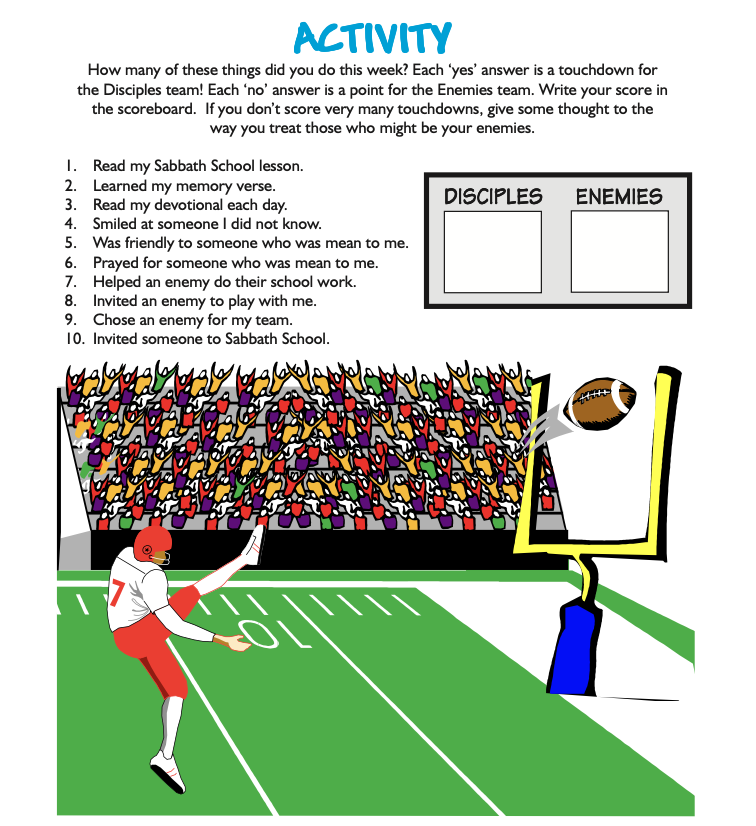
Before class, write each of the ten things listed below on separate strips of paper, and attach a long piece of butcher’s paper to the wall. Put the strips of paper in a basket and let each student draw one. If the class is small, have them draw more than one. If the class has more than ten students, have them work in pairs. Explain to the class that we are going to make a mural by drawing pictures about what we learned in today’s lesson. Ask each to read the statement on the paper they drew, go to the butcher’s paper on the wall, and draw a picture to illustrate what their statement says. They can use conversation bubbles and write in a prayer, sentence, or words to clarify their illustrations or make them better. When they are finished, ask them if this took thinking and planning. Say: We will always have to think and plan if we’re to be Jesus’ really good helpers.
1. Read my Sabbath School lesson.
2. Learned my memory verse.
3. Read my devotional each day.
4. Smiled at someone I did not know.
5. Was friendly to someone who was mean to me.
6. Prayed for someone who was mean to me.
7. Helped an enemy do her school work.
8. Invited an enemy to play with me.
9. Chose an enemy for my team.
10. Invited someone to Sabbath School.
REACH Activity
Word Study: Aphiemi (af-ee’-ay-mee)
Matthew 4:19-20 says: “And he saith unto them, Follow me, and I will make you fishers of men. And they straightway left their nets, and followed him.” The word for “left” is the Greek word “aphiemi,” an intense form of to go. That is, Peter and Andrew never hesitated. When Jesus called them, they went.
Did You Know?
Fishing was an important part of the economy in Galilee. The main types of fish would have been tilapia, carp, and sardines. Much of the fish catch would have been dried or made into fish sauce and imported throughout the Mediterranean world. So fishing would have been important as a part of the Roman Empire economy (Source: NIV Archeological Study Bible, p. 1676).
Music Notes: Jesus Calls Us
This hymn is found on page 180 of the CEM Hymnal. Mrs. Cecil Frances Alexander wrote the words to this hymn as a poem that her husband could use in a sermon on St. Andrew’s Day in 1852. In the Anglican church, St. Andrew’s Day recognizes Andrew’s response to Jesus’ call to follow him. Since Dr. William Alexander used his wife’s words to close his sermon, this hymn has been used to challenge people to hear Christ’s call in their lives and to love Him “best of all.”
In 1850, Mrs. Cecil Alexander married Dr. William Alexander, who later became archbishop for all of Ireland. As his wife, she devoted her writing talents to helping him with his ministry. She is recognized now as one of England’s finest female hymn writers. This particular hymn is one of the few, however, that was not specifically written for children. She wrote more than 400 poems and hymn texts, intended to teach children the Gospel of Jesus Christ (Source: Amazing Grace, Osbeck, K, p. 356).
Journal Jot
Would you leave what you were doing to follow Jesus—like Peter and Andrew did? Do you, in your daily choices, choose Jesus over what you want to do? Spend some time thinking about these questions. Then write a paragraph in your Bible notebook about your willingness to follow Jesus.
Back to the Bible
In Luke 6:21 we are told that Jesus “called them,” that is, James, son of Zebedee, and his brother, John. How do you think the 12 men whom Jesus chose as His disciples and apostles felt when He called them? When Jesus called them, they dropped everything they were doing and followed Him! One meaning for the word “call” is invite. Jesus was “inviting” these men to come and follow Him! When He “called them” He was giving them an invitation to learn from Him, and then go out and teach others. Today’s memory verse tells the directions Jesus left them when He went back to His Father. Wouldn’t you like to have an invitation like that from Jesus? Jesus does want you to be His disciple. The invitation is in your Bible. He calls you through the words that He spoke and the words that He taught. All Scripture comes from God, from Genesis to Revelation (1 Timothy 3:16). When you are older and ready to answer the “invitation,” you will then have the same job Jesus left His disciples. It will be the most important invitation you will ever receive. Practice and memorize Matthew 28:19 and be ready to answer Jesus’ call!
Just Toolin’ Around
Find the word “Gospel” in a Bible dictionary. Then find at least five Scripture verses where the word can be found.
Stretch it Out
Write an acrostic poem for the word D-I-S-C-I-P-L-E that tells what you learned from the lesson.
Questions?
Remember to write any questions that you have in your journal. That way you will remember to ask your parents, teacher, or minister.
Song
“I Have Decided to Follow Jesus” is on page 23 of the Kids Classics Collection.
Closing Prayer
Ask one of the students to lead in prayer. Suggest that they pray for our enemies.
Printable Pages