YE4X.1 · Activity Page
Isaiah 53:3-6
Matthew 26:26-28
Matthew 26:69-75
Luke 22:15-20
John 13:3-10
John 19:33-34
1 Corinthians 11:29
Hebrews 2:17
BIASED- mentally leaning or inclination, bent, partiality, prejudice
SCOURGE- whip, flog, inflicting severe punishment
Lilly was heartbroken. Just last week she had told her best friend, Beth, something she didn't want anyone else to know. Today, her whole class was talking about that very thing. Lilly was so hurt, so angry, so. .. lonely. She just wanted to crawl into a hole and die. How could Beth do this to her? She was her best friend! They'd been best friends since third grade! She had no one else to talk to. What would she do? That night she sat by her bed, her head on her knees, and prayed. "Dear God, I'm so angry at Beth. How could she do this to me? I'm so hurt. I know she didn't mean to hurt me this wav. I know no one is perfect but I feel so Betrayed. Help me to forgive her. Oh Lord, please comfort me. In Jesus' name. Amen”. Sobbing, she crawled into bed and fell asleep.
Lilly felt deserted, angry, alone, and Betrayed! Her best friend had broken her promise to keep her secret and now she didn't feel like she could trust her. Jesus also experienced betrayal from one of His friends.
Last year you learned about the first recorded Passover when God delivered the Israelites from Egyptian slavery. Today's lesson is about Jesus' last Passover when He was Betrayed by His friends.
Before this Passover, Judas went to the High Priest and asked him, "What are you willing to give me if I hand him [Jesus] over to you?" They agreed on 30 pieces of silver. From that time on, Judas looked for an opportunity to betray Jesus.
The Passover was prepared that evening for Jesus and the 12 disciples. While they were eating a meal, Jesus said, "I tell you the truth, one of you will betray me.” Eleven of the disciples said to Jesus, "Surely not I, Lord?" Jesus explained that it was the disciple who dipped his hand in the bowl with Him who would betray Him. And Judas said, "Surely it's not me?" But Jesus answered, "Yes, it is you."
Jesus then used new symbols for the Passover. He took bread, gave thanks, and broke it. He said, "Take and eat; this is my body." What did He mean? And why did He break the bread? The unleavened bread in the Passover represents Jesus' body that was broken for you - for your healing. He was beaten within an inch of His life, scourged with a cat-of-nine-tails, and experienced every type of pain known to man so that we can be healed. Isaiah 53:5 says, "But he was pierced for our transgressions [sins], he was crushed for our iniquities; the punishment that brought us peace was upon him, and by his wounds we are healed” (NIV). This part of the Passover should not be overlooked, nor misunderstood. I Corinthians 11:29 says: "For anyone who eats and drinks without recognizing the body of the Lord eats and drinks judgment on himself. That is why many among you are weak and sick, and a number of you have fallen asleep.”
Then Jesus took the second new Passover symbol, which was a cup of wine. He gave thanks and offered it to His disciples with instructions for them to drink all of it. Jesus explained that this represents his “blood of the covenant, which is poured out for many for the forgiveness of sins."
They sang a hymn and went to the Mount of Olives. Jesus told Peter that he would deny Him three times that very night, before the rooster crowed. Peter wasn't the only one. Jesus said that all of them would fall away that night on account of Him. Lilly was betrayed by one friend. But now we see that all 12 of Jesus friends would forsake Him in one night - the most awful night of His life.
Things went from bad to worse. Jesus left His disciples three times to go pray because He knew that the next day He would be beaten to the point of being unrecognizable. Each time He came back from praying, He found His disciples asleep. One time Jesus prayed so fervently, that His sweat became as great drops of blood. He asked His Father if He could find another way for you and for me to have forgiveness of our sins, so He wouldn't have to go through this horrible ordeal. But Jesus was so obedient to His Father that He always said, "Not my will, but your will be done.”
Judas found his opportunity to betray Jesus and showed up with a large crowd armed with swords and clubs. These men were sent by the highest religious leader of the day - the High Priest. By Judas kissing Jesus on the check, the men had the signal that identified who He was so they would know who to arrest. Peter got all frantic and took a sword and cut off the ear of the High Priest's servant. Jesus performed His last miracle before His death and put the ear back on.
Jesus stood trial all night long before a biased jury. He was beaten, insulted, humiliated, and scourged so that we can be healed. Then He was told to carry His stake to Golgotha where He was crucified. Late in the day a Roman soldier pierced His side and Jesus' blood poured out for our sins. He did this so that you can be forgiven and have eternal life. Even the Father turned His back on His Son so that He could die for you and for me. Christ’s sacrifice is extremely important. More than that, its's essential. Words can’t express the depth of love behind His death. Without His death, His suffering, His pain, you would be hopeless. But you have hope because of Him. You have a choice between life and death because of what He did for you.
Judas Betrayed Jesus. Peter did deny Christ three times before the rooster crowed. Are you going to betray Jesus as Judas did in the things you do? Every day we have a choice either to stand up for the truth and what is right or follow the world and reject our Lord. Judas chose death. Will you choose life? It's the choice only you can make. Will you accept the sacrifice of the Lamb of God for your sins and change your life to live by His every Word?
Dear Father in heaven,
Every day I have a choice to follow you or reject you. I pray for your Spirit to guide and strengthen me. Please help me to make the right decisions and honor you with my life.
In Jesus' name I pray.
Amen.
Sunday - Matthew 26:26-28
Monday - 1 Corinthians 11:29
Tuesday - Isaiah 53:3-6
Wednesday - John 13:3-10
Thursday - John 19:33-34
Friday - Hebrews 2:17
Saturday - Matthew 26:69-75
John 6:48-52
Romans 5:12
1 Corinthians 5:6-8
1 Corinthians 5:7-8
Galatians 5:9
Ephesians 5:1-21
Ephesians 6:10-18
James 1:15
CORRUPT - turn evil
SINCERITY - to really mean it, honesty
MALICE - mean-spirited
It was the middle of the Feast of Unleavened Bread and Sarah was in school. After her morning classes she plopped down beside her friends at lunch. Sarah's friend, Tasha, started talking about the birthday party she was planning that weekend. Instantly, the girls were rambling about the details.
"Oh yeah!" Said Tasha, I"almost forgot! My mom made a bunch of double peanut butter cookies for me last night. They're so good." She dug into her lunch bag and eventually pulled out a bag of scrumptious cookies. She gave each of her friends one and they each devoured their cookie, including Sarah.
As the girls finished their conversation and cookies, they began eating their lunches. Sarah's stomach dropped when she opened her lunch bag and pulled out the unleavened bread her mom had made her. "Oh no! I totally forgot about not eating leavening!”
Sarah told her mom about the cookie when she came home after school and asked her if she'd ever slipped up. Her mom answered. "It's really easy to do when you're used to eating whatever you want. That's one of the things that makes yeast such a good symbol for sin. You should ask God's forgiveness and try your best to remember not to ever do this again.”
Sin, just like tiny grains of yeast, will grow and invade other parts of your life if given the time and space to do so. The Feast of Unleavened Bread is a wonderful reminder that God wants us to remove all sin from our lives and replace that sin with righteousness. During the Feast of Unleavened Bread, leavened bread represents sin and unleavened bread represents Jesus Christ and His righteousness. Jesus said, "I am the Bread of Life."
Like yeast, sin is sometimes overlooked because it may seem small. Sin spreads and infects everything it touches, corrupting what was once good and pure.1 Thessalonians 5:22 says, "Avoid every kind of evil." Also, Ephesians 5:3 says, "But among you there must not be even a hint of sexual immorality or of any kind of impurity, or of greed, because these are improper for God's holy people." If we let sin remain in our lives it will separate us from God and draw us down the path to destruction. Think about this: Jesus still would have suffered and died for even one "little" sin of ours because that one sin would sentence us to eternal death.
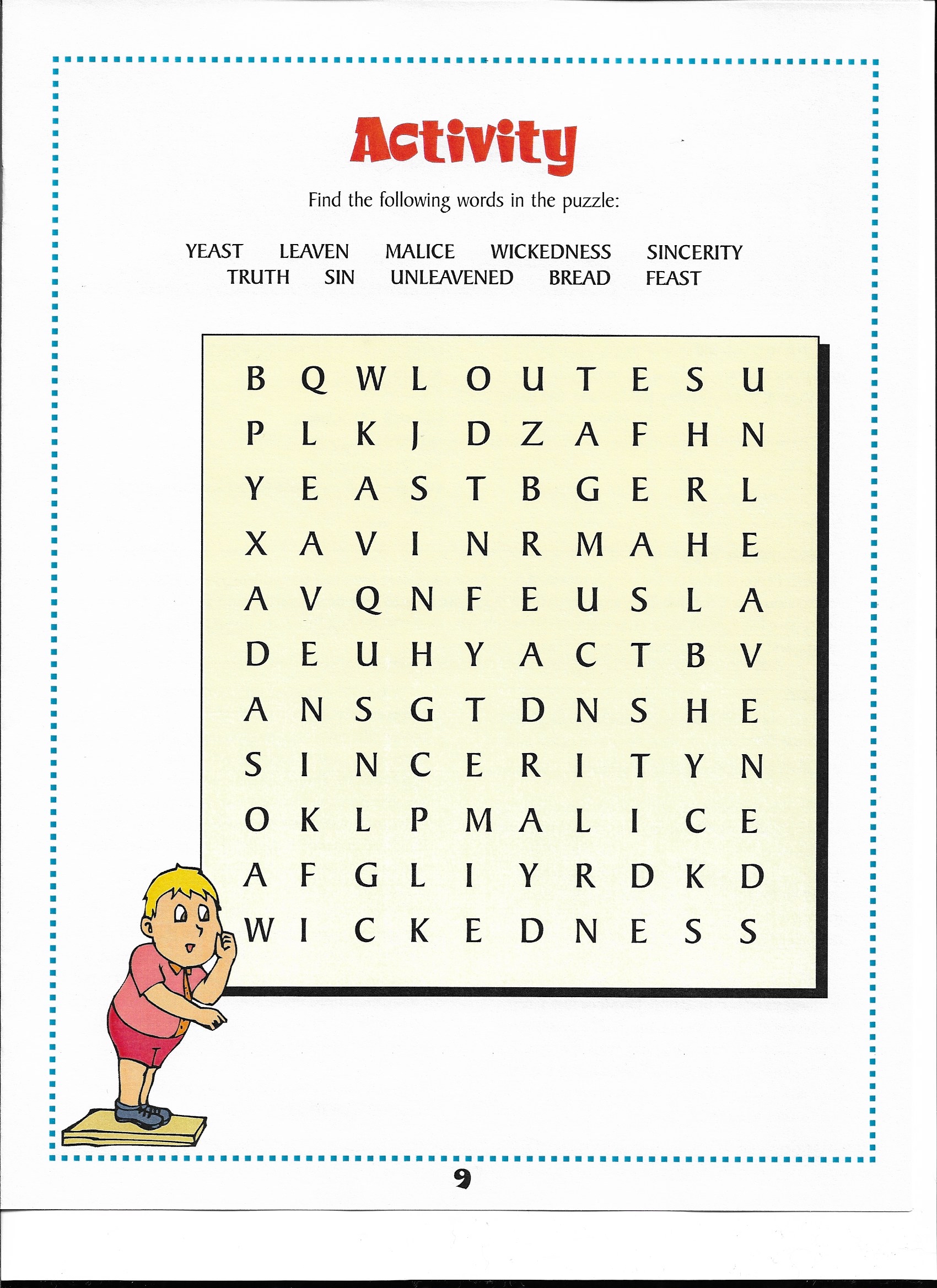
In I Corinthians 5:8 it says, "Therefore let us keep the Festival, not with the old yeast, the yeast of malice and wickedness, but with bread without yeast, the bread of sincerity and truth." Malice is a state of mind that causes wicked actions. If we change our state of mind, we can change our actions." 2 Timothy 2:22 says, "Flee the evil desires of youth, and pursue righteousness, faith, love and peace, along with those who call on the Lord out of a pure heart." Fleeing is a verb, also known as an action word! We must actively choose to do right, and not wrong, putting God first in our lives.
In Matthew 16:6 Jesus told His disciples, "Be careful be on your guard against the yeast of the Pharisees and Sadducees.” The disciples, who could be a bit thickheaded at times, took Jesus literally, and had no clue what He was talking about. Jesus explained that He meant the false doctrines of the Pharisees and Sadducees. He didn't care if the Pharisees or Sadducees gave the disciples bread! He was warning them about being deceived by them. Let's face it; friends can be pretty pushy sometimes when they want you to agree with them. They may label you as a "goodie two-shoes" if you try to live a godly life. But what's more important, pleasing your friends or God? Friends come and go, but God is forever.
God knows we're only imperfect humans; after all, He's the one who created us. Still, He requires excellence from His children. He knows we will fall, but He expects us to put Him first, to seek His Kingdom above all things, and to overcome evil with good. Repeat after me: “I can do everything through Him [Jesus Christ] who strengthens me!" (Philippians 4:13). Celebrate the Feast of Unleavened Bread with the Bread of Life. Put Jesus first in your life. Keep your eyes on the prize, your focus on Christ, stay far, far away from temptations and the things that will bring you crashing to the ground.
For seven days as you eat unleavened bread, remember that it pictures putting Jesus Christ into your life. How do you do that? You do it when you talk with Him in prayer, when you study your Bible, and as you meditate on what He is saying to you through his Word.
Dear God in heaven,
Please help me to put sin out of my life and follow you. Forgive me when I sin and pick me up when I fall. Teach me to follow you and live in righteousness. I know that because Jesus died for my sins, I can be forgiven and I pray all things in His name.
Amen.
Sunday - 1 Corinthians 5:6-8
Monday - Galatians 5:9
Tuesday - Ephesians 5:1-21
Wednesday- Romans 5:12
Thursday - lames 1:15
Friday - John 6:48-52
Saturday - Ephesians 6:10-18
Leviticus 23:15-21
Numbers 28:26-31
Proverbs 15:30
Acts 1:8
Acts 2:1-8
Acts 2:36-41
Ephesians 4:1-8
1 Thessalonians 5:19
ASCEND - to go up
APOSTLE - one sent
KUDOS - credit or praise for achievement; glory; fame
At school on Monday. Jamie saw his friend Alexis in the hall. She looked really down so he called to her from across the hall, "What's up, Alexis?”
"Oh, it's my family. My dad just got a new job and everyone's all stressed out. My mom hasn't had time to cook or go shopping, so we ate TV dinners last night which were really gross. We'll probably have peanut butter and jelly sandwiches tonight.”
Jamie frowned and sighed. "I've got to go. Hope you have something better for supper tonight.”
When Jamie arrived from school he told his mom about Alexis' situation. Before long they had a plan and Jamie helped his mom cook double portions for supper. They stuffed a large picnic basket with half of the food they'd prepared and loaded it into the car. Jamie and his mom grinned at each other as they drove over to Alexis’ house.
When Alexis opened the door she was totally surprised. Her mom cried as she unloaded the picnic basket. She must have hugged Jamie's mom a dozen times. Jamie was so happy to share with his friend and her family. Dinner tasted even better that night because he knew someone else's family was eating well too. Before Jamie went to bed he thanked God for all the blessings in his life. He also thanked God that he could share his blessings with others.
Pentecost is one of three harvest festivals. In the spring people reaped the harvest they had planted earlier in the year. In the Bible, Pentecost is mentioned as one of three appointed feasts on which God commanded every man to come before Him with offerings. After Christ's ascension, Pentecost marked the birth of the New Testament church.
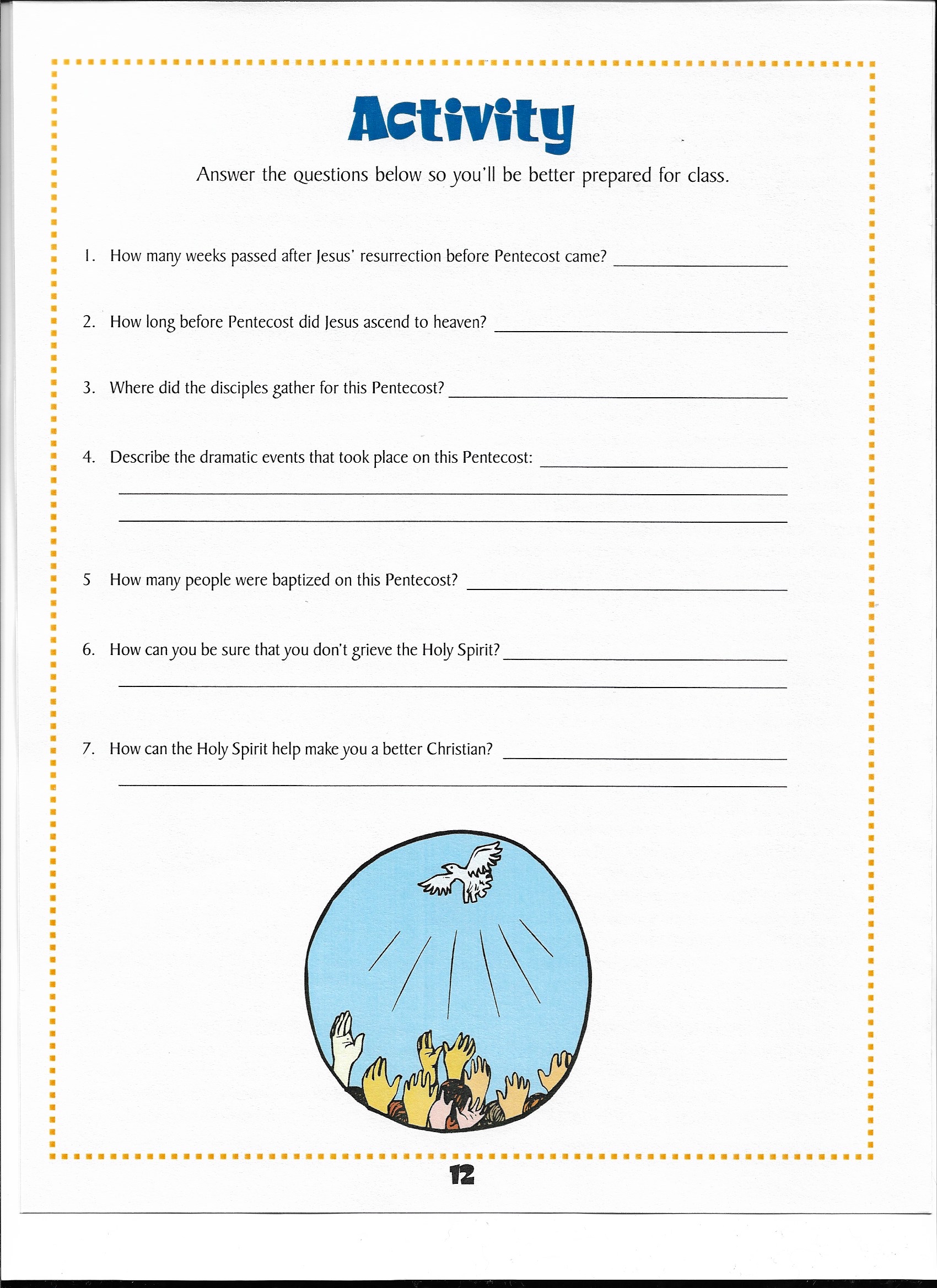
Seven weeks had gone by since Jesus' death and resurrection. He had ascended into heaven just ten days prior to Pentecost. Before His ascension, He told His disciples to wait in Jerusalem until He empowered them with the Holy Spirit. They did as they were told and gathered in Jerusalem for Pentecost. Suddenly a sound like the roaring of a mighty windstorm filled the house. What looked like tongues of fire appeared and sat upon each of their heads. Everyone was filled with the Holy Spirit and began to speak in languages that those present from other nations could understand. It was the Holy Spirit that gave them the ability to speak in foreign languages. This had to happen for Jews from many other nations to understand and learn about the mighty miracles of God! Can you imagine how surprised, maybe a little frightened, but yet grateful the people must have been?
Luke tells us, “But you will receive power when the Holy Spirit comes on you; and you will be my witnesses in Jerusalem, and in all Judea and Samaria, and to the ends of the earth" (Acts 1:8). The Holy Spirit wasn't given to those people to make them more important. It was given to them so they could do a job - spread the good news about Christ dying for their sins and being resurrected.
The Holy Spirit moved Peter to speak strong words that day. The minds and hearts of people were opened to believe on Christ as their Savior. On that Pentecost day 3,000 people repented of their sins and were baptized! Can you imagine the awe each person must have felt that day? How wonderful it must have been to have been a part of such an event. Everyone must have felt truly blessed.
On this day of Pentecost, everyone present was filled with the Holy Spirit so they could do God's work. We too can be empowered with the Holy Spirit. But we must know God, repent of our sins, love and believe in Jesus Christ as our Savior, and be baptized. God doesn't call us and give us His Spirit to do nothing. We too have a very important job to do. We are called to share the story of Jesus’ death and resurrection with others so they can know and love God the Father and Jesus His Son too. Jamie was so happy to share the good things his family had with his friend Alexis. He shared the blessings God gave him and that made them both very happy. We have the opportunity to do the same every day.
There are so many things we can do to share God's love. You can encourage and support a depressed friend with kind words and comforting scriptures. Proverbs 16:24 says, "Pleasant words are a honeycomb, sweet to the soul and healing to the bones." A simple smile or hug does wonders for the lonely and downcast, or as Proverbs 15:30 says, “A cheerful look brings joy to the heart, and good news gives health to the bones." Your example- the way you live your life - can also be a witness to God's love. How you act under stress, fatigue, and loss will impress people much more than what you say during the good times. As the saying goes, "I'd rather see a sermon than hear one any day.”
When we are baptized, a minister lays hands on us and asks God to give us the Holy Spirit. When you receive the Holy Spirit, it is for a purpose. God doesn't give His Spirit as kudos to you. He gives it to you so that you can live the Christian life to the full and do His will in everything. We should never underestimate the power or importance of the Holy Spirit. We have a truly rewarding job as witnesses for, or example of, God.
Paul warns us to, "Quench not the Spirit" (I Thessalonians 5:19). "And do not grieve the Holy Spirit of God, with whom you were sealed for the day of redemption" (Ephesians 4:30). How can you be sure that you don't grieve or quench the Spirit? You must always keep God's commandments and do your part in getting the Gospel out. You can make a big difference even through seemingly small acts of kindness. In the story of Christ's suffering and death there is a theme of love and hope of salvation. That's the story we get to tell to others: a story of hope, a story of love, and the story of salvation. How are you going to share that story with others?
Dear God in heaven,
Thank you so much for all the blessings in my life. Help me to share what I have with others and let them know how much God loves them.
In Jesus Christ's name I pray.
Amen.
Sunday - Leviticus 23:15-21
Monday - Numbers 28:26-31
Tuesday - Acts 2:1-8
Wednesday - Acts 2:36-41
Thursday - Proverbs 15:30
Friday - 1 Thessalonians 5:19
Saturday - Ephesians 4:1-8
Leviticus 23:23-25
Leviticus 23:24
Zechariah 13:8-9
Matthew 24:30-31
1 Corinthians 15:52
Revelation 6:12-14
Revelation 8:1-13
Revelation 9:1-21
COMMEMORATE - to celebrate by memorial
THE DAY OF THE LORD - a time of God's wrath on this earth
Jason's older brother, Brian, was coming home over the weekend. The whole family was anxious for his arrival. Brian had enlisted in a special unit of the army that trained dogs, and he'd been gone for several months now. When Brian last wrote his family he said he was bringing his new partner home with him. Everyone was excited to see Brian and curious about his new canine partner, Toby.
Jason was amazed at what Toby knew. Brian had a special whistle that he could blow in different ways to tell Toby what to do. Jason asked his brother how Toby could understand all those commands.
"Well, they start training them when they're just puppies. We use rewards when they respond correctly to our signals and before long they see the connection. If you think about it, it's not that different from training people. We learn that a red light means stop and letters have sounds associated with them pretty early in life. It's the same with dogs." Jason rubbed Toby behind the ears affectionately and Toby thumped his tail on the ground.
Just as Toby learned that certain signals require specific actions, God told the Israelites to use trumpets to signal different things. For Toby, two short blasts on the whistle mean sit. For the Israelites, blowing two trumpets meant the whole community was to assemble at the Tent of Meeting.
Trumpets were used a lot of different ways in the Bible. They were used to gather the community or the leaders, as mentioned above, and they were also used in worship. Trumpets were used to make announcements, to lead men into war, and a trumpet will be used to announce the Feast of Trumpets and Christ's return when the saints are resurrected from the dead (I Corinthians 15:52).
The Feast of Trumpets' lesson title a year ago was Grab the Rope. We learned that the Feast of Trumpets pictures the return of Christ to this earth as a rescue mission. World conditions will be horrible at that time. The world will be on the brink of utter destruction and Christ will return to save His people. But could Christ come tonight? Are there signals that will let you know His coming is soon?
Jesus' disciples clearly expected that there would be some prior indication that Jesus' return was imminent. He spoke to them of the destruction of the Temple. The disciples came to Him privately on the Mount of Olives and asked Him, "Tell us, when shall these things be? And what shall be the sign of your coming and of the end of the age?" (Matthew 24:3). Then Jesus put together a comprehensive list of events that will take place before He returns.
One of the things that will happen will be a sequence of seven trumpets or The Signal that is mentioned in the book of Revelation. The first six trumpets are described in the eighth and ninth chapters of Revelation. It begins with the opening of the seventh and last seal followed by a short period of silence.Then John saw seven angels standing before God and they were given seven trumpets.
The angels then sounded their trumpets in sequence and the following happened when each trumpet sounded: (I) "There was hail and fire mingled with blood, and they were cast upon the earth; And the third part of trees were burnt, and all green grass was burnt up" (verse 7). (2) It was like a great mountain burning with fire and was cast into the sea. A third part of the sea became blood: a third part of the living creatures in the sea died; and a third part of the ships were destroyed (verses 8 and 9). (3) A great star named wormwood falls on the rivers of waters and a third part of them are made poison (verses 10, 11). (4) A third part of the sun, moon, and stars go dark (verse 12).
The fifth, sixth, and seventh trumpets consist of the "three woes" (Revelation 9:1-21). This is the ultimate war. If Jesus did not intervene to stop the third woe, it would mean, quite literally, the end of the world.
Since we're looking for events that will happen just before Jesus* return, let's look carefully at the sixth trumpet in Revelation 9:13-16, "And the sixth angel sounded, and I heard a voice from the four horns of the golden altar which is before God, Saying to the sixth angel which had the trumpet, Loose the four angels which are bound in the great River Euphrates. And the four angels were loosed, which were prepared for an hour, a day, and a month, and a year, for to slay the third part of men. And the number of the army of the horsemen were two hundred thousand thousand: and I heard the number of them."
This is an army of very specific size - 200 million men! In the specific time of one year, one month, one day, and one hour, one-third of the earth’s population will be slain! This sounds like something out of science fiction. This will be The Signal of Christ's return because it is to take place just before He comes back. Jesus Christ could not come tonight because these events haven't taken place. But how long do you think it will be before we see The Signal?
Zechariah 13:8, 9 says. "two-thirds will be struck down and perish; yet one-third will be left in it. This third I will bring into the fire; I will refine them like silver and test them like gold.They will call on my name and I will answer them; I will say, 'They are my people,' and they will say, ‘The Lord is our God.’" Think about it. We don't sacrifice any offerings with fire at this time, however we ourselves are sacrifices to God. We are brought through a type of refining fire: trials and tribulations. Through these things we are brought closer to God and made stronger. Celebrate the Feast of Trumpets with joy and make yourself ready for the return of Christ. Now think about this. How long do you think it will be before we see The Signal? Will you be ready?
Dear Lord in heaven,
Teach us to accept the refining fire of hardship and trial each day and prepare for your return in gladness. We put our trust and hope in you.
In Jesus' name I pray.
Amen.
Sunday - Leviticus 23:23-25
Monday - Revelation 8:1-13
Tuesday - Zechariah 13:8-9
Wednesday - 1 Corinthians 15:52
Thursday - Revelation 9:1-21
Friday - Matthew 24:30-31
Saturday - Revelation 6:12-14
Exodus 12:3-13
Leviticus 16:20-34
Leviticus 16:34
Numbers 16:46
2 Chronicles 7:14
Psalm 103:8-12
Luke 22:20
John 3:15-17
2 Peter 3:9-10
ATONEMENT - covering for our sins
SCAPEGOAT - azazel; this goat carried the sins of the people into the wilderness
HOLY OF HOLIES - or Most Holy Place; where the Ark of the Covenant was kept
Have you ever wondered What's the Difference between Atonement and Passover? Why does God give us rituals and ceremonies for two days that seem so similar? Both days symbolize Christ removing our sin, both days are somber and serious, and both days are days that God commanded us to keep. So, What's the Difference?
Starting in Leviticus 16, God explained to Moses how Aaron, the High Priest, should make atonement for himself and his family, and for the people. God detailed instructions for the High Priest to follow exactly like he gave them. He was not to go into the Holy of Holies where the Ark of the Covenant was kept except once a year on the Day of Atonement or he would die. That was because God was there in a cloud over the Atonement cover. The following outlines instructions God gave the High Priest for the Day of Atonement:
1. Bathe yourself and put on white linen garments.
2. Enter the sanctuary with a bull as a sin offering and ram for a burnt offering.
3. From the community of Israel, take two male goats for a sin offering and a ram for a burnt offering.
4. Ofer the bull for your own sin offering making atonement for yourself and your family.
5. Take the two goats and present them before the Lord at the entrance of the Tent of Meeting. Then cast lots to determine which goat would represent the Lord in the Atonement ceremony and which one would be the scapegoat.
6. Choose by lot the goat to represent the Lord so it will be sacrificed.
7. Don't kill the scapegoat. The goat chosen by lot to be the scapegoat shall be kept alive to be sent into the desert.
8. After the bull is killed as a sacrifice for your sins and the sins of your family, you take a censor full of burning coals from the altar, two handfuls of finely ground fragrant incense behind the curtain in the Holy of Holies. This smoke will prevent you from seeing God and dying. (No physical human being can look upon God and live.)
9. Then take the bull's blood with your finger and sprinkle it on the front of the atonement cover and sprinkle it seven times before the atonement cover.
10. Slaughter the goat for the sin offering for the people and take the blood behind the curtain and do like you did with the bull's blood. This was to make atonement for the Holy of Holies because of Israel’s uncleanness, rebellion, and sins. No one can be in the Tent of Meeting from the time you go in until you come out from making atonement for yourself, your family, and the whole community of Israel.
After all of this was completed, Aaron went outside and laid both his hands on the scapegoat and confessed over it all of the wickedness, rebellion, and all of the sins of Israel. This ceremony was to symbolically put all of the sins of Israel on this goat’s head. Then this goat was sent into the desert to be released in a solitary place. This ceremony shows that our sins are removed as far as the east is from the west.
So What's the Difference between Passover and Atonement? On the original Passover night, the blood of a lamb was required for each family, meaning a lot of goats were killed. God spoke to Moses and Aaron in Exodus 12:3. "Tell the whole community of Israel that on the tenth day of this month each man is to take a lamb for his family, one for each household." In Luke 22:20 Jesus says. "This cup is the new covenant in my blood, which is poured out for you." From these verses we can see that Passover is a personal rite or ceremony.
Both days involved animal sacrifices and both point to Christ, but Atonement is national or communal forgiveness (Leviticus 16:16) while Passover shows the forgiveness of sin for the individual. This is the main difference between Atonement and Passover. At the Passover, you take the bread, you take the wine, and in doing so, you acknowledge that Christ suffered and died for you and your sins. If you were the only person alive and you committed just one sin, Christ still would have died.
Passover reminds us that Christ's sacrifice is very personal. Atonement is for our national sins which need to be forgiven. What are some of our nation’s sins? Just for starters they are greed, killing off more than 40 million babies through abortion, getting rid of God in our schools, public life, etc. If our nation came before God on the Day of Atonement asking forgiveness of our nation's sins then they could be symbolically put on the head of the goat that is sent into the desert and let go. Our nation's sins would be removed as far as the east is from the west. God would forgive us and our nation would be blessed. But there would be one requirement: We must stop doing them!
Gracious Father,
You have done something amazing by sending your Son to save the world. As I keep the Day of Atonement, I humbly accept His sacrifice and acknowledge that it was not only for me that He died, but for everyone. Help our nation to recognize its sins and to repent of them.
In Jesus' holy and righteous name.
Amen.
Sunday - Leviticus 16:20-34
Monday - Exodus 12:3-13
Tuesday - Luke 22:20
Wednesday - John 3:15-17
Thursday - Psalm 103:8-12
Friday - 2 Chronicles 7:14
Saturday - Numbers 16:46
Deuteronomy 12:6-9
Deuteronomy 12:11-21
Deuteronomy 14:22-27
Psalm 50:10
Proverbs 3:9
Malachi 3:6-12
Malachi 3:10
TITHE - a tenth of a person's increase
It's September and school has started. Soon you'll be visiting with your teachers about taking off for eight days to go to the Feast of Tabernacles. What happens when Feast time rolls around and you simply don't have enough money to go? Have you ever looked in every drawer, pocket, and purse to find even pennies, nickels, and dimes so you could put together enough money to make it to the Feast? You know that God commands you to get up and go. Now you've got permission to get out of school for religious reasons. After all of this, you may be having trouble putting together enough money to make the trip and stay for eight days. Now it's becoming obvious that there will be no money to have a really good time. Was this what God intended?
Does God expect you to go to the Feast on a shoestring budget? Does He intend that you break the bank to go? Or does God intend that you have plenty of Money to Spend while you're at the Feast? fI so, how do you get it?
The children of Israel were crossing over the Jordan River to enter the Promised Land. Remember, they had now walked 40 long years to get to their destination. God knew His people would need some instructions about keeping the Feast of Tabernacles. So He told them they were to celebrate the Feast of Tabernacles in the place where God chose. There they were to rejoice with their sons, daughters, servants, and the Levites, who had no inheritance.
Then it says in Deuteronomy 14:22-23, “Be sure to set aside a tenth of all that your fields produce each year. Eat the tithe of your grain, new wine and oil, and the firstborn of your herds and flocks in the presence of the LORD your God at the place he will choose as a dwelling for his Name, so that you learn to revere the LORD your God always.”
If you'll notice in verse 23 the Israelites were to take their grain, wine, oil, and the firstborn of their herds or flock for them to eat at the place where God chose. So what about us today? What if you live in Washington, California, or Arkansas and the Feast is held in Florida? Are you to rent a truck, load up all your cattle, grain, wine, and oil and transport them to Florida? After you get there you would have to slaughter them to eat. God knew that this could be a problem, so He gave us the answer.
Notice verses 24-25. "But if the place is too distant and you have been blessed by the LORD your God and cannot carry your tithe (because the place where the LORD will choose to put his Name is so far away), then exchange your tithe for silver, and take the silver with you and go to the place the LORD your God will choose." In other words, if you're a farmer, you can sell your produce and cattle and take the money with you to the Feast. But you're probably not a farmer. So if you do work, then all year long you save one tenth of your increase (your earnings) as a festival tithe. Then what do you do with it? This is a separate tithe from what you give to God. Verse 26 answers those questions. "Use the silver to buy whatever you like..." Now that sounds like fun.
Just think if you have ten percent of everything you or your parents earn each year to get you to and from the Feast of Tabernacles and take care of all of your needs there, you'll have a lot of Money to Spend. Let's say that you have a part-time job for eight months out of the year, working 10 hours each week, that pays you $10.00 per hour. And you earn the same amount per hour three months during the summer working 40 hours each week. Do you realize that you would earn $8000? A tithe of that would be $800. Now you can do a lot at the Feast with $800 and you'd never have to ask Dad for money. You can enjoy the rides at the track, have pizza several times, and really have fun, especially if your parents are taking care of your travel expenses, condo where you stay, and most of your meals.
But does God require a teenager to tithe on their part-time job? Exodus 12:49 says, "The same law applies to the native-born and to the alien living among you.” The principle would cary over to there being one law for you and your parents. Any teenager earning a wage has an obligation to tithe to God and save a festival tithe to make the Feast more enjoyable.
You may not think you need one tenth of what you make, your increase, as a festival tithe. We're always wise to keep in mind that it's not what we think that counts, but what God thinks. Another thing is that with every blessing comes a responsibility. The Bible says the poor will always be with us. When God blesses us we have a responsibility to share what He gives us with those who are less fortunate than we are. Sharing is one of the great blessings God has given us. If you have nothing, you can't share, but when God blesses you with income whereby you can save a festival tithe, He wants you to share it. You’re to go to the place where God chooses, you, your sons and daughters, your menservants and maid servants, and the Levite from your town, and you are to rejoice before the LORD your God.
"There in the presence of the LORD your God, you and your families shall eat and shall rejoice in everything you have put your hand to, because the LORD your God has blessed you" Deuteronomy 12:7, NIV). God tells you to rejoice at the Feast of Tabernacles. Now that shouldn’t be hard to do, especially when He tells you how you can afford to do it. But now you know what you should do. Will you obey God and set aside one tenth of what you earn so that you can rejoice and help others rejoice at His Feast?
Gracious Father,
You are so good to us. You set a Feast before us and provide a way that we can have such a wonderful time. Thank you for your plan. Help me to always remember those who are less fortunate and help them with my festival tithe.
In Jesus' name I pray.
Amen.
Sunday - Deuteronomy 12:11-21
Monday - Malachi 3:6-12
Tuesday - Proverbs 3:9
Wednesday - Psalm 50:10
Thursday - Deuteronomy 14:22-26
Friday - Deuteronomy 14:27
Saturday - Deuteronomy 12:6-9
Leviticus 23:36
Isaiah 51:6
Ezekiel 37:1-28
John 1:1-15
John 7:37-39
2 Peter 3:9
Revelation 21:1-7
UNIVERSAL SALVATION - the teaching that every person who has ever lived will eventually be saved and inherit eternal life.
SINEWS - tendons
Do you like creepy, gross things, or do they scare you? Are you afraid of cemeteries? What if an angel appeared to you and told you to go out to the nearest cemetery and wait for instructions. You went out there and saw a lot of disconnected human bones scattered all across the landscape. What would you do? Would you scream and get out of there as fast as you could? But what if that angel wanted to give you a guided tour through this valley of bones? Would you still be with him? What if he said, "I want you to preach to these bones?" Would you say, "Not me, man, I've got other things to do."
There is a very interesting story in the Bible where the Spirit of the Lord carried the Prophet Ezekiel to a valley full of old, dry bones. He was given a guided tour through this cemetery and saw human bones scattered all over the place. No, this wasn't Halloween where people hang paper skeletons on their doors or in trees. Something much more important was happening - and it's for real. When it happens, it won't be spooky or scary, it will be awesome!
The one guiding Ezekiel through this cemetery asked Ezekiel, "Can these bones become people again?" Ezekiel didn't have the answer to that question. So he told Him, "Master God, only you know that.
"He said to me, ‘Prophesy over these bones. Dry bones, listen to the Message ofGod.’" Would you feel a little crazy talking to a bunch of Disconnected Bones lying in a valley? If God told you to, would you preach to them? The story continues..
"God, the Master, told the dry bones, 'Watch this. I’m bringing the breath of life to you and you'll come to life. I'll attach sinews to you, put meat on your bones, cover you with skin, and breathe life into you. You'll come alive and you'll realize that I am God! . . . They stood up on their feet, a huge army" (Ezekiel 37, The Message).
What do you think is really happening here? When dry, disconnected bones put on skin and sinews and begin to breathe, what kind of people are they? Dead people don't breathe. This means they are no longer dead; they are alive - a huge army of people. This story is about a resurrection from the dead. But you may say, our lesson in this book titled "The Signal" was about the resurrection. How can this be?
Revelation 20:5 speaks of "the first resurrection." That was what your lesson titled, “The Signal" was about. In other words, today, we’re learning about a different resurrection - a second one.
But who are all of these people - these Disconnected Bones? Ezekiel 37:11 answers that question. "These bones are the whole house of Israel." These are people who died without knowing God - without ever being converted. When these bones are made to live, these people are going to think they have no hope. But God is so merciful, He will give them hope. God says, “You will know I am the Lord. I will put my Spirit into you, and you shall live and return home again to your own land. Then you will know that I, the Lord, have done just what I promised you" (Ezekiel 37:14).
Have you known people who have died, maybe a baby, a grandparent, or a friend, who did not know God and had never been baptized? Have you wondered what will happen to them when Christ returns? "The Lord is not slack concerning his promises, as some men count slackness; but is long suffering to us-ward, not willing that any should perish, but that all should come to repentance" (2 Peter 3:9). The Bible does not teach universal salvation where every last person who is ever born will be saved and enter eternal life. But it does teach a God of love and mercy who has a plan to give every person who has ever lived a chance for salvation. This is only part of the lesson we are to learn from the Last Great Day.
So what are your advantages of being in the first resurrection rather than being some of the dry, Disconnected Bones that are resurrected? The people who will be in the first resurrection get to spend one thousand years with Christ before all of these Disconnected Bones in today's lesson are resurrected and live again. Hebrews 11:35 speaks of a"better resurrection.” Would you agree that being resurrected to live a thousand years before another group of people are resurrected would be a better resurrection?
Those who are resurrected at Christ's return will be able to enjoy one thousand years in God's Kingdom before this prophecy in Ezekiel 37 is fulfilled and these Disconnected Bones come back together, flesh and muscle adhere to them, and they start breathing. Then they are taught God's way, become converted, and receive God's Spirit. So it really matters - it matters a thousand years worth of exciting living - if you repent of your sins, obey Jesus by being baptized, and receive the Holy Spirit now.
Think about it. Do you want to be some of those Disconnected Bones that dry out in the grave for a thousand or more years, or do you want to be a part of the most exciting time in human history? It's your choice? What will you do?
Awesome God and Father,
Your plan to give everyone an opportunity for salvation is so wonderful and merciful. Thank you for showing me that there are two resurrections. Help me to do everything I can to be in the first, the better resurrection.
In Jesus' name I pray.
Amen.
Sunday - 2 Peter 3:9
Monday - Ezekiel 37:1-15
Tuesday - Ezekiel 37:16-28
Wednesday - John 7:37-39
Thursday - John 1:1-15
Friday - Revelation 21:1-7
Saturday - Isaiah 51:6
Judges 2:11-13
1 Samuel 7:3-7
1 Samuel 12:8-11
1 Kings 11:29-33
Isaiah 44:12
Jeremiah 7:18
Acts 12:1-5
FAT TUESDAY - the "last hurrah" before Lent begins on Ash Wednesday
ASH WEDNESDAY - 40 days before Good Friday and the day Lent begins
LENT - (real meaning) to give for temporary use on condition that the same or equivalent be returned; (Religious meaning) The 40 days of abstinence that precedes Easter
MARDI GRAS - literally means "Fat Tuesday" in French
HOT CROSS BUNS - the buns are traditionally eaten on Good Friday, with the cross standing as a symbol of Christ. They actually pre-date Christianity and were used in pagan worship
Our Protestant and Catholic friends do a lot of good things. They may try hard to help their teenagers understand the Bible, fulfill their religious obligations, and have a spiritual experience. During Mardi Gras, Fat Tuesday, Ash Wednesday, Lent, and the Easter period they may do many religious things. But are these things commanded or even mentioned in your Bible? Do these things connect teenagers to God? Do they give teens a deeper spiritual experience in keeping with the Bible teaching?
To determine this, we have to answer the question. "Are those who celebrate Mardi Gras, Fat Tuesday, Ash Wednesday, Lent, Good Friday, and Easter doing things that are laid out in the Bible for Christians to do?”
Get your concordance out and turn to Fat Tuesday and see how many scripture verses you can find that mention this date. The word 'fat' is mentioned numerous times in the Bible, but never in conjunction with the word "Tuesday." As a matter of fact, the word "Tuesday" is never mentioned in your Bible. All of God's holy days are mentioned in the Bible. Does it leave you thinking that since Fat Tuesday cannot be found in the Bible, that God must not intend for us to observe it? If God had wanted us to celebrate it, He would have mentioned it by name in the Bible and told us to celebrate it.
You have probably seen some of the Mardi Gras celebrations shown on television from New Orleans. These include masked balls, parties, and drunken people making fools of themselves. Mardi Gras literally means "Fat Tuesday" in French. The name comes from slaughtering and feasting on a fatted calf on the last day of the carnival. But again, when you check your concordance to find scripture verses in the Bible that tell us to celebrate Mardi Gras, they simple are not there.
What about Ash Wednesday. Oops, it’s not anywhere to be found. But let’s be honest: the word "ash" is mentioned one time and Ash Wednesday is not mentioned at all in your Bible. Do you think if God wanted you to keep, celebrate, or observe this day that He would have included it in your Bible?
But as we said, "ash" is mentioned one time in the Bible. In Isaiah 44:14, it says, "He heweth him down cedars, and taketh the cypress and the oak, which he strengtheneth for himself among the trees of the forest: he planteth an ash, and the rain doth nourish it.” Is this what happens in Catholic and some Protestant churches on Ash Wednesday? Do they go out and plant an ash tree in the forest. Hardly. What Catholics and some Protestants do is go to church on Ash Wednesday and have their foreheads marked with ashes in the shape of a cross. So does that one and only scripture in your Bible that mentions the word "ash" tell us to do that? I think not.
Since there is no commandment in the Bible to keep Ash Wednesday, where did it come from and how did it get started? Even the Catholics can't come up with anything special happening 40 days before Christ's crucifixion and say it doesn’t commemorate any event. If the Bible doesn't tell us to celebrate Ash Wednesday and even the Catholics don't know of any event it commemorates, then why should we bother keeping it?
For Catholics and some Protestants, first comes Mardi Gras, Fat Tuesday, Ash Wednesday and then Lent. Can we find Lent in the Bible? If so, does God command us to celebrate it? And what in the world does Lent mean? Well, for Catholics and Protestants, Lent begins on Ash Wednesday every year followed by 40 days of fasting or abstinence and ends on Easter Sunday. When you check your handy-dandy concordance again to find the word “Lent,” you find it mentioned in Exodus 12:36; Deuteronomy 23:19; 1 Samuel 1:28, 2:20; and Jeremiah 15:10 (KJV). Check each one of these scriptures out for yourself. Every one of these verses has everything to do with something that was given for temporary use on condition that the same or equivalent be returned. None of these verses says anything about a 40-day period of fasting and abstinence.
Now, isn't Easter in the Bible? Well, that depends. In Cruden's Concordance you will find Easter in it one time in Acts 12:4 (KJV). It says: "And when he had apprehended him, he put him in prison, and delivered him to four quaternions of soldiers to keep him; intending after Easter to bring him forth to the people." This is the only place in the Bible where Easter is mentioned. It says nothing about Christians celebrating it. Additionally, Easter is a mistranslation that should be Passover. Notice just below Easter in your Cruden's Concordance that it says "(The Passover. The name Easter was given later in the Christian celebration of this season). The King James translation is the only version of the Bible that uses Easter. The Living Bible, NIV, The Message, etc. all use the word Passover. What have we found? We have found that one of the days and seasons most celebrated by Catholics and Protestants isn't mentioned in the Bible and has no biblical origins.
Judges 2:11-13 says, "Then the Israelites did evil in the eyes of the LORD and served the Baals. They forsook the LORD, the God of their fathers who had brought them out of Egypt. They followed and worshiped various gods of the peoples around them. They provoked the LORD to anger because they forsook him and served Baal and the Ashtoreths" (NIV). What were the Ashtoreths? Astarte was one of them. She was goddess of the evening star and renowned for her beauty. She was a goddess of fertility, love and war, often linked with Baal" (The Expositor's Bible Commentary, page 395). Astarte is another name for Easter.
Great God and Father,
Thank you for your Son who gave His life that I might have forgiveness of my sins. Help me to never diminish that with cheap substitutes.
In Jesus' name I pray.
Amen.
Sunday - Isaiah 44:12
Monday - Judges 2:11-13
Tuesday - Acts 12:1-5
Wednesday- Jeremiah 7:18
Thursday - 1 Samuel 7:3-7
Friday - 1 Samuel 12:8-11
Saturday - 1 Kings 11:29-33
Leviticus 23:34-36
Deuteronomy 12:29-32
1 Samuel 15:23
1 Kings 12:25-33
Malachi 3:6
1 Corinthians 3:11
Philippians 4:8
James 1:16-17
DISSEMINATION - to spread abroad as though sowing seed
How do you know what is the exact time? You may look at your wrist watch or you may check the clock on the wall. One may say it's three minutes past two, and the other may tell you that it is two minutes before two. So which one is right? There has to be a standard to determine if your watch is correct or the clock on the wall is right. So where do you go to see which one is right, or if they are both wrong?
"Precise Time and the Master Clock” says, "The U.S. Naval Observatory (USNO) is charged with the responsibility for precise time determination and management of time dissemination.” You will find this article interesting and may want to check it out on the web and read it.
In the same way as the U.S. Naval observatory is charged with the responsibility for precise time and has the "Master Clock," God is charged with the responsibility for setting the standard for what is precisely right and what is wrong. His standards are laid out in the Bible. As part of His standard, God has included days for us to celebrate.
As a part of God's standards, He commands a celebration of an autumn festival. We call it the Feast of Tabernacles. "On the fifteenth day of the seventh month the LORD's Feast of Tabernacles begins, and it lasts for seven days. The first day is a sacred assembly, do no regular work. For seven days present offerings made to the LORD by fire, and on the eighth day hold a sacred assembly and present an offering made to the LORD by fire. It is the closing assembly; do no regular work" (Leviticus 23:34-36, NIV).
Halloween is celebrated in America on October 31 of each year. This is about a month after the Feast of Tabernacles. The celebration includes many things such as decorations, costumes, food, trick or treating, carnivals, etc. Doing these things may seem like a lot of fun. On the surface they may seem perfectly harmless. But does celebrating this day Follow the Standard? Should you as a teenager participate in the celebration of Halloween? To answer those questions, you'll have to dig deeper than the surface.
You will recall from other YEA lessons and from reading your Bible that Jacob had 12 sons whose families grew into the 12 tribes of Israel. After a number of years, the 12 tribes of Israel split into two tribes - the Northern and the Southern Tribes. Benjamin and Judah remained with King Rehoboam. All of the other tribes followed King Jeroboam who didn't Follow the Standard. He made two golden calves as pagan gods to worship. He didn't Follow the Standard God had laid out concerning the priesthood, and he appointed priest who were not Levites. Then he changed the Feast of Tabernacles to be a month later (I Kings 12:25-33). This threw the Feast about the time Halloween is celebrated today. This isn't saying that Halloween started here. But it is saying that among other things, King Jeroboam didn't Follow the Standard for the time to celebrate God’s Feast. The Standard, God's Word, commands us to keep a Feast in the seventh month, not the eighth month.
Let's notice three things about God's command to keep the Feast of Tabernacles: I) This Feast is in the seventh month. 2) It is for seven days. 3) There is nothing said about dressing up in costumes, trick or treating, or decorating your house with witches, spiders, cats, and scary things. It's not a morbid, scary feast about death, witches, evil spirits, spiders, and demons. The Feast of Tabernacles is to be a joyful Feast. Paul told us in Philippians 4:8 "Fix your thoughts on what is true and good and right. Think about things that are pure and lovely, and dwell on the fine, good things in others" (TLB). God intends for the Feast of Tabernacles to be a lot of fun with no regrets. That is not the case with Halloween. All too often people get hurt with Halloween pranks or from sharp or harmful objects in trick or treat candy.
"The earliest Halloween celebrations were held by the Druids in honor of Samhain, Lord of the Dead, whose festival fell on November I” (Halloween Through Twenty Centuries, by Ralph Linton, pg. 4). "In many Catholic countries the belief that the dead return on this day is so strong, that food is left on the tables and people still decorate the graves of the dead (on this day)" (Dictionary of Folklore, Funk and Wagnalls, .v ,1 p. 38).
Weeks before Halloween, schools, many stores, homes, yards, and other places are decorated with weird lanterns, witch-balls, and witches cauldrons. Halloween decorations can be as important as the food for this celebration. To create a scary, spooky setting the room may be dimly lit (preferably by candle and firelight); the decorations must be bold to be effective. The colors of orange, black, and red are carried out as far as possible. Paper streamers and lanterns may be hung from the ceiling. If a person would like to have something more unusual, they might make a giant spider's web with a large spider. Large silhouettes of bats, cats, owls, and witches on broomsticks may decorate walls.
So where did Halloween come from? The testimony of history stamps Halloween as a heathen festival. It does not Follow the Standard, but it is built on a pagan foundation. 1 Corinthians 3:11 says, "For other foundation can no man lay than that is laid, which is Jesus Christ." Before Israel entered the Promised Land, God warned them against using the things to worship Him that heathen nations used in worshiping their gods. "You must not worship the LORD your God in their way, because in worshiping their gods, they do all kinds of detestable things the LORD hates. They even burn their sons and daughters in the fire as sacrifices to their gods. See that you do all I command you, do not add to it or take away from it" (Deuteronomy 12:29-32). Those who celebrate Halloween do not Follow the Standard. They are adding things to the Bible that God never said we are to do. So Follow the Standard.
Righteous Father,
Thank you for giving us the Standard whereby we should live. If I will follow the Standard you've laid out, I will avoid so many bad consequences and enjoy the awesome blessings you want me to have. Thank you for showing me the evils of Halloween. I purpose to keep your Feast in the seventh month as your Standard shows.
In Jesus’ name I pray.
Amen.
Sunday - Leviticus 23:34-36
Monday - Deuteronomy 12:29-32
Tuesday - 1 Kings 12:25-33
Wednesday - 1 Corinthians 3:11
Thursday - Philippians 4:8
Friday - 1 Samuel 15:23
Saturday - James 1:16-17; Malachi 3:6
Deuteronomy 15:11
Jeremiah 10:2-5
Matthew 5:20
Matthew 25:35-46
Acts 20:35
1 Corinthians 10:19-21
James 1:22-27
DRUIDS - a member of a Celtic religious order of priests, soothsayers, etc.
SATURNALIA - the ancient Roman festival of Saturn, held about December 17, with general feasting and revelry in celebration of the winter solstice.
SOLSTICE - the time at which the sun reaches its farthest northern or farthest southern point.
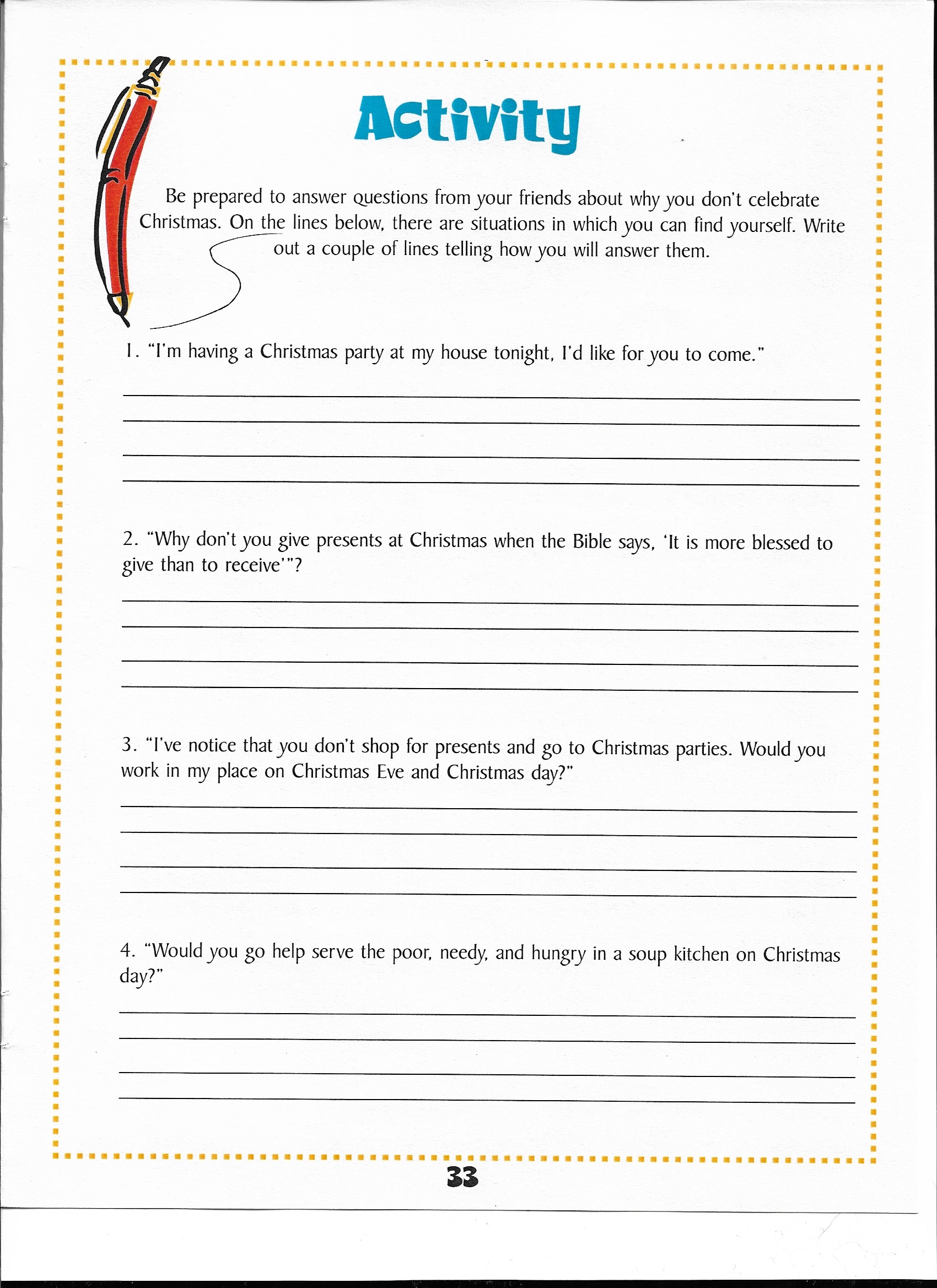
We returned from the Feast of Tabernacles this year to see stores being dismantled and decorated for Christmas while shelves were being stocked with decorations and possible gift items. By Halloween, Christmas trees were decorated and lights turned on. Isn't that a little early?
Brace yourselves! The jangling Salvation Army bells will soon be ringing at the entrance of virtually every shopping mall, grocery and other stores. Church leaders will cry out to "Put Christ back in Christmas" this year. But was Christ ever really in Christmas?
Get your concordance out and look for the word "Christmas." It's simply not in your Bible. But maybe the Christmas tree is. In Jeremiah 10:3-5 we find, "For the customs of the people are worthless; they cut a tree out of the forest, and a craftsman shapes it with his chisel. They adorn it with silver and gold, they fasten it with hammer and nails so it will not totter. Like a scarecrow in a melon patch, their idols cannot speak, they must be carried because they cannot walk. Do not fear them; they can do no harm nor can they do any good" (NIV). Hmm, this really sounds like a Christmas tree, but it's in the Old Testament before Christ was ever born.
Episcopal priest Earl Count wrote a book titled 4,000 Years of Christmas: A Gift From the Ages (1997). But wasn't Jesus born more like 2000 years ago? Yep. You've got it. So what does this mean? This book shows that people were exchanging gifts, following the same customs to celebrate the ancient Roman Saturnalia as people are doing in the 21th century to celebrate Christmas. Earl Count outlines how mistletoe was adopted from Druid mystery rituals and that December 25th has more to do with Saturnalia, or worshiping the sun, than with celebrating the birth of Jesus. He relates historical connections between the exchanging of gifts on the 12 days of Christmas and customs originating in ancient, pagan Babylon 4,000 years ago.
Many ancient religions conducted festivals at that time of the year, the time of the winter solstice in the northern hemisphere, when days are the shortest, to appease the various gods to restore the sun and bring an end to winter. Nowhere in the New Testament do we see Jesus' disciples observing Christmas. As late as the third century a Catholic theologian named Origen declared that it was a sin to celebrate Christmas because of its pagan connections.
The Apostle Paul warns us to avoid having anything to do with pagan religious customs. He calls these actions to be having fellowship with demons. "What am I saying then? That an idol is anything, or what is offered to idols is anything? Rather, that the things which the Gentiles sacrifice they sacrifice to demons and not to God, and I do not want you to have fellowship with demons. You cannot drink the cup of the Lord and the cup of demons; you cannot partake of the Lord's table and the table of demons” (1 Corinthians 10:19-21).
Thousands of pagans were outwardly converting to Christianity. But they refused to give up their former religious rituals and ceremonies. They held dear the ancient Roman festival that was celebrated during late December in honor of Saturn, the god of agriculture. Dr. Count sums up this historical struggle: “To the pagans, the Saturnalia were fun. To the Christians, the Saturnalia were an abomination in homage to a disreputable god who had no existence anyway. The Christians, moreover, were dedicated to the slow, uphill task of converting these roistering pagan Romans."
So what does all of this have to do with you and the days you celebrate? First, don't allow yourself to fear and worry. Realize that for a lot of people, Christmas isn't a big deal. In fact, the world is full of people who, like yourself, don't care for the frantic pace and gift-giving of Christmas. And many Christians, who attend church on Sunday and observe Christmas each year, probably see this celebration as being greatly commercialized. In addition to those Christians, there are Jews, Muslims, and people of other religions who do not keep Christmas. So relax, you're certainly not alone.
With these things in mind, how do you handle the Christmas situation with your friends and peers? Religious tolerance is taught in schools today. So don't make a mountain out of a molehill. When your friends ask about what you're doing for Christmas, let them know that you're not interested in keeping up with all the Christmas bother any more. And Christmas is a lot of bother.
I once sold real estate for commissions only. That meant that my broker paid me nothing if I didn't sell and close on the property. Other agents in the office were frantic at Christmas trying to earn a living, going to all the parties, shopping for presents, and preparing the many special meals for house guests expected at that time of the year. December was often a high month in sales for me. My co-workers noticed that I calmly went about my work during this season. Sometimes I could even show an agent's customers’ homes and split the commission with him. Before the season was over, other agents were envious of me and remarked that they were "going to join my church so they wouldn't have to keep Christmas." So calmly go about your business, be cheerful, and see how many poor people you can help. Who knows, you may become the envy of your friends who keep Christmas.
We know that "it is more blessed to give than receive." And we should all give generously throughout the year. But count your blessings that you don't have to be in the crazy traffic and crowds that are irritable and pushy, trying to buy a gift that probably won't please the recipient, on a credit card that you'll pay for over many years. Think about it. God has solved a major problem for you. Not only does He give you the wonderful blessing of celebrating the Feast of Tabernacles for seven days, He's saved you from the enormous hassle and burden that Christmas is. Be thankful and rejoice in God's love!
Gracious Father,
Thank you so much for revealing to me your holy days so that I don't have to celebrate Christmas. You've given me a greater blessing and have saved me from spending money that I don't have on gifts for people that they probably won't like. I can calmly go about my life during this season and do things that are productive.
In Jesus' name I pray.
Amen.
Sunday - Jeremiah 10:2-5
Monday - 1 Corinthians 10:19-21
Tuesday - Acts 20:35
Wednesday - Matthew 5:20
Thursday - Matthew 25:35-46
Friday - James 1:22-27
Saturday - Deuteronomy 15:11