YE4W.1 · Activity Page
Exodus 1 - 12
Exodus 6:1-6
Exodus 7:2-5
Exodus 12:3-12
Exodus 12:14
Isaiah 53:4-7
John 8:31-36
Romans 6:16-18
Romans 8:1-4
TRANSATLANTIC - reaching across the Atlantic Ocean
TASKMASTER - a person who assigns burdensome tasks and works people rigorously
SPEECH IMPEDIMENT - any physical defect that impedes normal or easy speech
You have probably learned during Black History Month about the turbulent legacy of transatlantic slave trade. Slaves were not widely used in Mexico or Canada but were imported in great numbers to the Southern states of the United States. Africans were sold as slaves and brought to this country to work on cotton, tobacco, and sugar plantations. In 1808, it became illegal to import slaves to this country. This legacy of slavery molded much of European, African and North American society for almost 400 years.
This is not the only time in history that a race of people was held in slavery. Black, white, brown, and yellow people have been slaves in other countries. A similar historical event that you may not have learned about in school has also had an impact on our society.
After Joseph and his brothers died, their descendants had many children. The Israelite population was increasing very rapidly in Egypt. The new king felt this was a dangerous situation, especially if war should break out. He was afraid the Israelites would join Egypt’s enemy in the battle and escape out of the country. The king went to his people and asked for help in finding a solution to this problem.
What was the solution? Make the Israelites slaves! Put brutal taskmasters over them to wear them down. Guess what? It didn’t work! The Israelites had more and more babies. The more the Egyptians mistreated and oppressed them, the more God seemed to bless them with children.
But the Egyptians were hardheaded about this. The Israelite slaves’ lives became even more bitter. They were forced to work long and hard in the fields and to carry heavy loads of mortar and brick.
One day as Moses was tending the flock of his father-in-law, Jethro, an angel appeared to him as a flame of fire in a bush. The bush didn’t burn up. So Moses went to investigate. God called to him, “Moses! Moses!” Well, Moses didn’t know who was calling him. So he asked, “Who is it?” God told him to take off his shoes and not come any closer – he was standing on holy ground. He had to explain that He was the God of Abraham, Isaac and Jacob. The Israelites had been in slavery for 400 years and had completely lost sight of the true God. Moses said to God, “If I go to the people of Israel and tell them that their father’s God has sent me, they will ask, ‘Which God are you talking about?’” God told Moses that He would have him perform miracles so the Israelites would believe that He was the true God.
Moses wasn’t pleased with the job God wanted him to do. So he pleaded with God, “O Lord, I’m just not a good speaker. I never have been, and I’m not now, even after you have spoken to me, for I have a speech impediment.” God reminded Moses that He gave him his mouth and the ability to talk. But that wasn’t good enough for Moses. He asked God again to send someone else. God became angry. He told Moses that Aaron, his brother, was a good speaker and he would go with him to speak to Pharaoh.
The day came for Moses and Aaron to go see Pharaoh. “We bring you a message from Jehovah, the God of Israel. He says, ‘Let my people go, for they must make a holy pilgrimage out into the wilderness, for a religious feast, to worship me there.’”
Does it surprise you to learn that Pharaoh didn’t receive that message very well? Pharaoh retorted, “Is that so? . . . And who is Jehovah, that I should listen to Him, and let Israel go? I don’t know Jehovah and I will not let Israel go.”
Time and again Moses and Aaron visited Pharaoh and asked that he let God’s people go. Pharaoh kept saying no. God had sent nine plagues – the water of the Nile turned to blood, frogs, lice, flies, murrain, boils, hail, locusts, and darkness. As repulsive and as difficult as these things were on the Egyptian people, Pharaoh’s heart remained hardened.
Nearly a year had passed, spring was approaching, and God was prepared to send a tenth plague that would cause Pharaoh to let His people go have their feast. Moses told Pharaoh, “Jehovah says, ‘About mid- night I will pass through Egypt. And all the oldest sons shall die in every family in Egypt, from the oldest child of Pharaoh, heir to his throne, to the oldest child of his lowliest slave; and even the firstborn of the animals. . . On the evening of the fourteenth day of this month, all these lambs shall be killed, and their blood shall be placed on the two side-frames of the door of every home and on the panel above the door. . . For I will pass through the land of Egypt tonight and kill all the oldest sons and firstborn male animals in all the land of Egypt, and execute judgment upon all the gods of Egypt – for I am Jehovah.’” God promised to pass over the houses with blood on the door and spare their firstborn from death.
The wail of death resounded throughout the entire land of Egypt. “Never before has there been such anguish, and it will never be again.” This was the first Passover! “That night the people of Israel left Rameses and started for Succoth; there were six hundred thousand of them, besides all the women and children, going on foot. . .” Israel was free at last! (Excerpts have been quoted from Exodus 1-12 from The Living Bible).
God of Isaac, Abraham and Jacob,
Thank you for delivering your people from slavery. This is one of the most important events in all of history. Help us to fully appreciate it and learn the lessons you intend that we learn.
In Jesus’ name we pray.
Amen.
Sunday - John 8:31-36
Monday - Romans 8:1-4
Tuesday - Romans 6:16-18
Wednesday - Exodus 7:2-5
Thursday - Exodus 6:1 -6
Friday - Exodus 12:3, 5, 7, II, 12
Saturday - Isaiah 53:4-7
Exodus 3:13-15
Exodus 10:1-2
Exodus 12:14-16
Exodus 12:17
Exodus 12:37-39
Exodus 12:41-42
Ezekiel 20:10-12
Ezekiel 39:7
I Corinthians 5:6-8
I Corinthians 14:33, 40
EXCOMMUNICATE - to cut off from communion or membership
FEND - to resist or make defense
RIGOROUS - extremely harsh
Choices – choices – choices! Every day we face them. What is important to us determines what we choose. And what we choose shows what is really important to us. Whatever we value gets priority in our lives.
“It has been said that there are two things most difficult to get people to do: to think – and to do things in the order of their importance. Armies of activities cry for our time. Carelessness about our priorities can soon leave our lives like the little boy who fell asleep with gum in his mouth – a tangled mess” (Proverbs for Graduates).
Israel had completely lost the right priorities. They were slaves in captivity and didn’t even know who the True and Living God was. Slaves didn’t have the privilege of setting priorities and doing things in the order they consider to be important. They didn’t have the right to think and plan. Their taskmasters did all of this for them. The Israelites had no choice but to follow orders. There was nothing they could do to get out of the mess they were in. God had to get them out. He gave them priorities and showed them they must do things in the order of His importance.
That night the people of Israel left Rameses and started for Succoth. “When the people stopped to eat, they baked bread from the yeastless dough they had brought along. It was yeastless because the people were pushed out of Egypt and didn’t have time to wait for the bread to rise to take with them on the trip.” They couldn’t buy yeast at a grocery store to put in their dough and make their bread rise. Their dough had to set for some time collecting yeast spores from the air before it would rise. There was no time for this. Israel had to get out of Egypt, and get out in a hurry.
The Israelites probably numbered more than two million when they left Egypt. This must have been some sight! Six hundred thousand men, plus women and children and animals, moving all of their earthly possessions on foot and on the animals to another land. People of all sorts went with them as well. This is how the Days of Unleavened Bread began.
We celebrate “The Night to Be Much Observed” remembering that God freed Israel from the rigorous slavery of Egypt. It was a time of great celebration – at last they were free. Our forefathers left Egypt with a “high hand” under a full moon.
God began to teach them priorities, and that doing things in His order of importance was good for them. “You shall celebrate this every year (this is a permanent law) to remind you of this fatal night. The celebration shall last seven days. For the entire period you are to eat only bread made without yeast. Anyone who disobeys this rule at any time during the seven days of the celebration shall be excommunicated from Israel. On the first day of the celebration, and again on the seventh day, there will be special religious services for the entire congregation, and no work of any kind may be done on those days except the preparation of food” (Exodus 12:14-16 TLB).
What does all of this have to do with you as a teenager today? Should you have priorities? Should you learn to think – and to do things in the order of importance? If so, what should your priorities be ?
Some of the choices you have to make during the Days of Unleavened Bread are choosing between having a slice of pizza or a hamburger, and eating flat bread. Why should you choose flat bread over a slice of pizza? Well, God said you should. He provides you with every bite you eat. He has an order of importance. It’s okay to eat pizza for 51 weeks out of the year. But it is not pleasing to God for you to eat pizza during these seven days. He wants you to remember that Israel was pushed out of Egypt and had to leave in such a hurry that they didn’t have time for their bread to rise. It is so important to God that we don’t eat leavening for seven days that He said any Israelite who did would be excommunicated. They would be cut off from the camp of Israel and left to fend for themselves in the wilderness. They would be in danger of the Egyptians taking them back to the rigorous tasks of slavery.
For seven days, leavening pictures sin. Going back into sin would be like an Israelite being taken back as a slave. God says, “And you shall know the truth and the truth shall make you free.” Obeying God’s truths, His rules, makes you free from the consequences of sin. Christians are no longer in slavery to sin.
Do your choices show that you value pleasing God? Give some thought and prayer to what is important to God. On “The Night to Be Much Observed,” go outside and look up at the full moon. Think about your forefathers who were held in slavery for 400 years. How do you think they felt when they were free? You don’t have to be like the little boy who fell asleep with gum in his mouth. You have a choice that can untangle your mess. By choosing to obey God, your life will reflect right priorities. It will have order pleasing to Him. You can be free from the consequences of sin and have blessing beyond belief!
Great God and Father,
You brought our forefathers out of Egypt and freed them from slavery. What a night to celebrate! Help us always remember that it is one of your priorities for us to celebrate this for seven days and not eat any leavening during that time. Thank you that through your love you will deliver us from the consequences of sin as you delivered Israel from slavery.
In Jesus’ name we pray.
Amen.
Sunday - Exodus 10:1-2
Monday - Exodus 3:13-15
Tuesday - Ezekiel 39:7
Wednesday - I Corinthians 5:6-8
Thursday - I Corinthians 14:33, 40
Friday - Exodus 12:41-42
Saturday - Ezekiel 20:10-12
Exodus 19:3-6, 16
Exodus 19:18-20
Leviticus 23:21-24
Psalm 1:1-3
Psalm 19:7-8
Psalm 119:165-168
Proverbs 6:23
Romans 7:12
I Corinthians 15:20-23
BILLOW - any surging mass
REPROOF - rebuke
CONVOCATION - commanded assembly
SHEAF - a bundle or cluster of grain
MANIFESTATION - something made clear to the eye
Take a moment to look up a video of when the new millennium came to Times Square in New York. What a display of fireworks! What a celebration! When compared to what happened about three months after Israel left Egypt, this pales into insignificance.
When the Israelites arrived in the Sinai Peninsula, they set up camp at the base of the mountain. “Moses climbed the rugged mountain to meet with God, and from somewhere in the mountain God called to him and said, ‘Give these instructions to the people of Israel. Tell them, you have seen what I did to the Egyptians, and how I brought you to myself as though on eagle’s wings. Now if you will obey me and keep your part of my contract with you, you shall be my own little flock from among all the nations of the earth; for all the earth is mine. And you shall be a kingdom of priests to God, a holy nation’” (Exodus I9:3-6 TLB).
God gave Moses instructions to pass on to the children of Israel. They were to wash and purify themselves in preparation of the big event.
“On the morning of the third day there was a terrific thunder and lightning storm, and a huge cloud came down upon the mountain, and there was a long, loud blast as from a ram’s horn; and all the people trembled” (verse 16). Was the millennial celebration you attended so awesome that you trembled? This event was far more awesome! Why?
God was about to give His Law – The Ten Commandments – to His people. This was probably the first Pentecost the children of Israel ever celebrated. And what a celebration it was!
“All Mt. Sinai was covered with smoke because Jehovah descended upon it in the form of fire; the smoke billowed into the sky as from a furnace, and the whole mountain shook with a violent earthquake. As the trumpet blast grew louder and louder, Moses spoke and God thundered his reply. So the Lord came down upon the top of Mt. Sinai and called Moses up to the top of the mountain, and Moses ascended to God” (verses 18-20).
God told Moses to warn the people of their boundaries. They were not to come up to the mountain and try to see God or they would die. Because of God’s presence, Mt. Sinai was filled with such awesome power!
On this Pentecost Day, God began to reveal to Israel the most righteous Law man has ever known. He gave Israel the Ten Commandments. The Apostle Paul tells us, “the law is holy, and the commandment holy, and just, and good” (Romans 7:12). Each law shows you how to have a better life – how to keep from hurting yourself and suffering the consequences of breaking it. “For the commandment is a lamp, and the law a light; and reproofs of instruction are the way of life” (Proverbs 6:23).
In Leviticus 23 we find more instructions for celebrating Pentecost. “That day shall be announced as a time of sacred convocation of all the people; don’t do any work that day. This is a law to be honored from generation to generation. (When you reap your harvests, you must not thoroughly reap all the corners of the fields, nor pick up the fallen grain; leave it for the poor and for foreigners living among you who have no land of their own; I am Jehovah your God!)” (verses 21-24).
Pentecost is one of the three harvest festivals God gave us to celebrate. It is also called the Feast of Weeks, and the Feast of First Fruits (Numbers 28:26). Pentecost literally means “fiftieth.” It is the only festival that is not a set date on the calendar – we have to count days to determine when we are to celebrate it.
“From the day after the Sabbath, the day you brought the sheaf of the wave offering, count off seven full weeks. Count off fifty days up to the day after the seventh Sabbath, and then present an offering of new grain to the LORD” (Leviticus 23:15-16 NIV).
Why is this a harvest festival? Is God that interested in grain? No, people are far more important to God. He wants to make us His own sons and daughters and this day points to that. “But Christ has indeed been raised from the dead, the firstfruits of those who have fallen asleep. For as in Adam all die, so in Christ all will be made alive. But each in his own turn: Christ the first fruits, then when he comes, those who belong to him” (I Corinthians 15:20-23).
Next year there will be another lesson about this great feast day. It will help you understand other relevant aspects of this celebration. In the meantime, why should you go to church on this day and not do any work?
Well, this day is so remarkable that God shook the earth with a powerful earthquake. There were other powerful manifestations. It was an enormous event in history. In future lessons we will see that on this day Christ empowered His church. Do you want power in your life? Then obey God and celebrate this festival as He commands. You can become a part of the “kingdom of priests to God, a holy nation.”
Awesome God,
When I think about when you gave the Ten Commandments on Mt. Sinai, I am awestruck. What a wonderful Law
to give to your people. You gave it to be a lamp to our feet and a light to our path. It is for our good – to keep us out of trouble. Thank you for the Feast of Pentecost and all of its significance.
In Jesus’ name I pray.
Amen.
Sunday - Exodus 19:18-20
Monday - Exodus 19:3-6
Tuesday - Leviticus 23:21-24
Wednesday - I Corinthians 15:20-23
Thursday - Psalm 119:165-168
Friday - Psalm 1:1-3
Saturday - Psalm 19:7-8

Leviticus 23:23-25
Numbers 10:9-10
Psalm 81:1-4
Matthew 24:22
Matthew 24:29-31
John 3:17-19
I Corinthians 15:50-53
I Thes. 4:16-18
Revelation 8, 9
YEARN - to have a strong desire
RESCUE - to free from danger, save
COMMEMORATE - to serve as a memorial or reminder
A terrible flood came in a small Midwestern town. It rained so hard the creeks and rivers over- flowed their banks. The people were told to evacuate. The National Guard and local police force were marshaled to assist people in getting to dry land.
But Mr. Davis, an elderly gentleman, refused to go. He prayed and trusted that God would save him. As the water climbed higher and higher it made its way into the old gentleman’s house. A four-wheel- drive came to rescue him, but he wouldn’t leave his house. Then a row boat came and again he refused to go. Eventually the water rose all the way to the roof of his house. He stood on the roof and a helicopter came and threw him a rope. Again, he said he had prayed and trusted that God would save him.
This well-intentioned elderly gentleman died in that flood. As the story is told, the old man went to heaven. The first thing he asked God was, “Why didn’t you save me from the flood – after all, I prayed earnestly and I trusted you.” God said, “I heard your prayers and sent a four-wheel-drive, a row boat and a helicopter. Why did you send them away?” God is in the business of rescuing people. He has a rescue plan for us that is pictured in the Feast of Trumpets.
About four months after Israel celebrated the first Pentecost it was time for yet another festival. God told the Israelites, “When you arrive in the Promised Land and go to war against your enemies, God will hear you and save you from your enemies when you sound the alarm with these trumpets. Use the trumpets in times of gladness, too, blowing them at your annual festivals and at the beginning of each month to rejoice over your burnt offerings and peace offerings. And God will be reminded of his covenant with you. For I am Jehovah, your God” (Numbers I0:9-I0 TLB).
Every new moon in Israel began with a special celebration marked by blowing the trumpets. The trumpet sound echoed across the hills of Palestine. When the seventh trumpet sound was heard, the people knew it was the beginning of the new year. It was an important religious celebration. It was the Feast of Trumpets! Why should you celebrate the Feast of Trumpets?
The first reason is because God says that you should. “The LORD said to Moses, Say to the Israelites: On the first day of the seventh month you are to have a day of rest, a sacred assembly commemorated with trumpet blasts. Do no regular work, but present an offering made to the LORD by fire” (Leviticus 23:23-25).
Why is it called the Feast of Trumpets? The most obvious reason is because a trumpet was blown on that day. But more important, the seventh trumpet was blown on that day. The number seven is often used in the Bible to show completion. So what is God completing?
People often think of the Holy Days as being Jewish. But oddly enough, there is not a lot of information given in the Old Testament about the Feast of Trumpets. We have to go to the New Testament to see what God “completes” on the Feast of Trumpets. In I Corinthians 15:50-53 the Apostle Paul sheds some light on this. “I tell you this, my brothers: an earthly body made of flesh and blood cannot get into God’s kingdom. These perishable bodies of ours are not the right kind to live forever. But I am telling you this strange and wonderful secret: we shall not all die, but we shall all be given new bodies! It will all happen in a moment, in the twinkling of an eye, when the last trumpet is blown. For there will be a trumpet blast from the sky and all the Christians who have died will suddenly become alive, with new bodies that will never, never die and then we who are still alive shall suddenly have new bodies too. For our earthly bodies, the ones we have now that can die, must be transformed into heavenly bodies that cannot perish but will live forever” (TLB).
You’ve learned that the feast days are to be celebrated. You’ve heard about class reunions. You may have gone to a family reunion and seen cousins, aunts, uncles that you hadn’t seen for several years. Wasn’t that a very happy occasion – a celebration? When Christ returns, our grandparents, aunts, uncles, maybe even brothers or sisters who have died in Christ will be resurrected. They will get a new body. They will meet Christ in the air for a real celebration. Christians who are alive will join this reunion.
The Bible never says that Christ will return on the Feast of Trumpets. But we know that God has ap- pointed times and He honors those days. We also know that Christ will come when the last trumpet is blown and the seventh trumpet is the last trumpet.
Why will Christ return? The world will be so bad at that time. It will be on the brink of utter destruction. Christ’s return will be a rescue mission to save this world from the awful situation we have created. Christ will return with a shout and the sound of the trumpet. Just as the pilot of the helicopter threw down the rope to Mr. Davis, Christ is throwing us a rope to save us. Are you going to grab hold of that rope and meet Christ in the air at His return, or are you going to drown in this world’s pleasures as Mr. Davis drowned in the flood?
Next year, YEA will cover other interesting aspects of the Feast of Trumpets. In the meantime, grab onto the rope and celebrate the Feast of Trumpets in a big way. You may see something really great happen on that day. So, be prepared!
Dear God Our Father and soon coming King,
Thank you that Jesus Christ will return to this earth to save us from utter destruction. Help me to celebrate the Feast of Trumpets in a way that will please you. Help me to yearn for your Kingdom to come so that your will be done.
In Jesus’ name we pray.
Amen.
Sunday - Numbers 10:9-10
Monday - Leviticus 23:23-25
Tuesday - I Corinthians 15:50-53
Wednesday - I Thessalonians 4:16-18
Thursday - Psalm 81:1-4
Friday - Matthew 24:29-31
Saturday - John 3:17-19
Leviticus 16:21-22, 29-30
Leviticus 23:26-32
Leviticus 23:27-28
Psalm 103:10-12
Ecclesiastes 3:1
Romans 3:23-26
2 Corinthians 5:17-19
I John 2:1-2
I John 4:9-10
ATONEMENT - being reconciled to God through Christ
SCAPEGOAT - a person or animal made to bear the blame for another
What makes most of the Holy Days really neat is that you get out of school and you have some really good things to eat. Maybe your church has a potluck. You go through the line and pile your plate high. Or maybe your family goes to a nice restaurant, or you stay home and prepare a very special meal. The festivals of God are very special times. We all like to eat, and no one likes to go hungry. God wants you to feast six days out of the year. He wants you to cel- ebrate and have a great time!
Every Holy Day pictures something very special that you must celebrate. The Holy Days are God’s appointed times. They help us to understand Him better. They also help us to understand what He wants to do for us.
You’ve had a lesson where you learned about God rescuing the Israelites from Egyptian slavery. He brought them out of Egypt with a “high hand.” They came out so quickly that they didn’t even have time to let their bread rise. When they reached Mount Sinai, God called Moses up and gave him the most righteous Law ever known to man. The mountain quaked, there was thunder and lightning. This was an awesome event!
Then we learned that the Holy Days have a greater meaning than just being Jewish. We’ve learned that Christ is the center of every Holy Day. The trumpet is blown on the first day of the seventh month – the Feast of Trumpets. Christ will return at the sound of the seventh trumpet. He’s coming back to rescue us. If Christ doesn’t return, the earth will be completely destroyed. We’ve also learned that every- thing God does is good for us.
As much as we would like for life to be all fun and games – all feasting on special foods, it’s not always that way. In King Solomon’s great wisdom he said, “There is a time for everything, and a season for every activity under heaven” Ecclesiastes 3:1 (NIV). There is a time to eat and there is a time not to eat. The Day of Atonement is a day when God says that we should “afflict ourselves.” It is generally understood that we should not eat food or drink water on that day.
The children of Israel had completely lost God’s Law. They had never kept the Day of Atonement in Egypt. But now that they were free, God wanted them to know and follow His law because it was for their good. He said to Moses, “The tenth day of this seventh month is the Day of Atonement. Hold a sacred assembly and deny yourselves, and present an offering made to the LORD by fire. Do no work on that day, because it is the Day of Atonement, when atonement is made for you before the LORD your God. Anyone who does not deny himself on that day must be cut off from his people. I will destroy from among his people anyone who does any work on that day. This is to be a lasting ordinance for the generations to come, wherever you live. It is a sabbath of rest for you, and you must deny yourselves. From the evening of the ninth day of the month until the following evening you are to observe your sabbath” (Leviticus 23:26-32 NIV).
Is the Day of Atonement just for the Jews and not for Christians? Didn’t Christ make an atonement for us on Passover when He was crucified? Absolutely! Then why should Christians keep the Day of Atonement? What is different about the atonement made on this day and the Passover? Jesus Christ died to save us individually. Only you can repent of your sins and have the blood of Christ pay for them. The Day of Atonement is a communal forgiveness.
God required a ceremony to take place in the Temple on the Day of Atonement. It was like a play that was being acted out on a stage with two goats. Aaron, the High Priest, was required to make an
offering as an atonement for himself and his family. Then he had to slaughter a goat and take its blood behind the curtain in the Holy of Holies and make an atonement for the sins of the people. The one goat that represented Christ was killed.
After that, the High Priest laid his hands on the head of the second goat, the “scapegoat,” and confessed all the sins and wickedness of all the Israelites and put them on the goat’s head. . . “The goat will carry on itself all their sins to a solitary place; and the man shall release it in the desert” (Leviticus 16:21-22). Only Jesus can bear our sins and carry them away from us (John 1:29; 1 Peter 2:24; 2 Corinthians 5:21; Isaiah 53:4, 11-12) so that we can be reconciled to the Father.
Who is to keep the Day of Atonement and for how long is this law binding? “This is to be a lasting ordinance for you: on the tenth day of the seventh month you must deny your- selves and not do any work – whether native-born (an Israelite) or an alien living among you – because on this day atonement will be made for you to cleanse you.” (Leviticus 16:29-30 NIV).
God wants us to celebrate, but He also wants us to humble ourselves and repent of our sins because He wants to cleanse us. The Day of Atonement may seem like an eternity, but it only lasts for 24 hours. It’s worth keeping it because it will please God - the One to whom we owe so much!
Almighty God,
You are so wonderful to provide a way that we can be forgiven of our sins individually and as a community. Thank you for the Day of Atonement. It’s not my favorite Holy Day, but help me to understand you better and love you more on this day.
It’s in Jesus’ name that I pray.
Amen.
Sunday - Leviticus 23:26-32
Monday - Ecclesiastes 3:1
Tuesday - Psalm 103:10-12
Wednesday - Romans 3:23-26
Thursday - I John 2:1-2
Friday - I John 4:9-10
Saturday - 2 Corinthians 5:17-19
Leviticus 23:39-43
Deuteronomy 16:13-15
Psalm 119:127-130
Proverbs 3:15-17
Proverbs 19:8-10
Matthew I3:45-46
Matthew 13:44-46
Philippians 2:5-7
CUBIC ZIRCONIUM - an inexpensive stone commonly used to resemble a diamond
GLITTER - makes a brilliant show by reflecting light
One spring night, a thief broke into a jewelry store. It was an unusual break-in. The burglar stole no jewelry. What he did was switch the prices on every piece of jewelry that he could find. Some of the bracelets, rings, necklaces, and watches were the real thing. They were made of 14 or 18 carat gold and studded with diamonds, rubies, emeralds, pearls and other precious stones. Other pieces were simply costume jewelry. They were beautiful, but only gold plated, with cubic zirconium and other imitation stones.
The management didn’t realize what had been done at first. Customers were leaving their store with imitation jewelry for which they paid a big price. Yet others purchased expensive jewelry for mere pennies on the dollar.
Our world kind of looks like that jewelry store. It looks like someone came and switched the prices.
Sometimes we overlook real value for junk. The Feast of Tabernacles helps us understand the difference between something really valuable and junk. Like the imitation jewelry, there are a lot of attractive things in this world that glitter. But they are not lasting like a diamond or a real pearl.
Jesus said we should listen to this story. “The Kingdom of Heaven is like a pearl merchant on the lookout for choice pearls. He discovered a real bargain – a pearl of great value – and sold everything he owned to purchase it!”(Matthew 13:44 NIV).
Have you ever gone to the Feast just for the fun of it? Were you there simply to see your friends and enjoy the activities? Did you skip youth classes? Did you write notes during the sermon while thinking about things entirely different from what the minister was saying? Then what you got out of the Feast was very similar to imitation jewelry with artificial diamonds in it. Oh, it was attractive. But it was worth- less – mere junk that won’t last!
Five days after Israel fasted and kept their first Day of Atonement, God said they were to celebrate yet another Holy Day. It was to be the Festival of Shelters. “On the first day there will be a sacred assembly of all the people, don’t do any hard work that day. . . Remember that the first and last days of the festival are days of solemn rest. On the first day, take boughs of fruit trees laden with fruit, and palm fronds, and the boughs of leafy trees – such as willows that grow by the brooks – and (build shelters with them), rejoicing before the Lord your God for seven days. This seven day annual feast is a law from generation to generation. During those seven days, all of you who are native Israelites are to live in these shelters. The purpose of this is to remind the people of Israel, generation after generation, that I rescued you from Egypt, and caused you to live in shelters. I am Jehovah your God” (Leviticus 23:34, 39b-43 TLB).
Did you notice why they were to live in shelters and who was to live in them? Israelites were to live in them and it was to remind them that God rescued them from Egypt. Do you remember our lesson about the Feast of Trumpets that talked about Jesus Christ returning to this earth to rescue us?
God commands us to rejoice at the Feast of Tabernacles. YEA goes to a lot of trouble and expense to provide ways for you to rejoice at the CEM Feast site. We provide fun YEA classes and lots of exciting activities for our youth. God wants you to develop friendships and create lasting relationships. But if you only come to the Feast for physical activities and fun, you’re like the people who walked out of the jewelry store with fake jewelry thinking they had the real thing. Laser tag, skating and beach parties, a teen dance, and family picnics are wonderful things you should enjoy. But they are only temporary – they are the “glitter.”
Jesus Christ came to this earth as a temporary flesh and blood baby. The Feast of Tabernacles has Jewish history, but Jesus Christ is also pictured in it. He gave up being a permanent Spiritual being to come to this earth as temporary flesh and blood. He lived a temporary life like you and me so He could die for our sins. He now sits at the right hand of the Father and has inherited everything! He will soon return to this earth and set up His Kingdom that we can share with Him if we are ready.
What you learn about God and Jesus Christ and how they can help you every day of your life can be compared to 18 carat gold. Things you learn in the sermons and your YEA classes are the real gems – they give you wisdom that has eternal value. “For such wisdom is far more valuable than precious jewels. Nothing else compares with it. Wisdom gives: A long, good life, riches, honor, pleasure, peace” (Proverbs 3:15-17 TLB). Enjoy the Feast of Tabernacles, but don’t be fooled by temporary glitter. Look for the 18 carat gold that will last an eternity!
Great and Wonderful God,
Thank you for the Feast of Tabernacles that teaches us that the temporary glitter of this world is not where it is at. Learning your way of life gives wisdom. That is more precious than silver, gold or any precious stone. Your Kingdom will be permanent and its worth is invaluable! Help me to give up the junk for the pearl of great price.
In Jesus’ name I pray.
Amen.
Sunday - Leviticus 23:39-43
Monday - Matthew 13:44-46
Tuesday - Proverbs 3:15-17
Wednesday - Proverbs 19:8-10
Thursday - Deuteronomy 16:13-15
Friday - Psalm 119:127-130
Saturday - Philippians 2:5-7
Leviticus 23:36
Isaiah 51:15-16
Isaiah 65:17-18
Isaiah 66:22-23
John 7:37-39
I Corinthians 2:9
2 Peter 3:13-14
Revelation 21:1-4
SYMBOLIZING - something that stands for or represents something else
If you could create your perfect world to live in, what would it be like? If you like music, would it have singing trees? Would you be able to step on a rock and get instant music? Maybe your world would have Dalmatian dogs that could play guitars and Springer Spaniels that could play different kinds of drums. What kind of people would you put in your world? Where there are people, there is a need for laws to govern them. What would those laws be?
If you are a sci-fi freak, your imagination may be running wild with how you would construct your world. You might have transportation that could get you there before you ever started. Maybe you would have the ability to create other worlds and populate them. You might have the power to heal the sick and raise the dead. It’s fun to think about these things, isn’t it?
Many of the things we’ve just thought about will be in tomorrow’s world. Oh, there may not be Dalmatians playing guitars or Springer Spaniels playing drums. But the world God has planned for us will make science fiction look downright puny. “That is what is meant by the Scriptures which say that no mere man has ever seen, heard or even imagined what wonderful things God has ready for those who love the Lord” (I Corinthians 2:9 TLB).
The lessons in this Festival Supplement have tracked man’s history for several thousand years. We’ve learned how the Israelites were slaves in Egypt and God rescued them. When they left Egypt they had to eat flat bread. In their travels to the Promised Land, they came to Mount Sinai, the place where God gave a law that was so righteous, so good for them that it made Moses’ face shine.
Several months later, He gave the Israelites, along with the other people who came out of Egypt with them, the Feast of Trumpets. This Feast day shows that when the seventh trumpet sounds, Christ will return to this earth and raise those who have died in Christ. God had the High Priest act out a play in the Temple on the Day of Atonement. This play showed how our national sins are forgiven. It pictured the sins of the world being put on the head of a scapegoat. That goat was sent out into the wilderness symbolizing God removing sin from the earth forever.
Then God told Israel to make booths out of the limbs of trees and to live in the booths for seven days. This was to remind them that they lived in temporary dwellings for 40 years while going to the Promised Land. He wanted Israel to also learn that we look for a permanent home with Christ in His Kingdom. His Kingdom will be on this earth for one thousand years – a millennium! We keep this Feast for seven days. But wait a minute.
Why are we there for eight days?
Because there is something even better yet to come. There is a festival on the eighth day after the Feast of Tabernacles is over. That is the next festival God gave Israel. We call it the Last Great Day.
When we read the Old Testament, there is very little said about the Last Great Day. As a matter of fact, those words are not even used together in the Old Testament. We have to go to the New Testament to find them. What we do find in the Old Testament is the commandment to keep this day. “For seven days present offerings made to the LORD by fire, and on the eighth day hold a sacred assembly and present an offering made to the LORD by fire. It is the closing assembly; do no regular work” (Leviticus 23:36).
“On the last and greatest day of the Feast, Jesus stood and said in a loud voice, ‘If anyone is thirsty, let him come to me and drink. Whoever believes in me, as the Scripture has said, streams of living water will flow from within him. By this he meant the Spirit, whom those who believed in him were later to receive. Up to that time the Spirit had not been given, since Jesus had not yet been glorified” (John 7:37-39 NIV).
Did you notice that this is the “greatest day of the Feast”? What makes it so great? It’s because of what God will do when this day is fulfilled. That dream world we talked about in the beginning of this lesson will now come to reality. “THEN I SAW a new earth (with no oceans!) And a new sky, for the present earth and sky had disappeared. And I, John, saw the Holy City, the new Jerusalem, coming down from God out of heaven. It was a glorious sight, beautiful as a bride at her wedding. I heard a loud shout from the throne saying, ‘Look, the home of God is now among men, and he will live with them and they will be his people; yes, God himself will be among them. He will wipe away all tears from their eyes, and there shall be no more death, nor sorrow, nor crying, nor pain. All of that has gone forever’” (Revelation 21:1-4 TLB). That’s awesome! What a dream world! What a celebration this day should be! You must believe in God and obey Him if you want to be in this dream world.
Awesome God,
What you have planned for me blows my mind. It’s absolutely awesome! To think of a dream world where I can live with you is more wonderful than I can imagine. In addition to being with you, this world won’t have any pain, sorrow or death. Help me to believe you and obey you. I want to be in that dream world.
In Jesus’ name I pray.
Amen.
Sunday - Leviticus 23:36
Monday - John 7:37-39
Tuesday - Revelation 21:1-4
Wednesday - Isaiah 51:15-16
Thursday - 2 Peter 3:13-14
Friday - Isaiah 65:17-18
Saturday - Isaiah 66:22-23
Exodus 20:2-3
Exodus 32:1-35
Deuteronomy 4:2
Deuteronomy 12:2-3
Deuteronomy 12:29-32
Deuteronomy 12:32
Revelation 22:18
IDOLATRY - worshiping a god other than the true God
GENTILES - peoples of all other nations except Israel
HEATHEN - irreligious; pagans
OBELISK - a tapering four-sided stone used in the worship of false gods
SUPPLICATION - earnest request made in prayer
You probably have spring break just in time for one of the greatest religious celebrations – Easter and Good Friday. Your friends may spend a lot of time shopping for a really neat dress to wear to church on Easter Sunday morning. They may get up early and go to a park or special place for a religious service as the sun comes up. Your friends probably have the best of intentions. This may be a very deep religious experience for them. And they probably believe this is what God would have them do. But what does it say in the Bible about celebrating Easter?
As Israel came out of a pagan nation and headed for the Promised Land, God continued to teach them how to obey and worship Him. He was very specific about days and customs whereby they could worship Him. Idolatry was a very serious sin that He warned His people not to practice. “I am Jehovah your God who liberated you from slavery in Egypt. You may worship no other god other than me” (Exodus 20:2, 3 TLB).
“Then, as God finished speaking with Moses on Mount Sinai, he gave him the two tablets of stone on which the Ten Commandments were written with the finger of God.
“When Moses didn’t come back down the mountain right away, the people went to Aaron. ‘Look’, they said, ‘make us a god to lead us, for this fellow Moses who brought us here from Egypt has disappeared; something must have happened to him’” (Exodus 32:1 TLB).
Aaron participated in this evil idolatry. He asked for their golden earrings, melted them down, and formed them into the shape of a calf for the people to worship. When Moses returned and saw what the Israelites were doing, he was appalled at this evil act. He asked Aaron to explain. Aaron blamed the wicked bunch of Israelites and said they wanted him to make them a god to lead them since Moses hadn’t come back. The penalty for their idolatry was extremely severe. God told them to get their swords and go from one end of the camp to the other and kill even their own brothers, friends, and neighbors. About three thousand men died that day (Exodus 32).
Down through history, Israelites and Gentiles alike have worshiped other gods. This was very displeasing to God. “You must destroy all the heathen altars wherever you find them – high in the mountains, up in the hills, or under the trees. Break the altars, smash the obelisks, burn the shameful images, cut down the metal idols, and leave nothing even to remind you of them!” (Deuteronomy 12:2-3 TLB).
In the Book of Judges, Israel goes through five different patterns – sin, slavery, supplication, salvation, and silence. “They forsook the LORD, the God of their fathers, who had brought them out of Egypt. They followed and worshiped various gods of the peoples around them. They provoked the LORD to anger because they forsook him and served Baal and the Ashtoreths.
What were the Ashtoreths? Astarte was one of them. “She was goddess of the evening star and renowned for her beauty. She was a goddess of fertility, love and war, often linked with Baal” (The Expositor’s Bible Commentary, page 395). Astarte is another name for Easter.
In the spring of the year, about the time of the Passover, a feast was celebrated to this goddess. It was a joyous day of celebrations and games. Before the sun came up on Sunday morning, the people would meet outside and face the rising sun to praise Easter, their goddess. The celebration included finding colored eggs which were hidden in the grass, around trees, and in other hiding places. The children especially enjoyed the game. This happened many years before Jesus was ever born. Then rabbits were added to this celebration. (You can find even more information about this in the Encyclopaedia Britannica, Macropaedia Knowledge in Depth, volume 7, p. 475.)
God tells us to celebrate the Passover and the Days of Unleavened Bread. We don’t please Him if we add to or take away from what He has said, “Don’t add to what I’m commanding you. Don’t subtract from it either. Instead, obey the commands of the LORD your God that I’m giving you” (Deuteronomy 4:2 NlrV Kid’s Devotional Bible). God is very serious about this. “I am warning everyone who hears the words of the prophecy of this book. If you add anything to them, God will add to you the plagues told about in this book. If you take any words away from this book of prophecy, God will take away from you your share in the tree of life. He will also take away your place in the Holy City. This book tells about these things” (Revelation 22:18).
God is so pure, so good, so righteous. We must not confuse Him with other gods or goddesses. Every good and perfect gift comes from Him including our salvation. We’ve seen some of the horrible consequences for worshiping a false god such as Easter. Keeping God’s Holy Days brings blessings.
Dear One True God and Father,
Thank you for giving me days to celebrate that show your plan for mankind. Help me never to be tempted to leave you for a false god. We can make a god out of anything – money, fame, popularity, sports, beauty, etc. But you are my God and I put my trust in you. Many of my friends celebrate Easter. Help me to be a light to them and not condemn them.
In Jesus’ name I pray.
Amen.
Sunday - Deuteronomy 12:2-3
Monday - Deuteronomy 12:29-32
Tuesday - Exodus 32:1-5
Wednesday - Exodus 32:6-10
Thursday - Deuteronomy 4:2
Friday - Revelation 22:18
Saturday - Exodus 32:11-16
Exodus 22:18
Deuteronomy 18:9-14
2 Chronicles 33:6
I Corinthians 10:20-21
2 Corinthians 6:14-17
Ephesians 5:11
Philippians 4:8
I Thes. 5:22
2 Timothy 1:7-10
James 4:7-8
I Peter 5:8
CELTS - one of an ancient people of western and central Europe, including the Britons, Gauls, Scots, Irish
DRUIDS - priests to the Celtic people
DIVINATION - seeking to know the past, present or future by astrology, horoscopes, channeling, tarot, etc.
OCCULT - secret knowledge and practices or pertaining to, dealing with supernatural influences
WITCHCRAFT - practice of the occult
SEANCE - a meeting of persons to try to hear messages from the dead. Usually conducted by a medium.
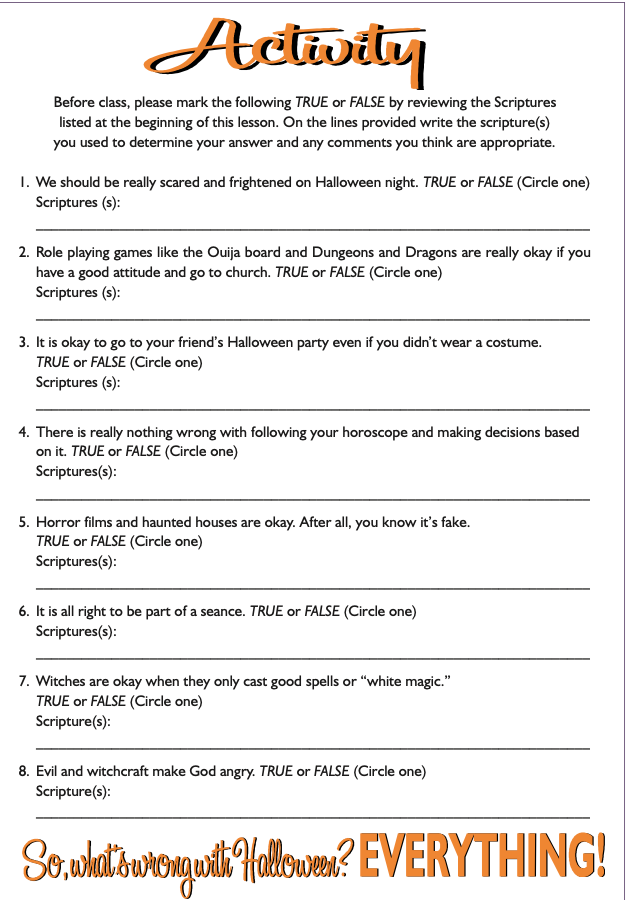
On Halloween, Katie attended a party where the Ouija board was brought out. It seemed harmless, so she played with her friends. But this seemingly innocent “game” created an unquenchable thirst within Katie to gain more supernatural power. She tried such things as voodoo, magic, witchcraft, and astrology, not understanding where it might lead. In the end demonic spirits controlled Katie, leaving her without control over her own life.
Seemingly innocent things such as Halloween can appear to be a lot of fun. After all, everyone keeps Halloween and dresses up to get candy. Just because “everyone does it,” does that mean these things are not dangerous? Where did such things as Halloween come from?
The modern celebration of Halloween originated from the ancient fire festival, “Samhain” (pronounced “sow-in,” sow rhyming with cow). Samhain was a joyful celebration of the final harvest, first observed hundreds of years before Christ by the ancient Celts. It was celebrated on November 1. Samhain symbolized the death of the old year and the beginning of a new one. The eve of Samhain, October 31, was the most feared time of the year. The Celts believed that at this time the division between the physical earth and the supernatural world became very thin. At this time ghosts and spirits of the dead were free to wander as they pleased.
The Celtic priests who carried out the celebration rituals were called Druids. Most rituals performed by Druids involved the offering of sacrifices to placate the various gods. Samhain was to frighten away evil spirits to ensure that the sun would return after winter. During Samhain all fires were extinguished except bonfires built by Druids. Householders paid a fee for embers from the “holy” fire to relight the home fire. The embers were carried back to the homes in carved out turnips and beets. During this festival, people engaged in witchcraft such as fortune telling, divinations, casting spells, general mischief, and destruction. The focus of Samhain was fear, death, horror, and evil.
The ancient origins of some current Halloween customs are:
Bonfires - built by Druids on Samhain to rejuvenate the sun and banish evil spirits. The fires represented the sun and were used for the burning of animal, crop, and occasional human sacrifices. (“Bon Fire” literally means a fire in which bones were burned.)
Trick or treat - during Samhain, Druids believed the dead played tricks on mankind and caused panic and destruction. To appease the spirits of the dead the country people would leave delicious treats of food and fruit to satisfy the wandering spirits so they would not cause them or their households any harm.
Jack-o’-lantern - from the carved out turnips and beets used to carry embers from the bonfire back to their homes to relight the family hearth.
Costumes/masks - the Celts disguised them- selves in hideous costumes and masks made from animal skins and heads. They blackened their faces with soot hoping to blend in with demonic ghosts and spirits so they would not be noticed and possessed.
Bobbing for apples - a marriage or fortune divination. The first person to bite an apple without using their hands would be the first to marry or would have good luck in the coming year.
Why do we now call the feast of Samhain, Halloween? In the seventh century Pope Boniface IV established All Saints’ Day to recognize all of the saints who did not have their own day. It was originally celebrated on May 13, but was moved by Pope Gregory to November I in the eighth century. Many believe this was done to appease both the pagans and the Christians by putting a “Christian” label on the pagan rituals. Halloween was originally called All Hallows’ Eve. This means the evening or night before All Saints’ Day, “Hallow” is an old English word for “saint.” This was eventually shortened to Halloween.
Halloween observance in the United States was outlawed until 1845. The Irish, who immigrated into this country in the early 1840’s, brought many of their holidays and customs with them. Some changes were made to traditions such as carving pumpkins (which were plentiful here) instead of turnips. According to the Dauphin County Library System, the first official citywide observation of Halloween occurred in 1921 in Anoka, Minnesota. New York City followed in 1923 and Los Angeles in 1925.
Halloween has quickly grown into a major holiday. In America major stores start putting Halloween candy and costumes on the shelves as school supplies come off the shelves. Currently Halloween is second only to Christmas in total retail sales.
Katie found out the hard way what can happen when you play around with the spirit world. What guidelines does God give us about the parts that make up a celebration focused on death, evil, witchcraft, and fear? What are you going to do about it?
Father in Heaven,
We come to you in the name of your Son, Jesus Christ, to thank you for the opportunity to learn more about you and your desires for us. Help us to focus on your ways every day and guide us in all our thoughts, and what we do and say. Help us to use your Word as our guide in making decisions on how we live each day so we may live to honor you.
In Jesus' name.
Amen.
Sunday - 2 Corinthians 6:14-17
Monday - Ephesians 5:1I
Tuesday - I Corinthians 10:21-21
Wednesday - Exodus 22:18
Thursday - 2 Chronicles 33:6
Friday - 2 Timothy 1:7-10
Saturday - James 4:7-8
Exodus 20:2-6
Deuteronomy 12:30-32
2 Kings 16:1-4
Jeremiah 10:2-4
Jeremiah 10:23-25
Romans 12:1-3
Hebrews 11:5-6
PERMEATE - to pass into every part; spread through
EGGNOG - a rich sweet drink made of cream and eggs
IMBIBE - to receive into the mind
WEATHER - to bear up against and come safely through a storm
Have you ever gone to the mall after the Feast and noticed the dramatic transformation? Right after Halloween, Christmas arrives big time at the mall. All stops are pulled. The biggest celebration of the entire year is made ready. Every effort is made to appeal to all your senses – sight, sound, smell, taste and touch.
Bells are ringing. Children are singing, “Rudolph the Red Nose Reindeer.” The Salvation Army band is playing, “Joy to the World.” Choirs are singing Christmas carols. Beautiful lights, tinsel, garlands, and red, green, gold and silver bows are everywhere. Christmas trees are beautifully decked with a star or angel on the top and puffy white sparkling cotton around the bottom. Children are sitting on Old St. Nick’s red velvet lap telling him what they want for Christmas.
The aromas are heavenly! The delightful smell of cedar, cinnamon, and rich spices permeates every store as you enter. Fruitcakes, special cookies and candies, bags of nuts, and eggnog are tempting buyers as they pass by. A celebration is at hand!
Christmas is exciting. And the Christmas spirit is real. But is this spirit really something that Christ would have you imbibe in? Is December 25 really the birthday of our Savior? Do the shopkeepers in the mall go to all this effort, time, and expense to honor Christ? Or is it to get you to pull out your cash or sign a credit card charge on the dotted line?
Many years before Christ was born, the 25th of December was celebrated in much the same way as it is today. Does that seem odd to you? Yep, there was a big celebration of this day before Christ was ever born. But it was not to celebrate the birth of the Son of God. Rather it was to celebrate the sun god named Sol Invictus. People even decorated a tree, much the same as they do today. “Do not learn the ways of the nations, or be terrified by signs in the sky, though the nations are terrified by them; they cut a tree out of the forest, and a craftsman shapes it with his chisel. They adorn it with silver and gold; they fasten it with hammer and nails so it will not totter” (Jeremiah 10:2b-4, The New Adventure Bible).
People loved this custom. After Jesus was born Christian churches thought it would be a good idea to use the same customs, but use them to worship Christ. Well, do you think God approves of that? Does this really matter? What does the Bible have to say about it?
“Don’t ask questions about their gods. Don’t say, ‘How do these nations serve their gods? We’ll do it in the same way.’ You must not worship the LORD your God the way they worship their gods. . . Be sure you do everything I’m commanding you to do. Don’t add anything to my commands. And don’t take anything away from them” (Deuteronomy 12:30-32, NlrV Kid’s Devotional Bible).
Is God just trying to make you look different to your friends or keep you from having fun by forbidding us to celebrate Christmas? Again, what does the Bible say about it?
“You shall have no other gods before me.
“You shall not make for yourself an idol in the form of anything in heaven above or on the earth beneath or in the waters below. You shall not bow down to them or worship them; for I, the LORD your God, am a jealous God, punishing the children for the sin of the fathers to the third and fourth generation of those who hate me, but showing love to a thousand generations, of those who love me and keep my commandments” (Exodus 20: 2-6, The New Adventure Bible).
Did you notice that the Second Commandment carries a punishment if you break it? There is not only punishment for you, but it will extend to your great grandchildren if you hate God. God’s commandments were given to make life better for you – to keep you out of trouble. Notice what verse 6 says: “but showing love to a thousand generations, of those who love me and keep my commandments.” The benefits of keep- ing the commandments extend far beyond any punishment received for not keeping them. God is such a Wonderful God!
God hasn’t left you without days to celebrate. He commands us to keep seven festivals every year. Christmas is only a one day celebration, but the Feast of Tabernacles lasts for seven days. God specifically tells us to rejoice at the Feast of Tabernacles. And He wants you to have a good time. He wants you to see your friends from all over the nation. He wants it to be a big celebration! He wants it to be bigger and better than Christmas.
Loving God,
Thank you for your Son Jesus Christ who was born as a baby, experienced every temptation that I have, lived a sinless life and died for my sins. What a loving Savior I have! My friends keep Christmas and don’t understand why I don’t. Sometimes it gets a little difficult at this time of the year. Help me to remember how much bigger and better the Feast of Tabernacles is.
In Jesus’ name I pray.
Amen.
Sunday - Jeremiah 10:2-4
Monday - Exodus 20:2-6
Tuesday - Deuteronomy 12:30-32
Wednesday - Romans 12:1-3
Thursday - Hebrews I1:5-6
Friday - Jeremiah 10:23-25
Saturday - 2 Kings 16:1-4