YE4H.1 · Activity Page

Exodus 13:17-20
Exodus 14:1-18
Joshua 24:31-33
Isaiah 45:15-17
Isaiah 55:8-9
Romans 8:33-36
ABSCONDED - to steal off and secrete oneself
FUGITIVE - itinerant o r vagabond
CARAVAN - a company of travelers on a journey through a desert or hostile regions
INFINITE - without limits of any kind
OMNIPOTENCE - Unlimited in power, ability, or authority
Has your team ever lost a sporting event when you really expected to win? What was it like when the team loaded on the bus? Was everyone depressed? Was going home almost as sad as a funeral? Think about what it must have been like in Pharaoh’s palace after he was so badly defeated in the fight to hang on to the Israelites.
Pharaoh's slave workforce was gone. His nation had been ravaged with plagues. But even worse, he'd lost his firstborn son, the heir apparent to the throne. He lost big time! His tenacious stubbornness and defiance of the Living God didn't work. He was a loser.
At last, the Israelites were free. They were on their way to the Promised Land in military formation. Moses took the bones of Joseph with him, fulfilling a promise the Israelites had made to Joseph. Later they would bury them in Shechem (Joshua 24:32).
God led the Israelites with a pillar of cloud during the day, and a pillar of fire gave them light at night. This allowed them to travel day or night.
God told Moses to tell the people to turn toward Pihahiroth, between Migdol and the sea, and to camp there. "For Pharaoh will think, 'Those Israelites are trapped now, between the desert and the sea!' And once again I will harden Pharaoh's heart and he will chase after you. I have planned this to gain great honor and glory over Pharaoh and all his armies, and the Egyptians shall know that I am the Lord."
Think about it. There were no cell phones. No, there weren't any line phones either. There were no newspapers or television sets or radios. Yet somehow, the word reached Pharaoh that the Israelites were not planning to return to Egypt after three days, but they would keep on going. Well, maybe some Israelite let the cat out of the bag before leaving Egypt, and it took awhile before anyone was willing to tell Pharaoh.
But when he learned this news, to say the least, he wasn't a happy camper. His anger must have surpassed his mourning for his son who had died the night the Destroyer passed over. Pharaoh became his usual bold and arrogant self, asking, "What is this we have done, letting al these slaves get away?"
Pharaoh picked 600 chariots from his corps and instructed his officers to get aboard them. Come what may, he was determined to chase down those Israelites. The Israelites had absconded with most of the nation's wealth.These people were his workforce. They made his economy work. Now that they were gone, who would do all of the hard labor? So, The Chase Was On!
Pharaoh was determined. His entire cavalry - horses, 600 chariots in all, and charioteers were in this chase. You can almost hear the "William Tell Overture" as Pharaoh's cavalry raced towards God's people camped beside the shore near Pihahiroth, across from Baalzephon. Doubtless, the noise preceded them.
Then Israel saw Pharaoh's army far in the distance racing after them, and they didn't like what they saw. They cried out to God to help them. But that wasn't all. They turned against Moses and started whining, "Have you brought us out here to die in the desert because there were not enough graves for us in Egypt? Isn't this what we told you, while we were slaves, to leave us alone? We said it would be better to be slaves to the Egyptians than dead in the wilderness."
How do you think Moses must have felt? He never wanted this job. Yet he rose to the occasion and repeatedly went to Pharaoh and asked for the freedom of his people. But even more, how do you think God felt? He saw how hard their lives were in Egyptian slavery. He called Moses from the burning bush to free them. Time and again, God sent Moses and Aaron to Pharaoh. He backed up His message with ten awesome plagues - all for
this whining people.
Moses, being the leader that he was, reassured the people and told them not to be afraid. "Just stand where you are and watch, and you will see the wonderful way the Lord will rescue you today. The Egyptians you are looking at - you will never see them again. The Lord will fight for you, and you won't need to lift a finger!" Do you think some of the Israelites may have worked for some of the Egyptians they saw that day?
God left nothing to chance. "The Angel of God, who was leading the people of Israel, moved the cloud around behind them, and it stood between the people of Israel and the Egyptians. And that night, as it changed to a pillar of fire, it gave darkness to the Egyptians but light to the people of Israel! So the Egyptians couldn't find the Israelites!" How slick!
How often do you underestimate what God can do for you? Do you have trouble trusting God and believing His promises? Think deeply about what you are reading. Remember the mighty miracles God performed for the Israelites when you have doubts. He's just as powerful today and can work miracles for you as well. But you must believe him.
Great God who freed the Israelites,
Thank you for this story. Help me to always remember it when I need your help or lack faith in you.
In Jesus' name I pray.
Amen.
Sunday - Romans 8:33-36
Monday- Isaiah 45:15-17
Tuesday - Joshua 24:31-33
Wednesday - Exodus 13:17-20
Thursday - Exodus 14:1-4
Friday- Exodus 14:5-9
Saturday - Exodus 14:10-18
Exodus 14:15-31
Numbers 14:14
Nehemiah 9:9-12
Isaiah 43:1-13
Isaiah 43:10
Romans 11:33-36
2 Corinthians 7:8-10
HARASS - to worry and impede by repeated raids
How much time should you spend in prayer? Have you ever thought God wants you to pray all the time? Have you ever had God tell you to quit praying?There was a time when God thought it was Action Time and Moses needed to stop praying and to get the people of Israel moving. God said, "Forward, march! Use your rod - hold it out over the water, and the sea will open up a path before you, and all the people of Israel shall walk through on dry ground! I will harden the hearts of the Egyptians and they will go in after you and you will see the honor I will get in defeating Pharaoh and all his armies, chariots, and horsemen. And all Egypt shall know that I am Jehovah" (Exodus 14:16-18 TLB).
Does this situation tell you that sometimes God expects action, not prayers? Oh, there certainly is a time for prayer and doubtless, most of us don't pray enough. Ecclesiastes 3:1-8 tells us “There is a right time for everything: A time to be born, a time to die; A time to plant; A time to harvest; A time to kill; A time to heal; A time to destroy; A time to rebuild; A time to cry; A time to laugh; A time to grieve; A time to dance; A time for scattering stones; A time for gathering stones; A time to hug; A time not to hug; A time to find; A time to lose; A time for throwing away; A time to tear; A time to be quiet; A time to speak up; A time for loving; A time for hating; A time for war; A time for peace" (TLB). In other words, there is a time and place for everything, and timing is important.
God already knew what Moses and the Israelites needed. Moses had prayed and God was ready to answer his prayer. It was Action Time!
Moses stretched out his rod over the sea and God opened up a path through the Red Sea. A wall of water stood on each side. A strong east wind blew all night long and dried the bottom of the sea. Then the Israelites walked through the Red Sea on dry ground. Can you imagine?
The Egyptians thought, "We're gonna get 'em this time." So they followed the Israelites down into the bottom of the sea. God saw this army of men and began to harass them. Wheels came off and their chariots scraped dry ground. 'Let's get out of here' the Egyptians yelled. Jehovah is fighting for them and against us.’” Interesting! They actually recognized that the Eternal God was fighting for the Israelites. But it was too late.
The Israelites arrived on the other side of the Red Sea and God told Moses to again stretch out his hands over the sea. Guess what happened? The waters flooded back over the sea and covered the Egyptians' chariots and horsemen. Not one Egyptian soldier remained alive. God drowned them in the sea. Does that bother you? Do you remember the scripture you read above in Ecclesiastes that there is a time to kill? What does your memory verse say? Isaiah 43:10, "But I have witnesses, O Israel, says the Lord! You are my witnesses and my servants, chosen to know and to believe me and to understand that I alone am God. There is no other God; there never was and never will be" (TLB). God is Supreme, and we're not. Always remember what the sixth commandment says, "Thou shalt not kill." Abetter translation would be "Thou shalt do no murder." Even though God has the authority to kill, He doesn't do it arbitrarily. He also has the power to make alive, and we don't.
Do you remember the lesson Flip Flopped in your last book? Time and again Pharaoh appeared to repent of his stubbornness and said he'd let God's people go. Then he changed his mind. You learned that "Godly sorrow brings repentance that leads to salvation and leaves no regret, but worldly sorrow brings death" (2 Corinthians 7:10). True, God hardened Pharaoh's heart. But did you notice that Pharaoh's heart became hardened every time God removed the plague? Pharaoh was a free moral agent and always had the freedom to remain repentant, but he didn't. Payday had arrived, and Pharaoh's worldly sorrow brought death - the death of the first born, the death of his army, and even his own death!
We learned in our lessons that when you truly repent, God will forgive you, but that does not mean He will remove the consequences. This is something to think long and hard about before you ever sin. Ask yourself before you commit a sin, "What will be my consequences? Who will be affected? How long will the consequences last? Is this sin worth it?"
God saved the people of Israel. They actually saw hundreds of dead bodies wash up on the seashore. "When the people of Israel saw the mighty miracle the Lord had done for them against the Egyptians, they were afraid and revered the Lord, and believed in him and in his servant Moses."
Have you noticed why God did this mighty miracle? Notice Exodus 14:18, "And all Egypt shall know that I am Jehovah." Why should we want other people to know who God is? Romans 11:33 (NKJV) shows that God's judgments are 'unsearchable' and His ways 'past finding out!' God has a plan for us that far exceeds this human life. He wants to share what He has with us. But we must know Him. How do we know Him? By studying the pages of your Bible, spending time with Him in prayer and meditation, and studying your YEA lessons. Sometimes it's difficult for teenagers to read the Bible and understand it. YEA lessons are put into words that will help you understand and really come to know God. But, you must read your lessons and be in class to benefit from these studies. Are you willing to do these simple things? Is it worth it to you to really know God?
Almighty God and Father,
Thank you for opening your Word up to me. Help me to understand your Word as I read it. Help me to remember to read
my YEA lessons, to think about what I read, and learn my memory verse so I can recall it when I need help that comes from the Bible.
In Jesus' name I pray.
Amen.
Sunday - Isaiah 43:1-8
Monday - Isaiah 43:9-13
Tuesday - 2 Corinthians 7:8-10
Wednesday- Romans 11:33-36
Thursday - Exodus 14:19-20
Friday- Nehemiah 9:9-12
Saturday - Numbers 14:14
Exodus 15:1-27
Proverbs 24:10
Revelation 15:1-4
Revelation 21:7-8
ADVERSITY - a state of wretchedness or misfortune, poverty, or trouble
JIHAD - a holy war waged on behalf of Islam as a religious duty
AMPUTEE - one that has had a limb amputated
PROSTHESIS - an artificial device to replace a missing part of the body
Can you imagine what it must have been like watching the Red Sea part as it made a path in between two foaming, unsupported high walls of water? The water must have churned and bubbled as God held the sea back by His power. This happened after God told Moses to stretch his rod over the sea.
A strong east wind blew all night long and dried the path. Then the Israelites walked across the bottom of the Red Sea on dry land with two towering walls of water standing on either side. Only the hand of God was holding back these two walls of water. What a sight! It was awesome!
Do you think seeing this miracle would have made believers out of the Israelites? Would it have made a believer out of you? Would this miracle have put the fear of God in you? After seeing something like this, if God said do something, would you say, "Yes, Lord” and immediately obey? After seeing such a miracle, do you think you would have complete faith in God to take care of you and never let you down? How long do you think this experience would last in your mind and keep you obediently trusting God? This miracle had a great impact on the children of Israel. They were afraid and revered God. They believed in Him and in His servant Moses. But how long did this last?
After reaching the other side of the Red Sea and seeing Pharaoh and his chariots and armies drown in it, Moses and the Israelites sang a song to God. It was about how gloriously He had triumphed over Pharaoh's chariots and armies. You can read the song in Exodus 15. The Israelites recounted how the waters divided into two walls. It talks about how God blew His wind and the sea covered the Egyptians and they sank as lead in the mighty waters. It went on to proclaim how loving and kind God was to guide them and that He would reign forever.
Then Miriam, the sister of Moses, took a timbrel and led the women in a dance. Miriam began singing:
"Sing to the Lord, for he has triumphed gloriously.
The horse and rider have been drowned in the sea.”
"Then Moses led the people of Israel on from the Red Sea, and they moved out into the wilderness of Shur and were there three days without water." They made it to Marah, and they couldn't drink the water because it was bitter. Doubtless, they were disappointed. But now their attitudes were being tested.
The Israelites had problems. After finding the water at Marah to be bitter, would they still trust God and believe in His servant, Moses? No. They turned against Moses. "Must we die of thirst?" they demanded. Does getting thirsty give us the right to turn against the leader God gives us? Does it give us the right to accuse and complain? What does your memory verse say? "If you faint in times of trouble, how small is your strength!"
They had seen such mighty miracles as the ten plagues God brought on Egypt to free them. They saw the parting of the Red Sea, and walked through it on dry land. Then what would they have to see before they would have the strength to believe that God could provide such a simple thing as water? A little human discomfort and things changed from singing, dancing, and praising God to complaining.
Moses asked God to help them and again, God came through. He showed Moses a tree to put in the bitter water. When he did, the water became sweet.
Now that God had taken care of another one of their needs, He wanted to test their commitment. He said, “If you will listen to the voice of the Lord your God, and obey it, and do what is right, then I will not make you suffer the diseases I send on the Egyptians, for I am the Lord who heals you.” What a blessing! He'll protect them from diseases and He will heal them.
The Israelites made their way to Elim where there were 12 springs and 70 palm trees and camped there.
Captain David Rozelle had a price on his head in the Iraqi war. The enemy did everything it could to disrupt his mission. "Finally, when an anti-tank mine tore off his right foot, the warriors of jihad in Iraq thought they had neutralized one of their most resourceful, determined foes. They were wrong.
After months of recovery and getting a good protheses, "refusing to let his injury stop him, Captain David Rozelle roared back into action, returning to Iraq as commander of an armored cavalry troop. He became the first amputee in recent military history to resume a dangerous command on the same battlefield" (Back in Action).
God is looking for young people like Captain Rozelle who don't faint in a time of adversity. Matthew 10:22 tells us that "All of you who endure to the end shall be saved." Revelation 21:7 says, "He that overcomes shall inherit all things."
Trials, adversities, problems, and hardships are bound to come. The question is, how are you going to handle them? Will you complain and turn on your leader, or will you look to God with faith and believe He can help you overcome it? Will your faith endure to the end?
Eternal Father,
Thank you for this lesson that shows your power and your love for me. It is so easy to faint in a time of adversity, but help me to remember that Captain Rozelle lost a leg and resumed a dangerous command on the same battlefield. Help me to trust you and endure to the end.
In Jesus' name I pray.
Amen.
Sunday - Exodus 15:1-7
Monday- Exodus 15:8-10
Tuesday - Exodus 15:11-16
Wednesday - Exodus 15:17-19
Thursday - Exodus 15:20-21
Friday - Revelation 15:1-4
Saturday - Revelation 21:7-8
Exodus 16:1-31
Isaiah 55:6-9
Isaiah 55:9
Matthew 12:9-12
John 6:31-49
Philippians 2:3-6
Hebrews 9:4
MANNA - What is it?
PREDATOR - one that preys, destroys, or devours
“It all happened so fast, Dad hardly had time to think. He looked down and there was a little brown cottontail - utterly spent - crowded up against his boots. The little thing was trembling all over, but it just sat there and didn’t budge.
“Now this was really strange. Wild rabbits are frightened of people, and it’s not that often you’d ever actually see one - let alone have one come and sit at your feet.
“While Dad was puzzling over this, another player entered the scene. Down the road - maybe twenty yards away - a weasel burst out of the brush. When it saw my dad - and its intended prey sitting at his feet - the predator froze in its tracks, its mouth panting, its eyes glowing red.
"It was then that Dad understood he had stepped into a little life-and-death drama of the forest. The cottontail, exhausted by the chase, was only moments from death. Dad was its last hope of refuge. Forgetting its natural fear and caution, the little animal instinctively crowded up against him for protection from the sharp teeth of its relentless enemy" (Stories For The Heart).
Trials and disappointments come in all shapes and sizes. For this cottontail, it was a weasel seeking to have him for dinner. But trials for us humans can be our parents divorcing, a broken friendship, an unfulfilled romance, an untimely death, a failing grade, not getting a cell phone with all the bells and whistles, or not getting to go to summer camp. Everyone experiences disappointments and trials. The Israelites did as well. But as painful as the trial may be, the most important thing is How You Handle It.
The Israelites continued their journey towards the Promised Land. They left Elim and went on into the Sin wilderness. This is between Elim and Mt. Sinai. They arrived there on the 15th day of the second month.
The Israelites were not happy campers. They were hungry and thirsty, because there was no food or water. So they began griping, grumbling, and complaining about Moses and Aaron. “Why didn’t GOD let us die in the comfort in Egypt where we had lamb stew and all the bread we could eat? You've brought us out into the wilderness to starve us to death, the whole company of Israel!" Wow! Do you realize what you just read? When the Israelites faced a trial, they didn't look to God for help as the cottontail sought protection from his predator. They accused God!
About one million people - all of the Israelites - turned on Moses and Aaron and began accusing them and God of trying to kill them with starvation. What a pity party of moaners and complainers! Think about it. It had just been exactly one month since God miraculously delivered these ungrateful gripers from hard and brutal slavery. They had seen how God had specifically saved them with miracle after miracle. A little physical discomfort came and they completely forgot all the things God had done for them - after only one month had passed.
Think about all they had seen. Why didn't they trust God to see them to the Promised Land? Why didn't they get on their knees and humbly ask God to provide them with daily bread? Why didn't they have faith in God to do this? Why didn't they have the vision to see that God had focused His full attention on them and had mercifully freed them from slavery? They were His chosen people and He wasn't about to give up on them that easily. Philippians 1:6 reassures us that God doesn't start something and not finish it. "Being confident of this very thing, that he which hath begun a good work in you will perform it until the day of Jesus Christ.”
The Israelites didn't put their trust in God as the cottontail did with Dad to gain protection. They made the mistake of looking at God as having the same weaknesses that man has. But God is so much more awesome. Isaiah 55:9 says "For as the heavens are higher than the earth, So are My ways higher than your ways, And My thoughts than your thoughts."
The Israelites had forgotten God's love for them and all the miracles He had done to free them. However, God mercifully heard their complaints and miraculously fed them. But with this food would come a test. This test was to "prove them, whether they will walk in my law, or not" (Exodus 16:4).
God told Moses and Aaron to meet with the Israelites and explain that "This evening you will realize that it was the Lord who brought you out of Egypt. In the morning you will see more of his glory, for he has heard your complaints against him." In the evening God would cast vast numbers of quail to cover the camp. In the morning He sent tiny flakes of something as small as hoarfrost on the ground - manna. Moses told them this was food God has given them to eat. He explained that every day they were to gather enough for their family, but not any more. If they did it would become maggot infested and stink. But there was one exception to this. On Friday, they were to gather twice as much and prepare it, because there wouldn't be any manna or quail on the Sabbath. The Sabbath would be a day of rest.
"But some of the people went out anyway to gather food, even though it was the Sabbath, but there wasn't any" (Exodus 16:27 TLB). Think about it. Time and again God took care of the children of Israel. He gave them this test to see if they would keep His Sabbath or not. And some failed the test. Are you going to believe and obey God's instructions, or will you fail the test?
Great God who delivered Israel,
Thank you for loving them so much that you miraculously provided for them time and again. No one gets through this life without trials and disappointments. Help me to remember this story and look to you to take care of me rather than griping and complaining and disobeying you.
In Jesus' name I pray.
Amen.
Sunday - Isaiah 55:6-9
Monday - Philippians 1:2-6
Tuesday - Exodus 16:4-5
Wednesday- Exodus 16:23-27
Thursday - Matthew 12:9-12
Friday - Hebrews 9:4
Saturday - John 6:31-49
Exodus 16:32-36
Numbers 11:4-9
Deuteronomy 4:9
Deuteronomy 8:1-5
Deuteronomy 8:3
Joshua 5:10-12
Psalm 78:1-25
Hebrews 9:4
MANNA - what is it?
Mr. Allen assigned his high school freshman class five paragraphs to write on the meaning of life. "What does Mr. Allen expect?" Staci wondered. She was absolutely clueless as she sat with pencil in hand and a blank paper before her.
Staci stretched her arms above her head and looked around her room. “My room is so me,” she thought. CDs and pictures of her European trip littered her floor. The posters on her wall told stories of so many good times and places she had been. Then her eyes focused on a photograph of her as a cheerleader. She froze for a minute.
Memories now rolled through her mind and flooded her brain. The pencil began to move across the paper. Staci remembered the long, loud bus rides; water fights, trips to fast food eateries after the races, the stinging words of many arguments; the tinkling giggles of laughter gone by. As her pencil lead scraped the blank white paper, she began to realize that the meaning of her life was in these memories.
Doubtless, the Israelites didn’t consider it to be a picnic making their way through the dusty dry desert. But they were making memories every day. They were learning more and more about the meaning of life with every trial and experience.
When the disobedient people went out on the Sabbath to gather manna, God said to Moses, “How long are you going to disobey my commands and not follow my instructions? Don't you see that GOD has given you the Sabbath? On the sixth day he gives you bread for two days. So, each of you, stay home. Don't leave home on the seventh day.
"So the people quit working on the seventh day.
“The Israelites named it manna (what is it)? It looked like coriander seed, whitish. And it tasted like a cracker with honey" (The Message).
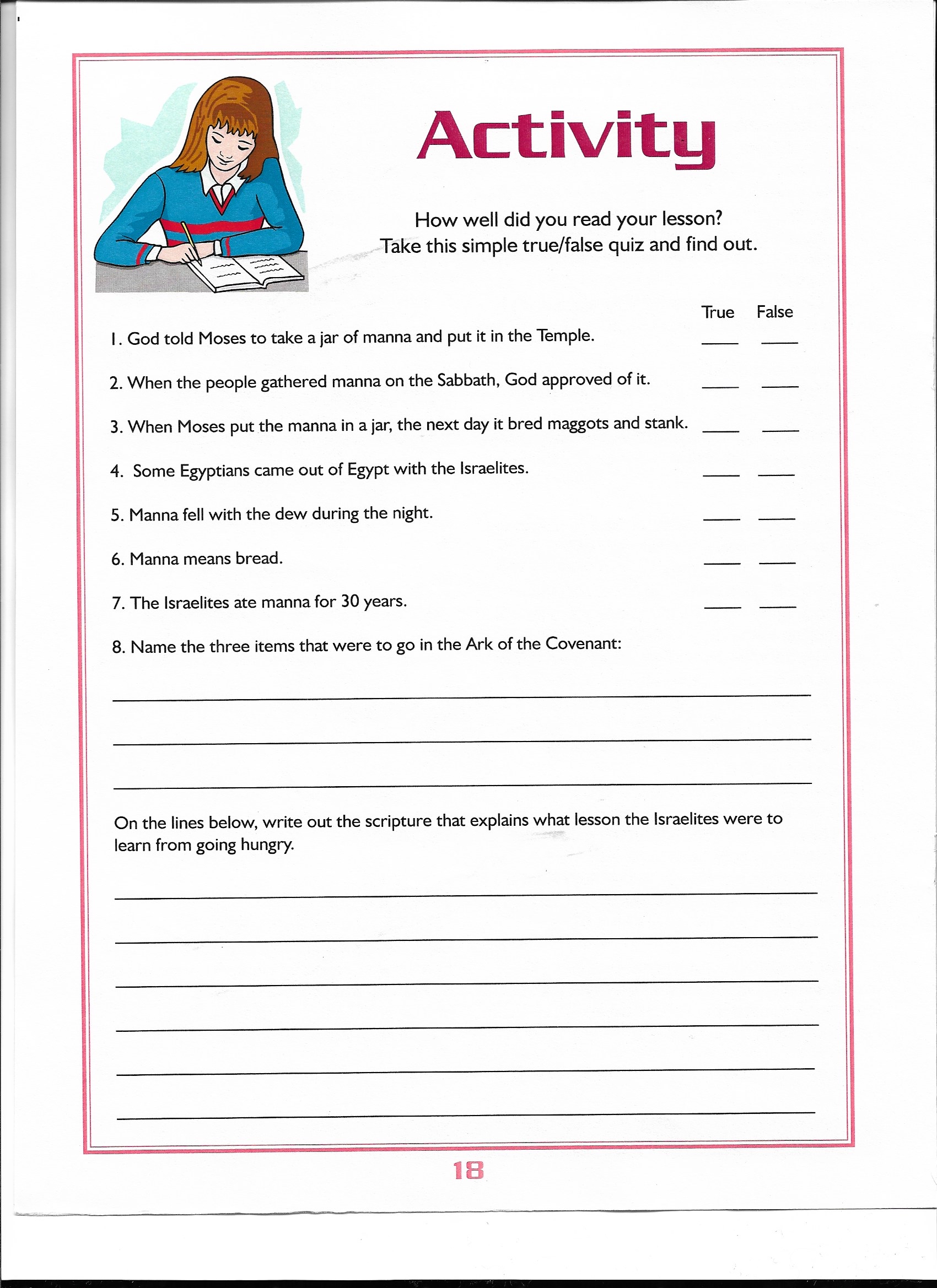
God wanted the Israelites to always remember that He gave them manna. So he commanded them to keep two jars of it, an omer, which was about two quarts. Now God would see to it that this manna would not breed maggots and stink. God wanted it kept for future generations to see the bread with which He fed the Israelites in the wilderness after He brought them out of Egypt.
Moses instructed Aaron to fill the jar with an omer of manna and place it before God, keeping it safe for future generations. Aaron did exactly as Moses instructed.
The Israelites ate manna for 40 years until they arrived at the border into Canaan, the Promised Land.
As you can see, manna was a very important part of the lives of those finding their way through the desert without any other food. But they wouldn't have had this if God had not supplied it. This was certainly something the Israelites and future generations should remember.
But did the Israelites really appreciate God giving them manna? How long did this appreciation last?
"But the Egyptians who had come with them began to long for the good things of Egypt. This added to the discontent of the people of Israel and they wept, 'Oh, for a few bites of meat! Oh, that we had some of the delicious fish we enjoyed so much in Egypt, and the wonderful cucumbers and melons, leeks, onions, and garlic! But now our strength is gone, and day after day we have to face this manna!'
"The manna was about the size of coriander seed, and looked like droplets of gum from the bark of a tree. The people gathered it from the ground and crushed it into flour or pounded it in mortars, boiled it, and then made pancakes from it - they tasted like pancakes fried in vegetable oil. The manna fell with the dew during the night" (Numbers 11: 4-9).
God thinks bigger than we do. Even though the Israelites and the Egyptians who left Egypt with them grew weary of manna, it was a miracle from Him and He wanted them to remember it.
So God instructed them to keep the omer of manna in a sacred place from generation to generation. When the first Tabernacle and Ark of the Covenant were built, this manna was kept in it. When Solomon built the Temple, manna was kept in a gold urn in the Ark of the Covenant, along with Aaron's rod that budded, and the Ten Commandments tablets (Hebrews 9:4).
Why was this so important to God? God wanted the Israelites to remember every road that God led them down for 40 years. He wanted them to remember that He pushed them to their limits and tested them. But what lessons did He want them to learn from going hungry? Your memory verse has the answer, "That he might make you know that man doth not live by bread only, but by every word that proceedeth out of the mouth of the LORD doth man live" (Deuteronomy 8:3b). Think about it, the meaning of our life is in that bread kept in a gold urn in the Ark of the Covenant.
Great God and Father,
Thank you for miraculously feeding the children of Israel with manna from heaven. Help me understand that our faith is strengthened by knowing that you love us and care for us. May I ever be grateful to you and never doubt your love.
In Jesus' name I pray.
Amen.
Sunday - Exodus 16:32-36
Monday - Numbers 11:4-9
Tuesday - Deuteronomy 8:1-5
Wednesday - Psalm 78:1-8
Thursday - Joshua 5:10-12
Friday - Deuteronomy 4:9
Saturday - Psalm 78:9-25
Exodus 17:1-7
2 Chronicles 7:12-16
Psalm 107:17
Psalm 107:17-22
Psalm 139: 23-24
Isaiah 59:1-8
Ezekiel 18:23-24
Philippians 4:6-7
WAILED - to express dissatisfaction plaintively
LOGIC - science of the formal principles of reasoning
It's tough being a teenager. Your mom keeps saying that you've got to make the grade. It seems like everyone you know is trying to be so cool. When you try it, you may just end up thinking you've been a fool. You wake up every morning, and when you stare into the mirror, you see your face. It looks the same as it did yesterday, but you didn't like it any better then. You want to be good-looking, but you're stuck with the face and body you have. You may begin to fear that you just don't fit in - especially when your friends find out that you are still a virgin or don't take drugs. Sometimes you may get so low that you wonder what to do, where to go, and who you can talk to.
The Israelites had problems too. It was tough in the desert, especially when there was no water. Finding watering holes was important out there in the desert. A person can’t last long without water. It’s essential to life. Here were more than a million people making their way from the Sin Desert to Rephidim. They arrived and found that there was no water - zilch, zero, none! How do you think they felt? Was this a little more serious than not fitting in with the crowd you hand out with? What do you think the Israelites did?
If anything, they were more disappointed than when they arrived in the Sin Wilderness just a month after departing Egypt. Do you remember how they accused Moses, Aaron, and even God of trying to starve them to death? This time their moaning turned into growling and complaining to Moses. "Give us water!' they wailed.
How many times would God have to perform miracles to meet their needs before they would trust Him? What would it take for them to learn that the first thing they should do is to get on their knees and ask God to provide water for them? Why do we think complaining, wailing, moaning, and growling is an effective way to get God's attention and the help we need?
Think about it. If your little sibling wanted a glass of water, but was too small to reach the faucet, would you react better if he came to you and said, "Could I please have a drink of water?" than if he demanded you give him a glass of water? What if his first course of action was to throw a temper tantrum with loud crying, moaning, and growling? How would you react to that? Why do we think God will react differently than we do to demands, temper tantrums, and complaining?
The Israelites became even more aggressive with their requirements. "Why did you ever take us out of Egypt?" they demanded. "Why did you bring us here to die with our children and cattle too?" In Ezekiel 18:23 the question is asked and answered, “'Do you think I like to see the wicked die?’ asks the Lord. ‘Of course not! I only want him to turn from his wicked ways and live.’" The Israelites were God's chosen people and He certainly didn't take pleasure in their death. After being in slavery for 430 long years, He freed them using miracle after miracle. So how in the world did they conclude that God brought them out into the wilderness to kill them? That simply doesn't follow good logic.
They were so worked up, so agitated that Moses feared they would stone him. He cried out to God for help. He heard Moses' request and came to his rescue. "Take the elders of Israel with you and lead the people out to Mt. Horeb. I will meet you there at the rock. Strike it with your rod - the same one you struck the Nile with- and water will come pouring out, enough for everyone!' Moses did as he was told, and the water gushed out!”
How difficult was that? Why didn't the Israelites try it first? The formula is simple. Go to God and make your request and believe He will answer.
When life seems tough for you and you begin to fear that you just don't fit in - especially when your friends find out that you are still a virgin or don't take drugs, what do you do? Do you go into a fit of depression and begin to moan and complain? Do you get so low that you wonder what to do, where to go, and who you can talk to? What should be the first thing you do? Who should you go to first? What is the Simple Formula we've just discussed?
Okay, so you've tried praying, and you think it doesn't work. Why? Isaiah 59:1, 2 says, "LISTEN NOW! THE Lord isn't too weak to save you. And he isn't getting deaf! He can hear you when you call! But the trouble is that your sins have cut you off from God. Because of sin he has turned his face away from you and will not listen anymore." Well, what do you do now?
2 Chronicles 7:14 tells us, "If my people will humble themselves and pray, and search for me, and turn from their wicked ways, I will hear them from heaven and forgive their sins and heal their land. I will listen, wide awake, to every prayer made in this place."
Then if God has turned His face from you because of your sins, how do you know which one? Any sin. Psalm 139:23-24 gives you another Simple Formula. Just get on your knees and pray this prayer: "Search me, O God, and know my heart; test my thoughts. Point out any thing you find in me that makes you sad, and lead me along the path of everlasting life."
Just think how different things could have been for the Israelites had they followed this Simple Formula. We can't do anything about the Israelites' problem today. But we can have an enormous impact on our problems and attitude if we'll follow this Simple Formula. What are you going to do about it the next time you think it’s tough being a teenager?
Gracious Father,
You loved the Israelites and wanted to give them every good thing. But their attitude was often rotten. Help me to follow the Simple FormulaI learned in this lesson and to get on my knees and ask your help in searching my heart. Grant me the willingness to always repent of my sins and look to you.
In Jesus' name I pray.
Amen.
Sunday - Exodus 17:1-7
Monday - Ezekiel 18:23-24
Tuesday - 2 Chronicles 7:12-16
Wednesday - Psalm 139:23-24
Thursday - Psalm 107:17-22
Friday - Isaiah 59:1-8
Saturday - Philippians 4:6-7
Exodus 17:8-16
Exodus 33:19
Deuteronomy 25:17-19
Ecclesiastes 3:1-8
Isaiah 54:8-10
Romans 9:14-16
Romans 11:22
Romans 11:22-23
SEVERITY - strict in judgment, discipline, or government; rigorous in restraint, punishment, or requirement
Do you remember that Lesson Two showed there is a time for everything? It says in Ecclesiastes 3, “There is a right time for everything: A time to be born, a time to die... A time for war; A time for peace."
Have you ever heard of Tommy Franks? He's one of the great men of our time. He grew up in Midland, Texas. After graduating from high school, he attended the University of Texas in Austin. Between the girls, the beer, and the hours he spent lollygagging around the DU house instead of studying, he ended up with a 0.5- six hours of “D”s or “F”s in only a 12-hour course load. He dropped out of college and joined the army as an enlisted soldier. His college years showed a real lack of discipline. Deep inside, he was a good man, but that goodness was yet to emerge.
Tommy Franks' military service experience included being an Artillery officer in Vietnam, a reform-minded Cold War commander, a shrewd tactician during Operation Desert Storm, and the senior American military officer at CENTCOM. He is probably best remembered as the Commander in Chief of the United States Central Command from July 2000 through July 2003. General Tommy Franks made history by leading the American and Coalition forces to victory in Afghanistan and Iraq - the decisive battles that launched the war on terrorism. General Franks knows well that there is A Time to Fight. He knew that if we don't fight the terrorists on their soil, we'll have to fight them on ours. I think you would agree that it's better done on theirs than ours.
Throughout man's history there have been wars. "The Amalekites came and attacked the Israelites at Rephidim. Moses said to Joshua, 'Choose some of our men and go out to fight the Amalekites. Tomorrow I will stand on top of the hill with the staff of God in my hands.’
"So Joshua fought the Amalekites as Moses had ordered, and Moses, Aaron and Hur went to the top of the hill. As long as Moses held up his hands, the Israelites were winning, but whenever he lowered his hands, the Amalekites were winning.
"When Moses' hands grew tired, they took a stone and put it under him and he sat on it. Aaron and Hur held his hands up - one on one side, one on the other - so that his hands remained steady till sunset. So Joshua overcame the Amalekite army with the sword.
"Then the LORD said to Moses, ‘Write this on a scroll as something to be remembered and make sure that Joshua hears it, because I will completely blot out the memory of Amalek from under heaven.’
"Moses built an altar and called it The LORD is my Banner. He said, 'For hands were lifted up to the throne of the LORD. The LORD will be at war against the Amalekites from generation to generation'" (Exodus 17:8-16 NIV Study Bible).
The battle with Amalek was the first attempt, outside of Egypt, to interfere with Israel's march to Canaan. As a result, God commanded that Amalekites be exterminated. "You must never forget what the people of Amalek did to you as you came from Egypt. Remember that they fought with you and struck down those who were faint and weary and lagging behind, with no respect or fear of God. Therefore, when the Lord your God has given you rest from all your enemies in the Promised Land, you are utterly to destroy the name of Amalek from under heaven. Never forget this" (Deuteronomy 25:17-19 TLB).
God was not going to tolerate the Amalekites striking down the faint and weary people that He provided for and loved so much. He felt the only solution for people who would do such a low thing was to utterly destroy them.
What should you learn from this lesson? The first thing is to make sure you respect and fear God. The second thing is that we should be careful how we treat less fortunate people who are faint and weary - God will notice.
The third lesson is that it takes team effort to do God's work. We have to hold up one another’s hands when the going gets rough and our friends are tired. There came a point when Moses no longer had the energy to stand up and pray and hold up his hands. Yet the Amalekites began to win when he dropped his hands. So Aaron and Hur had to assist by holding up his hands. How do we hold up the hands of our friends? We pray for them when the going gets rough. We encourage and help them. Friends should always be ready to help a friend.
The fourth lesson is that God is loving and merciful, but we should never forget both the goodness and the severity of God as it says in your memory verse in Romans 11: 22. "Notice how God is both kind and severe. He is very hard on those who disobey, but very good to you if you continue to love and trust him. But if you don't, you too will be cut off" (TLB).
Loving and Merciful God,
Thank you for taking notice when the Amalekites struck down the faint and weary Israelites. Your mercy extends to those who show mercy. Help me to always remember this and be careful to be merciful as you are.
In Jesus' name I pray.
Amen.
Sunday - Exodus 17:8-16
Monday- Deuteronomy 25:17-19
Tuesday - Romans 11:22-23
Wednesday - Ecclesiastes 3:1-8
Thursday - Isaiah 54:8-10
Friday - Romans 9:14-16
Saturday - Exodus 33:19

Exodus 18:1-27
Matthew 11:28-30
John 17:4
1 Corinthians 14:33, 40
Ephesians 2:10
2 Timothy 2:15
James 1:22
EFFICIENCY EXPERT - a person who has the skills and training to produce a decided, decisive, or desired effect
The famous composer-pianist, Paderewski was backstage during an intermission during his concert when a small restless boy entered the stage and sat down at the grand Steinway piano. He began to play "Chopsticks." Frowning faces remaining in the audience pointed in the boy's direction and began shouting, "Get that boy away from there."
The master overheard the sounds out front and quickly realized what was happening. He quickly grabbed his black tuxedo jacket and rushed on stage. Without one word, he stooped over behind the boy, reached around both sides, and began to improvise a counter melody to harmonize with and enhance "Chopsticks." As the two of them played, Paderewski kept whispering in the boy's ear: "Don't quit. Keep on playing. Don't stop . . .”
Do you think the Great Master looked down on the Israelites as they marched out of Egypt and whispered in their ears, “Don't quit; keep on walking; don’t stop”? Well, this didn't literally happen, but God was always there encouraging them each step of the way.
It had been along time since Moses had seen his wife. God must have known that Moses needed encouragement. Word reached Jethro, Moses' father-in-law, who was a priest of Midian, about all the miracles God had performed and how He had brought the Israelites out of Egypt.
Jethro took Moses' wife, Zipporah and his two sons to be with Moses. They arrived while Moses and the people were camped at Mount Sinai. Someone told Moses that his father-in-law, wife, and two sons had arrived. They had a lot to talk about. So they went into Moses' tent to hang out and catch up on the latest. A lot had happened since they had seen each other - the Israelites were freed from Egyptian slavery, they miraculously crossed the Red Sea, God supplied them with food and water, and they won the battle with Amalek.
"Jethro offered sacrifices to God, and afterwards Aaron and the leaders of Israel came to meet Jethro, and they all ate the sacrificial meal together before the Lord.”
"The next day Moses sat as usual to hear the people's complaints against each other, from morning to evening." When Jethro saw how much time this was taking, he asked Moses why he was doing this all by himself, especially when people had to stand all day long to get his help? Moses explained that the people came to him with their disputes, to ask for God’s decisions. "I am their judge, deciding who is right and who is wrong, and instructing them in God's ways. I apply the laws of God to their particular disputes.”
Jethro told Moses, “This isn't right. This job is too heavy a burden for you to bear all by yourself. You're going to wear yourself out and then how will the Israelites cope?” Jethro appears to have been some sort of an efficiency expert who wisely suggested that Moses modify Israel's leadership structure. Jethro said to Moses, "Now listen, and let me give you a word of advice, and God will bless you: Be these people's lawyer - their representative before God - bringing him their questions to decide; you will tell them his decisions, teaching them God's laws, and showing them the principles of godly living" (Exodus 18:19-20 TLB).
Jethro went on to set up an organizational structure which would take this heavy burden off Moses. He was to find and appoint capable, godly, honest men who hated bribes to be judges for each 1000 people. Each judge would have ten judges under him, each in charge of 100 people. He broke it down even further. The ten judges would have five judges under them who would council ten people each.These judges were responsible for serving the people with justice at all times. Important and complicated things would still be brought to Moses.
"Moses listened to his father-in-law's advice, and followed this suggestion. He chose able men from all over Israel and made them judges over the people - thousands, hundreds, fifties, and tens. They were constantly available to administer justice.They brought the hard cases to Moses but judged the smaller matters themselves" (Exodus 18: 24-26 TLB).
It wasn't long before Moses let his father-in-law go back to his own land.
What can you learn from this portion of the Bible? This gives us insight into God's character. He is Spirit and not encumbered with the weaknesses of the flesh. Moses was flesh and blood and had limitations. He could only do and take so much. He was to the point that his fleshly body couldn't take on anymore. It was time to Lighten the Load. He needed to share the responsibilities with others so he would be with the Israelites on their march to the Promised Land. God is a God of love. He knows we are but flesh and doesn't expect the impossible of us.
1 Corinthians 14:40 says that "Everything should be done in a fitting and orderly way." Verse 33 tells us that, "For God is not a God of disorder but of peace." The structure Jethro put in place gave order to every day. When a person had a problem, he no longer had to wait in line all day long to see Moses. The work load was distributed so many capable, godly, honest men shared in the responsibilities. God wants us to understand that not just anyone can be used in His work, that is, until they become capable, godly, and honest men. God needs laborers for His work. Will you measure up?
Loving Father,
Thank you for understanding that we are but flesh and you are not expecting the impossible from us. But at the same time, help us to strive to be capable, godly, and honest people so we can measure up to be helpers in your work.
In Jesus' name I pray.
Amen.
Sunday - Exodus 18:1-19
Monday - 1 Corinthians 14:33, 40
Tuesday- Matthew 11:28-30
Wednesday- Ephesians 2:10
Thursday- John 17:4
Friday - James 1:22
Saturday - 2 Timothy 2:15

Exodus 19:1-8
Psalm 1:1-2
Psalm 119:92-104
Isaiah 59:1-8
1 Peter 2:9
1 John 3:4
UNISON - in perfect agreement
DISSENTING - to differ in opinion
CODIFICATION - to reduce to a code
"One day a young man was walking along an isolated road when he heard something like a crying sound. He couldn't tell for sure what the sound was, but it seemed to be coming from underneath a bridge. As he approached the bridge, the sound got louder and then he saw a pathetic sight. There, lying in the muddy river bed, was a puppy about two months old. It had a gash on its head and was covered with mud. Its front legs were swollen where they had been tightly bound with cords.
"The young man was immediately moved with compassion and wanted to help the dog, but as he approached, the crying stopped and the dog snarled his lip and started to growl. But the young man did not give up. He sat down and started gently talking to the dog. It took a long time but eventually the dog stopped growling, and the man was able to inch forward and eventually touch the dog and begin unwrapping the tightly bound cord. The young man carried the dog home, cared for its wounds, gave it food and water and a warm bed. Even with all of this, the dog continued to snarl and growl every time the young man approached. But the young man did not give up.
“Weeks went by and the man continued caring for the puppy. Then one day, as the young man approached, the dog wagged its tail. Consistent love and kindness had won and a lifelong friendship of loyalty and trust began" (Stories For The Heart, Don't Give Up, retold by Alice Gray on page 110).
Do you recall how God looked down from heaven and heard the deep sorrow of His people in Egypt and heard their pleas for freedom from their harsh taskmasters? God called Moses from the burning bush and told him that He had come to "deliver them from the Egyptians and to take them out of Egypt into a good land, a large land, a land ‘flowing with milk and honey.'" The suffering Israelites were a lot like this poor, dirty puppy that had been bound and thrown into the muddy river. God had compassion on His people as the man did with dirty, hurting puppy. At first it seemed the puppy didn’t appreciate what the man was trying to do for it. Time and again, we’ve seen where the Israelites didn’t appreciate what God was trying to do for them either. They growled like the puppy and complained that God was trying to kill them.
Three months after the Israelites left Egypt, they came to the base of Mt. Sinai and set up camp there. This was probably just before Pentecost.
Mount Sinai is a very rugged mountain. Moses climbed that mountain to meet with God. Can you imagine having a meeting with God? Somewhere in that mountain God called to Moses and said, “Give these instructions to the people of Israel. Tell them, ‘You have seen what I did to the Egyptians, and how I brought you to myself as though on eagle's wings. Now if you will obey me and keep your part of my contract with you, you shall be my own little flock from among all the nations of the earth; for all the earth is mine. And you shall be a kingdom of priests to God. a holy nation.’”
This meeting with God was very important. God had a plan for the Israelites that far exceeded the plan Jethro gave Moses. God thinks big! He had a vision for the Israelites to become a kingdom of priests to Him - a holy nation. Now that is awesome!
After the meeting was over, Moses went back down the mountain and called a meeting of all the leaders of the people and told them what God had said. They responded in unison without a dissenting voice, saying, "We will certainly do everything he asks of us.” Then Moses told God what the people had agreed to do.
The stage is being set for the most major drama in the history of man to take place. God is getting ready to give His beloved people the best gift He can possibly give them, short of giving His own Son. The gift will be the codification of His Law - The Ten Commandments. This Law will show people how to live so they will be happy, healthy, and prosperous. It will be a light to their path to keep them out of trouble.
You have probably heard about God's law all of your life. Do you look upon it as one of the best gifts God could give you? Can you say with David, "Oh, how I love thy law! I meditate on it all day long. Your commands make me wiser than my enemies, for they are ever with me. I have more insight than all my teachers, for I meditate on your statutes. I have more understanding than the elders, for I obey your precepts. I have kept my feet from every evil path so that I might obey your word. I have not departed from your law, for you yourself have taught me" (Psalm 119: 97-102 NIV).
If you truly want to obey God, as the Israelites agreed to do, and to keep your part of the contract with God, you are truly on your way to God's Kingdom. Spend time each day of your life studying God's Word and thinking about His law. Psalm 1:1- 2 says, ”Blessed is the man who does not walk in the counsel of the wicked or stand in the way of sinners or sit in the seat of mockers. But his delight is in the law of the Lord, and on His law he meditates day and night.”
Don't Give Up! Walk in God's law. Apply God's law to every part of your life. Live His law every day. Life will work better for you.
Awesome God,
Thank you for bringing the Israelites safely to Mount Sinai for Moses to receive your law. Help me to make your law a lamp unto my feet and a light to my path all the days of my
life.
In Jesus’ name I pray.
Amen.
Sunday - Psalm 119:97-104
Monday - Psalm 1:1-2
Tuesday - Exodus 19:1-8
Wednesday - Isaiah 59:1-8
Thursday - 1 John 3:4
Friday - 1 Peter 2:9
Saturday - Psalm 119:92-95

Exodus 19:9-25
Exodus 34:28-30
Deuteronomy 4:32-33
Proverbs 3:1
Hosea 10:1-3
GENIUS - 1. a person who influences another for good or bad, 2. a strong leaning or inclination
"Early in the nineteenth century the French statesman, Alexander de Tocqueville, made a study of democracy in our country and wrote as follows . . .
"I sought for the greatness and genius of America in her commodious harbors and her ample rivers, and it was not there.
“I sought for the greatness and genius of America in her fertile fields and boundless forests, and it was not there.
"I sought for the greatness and genius of America in her rich mines and her vast world commerce, and it was not there.
"I sought for the greatness and genius of America in her democratic congress and her matchless constitution, and it was not there.
"Not until I went into the churches of America and heard her pulpits flame with righteousness did I understand the secret of her genius and power.
"America is great because America is good, and if America ever ceases to be good, America will cease to be great" (Stories For The Heart - The Greatness of America, Alexander de Tocqueville).
The YEA lessons in Bible Heroes, book one, will show you why America has been good and what will keep it good. It is through the teaching and keeping of the Ten Commandments that America is made good. Our politicians, schools, and legal system are trying to prohibit the Ten Commandments from being in public places and taught in our schools. When that is accomplished, America will cease to be good.
Just before Pentecost God was getting ready to codify His perfect law of truth, a delight to love and meditate on, that would be a lamp shining on their path, and a light to their feet. This law would make life work for anyone who lives by it.
God said to Moses, "I am going to come to you in the form of a dark cloud, so that the people themselves can hear me when I talk with you, and they will always believe you." He continued by telling him to go down and make sure the people could hear Him when He talked with Moses, so they would believe it was God talking.
The people were to sanctify themselves and wash their clothes for this holy occasion. "Then, the day after tomorrow, I will come down upon Mt. Sinai as all the people watch." Boundary lines were to be set to ensure the people did not go beyond them. If they so much as touched the boundaries or went up to Mount Sinai, they would die by stoning or be shot to death with an arrow. This absolute rule was in place until they heard the ram's horn blast.
Squeaky clean Israelites gathered at Mount Sinai for this holy meeting. There hasn't been a Fourth of July celebration anywhere more dramatic than the display God was about to put on. Special effects with dazzling laser beams synchronized to music are puny compared with what God did on Mount Sinai. At daybreak the third day, there was a clap of thunder, a huge display of lightning flashing, a thick cloud covering the mountain. A drama proceeded that surpassed anything this world had seen before.
Suddenly an ear-piercing blast on the ram's horn was heard. Moses led the Israelites out from the camp to meet God, and they stood at the foot of the mountain. The mountain was covered with smoke as God descended upon it in the form of fire.Then there was a violent earthquake that caused the mountain to shudder and shake. This was so awesome everyone trembled. Then Moses ascended to God.
God sent Moses down one more time to warn the people against crossing the boundaries. Not even the priests were allowed to cross the boundary line, or He would destroy them. Only Aaron was allowed to go back up with Moses.
Why do you think this Mountain Top Drama was so awesome and frightening? Was it to help the Israelites relate that event to how serious it is to break God's law? If giving the law is serious, breaking the law is even more serious, and God wanted them to understand that.
Some would have you believe that the law has been done away. Never in man's history has God ever put on such an awesome display before His people. Why would He go to all that trouble if He intended to do away with His law that is so holy and perfect, a delight to love and meditate on, that would be a lamp shining on your path and a light to your feet? This law can make life work for anyone. It doesn't make sense for anyone to say it has been discarded.
Holy Father,
Thank you for your law that is holy and perfect, a delight to love and meditate on. Help me to use it to shine as a lamp on my daily path so my life will work like you want it to.
In Jesus' name I pray.
Amen.
Sunday - Exodus 19:9-13
Monday - Exodus 19:14-20
Tuesday - Exodus 19:21-25
Wednesday - Proverbs 3:1
Thursday - Deuteronomy 4:32-33
Friday - Exodus 34:28-30
Saturday - Hosea 10:1-3