YEA Lesson Library
Saved From the Famine
About This Lesson
Using the story of Joseph bringing his family to Egypt, the student learns that God has a plan and a purpose in each person’s life.
Scriptures
Genesis 42:1-3
Genesis 43:1-2
Genesis 45:1-11
Genesis 47:7-12
Genesis 49:1-28
Psalm 119:19
Proverbs 16:1-8
Matthew 10:29-30
Romans 6:13
Words to Know
ABJECT - existing in a low state or condition
LAVISH - marked by an abundance or excess
The Lesson
Jacob, whom God had renamed Israel, finally agreed for his boys to take Benjamin and return to Egypt so they could get more grain. They loaded their donkeys with the best products of the land - balm, honey, spices, myrrh, pistachio nuts, and almonds. They took twice as much money so they could repay what they found in their sacks. Jacob asked for God's mercy before "this man" (Joseph), and that he would release Simeon and return Benjamin. Jacob had come to the place of accepting the death of these two sons, if he must.
Jacob's sons headed back to Egypt. At the entrance to the palace, they found Joseph's household manager. They told him about finding the money in their sacks and said they wanted to return it, explaining that they didn't know how it got there. The household manager told them not to worry about it; that God must have put it there. Then he released Simeon from prison and led them into the palace and gave them water to wash their feet while the donkeys were fed. They got presents ready to give Joseph when he came into the room.
Joseph entered the room and they bowed low before him. He asked if Jacob was alive. Remember, at this point, the brothers still didn't know this was Joseph. He was speaking through an interpreter. They told him that Jacob was alive and well. They bowed to him again. Joseph asked Benjamin if he was their youngest brother. "How are you, my son? God be gracious to you." He loved Benjamin so much, his emotions again got the better of him. He rushed out of the room and wept.
The 11 brothers were served a lavish banquet and Benjamin got five times more food as the others. It was a wonderful celebration even though Joseph ate alone.
Their sacks were filled with grain. Joseph secretly told his household manager to put Joseph's own silver cup at the top of Benjamin's sack, along with the money he paid for the grain. The brothers were up early and ready to return home the next morning. They were barely out of the city when the household manager caught up with them. "What do you mean stealing Joseph's silver cup?" he asked. They didn’t know it was in Benjamin's sack, so they answered, "What in the world are you talking about? If you find his cup with any one of us, let that one die. The rest of us will be slaves forever to your master."
"Fair enough," the man replied, "except that only the one who stole it will be a slave, the rest of you can go free." The sacks were searched and the silver cup was in Benjamin's sack. This was the last thing they wanted to happen because Jacob loved Benjamin so much. So they returned to the city to face Joseph one more time.
They made every effort to prove their innocence. But deep down they thought that God was still punishing them for the sin of selling Joseph into Egypt. They told Joseph that they had all returned to be his slaves. But that wasn't what Joseph wanted. He only wanted Benjamin and all the others could go home. That was the last person the brothers wanted him to have.
Judah, one of the brothers, stepped up and said, "O sir, let me say just this one word to you. . . we have a father, an old man, and a child of his old age, a little one. And his brother is dead, and he alone is left of his mother's children, and his father loves him very much. And you said to us, 'Bring him here so that I can see him. . . the lad cannot leave his father, for his father would die. . . and we will be responsible for bringing down his gray hairs with sorrow to the grave. .. Let me stay here as your slave instead of the lad and let the lad return with his brothers." Can you imagine becoming a slave in place of your sibling?
Joseph couldn't stand it any longer. He sent everyone out of the room except the brothers and he wept aloud. His sobs could be heard throughout the palace. "I am Joseph!" he said to his brothers. "Is my father still alive?" His brothers were so surprised they couldn't say a word. He reminded them that they had sold him into Egypt but asked that they not be angry with themselves. "Yes, it was God who sent me here, not you! And he has made me a counselor to Pharaoh, and manager of this entire nation, ruler of all the land of Egypt."
Then he told his brothers to hurry home and tell his father this story. He sent an invitation for him to come to Goshen to live near his children, grandchildren, and his flocks and herds. Joseph wanted him to come because there would still be five more years of famine. Coming to Egypt would spare Jacob and all of the family abject poverty. Joseph hugged Benjamin, and they both wept for joy. Then he hugged all of his brothers.
Pharaoh also extended an invitation to Jacob to come to Egypt. He promised the best territory in Egypt. He offered wagons to move their wives and children. Joseph gave them clothes, but he gave Benjamin five changes of clothes and 300 pieces of silver. He sent his father ten donkeys loaded with grain and all kinds of food.
The 11 brothers arrived home with the wonderful news that Joseph was alive! At first Jacob couldn't believe it. After seeing wagons filled with food he began to realize it was true. "I will go see him before I die,” he said. They all arrived in Egypt with a welcome from Pharaoh. He let them pick the best land. Jacob blessed Pharaoh.
Joseph was right when he said "God sent me here, not you." God was involved in this unusual story each step of the way. He had a purpose for Jacob and his son Joseph. He has a purpose for you too. Will you find it in your life?
Student Prayer
God of Abraham,Isaac, and Jacob,
Thank you for saving this beautiful story so that we can know about it. It means so much to know that you have a plan that you’re working out through people like Abraham, Isaac, and Jacob. Please show me how I fit into your plan and how I can serve you as they did.
In Jesus' name I pray.
Amen.
Daily Devotions
Sunday - Proverbs 16:1-8
Monday - Matthew 10:29-30
Tuesday - Genesis 45:1-11
Wednesday - Genesis 47:7-12
Thursday - Psalm 119:19
Friday- Romans 6:13
Saturday - Genesis 49:1-28
Objectives
At the end of this lesson, students will be able to:
1. Tell the story of Joseph's 11 brother's trips to Egypt to get grain during the famine.
2. Explain that Joseph being sold into Egypt was all in God's plan and he didn't blame his brothers.
3. Give an overview from Abraham to Israel (Jacob) going to Egypt.
Topics & Themes
Egypt
Famine
God’s Plan
Jacob
Joseph
Joseph’s Brothers
Prophecy
Purpose
Repentance
Materials Needed
Bibles, YEA Students' and Teacher's books, attendance and memory verse charts, songbook
How to Teach This Lesson
After opening the class with prayer, divide your students into groups of four. Ask: Can anyone tell us who was responsible for Joseph ending up in Egypt? Ask for a student to read aloud Genesis 45:1-8. God was in this all the way because He had a plan He was working out through Jacob, whose name was changed to Israel. This plan will unfold as you continue to study your Bible and the YEA lessons.
Now have each team draw one of the papers with a statement on it that you prepared before class. Make sure every statement is taken. Explain that they will have a few minutes to brainstorm. They can use their Bibles and YEA books. But they are to determine the significance of the statement, including any prophetic significance.
Call the students back together and have each group explain the significance of their statement. Ask if anyone else would like to add to what has been said.
Debrief - Let the students know that there are no “wrong answers” to these feelings. Ask: How did you feel about trying to find the significance of each of these statements? What does the story of Abraham and his family - Isaac, Jacob and Joseph - mean to you? How were Joseph’s experiences like or unlike things in your life? Did his brothers have any experiences that were like or unlike things in your life? Were the bad things Joseph's brothers did to him something God intended to take place? Why? How did Joseph benefit from being sold into Egypt? Why do you think Joseph was blessed so bountifully in Egypt? What lessons can you learn from Joseph?
Memory Verse - Have the students say their memory verse. Ask: How do you make a connection with it and this lesson?
Prophecy - Ask: How many of you have a desire to learn more about prophecy? Why do you think prophecy is important? (Prophecy is not just history written in advance. Prophecy is given so that we can change the course of events.) How do you see prophecy playing a role in today's lesson?Where do we find in the Bible that Abraham's family will play a role in the end times? Either have a good reader read Genesis 49:1-28 or have the students rotate reading these verses. Read the first three paragraphs of Background to your class. Ask: How did this help you to see the story flow of the Bible? Which of these Bible characters would you like to be most like? Why? What are you going to do to be more like this Bible character?
Teacher-Directed Activity
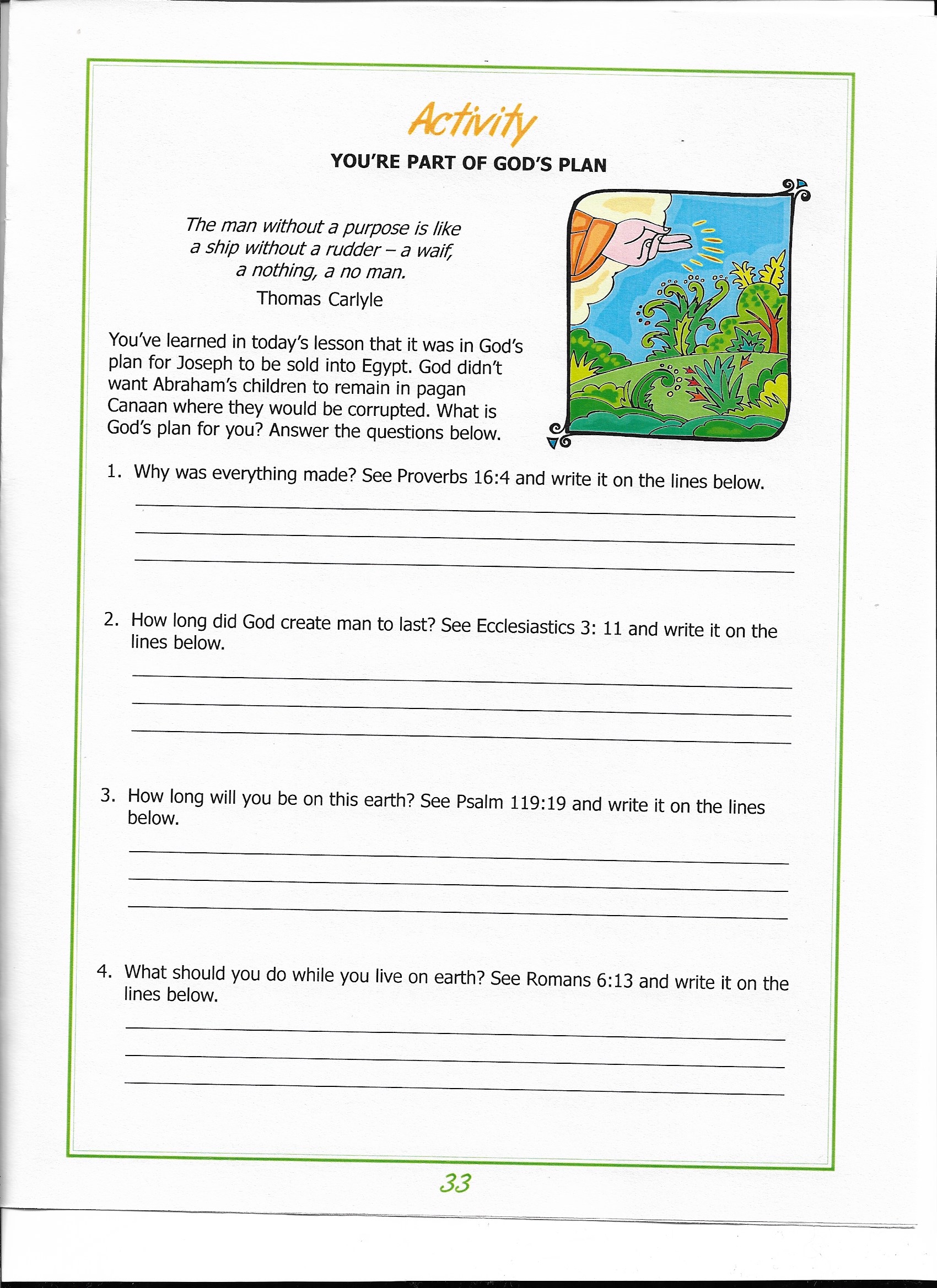
Go over the Activity in the students' book. Discuss the importance of seeking God's will in their lives. Have a student read Romans 6:13 aloud. Discuss what ti means to surrender your whole being to Christ and His purpose.
REACH Activity
Memory Verse Spotlight: Romans 6:13
The version of this verse in your lesson is interesting. Look up five other translations and write down Romans 6:13 the way that each of the versions translates it. Sometimes using different translations helps to define the meaning of the verse better than looking up each of the words. But if you are still unsure about exactly what Romans 6:13 means, choose one or two of the words to look up in a lexicon.
Write down what you find. And then think about this: have you given yourself to God? What does that look like? Are you being used for righteous purposes? How would you know? Write down your thoughts. Then talk about this with your family.
Where in the World? Joseph = Second in Command
You can be quite sure that Joseph’s brothers never expected that their plot to get rid of Joseph would ever have resulted in Joseph being second in command over all of Egypt. And then, when they got back home to Jacob, can you imagine the shock Jacob experienced at finding out that Joseph was still alive? You can imagine Jacob saying over and over, “What in the world?!”
In your Bible notebook, write a potential dialogue between Jacob and his sons as they tried to explain that Joseph was alive, that Joseph wanted them all to move to Egypt, and that they were the ones who sold him and then lied about his death.
They Did What Back Then? Bread
Look at the list of gifts that Jacob sent with his sons back to Egypt! There was famine in the land, but there was still some food. What does this tell you? It should tell you that bread really is the staff of life. What does that mean? Look it up. Research how important bread has been historically to people. Then think about how many people today have gluten sensitivities. Why do you think that is? How do you think that affects their understanding of how important the Bread of Life is? Talk about this with your parents and then write about it in your Bible notebook.
Making It Mine: Don’t Quarrel
Maybe you have brothers and sisters. Have you ever been on a long trip and riding in the car is just getting so boring and tiresome? What happens? Everyone gets grumpy. Pretty soon one of the siblings says something that irritates another sibling. Bickering starts. Then Dad says, “Do I have to come back there?” Sometimes that’s enough of a warning to quiet everything down, but pretty soon, the poking and bickering starts again. Eventually you hear this whiny voice say, “Mom, he’s looking at me.” Sound familiar? Well, take heart, this is nothing new. Joseph told his brothers to hurry up and get their father. Then he said, “And don’t quarrel on the way.” (Genesis 45:24) You can just imagine the conversations they would have had on the way home, the accusations, the assigning of blame and whose fault it was that Joseph had been sold. Joseph told them not to do that. Think about this. Why did he tell them not to quarrel on the way? Read Exodus 16:8 and think about how this might apply to Joseph’s brothers. Write about this in your Bible notebook.
Worldview Collisions: Suffering and a Good God
A secular worldview says that suffering in this world is evidence that God either doesn’t exist or God is not all powerful. They point to all of the children who starve to death, the earthquakes, tornadoes, hurricanes, and tsunamis which kill so many people every year, and the violent accidents that kill, maim, and destroy.
How do you answer that from a Biblical viewpoint? The Biblical worldview is that God is always good, all the time! And God is all powerful. He is the Creator of the universe. There is nothing He cannot do.
But God allows the suffering because He has given mankind freewill to follow his own desires. Freewill means that mankind can choose to do evil things, but then there are natural consequences which follow. Someone might say, “But God could keep those bad consequences from happening.” No, a just God has to let the consequences follow the actions. If you drop an egg, you expect that it will break all over the floor. If it suddenly stopped in midair and floated back up to your hand, you might drop another egg to see if it would do it again. We are able to function in this world because laws are consistent. Gravity works. Friction works. Inertia works. Phototropism works. When the laws are miraculously suspended, suddenly it creates chaos. It’s the same with God’s laws. Since they are not arbitrary (just made up for no good reason), they have a reason for our benefit. When they are broken, there has to be a consequence otherwise we’d never understand how they are for our good.
This is a deep subject. Talk about it with your parents. Then write a couple of paragraphs in your Bible notebook talking about the reasonable response (apology) you would make to the secular worldview.
Questions
As you’re working through the YEA lesson, Daily Devotionals, doing the activity, or reading the Bible, be sure to write down any questions you have. That way you’ll remember to ask someone. Also remember to share the really interesting things you’re learning with family and friends.
Song
“Here I Am, Lord” is on page 85 of The Group Songbook.
Closing Prayer
Have the students form a circle and join hands. Ask for each student to tell one thing they’ve learned from today’s lesson.
Printable Pages