YE4B.1 · Activity Page

Exodus 20:2-17
Deuteronomy 5:6-21
Matthew 5:17-19
Romans 2:10-20
Romans 3:29-31
Romans 6:12-14
Romans 7:12
I Corinthians 14:33, 40
Hebrews 8:7-12
CITE - to summon to appear in court
FORNICATION - voluntary sexual activity be- tween two unmarried persons
ADULTERY - voluntary sexual activity after marriage with someone other than your lawful spouse
Are you eager to get your freedom? Would you like to be a little older or grown-up? One of the greatest thrills a teenager has is getting more freedom. Taking Driver’s Ed and getting your license to drive a car will be really cool. Then you’ll have the freedom to take yourself places rather than depending on Mom or Dad to drive you there. Man, that’s living!
Your Driver’s Ed class will teach you that everyone who drives a car has to follow the same rules. If they don’t, they’re headed for big trouble. If the rules aren’t followed, a policeman can cite you and then you have to pay a costly fine. When a driver is deemed to be unsafe on the roads because he has received too many traffic tickets, his privilege to drive is taken away and his license revoked. Unsafe drivers have accidents and people get hurt or even killed. When driving a car, the stakes are high if you don’t follow the rules. The rules are there for your good. But far more important, they are there for everyone else who is on the streets or highways.
Rules are good. They define what you can do and what others can do. Traffic laws provide an orderly way for traffic to flow. These laws give the necessary information to prevent accidents. Think what it would be like in a large city if there were no traffic laws. Can you imagine how chaotic the streets would be? How would a car ever make it safely through a busy intersection if there were no rules to regulate who should stop and who should go? Traffic laws are for everyone to follow. Driving rules are consistent in their application. If a driver follows them, driving will be safer and fun.
From the very beginning God knew that people would need rules. He laid out a set of rules that will give us safety and happiness if we and our friends and neighbors consistently follow them. God did such a good job laying out these rules that there never has been, and never will be, a time when man should not obey these rules. Keeping these rules will always bring the same results – safety and happiness for all. The Ten Commandments form the heart and core of these rules.
One day Jesus went up the hillside with His disciples and sat down. He began to teach them some really important principles to live by. He told them to never let anyone convince them that He came to do away with the Ten Commandments or any part of the Law or the Prophets. He assured them that every law in the Book will continue until its purpose is achieved. With future generations being born, they too will need to be safe and happy. So the law will continue. Jesus went on to tell His disciples that if anyone breaks even a lesser commandment and teaches others to, he will be least in the Kingdom of Heaven. But if you will obey God’s law and teach others to do the same, you will be great in the Kingdom of Heaven.
As Jesus continued to talk with His disciples, He talked about sexual sins. Sex is only for a man and woman who are married to each other. Even having the desire to sleep around with a girl or boy who is not your wife or husband is wrong. This law was given to protect the family. When this law is broken there are consequences. Mom and Dad get hurt, but so do the kids. Everyone is unhappy. A right relationship in marriage makes the entire family happy, and it’s very beautiful to God.
Just as citations are issued for traffic violations, there are consequences for breaking God’s law. The penalty for murder requires that the killer be killed. Jesus made this law even more binding by saying, “I have added to that rule, and tell you that if you are only angry, even in your own home, you are in danger of judgment! If you call a friend an idiot, you are in danger of being brought before the court. And if you curse him, you are in danger of the fires of hell” (Matthew 5:22 TLB). Jesus is very concerned about your relationships with your friends, family and with Him. How you treat people will determine how many friends you have and what your relationship with God will be.
Just as traffic laws were established for our safety, the same thing is true with God’s law. It was given by God for our good. When we don’t keep the law it becomes a problem. Then we suffer the consequences. Excusing yourself by saying, “Everyone else does it!” just won’t save you from the consequences.
Think of how much better our world would be if everyone kept God’s law. You wouldn’t have to worry about some kid bringing a gun to school and shooting you or your classmates. You could trust and believe everyone. There would be no school activities on Friday nights and you wouldn’t be the only one in your class who keeps the Sabbath – everyone would.
God’s law is truly holy, righteous and good. God promises that if you will keep His law and teach others to keep it, you will be “great in the Kingdom of Heaven.” This means greatness for all eternity! But you must do what He says.
Great Father,
Thank you for giving such a wonderful law to show us how to live our lives. I want to do what you say, but sometimes I’m tempted to follow my peers. I know it’s not going to save me from the consequences by excusing myself with, “Everyone else does it.” Please give me the help each day to obey you.
It’s in Jesus’ name I pray.
Amen.
Sunday: Exodus 20:2-17
Monday: Deuteronomy 5:6-21
Tuesday: Romans 3:29-31
Wednesday: Romans 2:10-16
Thursday: Romans 2:17-24
Friday: Romans 6:12-14
Saturday: Hebrews 8:7-12
Genesis 14:20
Genesis 28:22
Leviticus 27:30-32
Numbers 18:21-28
Deuteronomy 16:13-17
Malachi 3:7-12
Mark 12:41-44
Luke 6:36-38
Luke 21:1-4
2 Corinthians 9:5-10
2 Corinthians 9:6
STEWARD - a person who manages another’s property or financial affairs.
RECEPTACLE - a container that holds something.
PROPRIETOR - the owner of a business establishment.
When you go to the grocery store, chances are it is a huge supermarket, one of many in a chain. Take a minute and think about how your grocery store first started. It was probably a small store on a street corner and originally a mom and pop business. The owner could have been an average person trying to feed his family from the small income derived from his business. Starting a new business is usually a struggle. Often proprietors work long hard hours with little or no salary when a business is new. Many new businesses fail within the first year. There could be several factors why one fails and another succeeds.
The H.E.B. grocery store chains started like others – one small store on a street corner. Howard E. Butt may have struggled at first to make a living. But he believed in tithing or giving at least one tenth of his increase or profit to God.
Today, most cities in South Texas have an H.E.B. grocery store. These very large supermarkets have a bakery, deli, meat market, produce department, and virtually everything else you would expect to find. Mr. Butt’s chain of grocery stores would certainly be considered a successful business. What made it a success? Hard work and good managerial decisions certainly played a major roll in its success. But could the fact that Mr. Butt tithed to God have anything to do with him being even more successful than he would have been? Did God bless him? What does the Bible have to say about this subject?
Mr. Butt is certainly not the only person who has experienced the joy of giving. Jesus tells us about a poor lady whose husband had died. She walked into the court of women in the Temple one day. This was as far as she was allowed to go in that building, because she was a woman. There were 13 trumpet- shaped receptacles for donations in the court. She had two coins with her. This was all the money she had. So she put those two coins in one of the receptacles. Jesus was sitting nearby watching as people gave their tithes and offerings.
This lady’s offering was such a remarkable thing that Jesus called His disciples to Him and told them that the widow lady had given more than all the rich men put together. What the wealthy men gave was no sacrifice – it was only a fraction of their wealth. But this poor lady gave her last penny. The lady wasn’t forced to give everything she had. She gave it willingly. The Bible says nothing to indicate that she had any hesitation about giving those two pennies, nor that she had any regrets. But we do know that it was noteworthy, even to Jesus. Because of her generosity, she is mentioned in the Bible for us to read about two thousand years later.
It was very difficult for a woman to support herself in Jesus’ day. Women were not used in the work force then as they are today. Considering these factors, do you think this widow lady may have been foolish to give her last penny when she had no husband to support her? Or could it be that she was a lady with enormous faith, who trusted God to take care of her? Do you think she reflected on all that God had given her and was filled with so much love and gratitude that she felt giving her all was the least she could do? Perhaps she knew what the Scripture says in Malachi 3:10.
“Bring all the tithes into the storehouse so that there will be food enough in my Temple. If you do, I will open up the windows of heaven for you and pour out a blessing so great you won’t have room enough to take it in!”
Jesus pointed out that all of the men in the Temple, who had the capability to earn a living, didn’t give as much as this poor widow lady. We may not fully understand her motivations, but her actions showed that she had the confidence that God would take care of her. She didn’t seem worried about physical things. What a joy to give with such faith!
But you know, God promises exactly the same thing for you. He says that there’ll be more blessings than you can take in, if you obey Him. But if you don’t, He says the consequences are a curse. Malachi 3:8-9 says, “ Will a man rob God? Yet you have robbed me. But you say, ‘Wherein have we robbed you?’ In tithes and offerings. You are cursed with a curse: for you have robbed me, even the whole nation.” What do you think that curse could be?
Have you ever seen people who live from paycheck to paycheck and never have enough money to make ends meet? These people are usually in debt up to their eyeballs. And usually their credit is very bad. Have these people applied good financial principles in their lives? Do you think that they have brought all of their tithes into the “storehouse”? It’s not for us to judge, but we do know what God promises in the way of consequences and rewards. We also know that “God loves a cheerful giver,” (2 Corinthians 9:7). What would it mean to you to know that God loves you like He did the widow lady? God wants you to be a joyful giver.
Awesome God,
You have given me everything I have. Yet I’m only required to return ten percent to you. This is awesome! Help me to have the faith that the widow lady had and never forget to tithe. I want to be a joyful giver.
In Jesus’ name I pray.
Amen.
Sunday: Genesis 14:20, 28:22
Monday: Leviticus 27:30-32
Tuesday: Numbers 18:21-28
Wednesday: Malachi 3:7-12
Thursday: 2 Corinthians 9:5-10
Friday: Luke 6:36-38
Saturday: Deuteronomy 16:13-17

Matthew 6:19-34
Matthew 10:29-33
Luke 12:16-34
Luke 12:31
John 12:23-28
Philippians 4:4-7
Colossians 3:1-4
I John 3:21-24
I John 5:12-14
ULTIMATE - unequaled or unsurpassed
SIGNIFICANT - important
ATTIRED - dressed or adorned
HEATHEN - people who do not acknowledge the God of the Bible; pagans, infidels
According to current statistics, do you know how many teenagers say they want to be close to God, and how many say they want to be active participants in a church? “Developing a close, personal relationship with God is of deep interest to most of them because they really want to be connected to something more significant than themselves. Until they find that ‘ultimate significant other,’ they will rely largely upon their own abilities and instincts to get them through the daily challenges. But they’re on the lookout for legitimate spirituality” (Get Real: Making Core Christian Beliefs Relevant to Teenagers).
Have you felt all alone in your desire to learn about God and do what Jesus would have you do? Doesn’t it encourage you to know there are many teenagers who value their relationship with God? They have experienced the difference this relationship makes in their lives. God can be there to help when you’re in trouble as well as when life offers you a lot of warm fuzzy feelings. How do you connect to the Supreme Eternal Being whom you can’t see?
That connection cannot be made without knowing God. Getting to know God is a very personal thing. It is a process which requires certain disciplines. You don’t just wake up one morning and consider a stranger you have never met to be your best friend. The same is true with God becoming your best friend. What disciplines are required to have the kind of relationship with God where He will be your best friend?
You spend a lot of time feeding, grooming, and taking good care of your body. You know what a good-looking body looks like, and having one is probably important to you. Showing perfect white teeth when you smile is really neat. Having a golden tan and the latest hairstyle makes a statement to be envied.
But think about it. You can’t go anywhere with- out your body. You can’t just hang it up in the closet and go to the mall without it. It provides the feet to take you to school and to the mall. Your body has hands which put food in your mouth. But your body is very physical and a relationship with God is spiritual. Knowing what the Bible says about having a relationship with God helps you understand the disciplines required. You’ll see how important agonizing and fretting over your beautiful body is to God.
Jesus told us not to worry about having enough food and clothing. The heathen frets over physical things. He thinks he can’t live unless he’s clad in Tommy Hilfiger shirts or clothes from the Gap. But you might say, “Wait a minute! Hamburgers, pizzas and hanging out in the mall are very important parts of my life.” God knows you need food to keep your body and soul together, and He doesn’t want you running around in your birthday suit. He promises to give these things to you if you will put Him first in your life. That means that you are willing to live your life like He tells you in the Bible.
Jesus said to go out and look at your garden or flower beds. Flowers don’t worry about how they look. God has dressed them with beautiful petals and has attired them even more beautifully than King Solomon in all of his glory. And King Solomon may have been the wealthiest person who ever lived.
The life cycle of a flower is very short. Yet God cares so much about it that He made it very beautiful. Don’t you think He cares more about you than a flower in your garden? “Look at the birds! They don’t worry about what to eat – they don’t need to sow or reap or store up food – for your Heavenly Father feeds them. And you are far more valuable to him than they are. Will all your worries add a single moment to your life?” (Matthew 6:26-27 TLB).
God makes flowers beautiful and feeds the birds, yet you are far more valuable and important to Him. Now God wants to know if He is more valuable and important to you than Tommy Hilfiger clothes, dressing like Britney Spears, having a hamburger, fries, or pizza. How will He know? By the way you spend your time. Do you spend more time fretting over how you look or at the mall than you spend with your Heavenly Father each day?
Jesus says “You cannot serve two masters: God and money. For you will hate one and love the other, or else the other way around.” A servant’s primary interest is in doing the things his master wants. If we truly want an eternal connection with God, our primary desire will be to do the things He wants us to do.
What things does God want us to do? We know that He gave us the Ten Commandments to show us how to live our lives in such a way as to honor Him, how to treat other people, and how to make our own lives work. So we start by keeping all ten of the commandments.
Your friends are no strangers to you. You talk with them at school, on the phone, and at many other times. Jesus did so much more for you than any friend you have. He died for your sins. He gave His own life for you. Isn’t it such a small thing to ask that you get to know Him and know Him well?
If you really want an eternal connection with God, obey Him and humble yourself before Him in prayer and Bible study. He will become your best friend.
This relationship offers you so much more than a mere human can give you. He will take care of you as He does the birds and flowers. He will always be there to help you resist peer pressure. He will be there to make you a better friend to others. He will help you be a better person. God offers you the ultimate connection. But the connection is not a one-way street. You must make the commitment to Him.
Dear Father in heaven,
Thank you for caring even more about me than you do for the birds and flowers. I want to commit my life to you and gain an eternal connection with you. For this to be, I must not put clothing or even food ahead of you. I know that I can always count on your promise to reward me.
In Jesus’ name I pray.
Amen.
Sunday: Luke 12:16-34
Monday: Colossians 3:1-4
Tuesday: John 12:23-28
Wednesday: Matthew 10:29-33
Thursday: Philippians 4:4-7
Friday: I John 5:12-14
Saturday: I John 3:21-24

Matthew 25:34-40
Luke 10:25-37
I Corinthians 13:4-7
Galatians 5:13-15
Ephesians 4:25-32
Colossians 3:12-15
James 1:22-27
James 1:27
I John 4:4-10
BANDIT - robber, especially a member of a gang
RAPE - an unlawful act of forcing a person to have sexual intercourse by threat or force
Tina attended the local junior college in the daytime and worked at the corner convenience store until ten at night to pay for her tuition. One night she drove to her apartment and rushed toward the door. Just before she reached it, two masked boys grabbed her. Tina screamed at the top of her lungs and neighbors came out onto their balconies to see what was happening. As they watched, these two strong boys tore her clothes off and raped her. Tina struggled, cried, and screamed, but no one came to her rescue or even called the police. What kind of neighbors do you think these people were?
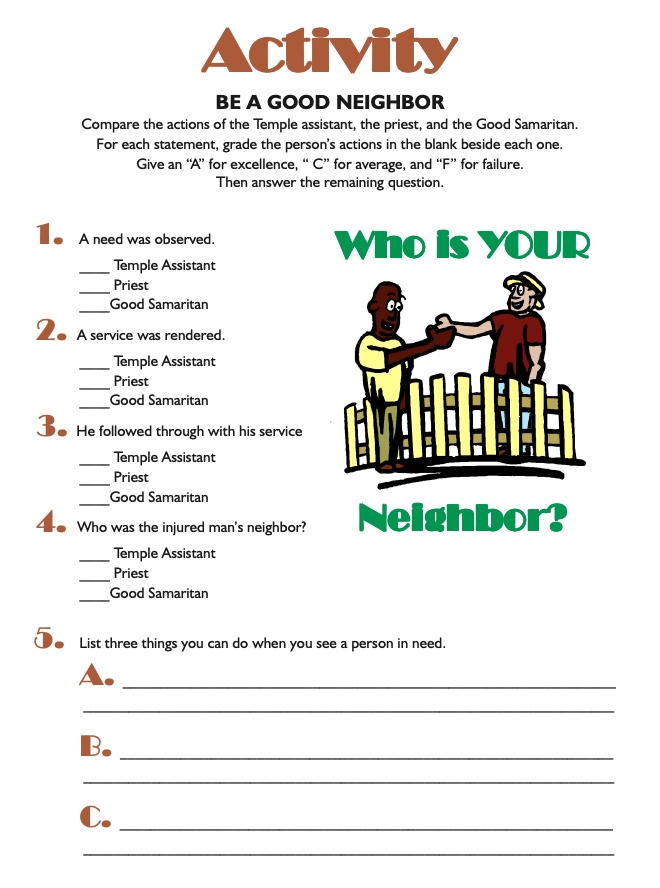
There is a story in the Bible that helps us to understand what a good neighbor is like. One day a teacher of the law came to test Jesus. He asked, “What does a man need to do to gain eternal life?” Jesus realized this was a trick question so He answered, “What does the law say about it?” This religious man said, “You must love God with all your heart, soul, strength and mind. And you must love your neighbor just as much as you love yourself.”
“Right!” Jesus replied. “Do this and you will live forever!” Since the man had problems with certain ethnic groups, he wanted to find out exactly which people Jesus considered to be his neighbors. Jesus told this story to answer that question.
A man was going on a trip from Jerusalem to Jericho and some bandits attacked him. They stripped him naked and took his money. After beating him up, they left him by the road half dead.
A priest came along and saw the injured man lying beside the road. He simply didn’t want to get involved so he crossed the road to the other side and continued on his way. A man who assisted in the Temple came along. He had the nerve to walk over and look at the man, but just like the first man, he did absolutely nothing to help the man. He too continued on his journey down the road.
A third man, who was a Samaritan, came along on a donkey. Samaritans were not liked in that part of the world and were probably discriminated against just as certain ethnic groups are today. As he passed by and saw the injured man he had real compassion for him. He knelt down beside him, soothed his wounds with medicine and put bandages on them. He helped the man onto his own donkey and walked along beside him until they came to an inn. He stayed with the man through the night and saw to his needs. As he left the next day, he gave the innkeeper money to ensure the injured man was cared for. He was such a considerate man that he even told the innkeeper that if the money he gave him wasn’t enough, he would pay the bill when he returned.
After Jesus finished telling this story, He asked this teacher of the law this question: “Which of the three men who saw the bandit’s victim along the roadside was his neighbor?” Naturally, the teacher replied that it was the Samaritan who showed pity on the injured man.
Did you notice that one of the men who walked right by the injured man was a priest who worked in God’s Temple? He was a religious man. But what did his religion do for his actions? It probably wasn’t cool to do such a menial task as helping a man alongside the roadway. So he actually walked over to the other side of the road to avoid him. Then a Temple assistant came along. He at least got close enough to look at the victim, but he didn’t help either. He went on down the road leaving the man in agony.
This Samaritan was really a big-hearted person. He checked the two of them into an inn and stayed with the man through the night. But that wasn’t all. As he left the next day, he gave the innkeeper money to ensure the poor man was cared for. The Samaritan even told the innkeeper that if the money that he gave him wasn’t enough, he would pay the bill when he returned.
How did you feel about the two men who worked right in God’s Temple passing by a badly hurt man without giving aid? Were their religious garments so special, so nice, that they didn’t want to soil them? Were they more interested in the way they looked than helping someone in need? Do you think their religion impacted their lives in a truly godly way? What does your memory verse say that “pure religion” is?
What would you have done if you had seen the rapists attack Tina? Would you have been like the other neighbors, just standing and watching? If something like this happened to you, what would you hope that others would do? The Golden Rule says that we should do for others in the same manner that we would want them to do for us.
It may not always be safe to go directly to the person and intervene. But there are three things you can do. You can pray instantly and fervently for God’s immediate intervention. You should call the police. In the meantime you can do everything you can to get immediate assistance from others until the police get there. No matter what the person looks like, he is still a child of God. He has feelings just like you do and God loves him. He is your neighbor!
Dear Feather, Thank you for showing me that I can show my love to you when I help others. We live in a dangerous world and I need your protection when I try to help others.
In Jesus’ name I pray.
Amen.
Sunday: I Corinthians 13:4-7
Monday: Galatians 5:13-15
Tuesday: Ephesians 4:25-32
Wednesday: James 1:22-27
Thursday: Colossians 3:12-15
Friday: Matthew 25:34-40
Saturday: I John 4:4-10
Psalm 103:1-22
Isaiah 55:6-9
Matthew 6:7-15
Matthew 18:21-35
Luke 6:35-38
John 8:3-11
Acts 5:29-32
Ephesians 4:32
I John 1:1-9
OSTRACIZE - to exclude, by general consent, from society, privileges, etc.
BLATANT - brazen, offensive
GRUDGE - the feeling of ill will or resentment because of a real or imagined wrong done to you
FORGIVE - to grant a pardon to a person who has wronged you
The beautiful model, Tyra Banks, tells a story in her book, Tyra’s Beauty Inside & Out. When she was in the sixth grade she hung out with a group of cliquish girls. Tyra was the leader of the pack. Once in a while a girl in this cool clique would be told she could no longer be a part of their group. Invariably, the dismissed girl would find her way to befriend Sally, a very religious girl who wore her skirts longer than any in Tyra’s group.
She wasn’t popular, but she was very pleasant and always had a smile on her face. Because she wasn’t stylish and cool, she didn’t have friends who would even join her for lunch, except when another girl in Tyra’s clique found herself friendless. Then each girl would gravitate to Sally until they were allowed back into the pack. At that point, the girl would drop Sally like a hot potato.
Even though Tyra was leader of her pack, one day she found herself being thrown out of her own clique. Her groupies couldn’t stand her bossiness. After Tyra was ostracized, she too found her way to Sally and they became best friends.
She may have justified her actions by saying, “I don’t want to be with the popular kids, I hate them, they stink, and they’re stuck up.” After a month or so the clique invited Tyra back in the group again. So she left her long-skirted, smiling friend and became one of the “in” crowd again. But Sally didn’t allow herself to have any hard feelings. She kept on smiling because she could see a larger, more important picture. She quickly forgave all the girls who only needed her friendship when others didn’t want it. Do you think she should have forgiven them? There’s a story in the Bible about this type of thing.
Peter came to Jesus one day and asked, “ ‘Sir, how often should I forgive a brother who sins against me? Seven times?’ ‘No!’ Jesus replied, ‘seventy times seven!’” Hum, that’s 490 times! Maybe Sally did the right thing after all.
As Jesus continued to talk with Peter, He explained that His Kingdom can be compared to a king who decided to bring his accounts up to date. To accomplish this, he brought in a man who owed him ten million dollars. But the man didn’t have that much money and couldn’t pay his debt. So the king ordered the man, his wife, and his children to be sold as slaves and all of his earthly possessions to be sold as well.
This was probably the most difficult time in this man’s life, losing absolutely everything he had. So he fell on his face in the dust and said, “Oh, sir, be patient with me and I will pay it all.” Seeing such a humble and contrite spirit, the king showed mercy, forgave his debt and released him. But his humility and contrition didn’t last long.
He left the presence of the king and went directly to a man who owed him only $2000 and grabbed him by the throat and demanded immediate payment. This man fell down before him, as he had done with the king, and begged for a little time to get the money together. The man assured him that he would pay him the $2000. But the man who had been forgiven a much larger debt by the king wouldn’t wait to be paid. He had the man arrested and thrown in jail until his debt was completely paid.
Such blatant behavior is rarely kept a secret. You guessed it! The king found out and he called for the man that he had forgiven. He said some rather stern things to him. “ ‘You evil-hearted wretch! Here I forgave you all that tremendous debt, just because you asked me to. Shouldn’t you have mercy on others, just as I had mercy on you?’
“Then the angry king sent the man to the torture chamber until he had paid every last penny due. So shall my heavenly Father do to you if you refuse to truly forgive your brother.”
Wow! Look at the consequences for not forgiving someone. You just don’t get by with this kind of attitude. Tyra reaped consequences for her behavior and was kicked out of her cool chic cocoon. However, her consequences were not as severe as the unforgiving man’s. But neither was her infraction as bad. Tyra came to see how wrong she was and said, “Even after the way I abandoned her, when I’d see Sally in the halls at school, she always smiled. I now realize that she was wise beyond her years and understood that I was too weak to break away from the pack and stand on my own. . . like her.”
Sally realized that the consequences of bitterness, anger, and hatred would eat her alive. She forgave and let it go without holding any grudges. Sally’s beautiful attitude allowed her to keep on smiling. In the end, Tyra respected Sally for being wise beyond her years and saw the real character she had.
Forgiving 490 times may seem like a tall order. But this 490 times really means an unlimited number of times. Forgiveness is freedom. It allows you to sleep at night and to get a life of your own. It puts a radiant smile on your face as it did on Sally’s. It wins the respect of others. But more important, it wins the respect of God.
Loving Father,
Thank you for the beautiful story about Sally. She turned her religion into a positive thing by smiling, befriending people who were rejected by others, and then forgiving them when she was rejected by them. That example reflects Jesus Christ in her life. Help me to follow it each day, forgiving others without holding any grudges.
In Jesus’ name.
Amen.
Sunday: Luke 6:35-38
Monday: Acts 5:29-32
Tuesday: Matthew 6:7-15
Wednesday: I John 1:1-9
Thursday: Matthew 18:21-35
Friday: Isaiah 55:6-9
Saturday: Psalm 103:1-22

Matthew 6:19-21
Matthew 13:44-51
Matthew 19:16-30
Mark 10:17-31
Luke 12:31-34
Luke 18:18-30
Luke 21:1-4
Romans 6:23
Colossians 2:1-7
BEDECKED - to deck out in a showy manner
PHOTOGENIC - having features that look good in a photograph
BOMBSHELL - something or someone having a sudden sensational effect
The most visible and loved royal personage in the twentieth century was Diana, Princess of Wales. Photogenic and beautiful, she clicked with the cameras. All eyes and media cameras were on her fairytale courtship and marriage to then Prince Charles. The world hadn’t seen so much pomp and ceremony since Queen Elizabeth II married the Duke of Edinburgh!
Diana arrived at St. Paul’s Cathedral in the horse-drawn royal carriage bedecked in oceans of ivory silk taffeta and real diamonds sparkling in her hair. She was young, bright and beautiful. “I thought I was the luckiest girl in the world when I looked at Charles through my veil,” she said. Joy for the world – and the “luckiest girl.” But after giving birth to an heir and a spare, as the British say, the fairytale story came to an end when she and her Prince Charming divorced. Even after a nasty divorce from the future heir to the throne of England, Diana continued to capture the hearts of the people all around the world. With title, wealth and tremendous beauty, she still had the ability to understand and empathize with ordinary people, but especially the desperately sick, rejected and unloved. She was the people’s princess until that fateful night when Diana lost her life in the horrible car wreck in Paris, France.
There’s a story in the Bible about a young ruler who may have been as wealthy as Princess Diana. Who knows, he may have been equally as good looking. He came to Jesus one day and asked, “Good master, what must I do to have eternal life?” Jesus was the most humble man to walk this earth. He held His Father in such awe. He replied to this man by saying, “God alone is truly good.” He continued to answer the young man’s question about what he had to do to have eternal life and be told him to keep the Commandments. The rich ruler asked for clarification as to which commandments Jesus meant. Then Jesus listed several of the Ten Commandments – don’t kill, don’t commit adultery, don’t steal, don’t lie, honor your father and mother and love your neighbor as yourself.
The rich man answered Jesus by saying that he always obeyed all of the Commandments and asked, “What else must I do?”
Then Jesus dropped the bombshell. “If you want to be perfect, go and sell everything you have and give the money to the poor, and you will have treasure in heaven, and come, follow me.” This was not what the rich young ruler wanted Jesus to say. We don’t know if his wealth equaled that of Princess Diana’s, but the Bible tells us he was very rich. Selling everything that he had and giving it to the poor was more than he was willing to do. He didn’t have the wit to see that being with God throughout all eternity was far more valuable than all his wealth. So he left very sad. Somehow this rich man wasn’t able or willing to see that things – money, gold, diamonds, land, mansions, etc., are all very temporary. When we die, we can’t take those things with us. And they won’t come up with us in the resurrection when God gives His children eternal life.
The rich young man somehow thought that his good deeds would earn him eternal life. Even though Princess Di was a fine role model for doing good deeds, these things didn’t earn her eternal life. She died in that car wreck like any other human being would have. The only thing on this earth that lasts beyond the grave is your relationship with God.
Jesus tells us that we don’t have to worry, He wants to take care of us. “Let not your heart be troubled; ye believe in God, believe also in me. In my Father’s house are many mansions; if it were not so, I would have told you. I go to prepare a place for you. And if I go and prepare a place for you, I will come again, and receive you unto myself: that where I am, there you may be also. And where I go you know, and the way you know” (John 14:2-4). Jesus is preparing a place for you to spend all eternity with Him.
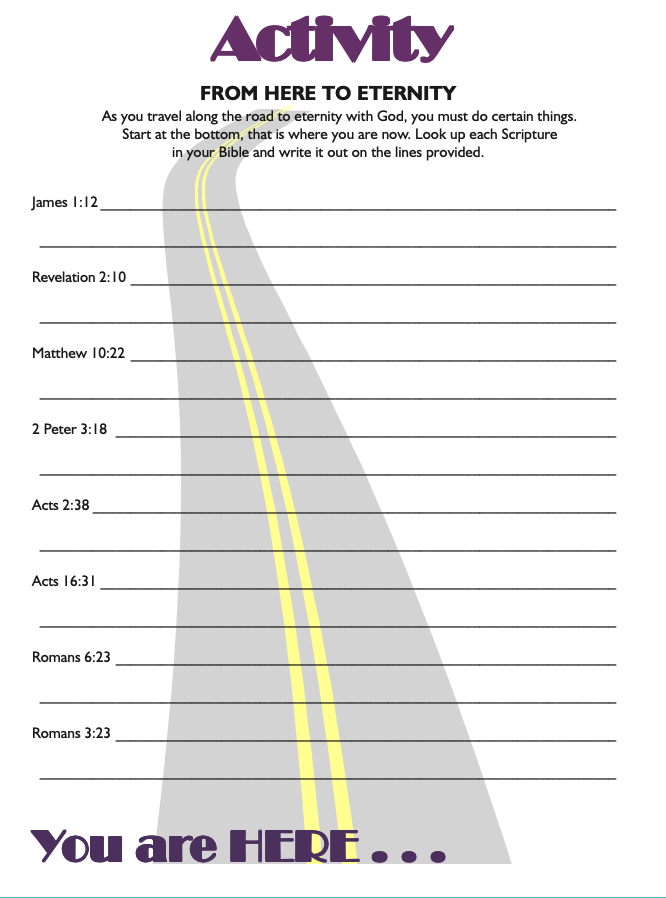
Now we’re back to the same question the young man asked Jesus. What must you do to have eternal life? On the first Pentecost after Jesus ascended into heaven, the people asked Peter this same question. Peter said, “Each one of you must turn from sin, return to God, and be baptized in the name of Jesus Christ for the forgiveness of your sins; then you also shall receive this gift, the Holy Spirit” (Acts 2:38 TLB). What does it mean to repent of your sins? “Sin is the transgression of the law” (I John 3:4). It means being very sorry for breaking God’s law and doing your best not to sin again.
The rich man’s money was more important to him than God was. And remember, the very First Commandment says you can’t put another god before Him. This man wasn’t willing to repent of breaking God’s law. Yet, all of the rich man’s money couldn’t gain him eternal life. All of Princess Di’s beauty, wealth, and good deeds couldn’t give her eternal life either. Jesus came that you might have eternal life. He gave His life that you might have forgiveness of your sins. But you must repent of your sins and be baptized to receive God’s Spirit. And then you can share God’s wealth in His Kingdom for all eternity.
God owns everything and He wants to share it with you. What he has far exceeds all that Princess Di and the rich young ruler had if they were put together. Now you know the way to have eternal life. But you must do those things that are required of you to enter into eternal life. Your reward couldn’t be greater if you will just follow Christ’s instruction. But From Here to Eternity depends on what you do about it.
Dear Father,
Please help me to realize how important it is to put you first in my life. Help me to never put money, the opinions of my peers, or anything before doing what you say. Eternal life with you far surpasses anything in this world. Thank you for that hope. Help me to take the necessary steps to have it.
In Jesus’ name.
Amen.
Sunday: Mark 10:17-31
Monday: Luke 18:18-30
Tuesday: Luke 21:1-4
Wednesday: Matthew 6:19-21
Thursday: Luke 12:31-34
Friday: Matthew 13:44-51
Saturday: Colossians 2:1-7
2 Chronicles 7:1-14
Psalm 55:15-23
Isaiah 59:1-14
Matthew 7:7
Matthew 7:7-11
Luke 11:1-13
Luke 18:1-8
Romans 12:1-13
Colossians 1:7-10
I Thes. 5:14-28
PERSPECTIVE - one’s mental view of facts, ideas, etc., and their interrelationships
VULNERABLE - defenseless, open to assault, difficult to defend, capable of being hurt physically or emotionally
VICTIM - a person who is deceived or cheated
The magic moment came as Mark McGwire stepped up to the batters’ box. Great anticipation filled the stands as everyone waited to see if Mark would hit his 62nd home run in one season, triumphing over both Babe Ruth’s and Roger Maris’ records. The pitcher threw the ball over home plate. Mark swung and hit the ball. Yes! Yes! Yes! It was a home run. The crowd quickly came to its feet to give him a standing “O.” What a thrill! Another equally exciting moment came within days of this as Sosa hit 62 home runs with 12 games left in the season. McGwire finally hit 70 home runs in the 1998 baseball season with Sosa only four homers behind.
“McGwire’s 62nd home run was only a 341 foot drive, his shortest for the season. Fearsome power was generated by his swing, his moon shots were inspiring. For all the controversy over how he got so big and muscled, it counted the same as 61 home runs that preceded it.
“If all of those home runs were stretched end to end, like lengths of rope, the distance would be impressive. Even more impressive is that McGwire understood the real trick was binding them together” (AP). We don’t know how many times McGwire struck out before he passed Babe Ruth’s and Roger Maris’ records. But we do know that he did not become disheartened. He went back to the batters’ box time and again, determined to hit another home run.
But what does this story have to do with your Bible lesson? A day came when Jesus sat down and told His disciples a story to show the importance of not becoming disheartened and giving up when their prayers weren’t answered. This is how the story goes.
A widow had no family as a support group. This made her very helpless and vulnerable. But the one thing she had in her favor was her unwillingness to give up until her mission was accomplished. She frequently appealed for justice against a man who had harmed her. A godless judge, who had great contempt for everyone, was to hear her case. But he ignored this widow lady. Without a single family member to bolster her, she didn’t play the victim. She didn’t let this godless judge intimidate her either. She didn’t become disheartened. And she hung in there. Repeatedly, she went back to the judge and appealed her case until she eventually got on his nerves.
“‘I fear neither God nor man,’ he said to himself, ‘but this woman bothers me. I’m going to see that she gets justice, for she is wearing me out with her constant coming!’” (Luke 18:5 TLB).
It really didn’t matter to this judge or change his judgment if the poor, helpless widow lady was right or wrong. He was godless, unjust and wouldn’t even listen. But God is just the opposite of this judge. He is merciful and compassionate and eager to hear your prayers. He wants to give you your request when it is right and best for you.
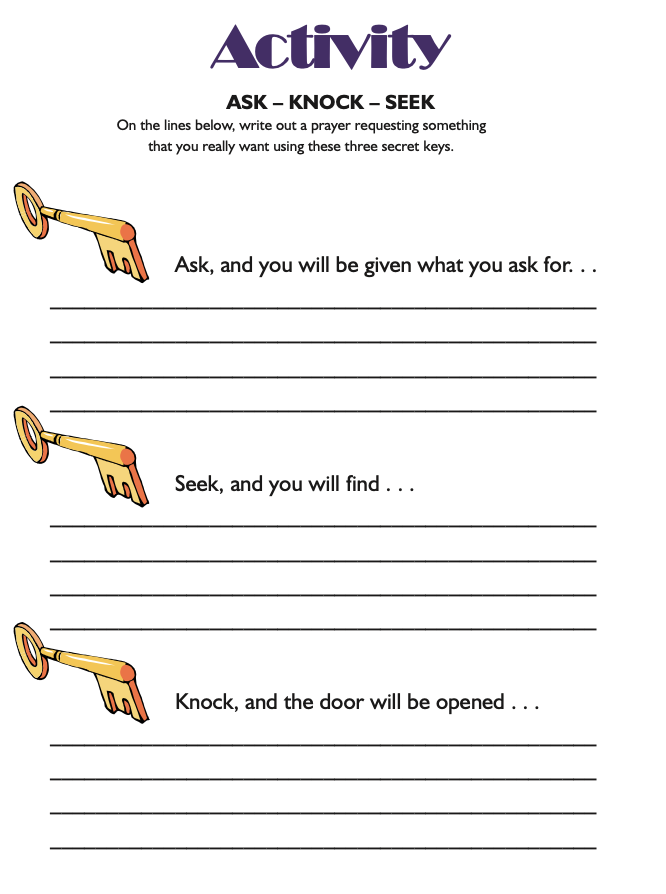
The point of the story Jesus told is that you should not give up praying for something until you get an answer. He was telling His disciples that they can’t expect an answer if they don’t ask. But asking may not be enough. They may have to seek. How do you seek? Has your dog ever hid its bone where it was unable to get it – maybe under the couch? What does the dog do? It sniffs, smells, paws, and tries to get your help. We may need to act a little like the dog trying to retrieve his bone when we don’t get an answer to our prayers.
Jesus also told the disciples the reason why you have to knock. Matthew 7:7 says, “Ask and it will be given to you, seek and you will find; knock and the door will be opened to you. Everyone who asks receives; he who seeks finds; and to him who knocks, the door will be opened.” He used the word “door” here to mean a way. So if you haven’t received an answer after asking and seeking, be persistent. Perhaps a way will open up for your prayer to be answered.
Jesus continues with His story using a father and son as an example. If a hungry child goes to his dad and says, “Dad, I’m hungry.” A loving dad isn’t going to give the child a stone to eat. If the child asks for a fish, his father is not going to give him a snake. If you had a child would you be cruel to it? Our Heavenly Father is gracious, generous, kind, loving, and perfect. He’s certainly not going to withhold the things from you that are good for you.
Does this mean that God is going to see to it that you get every frivolous whim? Of course not! There’s another piece to this puzzle under the three secret keys above – ask, seek, and knock. After you ask God for something, seek His will in the matter. After all, He’s been around a lot longer than your 12-15 years. So He sees things from a different perspective.
Go to God in prayer and seek His will. Ask Him if the things you are asking for will really be good for you. Tell Him that He sees things from the perspective of all eternity. He has an advantage that you don’t have. Ask Him if there may be reasons you should not be granted your request because it might harm you or someone else. Keep going back to God, and Ask - Seek - Knock until your answer comes. Don’t give up. Hang in there. That’s what the knocking is all about (read Luke 11:5- 6). Remember neither the widow lady nor Mark McGwire became disheartened because they didn’t get what they wanted the first time they tried.
Keep on asking, seeking, and knocking. God will give you what is best for you. Never forget, that not even the unjust judge could resist giving justice to the widow lady when she persisted.
Awesome Father,
You are so wonderful to give me so much hope! I’ve learned that the widow lady didn’t play the victim even though she was being cheated out of justice. She persisted until the unjust judge heard her. Help me to persist in prayer as the widow lady did with the judge.
In the name of Jesus Christ I pray.
Amen.
Sunday: Psalm 55:15-23
Monday: 2 Chronicles 7:1-14
Tuesday: Isaiah 59:1-14
Wednesday: I Thessalonians 5:14-28
Thursday: Luke 18:1-8
Friday: Romans 12:1-13
Saturday: Colossians 1:7-10
Psalm 34:1-21
Psalm 37:6-22
Psalm 128:1-2
Isaiah 57:15-21
Isaiah 61:1-11
Matthew 5:1-12
Matthew 5:6-8
Luke 1:46-55
Romans 12:18-21
Romans 14:14-19
2 Timothy 3:15-16
REVERENCE - a feeling of awe and respect.
REVILE - to criticize angrily in abusive language.
Most teenagers can’t wait for their first car. It means more to them than just transportation. It symbolizes freedom, independence, and a more adult status in the world. They think having a driver’s license and their own car will make them live happily ever after.
But how many teenagers know how a car works? Would you know how to maintain your car by changing the oil regularly, checking the tire pressure, and keeping the fluids at their proper levels?
Mark had just finished Driver’s Ed and passed his test. With license in hand, he approached his parents about getting a car. After discussing it, they told him that if he did the research and could find a good car at a reasonable price, they would buy it. But he would have to pay for the car insurance and maintenance out of his own pocket.
Mark, an eager teenager, sounded like a potential buyer when he phoned the man about the car in his front yard with a for sale sign on it. Mark just happened to be in the market for his first car.
The car turned out to be a good buy. While the family’s mechanic took a couple of days to look everything over and replace the hoses, its proud new owner spent some quality time with the manual. The owner’s manual taught him all he would need to know about the electrical system, how to tune the car, and how fast it should be driven in each gear. It also told him how to check the tire pressure, how often to replace the oil, and how to change a flat tire. There wasn’t anything he needed to know about that car that wasn’t in the owner’s manual.
Have you ever thought about how the Bible is the same way? Everything the human race will ever need to know about how to live a happy and successful life is found in this owner’s manual. Many people go about their lives searching for fulfillment without ever considering the words in this book. Some look for fulfillment in drugs or illicit sex. Others think happiness can be found by having an abundance of stuff. But the wisest man who ever lived, Solomon, had more expensive stuff than a man could want. He wrote the entire book of Ecclesiastes. In it he shows that you can’t find happiness in a lot of stuff – no matter how much or how cool it is. There is no happiness apart from God.
Jesus knew that people yearned for happiness. When He walked the earth, many of His teachings were meant to help people find happiness and satisfaction with life. Once, when He took His disciples up on a hillside, Jesus gave them the key ingredients to having a happy life. This is what He told them.
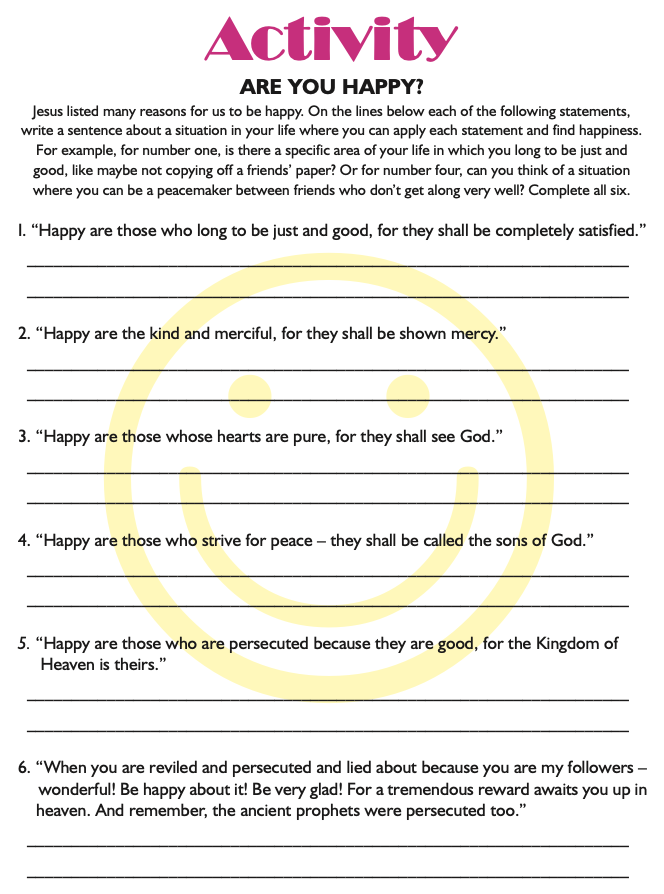
Those who humble themselves will be happy because they will be in God’s Kingdom. Those who mourn are blessed, for they will be comforted. The meek and lowly will inherit the earth.
“Happy are those who long to be just and good, for they shall be completely satisfied. Happy are the kind and merciful, for they shall be shown mercy. Happy are those whose hearts are pure, for they shall see God. Happy are those who strive for peace – they shall be called the sons of God. Happy are those who are persecuted because they are good, for the Kingdom of Heaven is theirs.
“When you are reviled and persecuted and lied about because you are my followers – wonderful! Be happy about it! Be very glad! For a tremendous reward awaits you up in heaven. And remember, the ancient prophets were persecuted too” (Matthew 5:11TLB).
Wow! What a statement! You mean I’m supposed to be happy when I’m reviled, persecuted, lied about, and made fun of for my religion? That’s what the Good Book says. But why should you be happy? It’s because you’ll have a tremendous reward that Jesus will bring with Him when He returns.
Happiness isn’t something that depends on what grades you make, what position you play on your sports team, or even how other people treat you. Happiness comes from a positive state of mind. It comes from knowing that God is with you and He wants to help make you a winner. If you are reading this lesson now, then you have been blessed with an opportunity that many people miss as a teenager, an opportunity for true happiness.
Just as the Apostle Paul wrote to the young man Timothy, “When you were a small child, you were taught the holy Scriptures; and it is these that make you wise to accept God’s salvation by trusting in Christ Jesus” (2 Timothy 3:15 TLB). You can’t truly be happy if you’re always making wrong decisions and suffering the consequences from your bad choices. God laid out in His Word what are the right and wrong choices. If you want to live happily ever after, it’s up to you to make right choices.
Chances are, you have heard a lot about the importance of obeying God and respecting Him. But did you know that if you’ll obey God and respect His law, there’s some really cool stuff in it for you too? When you respect and obey God, He promises to bless you with prosperity and make you happier than you could ever imagine. “Blessings on all who reverence and trust the Lord – on all who obey him! Their reward shall be prosperity and happiness” (Psalm 128:1-2). You can live happily ever after, but you must live what is in the book.
Great Father,
Thank you for showing us how to be happy. There are many things in this world to make us sad and depressed, but by following the instructions Jesus gave, I know I can live happily ever after.
In Jesus’ name.
Amen.
Sunday: Psalm 34:1-21
Monday: Isaiah 57:15-21
Tuesday: Psalm 37:6-22
Wednesday: Luke 1:46-55
Thursday: Isaiah 61:1-11
Friday: Romans 12:18-21
Saturday: Romans 14:14-19
Matthew 5:17-20
Matthew 13:3-9
Matthew 13:18-23
Matthew 28:18-20
Mark 4:1-20
Mark 16:15-20
Luke 8:4-8
Luke 8:11-15
Hebrews 4:1-9
Hebrews 12:1
BROADCAST - in the context of broadcasting seed, the meaning is to scatter them widely over an area.
A 40 year-old school teacher wanted to be- come a jogger and run the 26-mile Boston Marathon, shown in the TV drama “See How She Runs.” To some people, she seemed a little old to run this Marathon for the first time. People ridiculed and jeered her. But that didn’t stop her. She continued to train for the race and was strongly motivated to finish it. All participants were at the starting line when the gun was fired and the race began. The school teacher paced herself to make sure she really would see the finish line. Her feet began to hurt as she developed huge blisters on them. Then she was hit by a bicycle. But she kept on running. The worst kind of exhaustion hopelessly engulfed her body and it seemed almost impossible to continue. By this time some joggers had already finished and others had given up. But as difficult as it was, she kept on putting one foot in front of another.
Eventually, the 26 mile Marathon was more than her body was trained to run. She fell flat on her face, unable to get up. As her friends cheered her on, she raised her head enough to see that the finish line was in sight. She focused in on her goal to finish the Marathon. Exhausted but determined and with great effort and courage, she managed to get on her bleeding feet once again. She found some energy left in her body and ran the last few yards to the finish line. This teacher’s desire was so deep that adversity, jeering, and ridicule could not cause her to drop out of the race.
Whether we’re trained or not, we’re in a more important race. Jesus warned a crowd of His followers not to lose their enthusiasm and drop out of the race to become one of His very own children. He told us about it in this parable.
A farmer broadcasted his seeds over a field. Some fell beside a path, and the birds came and ate them. Some fell on rocky ground with shallow soil. These seeds came up quickly, but the plants didn’t have a good root system. The hot sun was too much for these weak, tender plants and they withered and died.
Other seeds fell among thorns which choked out the young plants before they produced any fruit. Then some of the seeds fell on rich soil and produced a good crop of 30, 60, and even 100 times as much as the farmer planted. Jesus pointed out to His disciples that the wise would pay very close attention to this parable and try to understand exactly what He meant.
To ensure that we do understand, He gave the keys to unlocking this parable beginning in Matthew 13:18. The ground along the path was hard. This first key is symbolic of the hearts of people who hear the good news about God’s plan to bring us into His Kingdom. But many people don’t understand and appreciate how important this is. They don’t know their Bible. They don’t spend time praying to establish an intimate relationship with God. They don’t pay close attention as Jesus said to do. This leaves them vulnerable to Satan. And guess what? Satan comes along and distracts them from God’s way of life and he snatches away the seed God planted in their hearts.
The second key is that the shallow, rocky soil represents Christians who hear God’s plan in such places as church, at Sabbath School, or on the Born to Win radio program. When they hear it, it makes sense. They are glad to learn about God’s plan. But unfortunately, these people aren’t highly motivated. They have no depth of understanding. They don’t have a burning desire to finish the race as the 40 year-old teacher had. They consider going to the mall, watching TV, going to the movies, or just hanging out to be more important than Bible study. They haven’t captured the vision that a deep, personal relationship with God through prayer can help their race.
So after a while, trouble sets in. They may be jeered and ridiculed for keeping the Sabbath or not keeping Christmas. They want to be like their peers. Their enthusiasm fades and they drop out of Sabbath School and church. When their feet have blisters and are bleeding they don’t have what it takes to get up and try it again.
The third key is understanding the part of the parable about the ground being covered with thorns and thistles. This represents Christians who hear the Word of God and start attending Sabbath School and church services. But the recurring desire for physical things and the approval of their peers are so important to them that they allow God’s Word to be choked out. Their relationship with God begins to diminish.
Not all of these keys are about the wrong kinds of things Christians do. The fourth key tells us about seeds that are sown on good ground. This good ground symbolizes the hearts of Christians who listen closely to sermons and Sabbath School lessons. They respond enthusiastically. They want to learn more about God and follow Him carefully. And they even go out and tell others about God and His plan. They sets goals to bring others to Sabbath School and to church. They pray daily and read their devotional Bible readings. They look for opportunities to help the less fortunate. This type of Christian will help 30, 60, or even 100 people find their way to Christ and His Kingdom.
Jesus gave us this parable to make us fully aware of how important it is for us to take our calling seriously. He wants us to understand that pain, adversity, peer pressure, money, or physical things should never deter us from keeping our eyes on the goal. He wants us to know that it’s not how we start the race that counts. Like the 40 year-old school teacher, we must be motivated to do what it takes to make it over the finish line. And we must bring others over that finish line with us.
Father,
Thank you so much for giving us such awesome instructions in this parable. If the 40 year- old school teacher can keep on going when she has bleeding blisters on her feet, and is jeered and ridiculed, so can I. Help my spiritual roots to grow deeper.
In Jesus’ name.
Amen.
Sunday: Mark 4:1-20
Monday: Luke 8:11-15
Tuesday: Hebrews 4:1-9
Wednesday: Matthew 28:18-20
Thursday: Mark 16:15-20
Friday: Matthew 5:17-20
Saturday: Luke 8:4-8
Genesis 2:1-3
Exodus 16:2-31
Exodus 20:8-11
Exodus 31:13-14
Isaiah 58:13-14
Matthew 12:10-12
Mark 2:27
Mark 3:1-6
Luke 13:10-17
John 9:1-14
BONDAGE - bound by some external control.
HYPOCRITE - a person acting like someone or something that he really isn’t.
MIRACULOUS - performed by or involving a super- natural power.
SKEPTIC - a person who questions the truth of something, especially religion.
In the movie Chariots of Fire, Eric Liddle, a young Scottish boy, ran the 100 yard dash in the Olympics held in Paris, France in 1924. He didn’t understand that Saturday is the Sabbath, but he firmly believed that Sunday was a day of rest. The fame, the glory, and a gold medal were at stake if he didn’t run on Sunday. But his conviction to rest on Sunday was so strong that he refused to do it. He trusted God for the outcome. His peers chided him for refusing to run on Sunday. One asked, “Why don’t you go be a missionary rather than running in the Olympics?” Eric answered, “I believe God. God made me fast; when I run I feel His pleasure.”
In the end, this Scottish lad won the 100 yard dash, he won the gold medal, and he won the respect of his competitors. After the race was finished another runner handed him a card that said, “He who honors me will I honor” (I Samuel 2:30).
Even though this Olympic gold medalist didn’t understand that Saturday is the Sabbath, he did understand that God commands us to rest one day each week and to keep it holy. He mistakenly assumed that Sunday was the Sabbath. He also firmly believed that it was more important to obey God even if it meant that he had to risk not getting a gold medal. This Scottish boy passed the test! In the end, he turned out to be a real winner.
A month after God miraculously brought the children of Israel out of Egypt, they began to gripe and complain about their food situation. They accused Moses and Aaron of bringing them into the wilderness to let them starve to death. God said, “Okay, I’ll give the Israelites a test.” He said He would rain down food from heaven. Everyone could gather as much manna as they needed six days out of the week, and on Friday, they were to gather twice as much. He warned them if they kept the food overnight, it would stink and be full of maggots. But He made an exception for the food they gathered on Friday. The Israelites were to keep the food they didn’t eat on Friday for their meals on the Sabbath. He assured them that it wouldn’t have worms and it wouldn’t stink.
Rebels and skeptics are always around, and this was no exception. They went out on the Sabbath to gather manna, but there was no food to be found. Even though God gave this wonderful miracle with specific instructions, some people didn’t pass the test.
There were skeptics around when Jesus was teaching in the synagogue on the Sabbath. A seriously handicapped woman had been bent double for 18 years and couldn’t straighten up. Jesus called the woman over, laid His hands on her and told her that she was healed. She was instantly able to stand up straight. To be able to stand up straight was such a wonderful thing that she praised and thanked God.
The local leader of the synagogue didn’t like that Jesus healed on the Sabbath and was very angry about it. “‘There are six days of the week to work,’ he shouted to the crowd. ‘Those are the days to come for healing, not on the Sabbath.’”
This fellow didn’t pass the test and Jesus knew it; he was a hypocrite! Jesus said, “You work on the Sabbath! Don’t you untie your cattle from their stalls on the Sabbath and lead them out for water? And is it wrong for me, just because it is the Sabbath day, to free this Jewish woman from the bondage in which Satan has held her for eighteen years?” (Luke 13:15- 16 TLB). Jesus put an end to that kind of hypocrisy and all of the people rejoiced at the wonderful thing He had done. The Sabbath was a great day for this woman who was healed, and for all of the people who witnessed it.
God also wants it to be the best day of the week for you. Mark 2:27 says that God made the Sabbath for man. He made it to make our lives better. You can sleep in and get additional rest on the Sabbath. You can feel liberated from having to work that one day each week. Man needs a day of rest.
Eric Liddle rested on Sunday and still got a gold medal. But he wasn’t the only one who will get a reward for passing the test. If you keep the Sabbath as God intends you to do, look at what your reward will be for passing the test.
“If you keep the Sabbath holy, not having your own fun and business on the day, but enjoying the Sabbath and speaking of it with delight as the Lord’s holy day, and honoring the Lord in what you do, not following your own desires and pleasure, nor talking idly – then the Lord will be your delight, and I will see to it that you ride high, and get your full share of the blessing I promised to Jacob, your father. The Lord has spoken” (Isaiah 58:13-14 TLB).
Lord of the Sabbath,
Thank you for giving us the gift of the Sabbath day. We need time to rest, to do good to others as Jesus did, and to spend time with you in prayer, Bible study, and meditation. Help me always to stand the test and be a winner in your sight.
In Jesus’ name I pray.
Amen.
Sunday: Genesis 2:1-3
Monday: Exodus 16:4-31
Tuesday: Exodus 31:13-14
Wednesday: Isaiah 58:13-14
Thursday: Matthew 12:10-12
Friday: Mark 3:1-6
Saturday: John 9:1-14