YEA Lesson Library
Test Day
About This Lesson
This lesson teaches the importance of persevering in keeping the Sabbath holy.
Scriptures
Genesis 2:1-3
Exodus 16:2-31
Exodus 20:8-11
Exodus 31:13-14
Isaiah 58:13-14
Matthew 12:10-12
Mark 2:27
Mark 3:1-6
Luke 13:10-17
John 9:1-14
Words to Know
BONDAGE - bound by some external control.
HYPOCRITE - a person acting like someone or something that he really isn’t.
MIRACULOUS - performed by or involving a super- natural power.
SKEPTIC - a person who questions the truth of something, especially religion.
The Lesson
In the movie Chariots of Fire, Eric Liddle, a young Scottish boy, ran the 100 yard dash in the Olympics held in Paris, France in 1924. He didn’t understand that Saturday is the Sabbath, but he firmly believed that Sunday was a day of rest. The fame, the glory, and a gold medal were at stake if he didn’t run on Sunday. But his conviction to rest on Sunday was so strong that he refused to do it. He trusted God for the outcome. His peers chided him for refusing to run on Sunday. One asked, “Why don’t you go be a missionary rather than running in the Olympics?” Eric answered, “I believe God. God made me fast; when I run I feel His pleasure.”
In the end, this Scottish lad won the 100 yard dash, he won the gold medal, and he won the respect of his competitors. After the race was finished another runner handed him a card that said, “He who honors me will I honor” (I Samuel 2:30).
Even though this Olympic gold medalist didn’t understand that Saturday is the Sabbath, he did understand that God commands us to rest one day each week and to keep it holy. He mistakenly assumed that Sunday was the Sabbath. He also firmly believed that it was more important to obey God even if it meant that he had to risk not getting a gold medal. This Scottish boy passed the test! In the end, he turned out to be a real winner.
A month after God miraculously brought the children of Israel out of Egypt, they began to gripe and complain about their food situation. They accused Moses and Aaron of bringing them into the wilderness to let them starve to death. God said, “Okay, I’ll give the Israelites a test.” He said He would rain down food from heaven. Everyone could gather as much manna as they needed six days out of the week, and on Friday, they were to gather twice as much. He warned them if they kept the food overnight, it would stink and be full of maggots. But He made an exception for the food they gathered on Friday. The Israelites were to keep the food they didn’t eat on Friday for their meals on the Sabbath. He assured them that it wouldn’t have worms and it wouldn’t stink.
Rebels and skeptics are always around, and this was no exception. They went out on the Sabbath to gather manna, but there was no food to be found. Even though God gave this wonderful miracle with specific instructions, some people didn’t pass the test.
There were skeptics around when Jesus was teaching in the synagogue on the Sabbath. A seriously handicapped woman had been bent double for 18 years and couldn’t straighten up. Jesus called the woman over, laid His hands on her and told her that she was healed. She was instantly able to stand up straight. To be able to stand up straight was such a wonderful thing that she praised and thanked God.
The local leader of the synagogue didn’t like that Jesus healed on the Sabbath and was very angry about it. “‘There are six days of the week to work,’ he shouted to the crowd. ‘Those are the days to come for healing, not on the Sabbath.’”
This fellow didn’t pass the test and Jesus knew it; he was a hypocrite! Jesus said, “You work on the Sabbath! Don’t you untie your cattle from their stalls on the Sabbath and lead them out for water? And is it wrong for me, just because it is the Sabbath day, to free this Jewish woman from the bondage in which Satan has held her for eighteen years?” (Luke 13:15- 16 TLB). Jesus put an end to that kind of hypocrisy and all of the people rejoiced at the wonderful thing He had done. The Sabbath was a great day for this woman who was healed, and for all of the people who witnessed it.
God also wants it to be the best day of the week for you. Mark 2:27 says that God made the Sabbath for man. He made it to make our lives better. You can sleep in and get additional rest on the Sabbath. You can feel liberated from having to work that one day each week. Man needs a day of rest.
Eric Liddle rested on Sunday and still got a gold medal. But he wasn’t the only one who will get a reward for passing the test. If you keep the Sabbath as God intends you to do, look at what your reward will be for passing the test.
“If you keep the Sabbath holy, not having your own fun and business on the day, but enjoying the Sabbath and speaking of it with delight as the Lord’s holy day, and honoring the Lord in what you do, not following your own desires and pleasure, nor talking idly – then the Lord will be your delight, and I will see to it that you ride high, and get your full share of the blessing I promised to Jacob, your father. The Lord has spoken” (Isaiah 58:13-14 TLB).
Student Prayer
Lord of the Sabbath,
Thank you for giving us the gift of the Sabbath day. We need time to rest, to do good to others as Jesus did, and to spend time with you in prayer, Bible study, and meditation. Help me always to stand the test and be a winner in your sight.
In Jesus’ name I pray.
Amen.
Daily Devotions
Sunday: Genesis 2:1-3
Monday: Exodus 16:4-31
Tuesday: Exodus 31:13-14
Wednesday: Isaiah 58:13-14
Thursday: Matthew 12:10-12
Friday: Mark 3:1-6
Saturday: John 9:1-14
Objectives
At the end of this lesson, students will be able to:
1. Explain that others have faced similar problems in keeping the Sabbath and they passed the test.
2. Discuss that the miracle God performed to feed Israel in the wilderness shows that the Sabbath is not just any day out of seven, but a specific day of the week.
3. Think in terms of celebrating the Sabbath as laid out in Isaiah 58:13-14 rather than focusing on the physical things they can’t do.
Topics & Themes
Jesus, His Ministry
Jesus, His Miracles
Healing
Manna
Rest
Reward
Sabbath
How to Teach This Lesson
After you open the class with prayer, give each student a 3 x 5 card and ask them to write a situation they face or have faced in keeping the Sabbath. Ask them not to put their names on the cards. After they finish, pick up the cards. Now have the class vote on two or three students to form a panel. Give the cards to the panel. Have one person read the situation and let the panel make suggestions about how it could be handled.
Debrief - Ask: What have your peers and friends said about your keeping the Sabbath? (Allow students to express their thoughts and even frustrations about having to keep the Sabbath. Don’t criticize them. Be very sensitive to the situation. Sometimes it may be best not to interfere, or even offer counsel unless it is asked for. In other situations, it may be wise for you to take the initiative. But let your class know that you understand their difficult situation and that you’re always there to support them with your prayers, counsel, and love.) Ask: How did you feel? What do you think is the best way to handle it when someone wants you to play ball or go to a movie on the Sabbath?
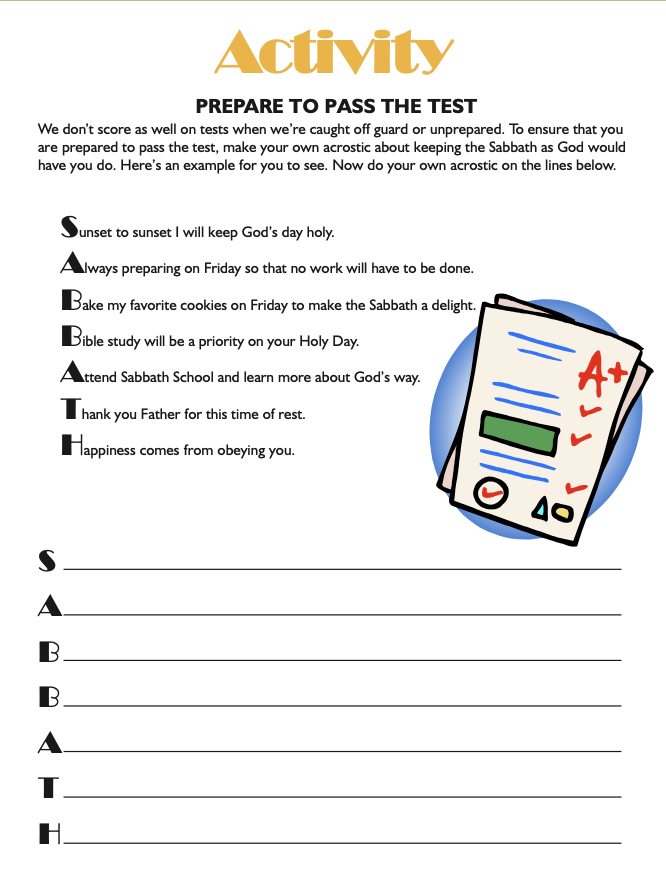
Student Activity - Let’s look at the acrostic in your Students’ books and see if we can find help and encouragement from our Christian friends faced with the same problem. Encourage students to read the acrostic they wrote. Give positive reinforcement to each one after they have read it.
Gold medal - How do you think Eric felt when one of his peers asked, “Why don’t you go be a missionary rather than running in the Olympics?” How would you have felt if your friends had asked you a question like that? How did you feel about Eric’s response? Who can tell us what the statement, “turn lemons into lemonade” means? Eric turned lemons into lemonade when he said, “I believe God. God made me fast, when I run I feel His pleasure.” What was Eric’s reward for not running on his Sabbath?
Skeptics broke the Sabbath - When God gave manna in the wilderness He instructed the Israelites that there wouldn’t be any on the Sabbath. Ask: Who didn’t obey Him? What were the consequences to those people who didn’t obey God and gathered twice as much on Friday? (They probably had to go hungry.) Why do you think God instructed the Israelites to gather twice as much on Friday? (To prepare for the Sabbath so they wouldn’t have to work on it.) Ask one of the students to read Exodus 16:23 aloud. How do we apply this in our lives today?
How did Jesus Keep the Sabbath? - Say: Rebels and skeptics are always around and Jesus had them as well. Ask: How did the people react when He healed the handicapped woman on the Sabbath? Why wasn’t this wrong? Ask one of the students to read Matthew 12:12 aloud. How can we fill the Sabbath with doing so many good things that we don’t have to feel sorry for ourselves because of the things we can’t do? How would it change your attitude toward the Sabbath if you thought in terms of celebrating the Sabbath rather than what you can’t do? How can you celebrate it?
Our reward - Ask: Is keeping the Sabbath worth it? Ask a student to read Isaiah 58:13-14 in The Living Bible.
Teacher-Directed Activity
The activity is the panel discussion that is part of the lesson.
REACH Activity
Memory Verse Spotlight
How does your memory verse relate to the Sabbath day? Write the verse in your Bible notebook. When did you first observe the Sabbath? In your Bible notebook write down the approximate date and explain what happened on that day. For example where did you go and with whom?
Where in the World?
Use Exodus 16:2-30 as the basis for a mural, comic strip, song, or play/skit. Include Scriptures and maps in your project from other related Scriptures. Share your project with another YEA class.
They Did What Back Then?
Begin research (who, what, when, where, how, and why) on the Sabbath, or seventh day. Scriptures can be any reference to those who observed the Sabbath as well as its purpose. One suggestion is to use assorted ruled index cards, with one set including four different colors. In that case combine what and how, and when and where. Use supplies that best showcase your information. Use your research to teach a younger YEA class about the Sabbath.
Making It Mine
There are so many pressures on Christians to abandon God. Some are obvious and extreme. Some are insidious; they creep up on you unawares. Celebrating the Sabbath from Friday sundown to Saturday sundown is challenged by our society both blatantly and craftily. Are you under pressure from your peers, your coach, your school, relatives, etc. to not keep the Sabbath holy? If you are feeling some pressure, you can bet the rest of your family is too. So make time to have a family meeting this week. Talk about what you want to do to make the Sabbath special each week. Talk about how you can work together as a family to encourage each other to truly rest and worship on the Sabbath. Write these ideas down. Select the ones which are truly doable. Then make every effort this Friday evening to bring the Sabbath in as a holy day with your family.
Worldview Collision
A biblical worldview says to obey God’s commandments, including “Remember the Sabbath day to keep it holy.” Other worldviews say it’s okay to rest when you need to, but don’t let resting keep you from doing what needs to be done or from pursuing what brings you pleasure or money. One view is eternal; one view is temporal. Which one will last? In your Bible notebook, chart the pros and cons of Sabbath observance. Do it for yourself, so that the next time someone tries to tempt you away from worshiping God, you’ll already be convinced in your own mind of what you should do.
Song
“I Will Celebrate” is on page 49 of The Group Songbook.
Closing Prayer
Have the students form a circle and join hands. Ask for a volunteer to lead in prayer asking for God’s help in pleasing Him with our Sabbath celebrations.
Printable Pages