YEA Lesson Library
It’s Not How You Start
About This Lesson
Using the parable of the seeds, this lesson teaches the importance of perseverance in seeking God and a close relationship with Him.
Scriptures
Matthew 5:17-20
Matthew 13:3-9
Matthew 13:18-23
Matthew 28:18-20
Mark 4:1-20
Mark 16:15-20
Luke 8:4-8
Luke 8:11-15
Hebrews 4:1-9
Hebrews 12:1
Words to Know
BROADCAST - in the context of broadcasting seed, the meaning is to scatter them widely over an area.
The Lesson
A 40 year-old school teacher wanted to be- come a jogger and run the 26-mile Boston Marathon, shown in the TV drama “See How She Runs.” To some people, she seemed a little old to run this Marathon for the first time. People ridiculed and jeered her. But that didn’t stop her. She continued to train for the race and was strongly motivated to finish it. All participants were at the starting line when the gun was fired and the race began. The school teacher paced herself to make sure she really would see the finish line. Her feet began to hurt as she developed huge blisters on them. Then she was hit by a bicycle. But she kept on running. The worst kind of exhaustion hopelessly engulfed her body and it seemed almost impossible to continue. By this time some joggers had already finished and others had given up. But as difficult as it was, she kept on putting one foot in front of another.
Eventually, the 26 mile Marathon was more than her body was trained to run. She fell flat on her face, unable to get up. As her friends cheered her on, she raised her head enough to see that the finish line was in sight. She focused in on her goal to finish the Marathon. Exhausted but determined and with great effort and courage, she managed to get on her bleeding feet once again. She found some energy left in her body and ran the last few yards to the finish line. This teacher’s desire was so deep that adversity, jeering, and ridicule could not cause her to drop out of the race.
Whether we’re trained or not, we’re in a more important race. Jesus warned a crowd of His followers not to lose their enthusiasm and drop out of the race to become one of His very own children. He told us about it in this parable.
A farmer broadcasted his seeds over a field. Some fell beside a path, and the birds came and ate them. Some fell on rocky ground with shallow soil. These seeds came up quickly, but the plants didn’t have a good root system. The hot sun was too much for these weak, tender plants and they withered and died.
Other seeds fell among thorns which choked out the young plants before they produced any fruit. Then some of the seeds fell on rich soil and produced a good crop of 30, 60, and even 100 times as much as the farmer planted. Jesus pointed out to His disciples that the wise would pay very close attention to this parable and try to understand exactly what He meant.
To ensure that we do understand, He gave the keys to unlocking this parable beginning in Matthew 13:18. The ground along the path was hard. This first key is symbolic of the hearts of people who hear the good news about God’s plan to bring us into His Kingdom. But many people don’t understand and appreciate how important this is. They don’t know their Bible. They don’t spend time praying to establish an intimate relationship with God. They don’t pay close attention as Jesus said to do. This leaves them vulnerable to Satan. And guess what? Satan comes along and distracts them from God’s way of life and he snatches away the seed God planted in their hearts.
The second key is that the shallow, rocky soil represents Christians who hear God’s plan in such places as church, at Sabbath School, or on the Born to Win radio program. When they hear it, it makes sense. They are glad to learn about God’s plan. But unfortunately, these people aren’t highly motivated. They have no depth of understanding. They don’t have a burning desire to finish the race as the 40 year-old teacher had. They consider going to the mall, watching TV, going to the movies, or just hanging out to be more important than Bible study. They haven’t captured the vision that a deep, personal relationship with God through prayer can help their race.
So after a while, trouble sets in. They may be jeered and ridiculed for keeping the Sabbath or not keeping Christmas. They want to be like their peers. Their enthusiasm fades and they drop out of Sabbath School and church. When their feet have blisters and are bleeding they don’t have what it takes to get up and try it again.
The third key is understanding the part of the parable about the ground being covered with thorns and thistles. This represents Christians who hear the Word of God and start attending Sabbath School and church services. But the recurring desire for physical things and the approval of their peers are so important to them that they allow God’s Word to be choked out. Their relationship with God begins to diminish.
Not all of these keys are about the wrong kinds of things Christians do. The fourth key tells us about seeds that are sown on good ground. This good ground symbolizes the hearts of Christians who listen closely to sermons and Sabbath School lessons. They respond enthusiastically. They want to learn more about God and follow Him carefully. And they even go out and tell others about God and His plan. They sets goals to bring others to Sabbath School and to church. They pray daily and read their devotional Bible readings. They look for opportunities to help the less fortunate. This type of Christian will help 30, 60, or even 100 people find their way to Christ and His Kingdom.
Jesus gave us this parable to make us fully aware of how important it is for us to take our calling seriously. He wants us to understand that pain, adversity, peer pressure, money, or physical things should never deter us from keeping our eyes on the goal. He wants us to know that it’s not how we start the race that counts. Like the 40 year-old school teacher, we must be motivated to do what it takes to make it over the finish line. And we must bring others over that finish line with us.
Student Prayer
Father,
Thank you so much for giving us such awesome instructions in this parable. If the 40 year- old school teacher can keep on going when she has bleeding blisters on her feet, and is jeered and ridiculed, so can I. Help my spiritual roots to grow deeper.
In Jesus’ name.
Amen.
Daily Devotions
Sunday: Mark 4:1-20
Monday: Luke 8:11-15
Tuesday: Hebrews 4:1-9
Wednesday: Matthew 28:18-20
Thursday: Mark 16:15-20
Friday: Matthew 5:17-20
Saturday: Luke 8:4-8
Objectives
At the end of this lesson, students will be able to:
1. Explain what Jesus meant when He gave the parables of seeds falling beside the path, on rocky soil, among thorns, and on good ground.
2. Discuss that to finish the race, their seed must fall on good ground that will bear good fruit in the form of bringing others to know Him.
Topics & Themes
Bearing Fruit
God’s Kingdom
Parables
Seeds
Perseverance
Relationship with God
How to Teach This Lesson
Open the class with prayer. Give each student a piece of graph paper and pencil. Explain it’s not how we start that counts. This activity is to help the class understand how we are doing on our race to the Kingdom. To win, we have to analyze how we’re doing from time to time. Ask students to draw a straight line across the center of the paper completing the diagram on the board. Tell them that the main line represents this past year’s spiritual life, there are high points and low points in everyone’s spiritual growth. Such things as the Feast of Tabernacles, summer camp, a particular sermon or YEA lesson, a Born to Win program, or an experience with a friend or family member can have a positive effect on your spiritual growth. Negative growth can be caused by such things as neglecting prayer, a relationship or family problem, or hanging around with negative friends. As you do this graph, think back over this past year and remember when you were close to God, served others, prayed effectively, grew because of your Bible study, or did other things that brought spiritual growth.
Consider the line you drew to be the base line. The area above it shows spiritual growth. The area below the base line represents times when your spiritual life slipped or stagnated. Draw a happy face in the particular space above the line for the times your spiritual growth was good, and briefly say what caused it. Draw a sad face below the line when your spiritual life slipped or stagnated, and note what you feel caused it.
Tell the students not to put their names on their papers. Allow the students several minutes to complete their “Spiritual Growth Graph.” Pick up the papers, shuffle them so no one will know whose paper it is and hand one to every student. To tally the papers ask: How many spiritual lows are on the paper you have? List numbers on the board from each student and total them. Ask: How many spiritual highs are on the paper you have? List the numbers from each student and total them. What things brought about spiritual lows? Let each student read them from the paper they have.
Debrief - Ask: What are the similarities in our spiritual lows? What similarities do you see in the spiritual lows on the board and the parables in today’s lesson? How should these act as warning signs to us? How could these spiritual lows be avoided? What are the similarities in our spiritual highs? Can you break them down into categories according to parables? Add this to the board. What lessons can we learn by relating our spiritual highs and lows to these parables?
Seeds - Ask: How can you know if Jesus has planted a seed in your heart? (Every time the Gospel is preached or the Bible is taught at home, in Sabbath School, or in church, seeds are being broadcast.) How can you make sure that the seeds God has thrown in your direction do not land beside the path? What can you do to ensure these seeds grow to strong plants which bear fruit?
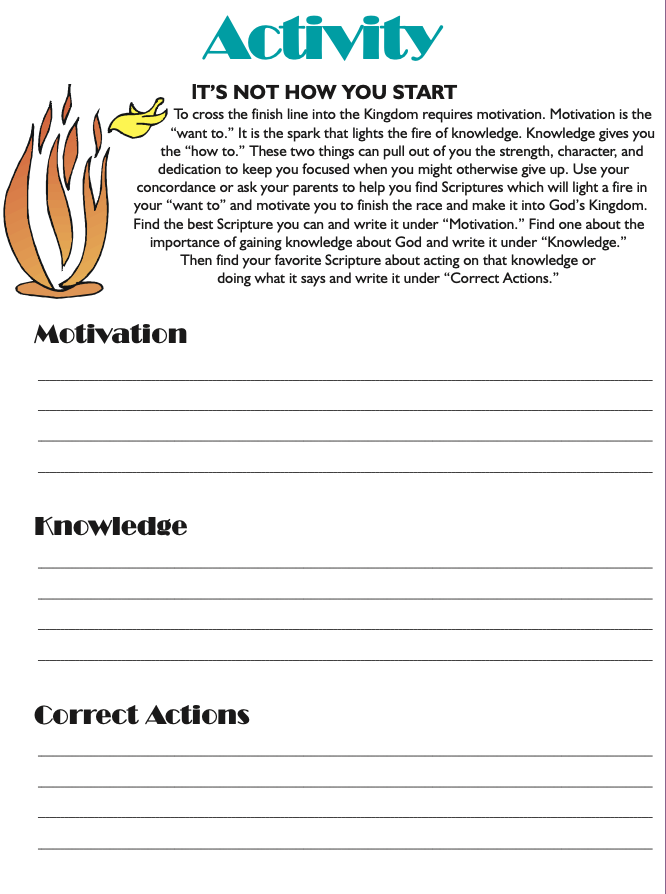
Students’ activity - Let each student give the Scripture from the activity in their book that was selected to motivate them, why biblical knowledge is necessary to finish the race, and what actions they plan to take to ensure they finish the race.
Teacher-Directed Activity
Explain that to cross the finish line, we must bear fruit. Remember the seed that fell on good ground represents the heart of a man who listens to the message and brings 30, 60, or even 100 others into the Kingdom. That means that we have to bring others to know Christ. Have the students brainstorm to determine what attendance goals the class should set for the next ten weeks. Have every student set a goal for inviting a certain number of kids to attend Sabbath School with them. Give each teen a pencil and piece of paper to make a list of kids they will invite. Tell them that you will throw a pizza party for them and all of the friends they invite, if they reach their goal.
REACH Activity
Memory Verse Spotlight
Another word for perseverance is endurance. What does “endure the race” mean to you? When you are with a class or maybe family members, it may be difficult to speak up and share what you really feel. In your Bible notebook, write down and pray about what entangles you and keeps you from running the race. No one needs to see what you wrote unless you want to share it with them. Remember that Jesus wants you to cross the finish line. He will be waiting for you on the other side! Endure to the end!
Where in the World?
When Jesus spoke in parables He used something familiar to explain the unfamiliar. In this YEA lesson the familiar was the seed. In what part of the Bible regions would seed be found? Using your Bible and Bible tools find out why seed was something common or familiar to the hearers. Write your information in your Bible notebook.
They Did What Back Then?
The disciples were eager to learn from Jesus, especially about the meanings of His parables. “Explain to us the parable of the weeds in the field” (Matthew 13:36 NIV). The disciples asked for an explanation and Jesus did not ignore their request. Read Matthew 13:24-43 for the whole story.
Making It Mine
In your Bible notebook, write about a time in your life when you really had to persevere to obtain your goal. Why did you work so hard? What was the goal? Was the goal worth it when you arrived? Then write about the goal of eternal life in God’s Kingdom. Why is that goal attractive? What will God’s Kingdom be like? Find Scriptures to support your ideas. Write down practical ways for you to reach the goal of God’s Kingdom. It’s a race, and if you’re going to win, you have to work at it.
Worldview Collision
A biblical worldview focuses on the goal of God’s Kingdom and becoming God’s son in His family. This outlook impacts daily choices; decisions are colored by faith in God and what He has reserved for those who love Him. A true Christian LIVES his/her belief in God and His eternal reward. Other worldviews see this life as all there is. When you die, it’s all over. Still other worldviews predict that there’s life after death, but it is uncertain and unknown. If either view is true, then each person should grab as much of what brings pleasure and happiness to the self as possible. People with these views take a selfish and temporal approach to life. Think of how each worldview would respond to this statement: You only go around once, so make it count. In your Bible notebook, compare and contrast each worldview and its impact on daily life choices.
Song
“Pass It On” is on page 26 of The Group Songbook.
Closing Prayer
Have the students join hands and form a circle. Invite a volunteer to lead in prayer asking God to help them take this lesson seriously so that they can finish the race into His Kingdom.
Printable Pages