YEA Lesson Library
Happy Ever Afterwards
About This Lesson
This lesson emphasizes the benefits which come from following God’s laws found in the Bible.
Scriptures
Psalm 34:1-21
Psalm 37:6-22
Psalm 128:1-2
Isaiah 57:15-21
Isaiah 61:1-11
Matthew 5:1-12
Matthew 5:6-8
Luke 1:46-55
Romans 12:18-21
Romans 14:14-19
2 Timothy 3:15-16
Words to Know
REVERENCE - a feeling of awe and respect.
REVILE - to criticize angrily in abusive language.
The Lesson
Most teenagers can’t wait for their first car. It means more to them than just transportation. It symbolizes freedom, independence, and a more adult status in the world. They think having a driver’s license and their own car will make them live happily ever after.
But how many teenagers know how a car works? Would you know how to maintain your car by changing the oil regularly, checking the tire pressure, and keeping the fluids at their proper levels?
Mark had just finished Driver’s Ed and passed his test. With license in hand, he approached his parents about getting a car. After discussing it, they told him that if he did the research and could find a good car at a reasonable price, they would buy it. But he would have to pay for the car insurance and maintenance out of his own pocket.
Mark, an eager teenager, sounded like a potential buyer when he phoned the man about the car in his front yard with a for sale sign on it. Mark just happened to be in the market for his first car.
The car turned out to be a good buy. While the family’s mechanic took a couple of days to look everything over and replace the hoses, its proud new owner spent some quality time with the manual. The owner’s manual taught him all he would need to know about the electrical system, how to tune the car, and how fast it should be driven in each gear. It also told him how to check the tire pressure, how often to replace the oil, and how to change a flat tire. There wasn’t anything he needed to know about that car that wasn’t in the owner’s manual.
Have you ever thought about how the Bible is the same way? Everything the human race will ever need to know about how to live a happy and successful life is found in this owner’s manual. Many people go about their lives searching for fulfillment without ever considering the words in this book. Some look for fulfillment in drugs or illicit sex. Others think happiness can be found by having an abundance of stuff. But the wisest man who ever lived, Solomon, had more expensive stuff than a man could want. He wrote the entire book of Ecclesiastes. In it he shows that you can’t find happiness in a lot of stuff – no matter how much or how cool it is. There is no happiness apart from God.
Jesus knew that people yearned for happiness. When He walked the earth, many of His teachings were meant to help people find happiness and satisfaction with life. Once, when He took His disciples up on a hillside, Jesus gave them the key ingredients to having a happy life. This is what He told them.
Those who humble themselves will be happy because they will be in God’s Kingdom. Those who mourn are blessed, for they will be comforted. The meek and lowly will inherit the earth.
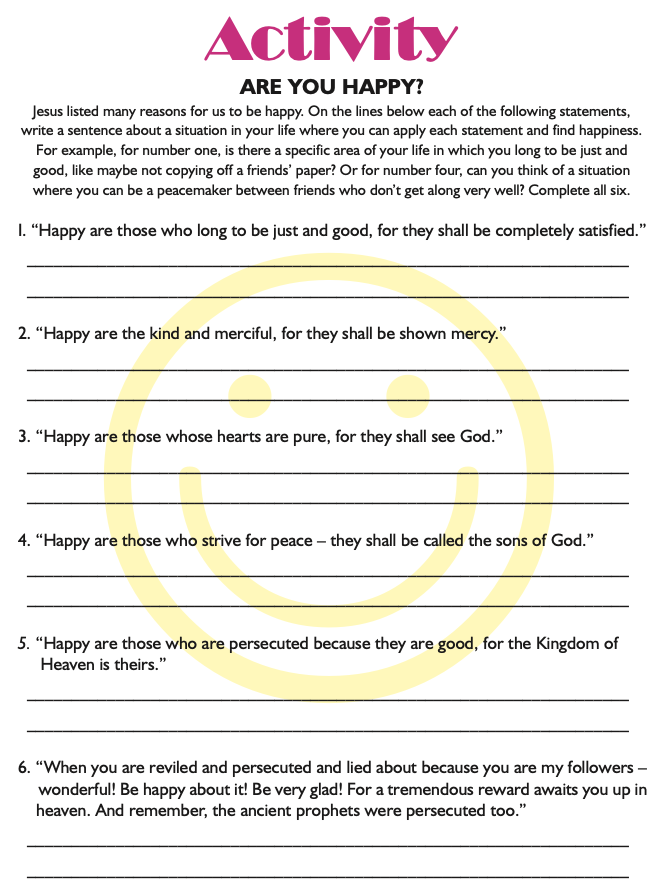
“Happy are those who long to be just and good, for they shall be completely satisfied. Happy are the kind and merciful, for they shall be shown mercy. Happy are those whose hearts are pure, for they shall see God. Happy are those who strive for peace – they shall be called the sons of God. Happy are those who are persecuted because they are good, for the Kingdom of Heaven is theirs.
“When you are reviled and persecuted and lied about because you are my followers – wonderful! Be happy about it! Be very glad! For a tremendous reward awaits you up in heaven. And remember, the ancient prophets were persecuted too” (Matthew 5:11TLB).
Wow! What a statement! You mean I’m supposed to be happy when I’m reviled, persecuted, lied about, and made fun of for my religion? That’s what the Good Book says. But why should you be happy? It’s because you’ll have a tremendous reward that Jesus will bring with Him when He returns.
Happiness isn’t something that depends on what grades you make, what position you play on your sports team, or even how other people treat you. Happiness comes from a positive state of mind. It comes from knowing that God is with you and He wants to help make you a winner. If you are reading this lesson now, then you have been blessed with an opportunity that many people miss as a teenager, an opportunity for true happiness.
Just as the Apostle Paul wrote to the young man Timothy, “When you were a small child, you were taught the holy Scriptures; and it is these that make you wise to accept God’s salvation by trusting in Christ Jesus” (2 Timothy 3:15 TLB). You can’t truly be happy if you’re always making wrong decisions and suffering the consequences from your bad choices. God laid out in His Word what are the right and wrong choices. If you want to live happily ever after, it’s up to you to make right choices.
Chances are, you have heard a lot about the importance of obeying God and respecting Him. But did you know that if you’ll obey God and respect His law, there’s some really cool stuff in it for you too? When you respect and obey God, He promises to bless you with prosperity and make you happier than you could ever imagine. “Blessings on all who reverence and trust the Lord – on all who obey him! Their reward shall be prosperity and happiness” (Psalm 128:1-2). You can live happily ever after, but you must live what is in the book.
Student Prayer
Great Father,
Thank you for showing us how to be happy. There are many things in this world to make us sad and depressed, but by following the instructions Jesus gave, I know I can live happily ever after.
In Jesus’ name.
Amen.
Daily Devotions
Sunday: Psalm 34:1-21
Monday: Isaiah 57:15-21
Tuesday: Psalm 37:6-22
Wednesday: Luke 1:46-55
Thursday: Isaiah 61:1-11
Friday: Romans 12:18-21
Saturday: Romans 14:14-19
Objectives
At the end of this lesson, students will be able to:
1. Explain that the Bible is the owner’s manual for our lives.
2. Discuss the reasons Jesus gave for what should make a person happy.
3. Discuss situations in their lives where they can apply Jesus’ words and find happiness.
Topics & Themes
Beatitudes
Bible Study
Blessings
God’s Laws
Obedience
How to Teach This Lesson
Begin the class by opening with prayer. Start by saying: Mark studied the owner’s manual of the car he bought to find out how to operate it and keep it in good condition. God provides us with an owner’s manual that we can study to learn how to live happily ever after. But we must study the Bible if we’re to find the way to be happy.
Divide a class of 12 or more into groups of twos or threes giving each group one of the questions you wrote out before class, a Living Bible, and a 3 x 5 card. Explain that the Living Bible is a paraphrase, not a translation, but that it is sometimes helpful in gaining a better understanding of a passage. Send students to separate places in the room to read the question, look up the Scripture (in both the Living Bible and their own translation) and write the answers on a 3 x 5 card. For a smaller class, give more questions and cards to individual students and have them look up answers.
Explain: When you follow the answers to these questions, you will be happy. Allow a few minutes for students to read questions, look up and write out answers. Bring them back together.
Debrief - Ask: Have you ever looked at the owner’s manual of a car? (Hold up one.) The manual goes into detail about the vehicle’s electrical system, how the engine works, what to do when your tires are low, how to change the oil, what makes the air bags deploy, etc. You have just looked in the owner’s manual for making your life happy.
Question I - Ask the person/group that has that question to share with the class the seven “potholes” that they found in Proverbs 6:16-19. (Haughtiness, lying, murdering, plotting evil, eagerness to do wrong, bearing false witness, sowing discord among brothers.) How would choosing not to be involved with these things bring greater happiness to your life?
Questions 2 - Ask: What does Proverbs 3:7-8 show you about how to keep your motor in top condition? (“Don’t be conceited, sure of your own wisdom. Instead, trust and reverence the Lord, and turn your back on evil.”)
Question 3: Ask: What was the best fuel you found in Luke 4:4? (“It is written in the Scripture, ‘Other things in life are much more important than bread.’”) What are those things?
Question 4: Ask: How does Proverbs 24:19-20 show how you can fix your engine when it’s running too hot? (“Don’t envy the wicked. Don’t covet his riches.”) How do envy and coveting heat up your engine?
Question 5: Ask: How does Proverbs 13:13 show you how to best avoid collisions? (Obey God’s Word and succeed.)
Question 6: Ask: What does Proverbs 25:12 say you’ll get if you handle it like the Bible says when someone runs into you or criticizes you? (A badge of honor.) Who will give it to you?
Teacher-Directed Activity
Read Matthew 5:1-12 aloud. Pin one or more Beatitudes to the back of each student. Have students ask each other questions to gain clues about their “Beatitude” without saying the exact word. After students guess all their words, write the passage on the board. Have them organize themselves in the order the words appear in the Scripture. Ask: Why do you find it hard to practice these qualities? How does God’s Word, our owner’s manual, help us practice these qualities? Why do you think God wants us to rejoice when we are reviled and persecuted for our religious beliefs? What are some of the other qualities that should lead to happiness? (Humility, meekness, justice, goodness, kindness, mercy, having a pure heart.)
REACH Activity
Memory Verse Spotlight
This YEA lesson includes an activity with questions for which all the answers could be found in the Book of Proverbs. What is a proverb? Your challenge is to write a proverb from Ecclesiastes 2:26 in your Bible notebook. How does your proverb compare with the YEA lesson memory verse? Share it with family or class.
Where in the World?
Solomon is a major writer of the Book of Proverbs. According to the NIV Archaeological Study Bible, “Similar compilations from the ancient Near East date from Solomon’s time or much earlier. Solomon’s era was the most prosperous and sophisticated in Israelite history. If any period was likely to have produced works of wisdom literature, it was precisely this one.”
They Did What Back Then?
“Is anyone happy? Let him sing songs of praise.” James 5:13 encourages you to be happy and to sing praises. Why do you think James said to sing if you are happy? And who should you praise? With your family or class discuss songs that everyone likes to sing when they are happy. Which songs also reflect praise to God? In your Bible notebook write the words to a song or two. Depend on these words to lift you up in times of discouragement. They will probably bring you a small measure of happiness!
Making It Mine
Most people want to be happy, but happiness can be an elusive emotion. Being an emotion, happiness swells and wanes. It is like chasing after the wind to make happiness your primary goal in life. The Christian looks instead to something much more constant: contentment. Contentment is a state of mind. Contentment depends on you and how you react to your circumstances. The Apostle Paul wrote, “I have learned the secret of being content in any and every situation, whether well fed or hungry, whether living in plenty or in want. I can do everything through him who gives me strength” (Philippians 4:12-13). What is the secret of being content? Why would you want contentment rather than happiness? Read Philippians 4:4-13. Then answer the two questions above in your Bible notebook.
Worldview Collision
“ . . . Choose for yourselves this day whom you will serve. . . But as for me and my household, we will serve the LORD” (Joshua 24:15). A biblical worldview calls us to serve God, to put Him first in our lives. Other worldviews put self, or riches, or happiness, first. The reality is, whatever you put first in your life becomes your god. Your own pleasure, the abundance of things you accumulate, the goal of your personal happiness—all of these things can become a god that you worship instead of the Creator, the Redeemer, the Author and Perfecter of your faith. If you seek to serve God, then your outlook focuses on the eternal, not the temporal. If God is first in your life, then you seek the things of God—His laws, His holy days, His direction in your life. If you’re looking to the Creator for direction in making your life work, you have a good shot of avoiding some major problems, heartaches, and pain. Find a proverb which contrasts God’s way with man’s way. Put it into your own words. Apply it to your own life. Decide for yourself whom you will serve.
Song
“Bubblin” is on page 21 of The Group Songbook.
Closing Prayer
Have the students join hands and form a circle. Lead in prayer thanking God for providing them with a manual so they can live happily ever after.
Printable Pages