YEA Lesson Library
Ask-Seek-Knock
About This Lesson
Using the parable of the persistent widow, this lesson teaches to persevere in asking God to answer prayers.
Scriptures
2 Chronicles 7:1-14
Psalm 55:15-23
Isaiah 59:1-14
Matthew 7:7
Matthew 7:7-11
Luke 11:1-13
Luke 18:1-8
Romans 12:1-13
Colossians 1:7-10
I Thes. 5:14-28
Words to Know
PERSPECTIVE - one’s mental view of facts, ideas, etc., and their interrelationships
VULNERABLE - defenseless, open to assault, difficult to defend, capable of being hurt physically or emotionally
VICTIM - a person who is deceived or cheated
The Lesson
The magic moment came as Mark McGwire stepped up to the batters’ box. Great anticipation filled the stands as everyone waited to see if Mark would hit his 62nd home run in one season, triumphing over both Babe Ruth’s and Roger Maris’ records. The pitcher threw the ball over home plate. Mark swung and hit the ball. Yes! Yes! Yes! It was a home run. The crowd quickly came to its feet to give him a standing “O.” What a thrill! Another equally exciting moment came within days of this as Sosa hit 62 home runs with 12 games left in the season. McGwire finally hit 70 home runs in the 1998 baseball season with Sosa only four homers behind.
“McGwire’s 62nd home run was only a 341 foot drive, his shortest for the season. Fearsome power was generated by his swing, his moon shots were inspiring. For all the controversy over how he got so big and muscled, it counted the same as 61 home runs that preceded it.
“If all of those home runs were stretched end to end, like lengths of rope, the distance would be impressive. Even more impressive is that McGwire understood the real trick was binding them together” (AP). We don’t know how many times McGwire struck out before he passed Babe Ruth’s and Roger Maris’ records. But we do know that he did not become disheartened. He went back to the batters’ box time and again, determined to hit another home run.
But what does this story have to do with your Bible lesson? A day came when Jesus sat down and told His disciples a story to show the importance of not becoming disheartened and giving up when their prayers weren’t answered. This is how the story goes.
A widow had no family as a support group. This made her very helpless and vulnerable. But the one thing she had in her favor was her unwillingness to give up until her mission was accomplished. She frequently appealed for justice against a man who had harmed her. A godless judge, who had great contempt for everyone, was to hear her case. But he ignored this widow lady. Without a single family member to bolster her, she didn’t play the victim. She didn’t let this godless judge intimidate her either. She didn’t become disheartened. And she hung in there. Repeatedly, she went back to the judge and appealed her case until she eventually got on his nerves.
“‘I fear neither God nor man,’ he said to himself, ‘but this woman bothers me. I’m going to see that she gets justice, for she is wearing me out with her constant coming!’” (Luke 18:5 TLB).
It really didn’t matter to this judge or change his judgment if the poor, helpless widow lady was right or wrong. He was godless, unjust and wouldn’t even listen. But God is just the opposite of this judge. He is merciful and compassionate and eager to hear your prayers. He wants to give you your request when it is right and best for you.
The point of the story Jesus told is that you should not give up praying for something until you get an answer. He was telling His disciples that they can’t expect an answer if they don’t ask. But asking may not be enough. They may have to seek. How do you seek? Has your dog ever hid its bone where it was unable to get it – maybe under the couch? What does the dog do? It sniffs, smells, paws, and tries to get your help. We may need to act a little like the dog trying to retrieve his bone when we don’t get an answer to our prayers.
Jesus also told the disciples the reason why you have to knock. Matthew 7:7 says, “Ask and it will be given to you, seek and you will find; knock and the door will be opened to you. Everyone who asks receives; he who seeks finds; and to him who knocks, the door will be opened.” He used the word “door” here to mean a way. So if you haven’t received an answer after asking and seeking, be persistent. Perhaps a way will open up for your prayer to be answered.
Jesus continues with His story using a father and son as an example. If a hungry child goes to his dad and says, “Dad, I’m hungry.” A loving dad isn’t going to give the child a stone to eat. If the child asks for a fish, his father is not going to give him a snake. If you had a child would you be cruel to it? Our Heavenly Father is gracious, generous, kind, loving, and perfect. He’s certainly not going to withhold the things from you that are good for you.
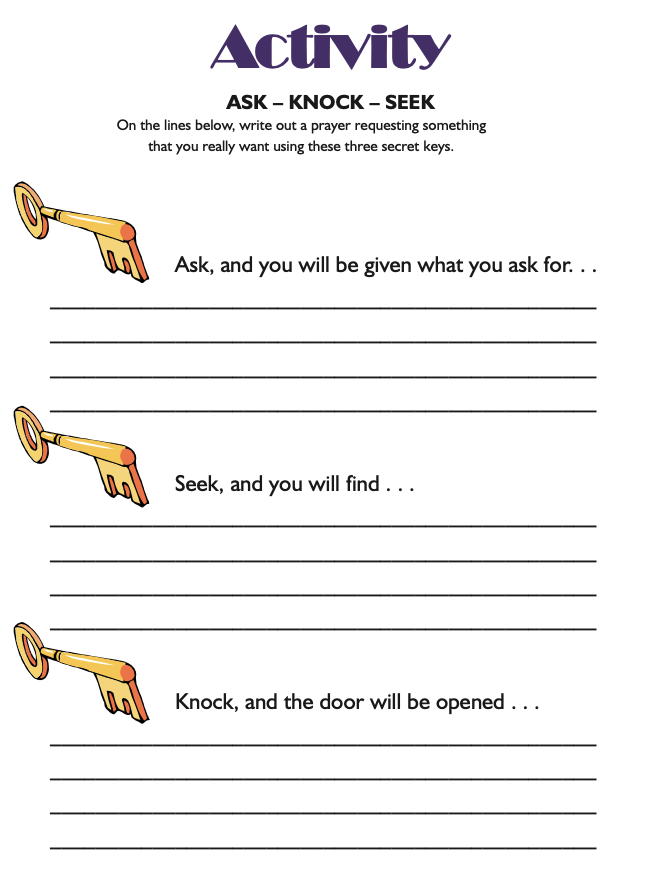
Does this mean that God is going to see to it that you get every frivolous whim? Of course not! There’s another piece to this puzzle under the three secret keys above – ask, seek, and knock. After you ask God for something, seek His will in the matter. After all, He’s been around a lot longer than your 12-15 years. So He sees things from a different perspective.
Go to God in prayer and seek His will. Ask Him if the things you are asking for will really be good for you. Tell Him that He sees things from the perspective of all eternity. He has an advantage that you don’t have. Ask Him if there may be reasons you should not be granted your request because it might harm you or someone else. Keep going back to God, and Ask - Seek - Knock until your answer comes. Don’t give up. Hang in there. That’s what the knocking is all about (read Luke 11:5- 6). Remember neither the widow lady nor Mark McGwire became disheartened because they didn’t get what they wanted the first time they tried.
Keep on asking, seeking, and knocking. God will give you what is best for you. Never forget, that not even the unjust judge could resist giving justice to the widow lady when she persisted.
Student Prayer
Awesome Father,
You are so wonderful to give me so much hope! I’ve learned that the widow lady didn’t play the victim even though she was being cheated out of justice. She persisted until the unjust judge heard her. Help me to persist in prayer as the widow lady did with the judge.
In the name of Jesus Christ I pray.
Amen.
Daily Devotions
Sunday: Psalm 55:15-23
Monday: 2 Chronicles 7:1-14
Tuesday: Isaiah 59:1-14
Wednesday: I Thessalonians 5:14-28
Thursday: Luke 18:1-8
Friday: Romans 12:1-13
Saturday: Colossians 1:7-10
Objectives
At the end of this lesson, students will be able to:
1. Explain the importance of persevering in prayer and the advantages it offers.
2. Elaborate on what it means to seek God’s will in prayer.
3. Discuss why they don’t always get an answer to a request they make in prayer.
Topics & Themes
Ask
God’s Love
God’s Will
Parables
Persistent Widow
Perseverance
Prayer
Prayers, Answered
Seeking God
How to Teach This Lesson
After you lead in prayer, with everyone standing ask for all students with red strips of paper to go to first base, all the green to second, all the blue to third, and all the yellow to home.
Ask them to brainstorm and come up with how many hits Mark McGwire made before he got to third base 61 times. Give them three minutes to do this. Set the timer and say go. When the bell rings, have the students arrange their seats in a semicircle. In 1998, Mark McGwire had 509 at bats, 130 runs, 70 homers, and 155 strike outs. He hit a homerun every 8.2 at-bats. He hit his 61st homer in game 143.
Debrief by taking a vote - Tell the students to remember the number they decided on with the other students on their base. Now take a vote of the entire class to determine what they think was the number of hits Mark McGwire made before he made it to first, second, third, and home. Ask: How would you compare this game with asking God for something in prayer? How often do we make it to first base with God, but don’t keep on praying until we make it further? What can we learn from Mark McGwire that will help us in our prayer life?
The defenseless widow - Ask: In what ways was the widow’s society different from our society today? Do you think the things you mentioned would have made it harder for her to keep going back to the unjust judge to ask for justice? How would you feel about going before a judge? How would it be harder if you had no family and no one to go with you? Would you do a lot of praying? Why or why not?
Immediate answers to prayer - Explain that we would all like for God to immediately answer every request we make. Ask: But what if He did? Would we begin to think of God as some sort of a magic slot machine? How would it affect your attitude toward God? What are some things you learn when God does not answer your prayers immediately? Why is it important to learn patience? Ask one of the students to read aloud 2 Peter 1:2-9 from The Living Bible.
Ask - Seek - Knock - Point out that the lesson title shows three things we should do when we pray – ask, seek, and knock. Write those three words on a chalkboard. Ask: How do you make a request of God? (Respectfully, with reverence, and in worship of God.) Ask a student to read Matthew 6:9 aloud. Write on the board: “God is supreme and we are mere humans.” Ask: Should this intimidate you and keep you from making your request to God?
What follows next in this model prayer? What follows after that? How does “seek” fit into your prayers? Ask the student to read verse 10 aloud again. Write on the board: “seek = Thy will be done.” Ask: Why is it better that God’s will be done than your will? How does “knock” fit into your prayer life? Invite one of the students to read Matthew 7:7 aloud. Write on the board: “the door will be opened.” Ask: How many times in a season did Mark McGwire strike out before he got 70 home runs? (We don’t know.) How often do you think the widow lady had to appeal her case to the unjust judge before she got justice from the man who harmed her? How often should you knock if you have a request to make before God? What effect do you think this will have in your getting answers to your prayers?
Teacher-Directed Activity
Bring an essential oils diffuser to class. Remind the students that our prayers go up before God like sweet incense. Read Exodus 30:1-9. Have them think of a prayer, then add each student can add one drop of oil to the diffuser. Be sure to use all the same oil or oils that blend well together.
REACH Activity
Memory Verse Highlight
Find Matthew 7:7 in another translation. Which translation do you prefer? Write it in your Bible note- book. What is most difficult for you to understand about prayer? Ask God to give you a heart to under- stand, seek wisdom through His word, and knock daily at His door!
Where in the World?
Use a Bible and Bible tools to find the location of Jesus and His disciples when He told the parable of the persistent widow. Draw a map of this Bible region in your Bible notebook and compare it with a current map of the area. What are the similarities or differences? Write them in your Bible notebook.
They Did What Back Then?
Throughout time there have been orphans and widows. The Scriptures have much to say about the care that they should receive. Use your Bible and find specific Scriptures that instruct about the care of orphans and widows. Look in both the Old and New Testaments. Did the instructions ever change? There were no Goodwill nor Salvation Army stores, so poor and needy people were taken care of and looked after by family members or church brethren. Does this sound familiar to you? Why or why not?
Making It Mine
What was the last request you made of God? Did He answer that request? Was the answer yes, no, or wait? Why do you think God gave the answer He did? Do you believe that God has your best interest at heart? Can you think of any Scriptures that would make you think He loves you and only wants the best for you? Look up and read 1 John 3:1; Matthew 6:25-26, 7:9-11; James 1:17, 4:3. It’s a matter of trust. Do you trust God enough to accept it when His answer to you is no? Write a prayer to God. Tell Him your feelings about how you trust Him or not, how you are willing to accept His will for your life or not, and how you need His help in trusting Him and submitting to His will in your life.
Worldview Collision
A biblical worldview says that God’s goal is your salvation. A false worldview says that once you become a Christian, God will give you everything and you will never experience pain, sorrow, or deprivation again. God does take care of us. He does make our path straight. But that doesn’t mean our lives will be easy and pain free. God knows what we need in our lives in order to get us into His Kingdom. In your Bible notebook, write a response to the false worldview. Why would it not be in your best interest for God to give you everything you wanted? Why does God say we will continue to experience pain, sorrow, and deprivation even though we are Christians? What is the purpose of those things in the life of a Christian? Use Scriptures to support your views.
Song
“How Deep Is Your Compassion” is on page 88 of The Group Songbook.
Closing Prayer
Have the students form a circle and hold hands. Ask them to close their eyes and pray silently about the request on their balloon. Then, lead them in a prayer asking that the these teenagers will remember to ask for God’s help, seek God’s will about each request they make, and to knock until they find an answer.
Printable Pages