YEA Lesson Library
My Neighbor
About This Lesson
Based on the Parable of the Good Samaritan, this lesson teaches that we need to help people when we see they are in need.
CAUTION: Vivid description of rape incident in student book, discussed in lesson presentation.
Scriptures
Matthew 25:34-40
Luke 10:25-37
I Corinthians 13:4-7
Galatians 5:13-15
Ephesians 4:25-32
Colossians 3:12-15
James 1:22-27
James 1:27
I John 4:4-10
Words to Know
BANDIT - robber, especially a member of a gang
RAPE - an unlawful act of forcing a person to have sexual intercourse by threat or force
The Lesson
Tina attended the local junior college in the daytime and worked at the corner convenience store until ten at night to pay for her tuition. One night she drove to her apartment and rushed toward the door. Just before she reached it, two masked boys grabbed her. Tina screamed at the top of her lungs and neighbors came out onto their balconies to see what was happening. As they watched, these two strong boys tore her clothes off and raped her. Tina struggled, cried, and screamed, but no one came to her rescue or even called the police. What kind of neighbors do you think these people were?
There is a story in the Bible that helps us to understand what a good neighbor is like. One day a teacher of the law came to test Jesus. He asked, “What does a man need to do to gain eternal life?” Jesus realized this was a trick question so He answered, “What does the law say about it?” This religious man said, “You must love God with all your heart, soul, strength and mind. And you must love your neighbor just as much as you love yourself.”
“Right!” Jesus replied. “Do this and you will live forever!” Since the man had problems with certain ethnic groups, he wanted to find out exactly which people Jesus considered to be his neighbors. Jesus told this story to answer that question.
A man was going on a trip from Jerusalem to Jericho and some bandits attacked him. They stripped him naked and took his money. After beating him up, they left him by the road half dead.
A priest came along and saw the injured man lying beside the road. He simply didn’t want to get involved so he crossed the road to the other side and continued on his way. A man who assisted in the Temple came along. He had the nerve to walk over and look at the man, but just like the first man, he did absolutely nothing to help the man. He too continued on his journey down the road.
A third man, who was a Samaritan, came along on a donkey. Samaritans were not liked in that part of the world and were probably discriminated against just as certain ethnic groups are today. As he passed by and saw the injured man he had real compassion for him. He knelt down beside him, soothed his wounds with medicine and put bandages on them. He helped the man onto his own donkey and walked along beside him until they came to an inn. He stayed with the man through the night and saw to his needs. As he left the next day, he gave the innkeeper money to ensure the injured man was cared for. He was such a considerate man that he even told the innkeeper that if the money he gave him wasn’t enough, he would pay the bill when he returned.
After Jesus finished telling this story, He asked this teacher of the law this question: “Which of the three men who saw the bandit’s victim along the roadside was his neighbor?” Naturally, the teacher replied that it was the Samaritan who showed pity on the injured man.
Did you notice that one of the men who walked right by the injured man was a priest who worked in God’s Temple? He was a religious man. But what did his religion do for his actions? It probably wasn’t cool to do such a menial task as helping a man alongside the roadway. So he actually walked over to the other side of the road to avoid him. Then a Temple assistant came along. He at least got close enough to look at the victim, but he didn’t help either. He went on down the road leaving the man in agony.
This Samaritan was really a big-hearted person. He checked the two of them into an inn and stayed with the man through the night. But that wasn’t all. As he left the next day, he gave the innkeeper money to ensure the poor man was cared for. The Samaritan even told the innkeeper that if the money that he gave him wasn’t enough, he would pay the bill when he returned.
How did you feel about the two men who worked right in God’s Temple passing by a badly hurt man without giving aid? Were their religious garments so special, so nice, that they didn’t want to soil them? Were they more interested in the way they looked than helping someone in need? Do you think their religion impacted their lives in a truly godly way? What does your memory verse say that “pure religion” is?
What would you have done if you had seen the rapists attack Tina? Would you have been like the other neighbors, just standing and watching? If something like this happened to you, what would you hope that others would do? The Golden Rule says that we should do for others in the same manner that we would want them to do for us.
It may not always be safe to go directly to the person and intervene. But there are three things you can do. You can pray instantly and fervently for God’s immediate intervention. You should call the police. In the meantime you can do everything you can to get immediate assistance from others until the police get there. No matter what the person looks like, he is still a child of God. He has feelings just like you do and God loves him. He is your neighbor!
Student Prayer
Dear Feather, Thank you for showing me that I can show my love to you when I help others. We live in a dangerous world and I need your protection when I try to help others.
In Jesus’ name I pray.
Amen.
Daily Devotions
Sunday: I Corinthians 13:4-7
Monday: Galatians 5:13-15
Tuesday: Ephesians 4:25-32
Wednesday: James 1:22-27
Thursday: Colossians 3:12-15
Friday: Matthew 25:34-40
Saturday: I John 4:4-10
Objectives
At the end of this lesson, students will be able to:
1. Explain the responsibility they have when they see someone who needs help.
2. Give three illustrations of things they can do to help a person who has been in an accident, mauled, knocked about, or raped.
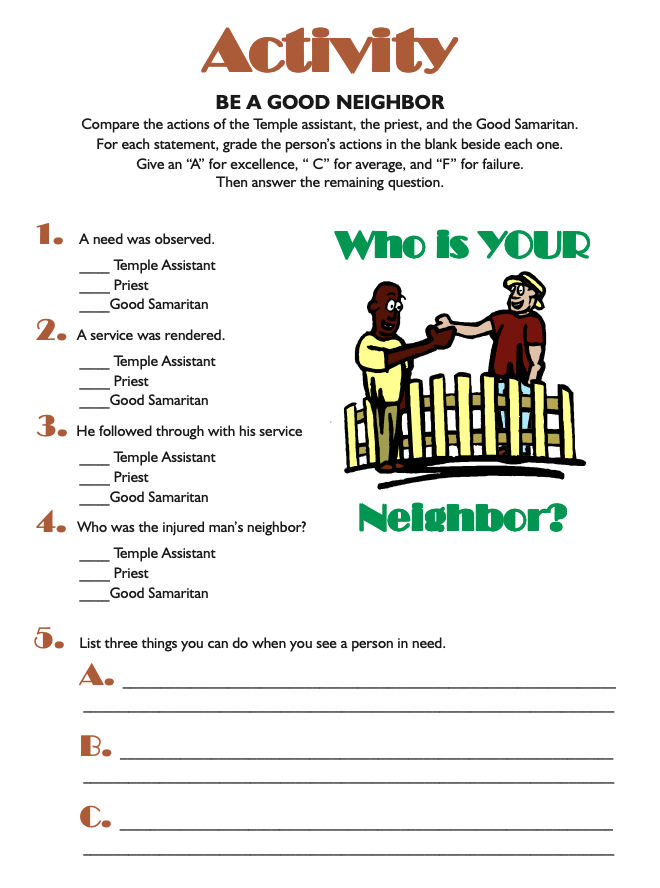
3. Compare the actions of the three people who passed by the injured man.
Topics & Themes
Eternal Life
God’s Protection
Golden Rule
Helping Others
Jesus, His Ministry
Loving God
Loving Others
Parables
Good Samaritan
Prayer
Samaritans
How to Teach This Lesson
Begin the class with prayer. Assign four students parts for characters in the story of the Good Samaritan to act out. Give them a few minutes to read their parts and then have them act out the story.
Debrief - Ask: How did you feel about the Temple assistant seeing the bandit’s victim lying there in agony and then crossing the street without offering any help? What would you have done?
How did you feel about a priest walking by and seeing the injured man, yet not doing anything to help? Do you think he had a greater obligation to help since he was a priest? Why or why not? Ask one of the students to read aloud Leviticus 22:4-7. Ask: Did this law prevent him from helping? Why or why not? Do you think that a minister would have a greater responsibility to stop and assist the man than you would? Why or why not? Ask one of the students to read aloud Deuteronomy 15:11. Ask: To whom does this apply?
Tell the students to close their eyes and pretend that they are walking down the road to Jericho. They come upon a man who has been beaten, bruised, and is bleeding. Give them a minute or so and then tell them they can open their eyes. Ask: What did you want to do for this man? Did you want to go to the other side of the street or did you want to help him?
How did you feel when you read the story about Tina having her clothes torn off and being raped while neighbors watched and did nothing? What things could Tina have done differently that might have prevented the rape from happening? Is it important to know people who live next to you? If Tina had known her neighbors, could things have been different if she had called one of them before she left her job and asked them to watch for her?
If you were attacked by someone who stripped you naked and mistreated you, what actions would you want those who saw you, or heard you screaming, to take? If you make a practice of opening your hand wide to the needy and showing mercy to others, what does God say will happen to you? Invite one of the students to read Matthew 5:7 aloud. Ask: How is this principle like buying an insurance policy against being left lying beside the road bruised and bleeding without any help?
Teacher-Directed Activity
Now it’s time to put your good thoughts into action. Encourage creativity and invite the students to brainstorm ideas, select a service project, and devise a plan of action for the class to become involved in for the next week or two. As they give ideas, list them on the chalkboard or pad. They should first consider older or needy church members. They might also consider helping in a soup kitchen, helping with special Olympics, visiting the children’s wing of a hospital, helping someone who is moving, or mowing the lawn and cleaning house for a sick person.
After all the ideas have been listed, take a vote to decide which project to do. Allow the students to devise a plan of action and write details on the board. It should include the specific project, date and time to do it, materials needed, transportation to and from the location, and how they will go about doing it.
REACH Activity
Memory Verse Spotlight
Partner with a family member or friend to compare and contrast the memory verse with 1 John 2:15-16. Further your Scripture study by discussing the words “pure,” “undefiled,” and “corrupt.” In your Bible notebook make a list of ways to keep yourself unspotted from the world. Put a mark next to the way or ways that pose the biggest challenge for you. Spend time in prayer and share your concerns with God.
Where in the World?
Map the man’s journey from Jerusalem to Jericho. Studying Bible maps reveals landforms and terrain in this particular area when this event occurred. Why would bandits or robbers have easy access to unsuspecting travelers? Write your thoughts on the subject in your Bible notebook.
They Did What Back Then?
Lamps in New Testament days were small, made of clay, and burned olive oil drawn up by a wick. They were put on lamp stands often set in a niche built into a wall. Set up like this, the lamps gave off the maximum amount of light in a room (NIV Archaeological Study Bible, p. 1565). Matthew 5:14 says, “You are the light of the world.” Jesus made this statement while speaking to a crowd on a mountainside, possibly near Capernaum. As a follower of Jesus Christ, you are a light before everyone! Put yourself in places where you can be “on a stand” so that the darkness of the world fades away. Let it shine so that the world can see your work and praise your Father in heaven. Did you notice that the praise is not for you, but for the Father? Everything you do should bring the Father glory and honor!
Making It Mine
Matthew 5:43-44 says to love your neighbor and your enemy and to pray for those who persecute you. Jesus was not talking about loving in a purely theoretical sense. He fully intended for Christians to show their love through their actions. This is not easy. It is very easy to love someone who is good to you. It is very difficult to show love to someone who is trying to harm you. What about the middle ground? Those people you don’t even know. When you look at Matthew 6:43, Jesus covers the two extremes. It implies that everyone in the middle is covered as well. You are not exempt from showing the love of God to everyone. Think of someone you know who is very difficult to love. It can be someone who gets on your last nerve or someone who mistreats you. What is the first thing you need to do to show love to that person? Pray for them. Ask God’s blessing on that person. Ask for God to change your attitude and be willing to love that person. That does not mean you put yourself in harm’s way. It means you treat them in a way that brings glory and honor to God. Pray about how to be that light that God calls us to be for Him. Make a reasonable plan for implementing your ideas with your family or church.
Worldview Collision
A biblical worldview says to honor others more than yourself; other worldviews place supreme importance on self. 2 Timothy 3:1-5 lists the characteristics of people in the last days before Christ’s return. The very first characteristic on the list is “lovers of themselves.” Is this true in our society today? It is a trend. People gradually become more concerned about themselves and less concerned about others. It’s a selfish, ignorant philosophy which is extremely short-sighted. A person may get along by himself just fine when times are good. But when times are bad, he will need help from others more and more. Look up Ecclesiastes 4:9-12, Hebrews 10:25, and Luke 16:1-9. Read these Scriptures. Write in your Bible notebook how these fit into a biblical worldview of building relationships with others in a godly way.
Song
“Here I Am Lord” is on page 85 of The Group Songbook.
Closing Prayer
Have the students form a circle and hold hands. Ask for a volunteer to lead in prayer asking that God would help each student to be sensitive to others and give help when needed.
Printable Pages