YEA Lesson Library
The Joy of Giving
About This Lesson
This lesson teaches the importance of tithing and giving offerings to God.
Scriptures
Genesis 14:20
Genesis 28:22
Leviticus 27:30-32
Numbers 18:21-28
Deuteronomy 16:13-17
Malachi 3:7-12
Mark 12:41-44
Luke 6:36-38
Luke 21:1-4
2 Corinthians 9:5-10
2 Corinthians 9:6
Words to Know
STEWARD - a person who manages another’s property or financial affairs.
RECEPTACLE - a container that holds something.
PROPRIETOR - the owner of a business establishment.
The Lesson
When you go to the grocery store, chances are it is a huge supermarket, one of many in a chain. Take a minute and think about how your grocery store first started. It was probably a small store on a street corner and originally a mom and pop business. The owner could have been an average person trying to feed his family from the small income derived from his business. Starting a new business is usually a struggle. Often proprietors work long hard hours with little or no salary when a business is new. Many new businesses fail within the first year. There could be several factors why one fails and another succeeds.
The H.E.B. grocery store chains started like others – one small store on a street corner. Howard E. Butt may have struggled at first to make a living. But he believed in tithing or giving at least one tenth of his increase or profit to God.
Today, most cities in South Texas have an H.E.B. grocery store. These very large supermarkets have a bakery, deli, meat market, produce department, and virtually everything else you would expect to find. Mr. Butt’s chain of grocery stores would certainly be considered a successful business. What made it a success? Hard work and good managerial decisions certainly played a major roll in its success. But could the fact that Mr. Butt tithed to God have anything to do with him being even more successful than he would have been? Did God bless him? What does the Bible have to say about this subject?
Mr. Butt is certainly not the only person who has experienced the joy of giving. Jesus tells us about a poor lady whose husband had died. She walked into the court of women in the Temple one day. This was as far as she was allowed to go in that building, because she was a woman. There were 13 trumpet- shaped receptacles for donations in the court. She had two coins with her. This was all the money she had. So she put those two coins in one of the receptacles. Jesus was sitting nearby watching as people gave their tithes and offerings.
This lady’s offering was such a remarkable thing that Jesus called His disciples to Him and told them that the widow lady had given more than all the rich men put together. What the wealthy men gave was no sacrifice – it was only a fraction of their wealth. But this poor lady gave her last penny. The lady wasn’t forced to give everything she had. She gave it willingly. The Bible says nothing to indicate that she had any hesitation about giving those two pennies, nor that she had any regrets. But we do know that it was noteworthy, even to Jesus. Because of her generosity, she is mentioned in the Bible for us to read about two thousand years later.
It was very difficult for a woman to support herself in Jesus’ day. Women were not used in the work force then as they are today. Considering these factors, do you think this widow lady may have been foolish to give her last penny when she had no husband to support her? Or could it be that she was a lady with enormous faith, who trusted God to take care of her? Do you think she reflected on all that God had given her and was filled with so much love and gratitude that she felt giving her all was the least she could do? Perhaps she knew what the Scripture says in Malachi 3:10.
“Bring all the tithes into the storehouse so that there will be food enough in my Temple. If you do, I will open up the windows of heaven for you and pour out a blessing so great you won’t have room enough to take it in!”
Jesus pointed out that all of the men in the Temple, who had the capability to earn a living, didn’t give as much as this poor widow lady. We may not fully understand her motivations, but her actions showed that she had the confidence that God would take care of her. She didn’t seem worried about physical things. What a joy to give with such faith!
But you know, God promises exactly the same thing for you. He says that there’ll be more blessings than you can take in, if you obey Him. But if you don’t, He says the consequences are a curse. Malachi 3:8-9 says, “ Will a man rob God? Yet you have robbed me. But you say, ‘Wherein have we robbed you?’ In tithes and offerings. You are cursed with a curse: for you have robbed me, even the whole nation.” What do you think that curse could be?
Have you ever seen people who live from paycheck to paycheck and never have enough money to make ends meet? These people are usually in debt up to their eyeballs. And usually their credit is very bad. Have these people applied good financial principles in their lives? Do you think that they have brought all of their tithes into the “storehouse”? It’s not for us to judge, but we do know what God promises in the way of consequences and rewards. We also know that “God loves a cheerful giver,” (2 Corinthians 9:7). What would it mean to you to know that God loves you like He did the widow lady? God wants you to be a joyful giver.
Student Prayer
Awesome God,
You have given me everything I have. Yet I’m only required to return ten percent to you. This is awesome! Help me to have the faith that the widow lady had and never forget to tithe. I want to be a joyful giver.
In Jesus’ name I pray.
Amen.
Daily Devotions
Sunday: Genesis 14:20, 28:22
Monday: Leviticus 27:30-32
Tuesday: Numbers 18:21-28
Wednesday: Malachi 3:7-12
Thursday: 2 Corinthians 9:5-10
Friday: Luke 6:36-38
Saturday: Deuteronomy 16:13-17
Objectives
At the end of this lesson, students will be able to:
1. Explain that a tithe is the first ten percent of what God gives you, and it is to be given back to Him.
2. Discuss the blessings God promises for obedience in giving.
3. Spell out the consequences of not tithing.
4. Explain that we can’t expect to be financially secure if we don’t do our part by applying all of the principles for success.
Topics & Themes
Blessings
Generosity
Obedience
Offerings
Putting God First
Stewardship
Tithe
Widow’s Mite
How to Teach This Lesson
Have one of the students hold a basket below the window as you pour the “blessings” through the window. Let the students pick up the “blessings” as they fall into the basket and overflow onto the floor. Now have the students read aloud the statement on the “blessing” they picked up. Then ask: What does God promise to those who bring all of the tithes into the storehouse? Are all blessings monetary? What do you have to do to receive these blessings?
Lottery - Ask: If you won the sweepstakes, what is the first thing you would do with the money? How do you see the lottery as a shortcut to becoming rich? Did you know that a high percentage of people who win the lottery or the sweepstakes are broke within three years? Why do you think that is?
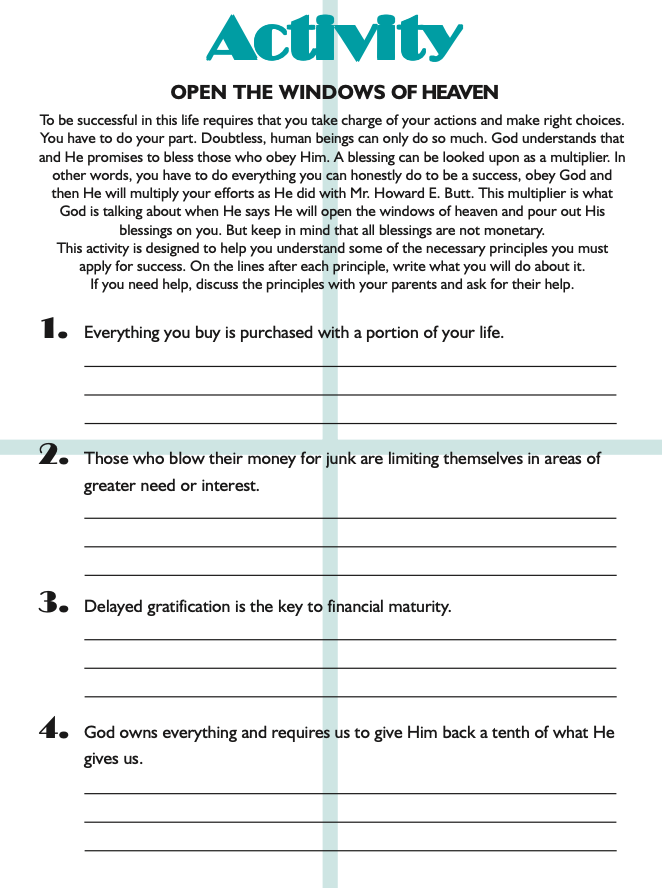
Mr. Howard E. Butt - Ask: What financial principles do you think he followed that caused him to be a very wealthy man owning a chain of supermarkets? Ignore the first financial principle for the time being. Write the second financial principle under Background on a chalkboard. Ask: What does it mean that “there is always a trade-off between time and effort and money and rewards”?
Write the third principle on the board and ask: If you blow your money for junk, how does it limit your financial future? What happens to so many sweepstakes winners within three years of winning the lottery? Why?
Write the fourth principle on the board and ask: What principle do you feel sweepstake winners overlook? (Delaying gratification in the short term to gain financial security.)
Discussion Tips - Invite students to tell what happened when they and their parents figured out how much more money they would have if they saved up for a car rather than getting a loan to buy it. (See Discussion Tips in the Students’ book.) Explain that waiting to get the car until they could pay cash for it is delaying gratification. It’s through this delayed gratification that they reap a greater reward of having more money.
First Principle - Write the first principle under Background on the chalkboard. Ask one of the students to read Psalm 50:10-11 aloud. Ask: What do you own? After the class answers, ask: Since God owns everything, can He take away what He lends you? Ask a student to read Job 1:21. Ask: Why do you think God would take away what He lends you? List the reasons on the chalkboard as the students give them.
Good Stewards - Lead the students to see that they are stewards of what God lends them. Stewardship carries the responsibility of taking good care of what God gives us. Ask: What is the first responsibility of a steward? (Putting God first – that means our tithe is given first to God before we spend any of our increase.) Ask one of the students to read Malachi 3:9-10 aloud. Ask: What are the consequences for not tithing? Do you think the sweepstake winners who are broke after three years applied these four principles? What does God promise if you bring all the tithes into the storehouse? What does He promise if you don’t?
Teacher-Directed Activity
Collect in a basket all of the “blessings” (green strips of paper) that were used at the beginning of this class. Pour them through the window one more time. Ask: What Scripture does this make you think of? In what way is this like what happens when you give God His tithes?
REACH Activity
Memory Verse Spotlight
Reflect on the title of this YEA lesson: The Joy of Giving. In your Bible notebook, answers these questions: What and why do you give to others? Where and when do you give to others? Do you feel obligated to give to others sometimes? Have you ever given a gift to someone, but you really didn’t want to? Are gifts the only way to give to someone else? Who do you think gets the greater joy, the giver or the receiver of a gift? If you feel comfortable share your responses with your family or a good friend. The purpose of journaling your thoughts are to help you focus on an area that makes some people very anxious and even depressed. People who do not have much money feel awkward as a special occasion approaches or when they feel obligated to “give,” whether it is to a ministry or church, within the family, school, or the office. Read Scriptures that teach the purpose and order of giving: tithing to God—He owns everything and gives you everything you have (Malachi 3:8-10), to your family ( Galatians 6:10), the needy (Matthew 25:35), and others (Luke 6:38). Understanding the Scriptures will encourage you to be a joyful giver!
Where in the World
To gain a better understanding of where Jesus was sitting in the Temple, read 2 Kings 12. Joash instructed the priests to collect money to repair damage to the Temple. This will give you a better perspective on how the money was handled and distributed.
They Did What Back Then?
There are two Scriptures in the Book of Acts that are quite amazing considering the worldview of giving: Acts 2:44-45 outlines quite specifically the attitude of giving among the believers: “All the believers were together and had everything in common. Selling their possessions and goods, they gave to anyone as he had need” (NIV). Later in Acts 4:32 the same theme is present, “All the believers were one in heart and mind. No one claimed that any of his possessions was his own, but they shared everything they had” (NIV). Consider this: Under what circumstances would you be willing to sell your possessions, or share everything you have? Examining our hearts for the motives we act on can be very difficult. God knows our weaknesses. That’s why we need Him. When we are weak He is strong! (Philippians 4:13 NIV). If you are willing to give to, or serve someone in need, let your family or teacher know so that you can be pointed in the right direction. Be a good steward of your time and resources and serve others with a cheerful heart!
Making It Mine
If you are like most people, God has given you a limited amount of resources: time, money, talents and abilities. You are called to be a good steward, a good manager, of the things God has given you. So it’s a good idea to make a plan and budget to make the most of these resources. God is always first. That’s a given to the devoted Christian. But it’s a balancing act to correctly put the rest of your life into the proper priority. You have resources to serve God, serve and help care for your family, and to work and/or go to school, in order to continue to have the money resource to use. First, make a list of your resources in your Bible notebook. Then make a workable plan for using your resources in a way that honors and pleases God.
Worldview Collision
A biblical worldview says that God has a right to the first tenth and the best of what you earn. This is not giving. You owe it to God—it’s His! If you don’t return it to God, you are stealing. A secular worldview pledges to give if there’s anything left over after you pay all your bills and buy what you want. In your Bible notebook, write down the reasons why the first thing you should do is to pay back to God the first ten percent of what you make. Here’s a good place to start: God owns it all. Once you’ve compiled a list, use a concordance to support the reasons on your list. For instance, God owns it all, you could use Job 41:11, “Everything under heaven belongs to me.” Share this list with your family.
Song
“It’s a Happy Day” is on page 47 of The Group Songbook.
Closing Prayer
Have the students form a circle and join hands. Ask a volunteer to lead in prayer asking God to teach each one to obey Him and give Him back His tenth.
Printable Pages